Priya Sharma, Chief People Officer at a global logistics company operating in thirty-two countries, learned the hard way that recruitment infrastructure failures carry enterprise-level consequences most leaders never anticipate. During a major Southeast Asia expansion, the company's recruiting technology stack, a patchwork of seven separate tools accumulated over six years without a coherent integration strategy, could not handle the volume, language diversity, or compliance requirements of hiring across five new markets simultaneously. Sourcing tools returned outdated candidate data for the region. Screening models trained primarily on Western resumes systematically misclassified qualified local candidates. Scheduling tools failed to account for time zone complexity across the new markets. Within three months, the expansion was six weeks behind schedule on hiring, business unit leaders were escalating complaints about talent gaps to the executive committee, and two senior recruiters in the region had resigned out of frustration with the technology. Sharma made a decisive move: she consolidated the entire recruiting stack onto a single AI-native platform, invested in dedicated platform engineering support, and established infrastructure reliability standards matching those applied to the company's supply chain and financial systems. Within six months of the new platform going live, time-to-fill for the Southeast Asia expansion dropped by thirty-eight percent, and candidate experience scores reached parity with established markets.
Why Recruitment Infrastructure Shifted from Optional to
Essential
Five years ago, most talent acquisition leaders treated AI recruiting tools as experimental additions to an existing ATS-centric workflow. The decision to adopt or skip a new sourcing tool carried the same weight as choosing between two email templates. That calculus has changed fundamentally. Enterprise hiring volume has increased, competition for specialized talent has intensified across nearly every industry, and tolerance for fragmented hiring processes has dropped to near zero among both candidates and hiring managers. Organizations now depend on AI recruitment systems to source at scale, screen accurately, and move candidates through workflows without the delays that plagued previous generations of technology. When these systems work, hiring becomes a competitive advantage. When they fail, positions stay open longer, hiring managers lose confidence, and top candidates accept competitor offers that moved faster. According to McKinsey, organizations that experience significant recruiting technology failures during peak hiring periods report fifteen to twenty-five percent higher voluntary turnover among hiring managers and measurable declines in business unit performance that persist for two to three quarters after the failure is resolved.
The shift is driven by structural labor market changes, not technology hype. The half-life of skills has shortened, meaning the candidates an organization needs today may not match existing database profiles. Remote work has expanded every talent market from regional to global, increasing evaluation volume and coordination complexity. Candidate expectations for speed have risen sharply, driven by consumer-grade experiences elsewhere. Meeting these expectations without AI-powered infrastructure is operationally impossible at enterprise scale. The infrastructure must handle discovery, engagement, screening, and scheduling as an integrated system. According to SHRM talent acquisition research, organizations relying on disconnected recruiting tools report forty to fifty percent longer time-to-fill and thirty to thirty-five percent lower candidate satisfaction compared to those with integrated AI recruitment infrastructure.
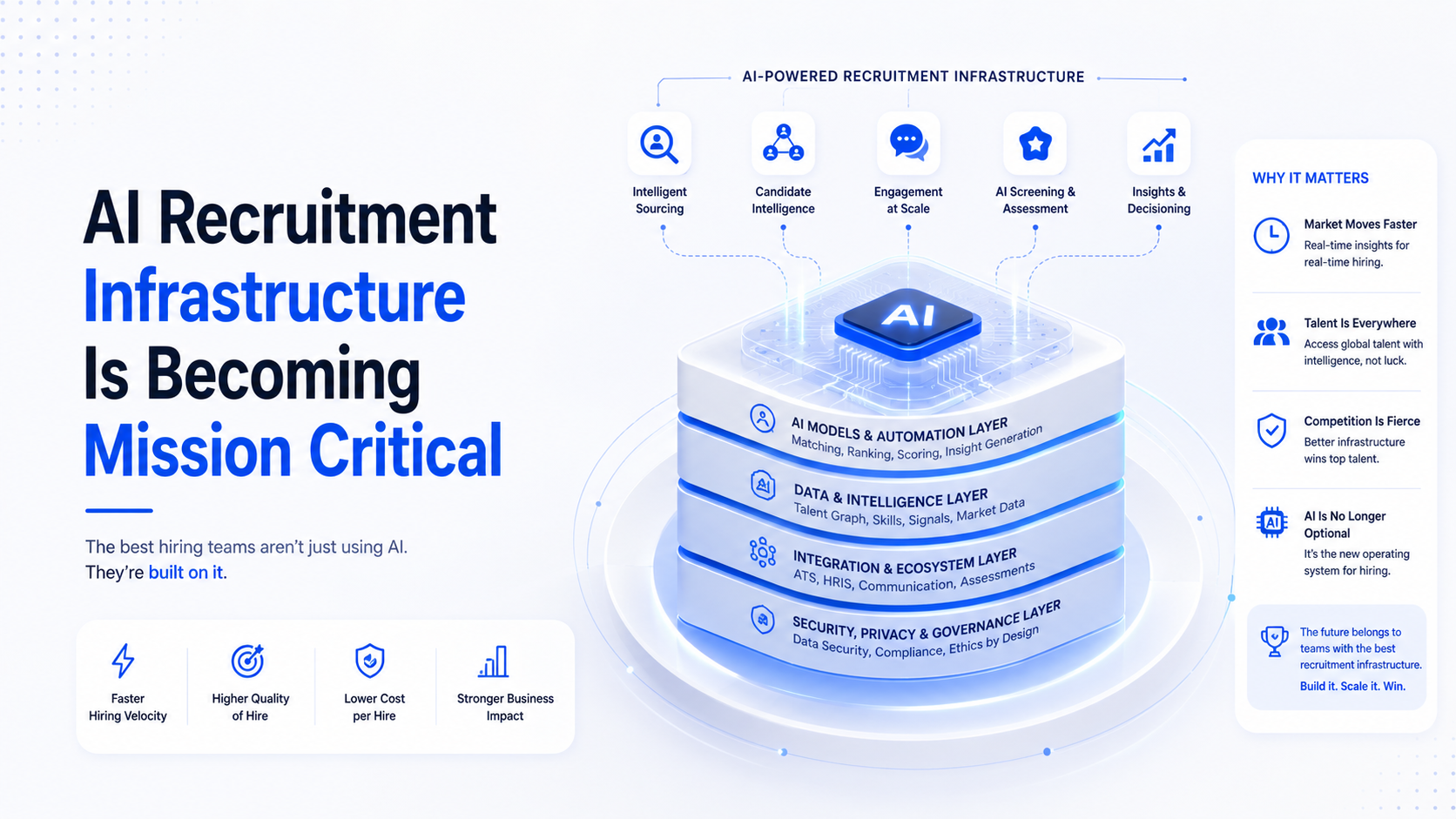
For chief human resources officers, the question is no longer whether to invest but how to build infrastructure reliable enough to be considered mission-critical. Mission-critical infrastructure in domains like financial systems and supply chain management is held to availability and reliability standards that recruiting technology has not been required to meet. That gap is closing as organizations recognize that recruiting infrastructure failure costs rival failures in other critical systems. Leading organizations now treat AI recruitment infrastructure with the same rigor as core business technology: dedicated platform teams, formal reliability standards, and continuous performance monitoring.
The Hidden Cost of Fragile Hiring Infrastructure
Fragile recruiting infrastructure creates costs that standard HR metrics rarely capture. The most visible cost is delayed hiring. When sourcing tools have outdated data, screening systems produce inconsistent results, or engagement platforms fail to deliver messages reliably,
the pipeline slows at multiple points simultaneously. Each delay compounds downstream, because a candidate contacted a week late may have already accepted another offer. The cumulative effect across hundreds of positions is a significant increase in average time-to-fill that translates to lost productivity and revenue. According to Deloitte workforce analytics research, organizations with fragile infrastructure relying on multiple disconnected tools report time-to-fill thirty to forty percent longer than those with integrated AI platforms, with productivity costs estimated at two to three times the annual salary of each unfilled position.
A less visible but equally damaging cost is quality degradation that occurs when infrastructure fragility forces recruiters to work around the system. When official tools are unreliable, experienced recruiters develop parallel workflows using spreadsheets, personal email, and offline tracking. These workarounds create data silos that prevent accurate pipeline views, leading to duplicate outreach, missed follow-ups, and inconsistent candidate experiences. The team appears productive, but data quality deteriorates until pipeline analytics become unreliable. Over time, the organization loses the ability to answer basic questions about hiring performance. The broader question of whether recruiters should worry about AI replacing their jobs becomes relevant here: when infrastructure fails, recruiters spend time compensating for technology gaps rather than performing the strategic work that justifies their roles, making them more vulnerable to displacement by systems that actually work.
The third hidden cost is recruiter burnout and turnover. When technology is unreliable, recruiters spend significant time troubleshooting, re-entering lost data, and manually performing tasks that should be automated. This frustration drives high-performing recruiters to organizations with better technology, eliminating institutional knowledge and candidate relationships built over years. Organizations that treat recruiting technology as a cost to minimize rather than infrastructure to invest in create a vicious cycle where poor technology drives turnover, which degrades pipeline quality, which extends time-to-fill, which increases strain on the already fragile stack. According to Gartner HR technology research, organizations where recruiters routinely work around official systems due to reliability issues report twenty to thirty percent lower confidence in pipeline data and fifteen to twenty percent higher recruiter turnover rates.
How Agentic Platforms Change the Infrastructure Equation
The emergence of agentic AI recruiting platforms represents a fundamental architecture shift. Traditional tools are reactive: they execute tasks when a recruiter triggers them, and the recruiter serves as the integration layer connecting tool outputs into a coherent workflow. Agentic platforms operate differently. They are designed to be agentic versus merely automated, meaning they can autonomously coordinate multi-step hiring workflows, make context-aware engagement decisions, and adapt behavior based on real-time signals. The recruiter shifts from integration layer to strategic supervisor. This architectural shift has profound implications for infrastructure reliability, because a single agentic platform coordinating the entire workflow eliminates the integration fragility that arises when multiple
disconnected tools connect through manual handoffs and data transfers.
The reliability improvement is not theoretical. When an agentic platform manages the candidate journey from sourcing through offer as a unified workflow, there are no integration points where data is lost, timing misaligns, or candidate experience fragments. The platform maintains a single source of truth that updates in real time. If a candidate responds to a sourcing message, the platform immediately updates the profile, adjusts pipeline stage, and triggers the appropriate next action without manual intervention. According to LinkedIn talent solutions research, organizations using agentic recruiting platforms report twenty-five to thirty-five percent fewer candidate drop-offs between pipeline stages compared to those using multi-tool stacks, because seamless workflow coordination eliminates the gaps that cause candidates to disengage.
For enterprise technology leaders, the agentic model also simplifies operational complexity. Instead of maintaining integrations between five to eight separate tools with different data models, API limitations, and release cadences, the enterprise maintains a single platform relationship. This reduces integration maintenance costs, eliminates data synchronization problems, and provides a single point of accountability. The vendor selection process becomes more consequential, but the operational benefits are substantial. According to McKinsey enterprise technology strategy research, organizations consolidating recruiting technology onto unified agentic platforms report thirty to forty percent reduction in total cost of ownership and fifty to sixty percent fewer integration-related incidents.
The Risk of Accumulating Point Solutions
One of the most persistent patterns in enterprise recruiting technology is the gradual accumulation of point solutions that address specific pain points without integrating into coherent infrastructure. A typical enterprise stack might include a legacy ATS for workflow management, a separate sourcing tool, an AI screening platform, a scheduling tool, a CRM, an analytics platform, and various communication tools. Each was acquired to solve a real problem, and each may perform its function well. But the collective result is a complex, fragile, expensive ecosystem. The observation that organizations end up with more tools and the same hiring problems captures the core dynamic: adding tools without infrastructure coherence addresses symptoms rather than structural issues, and each additional tool increases the integration burden that degrades reliability.
The financial cost is significant and frequently underestimated. Each tool carries direct subscription costs, but the larger expense is indirect: maintaining integrations between tools, training recruiters on multiple systems, managing vendor relationships, and troubleshooting data inconsistencies. Research consistently shows that total cost is two to three times the sum of individual subscriptions, because integration overhead, training burden, and operational complexity create costs not captured in any single vendor contract. According to Gartner HR technology cost research, the average enterprise recruiting stack has grown from three to four tools five years ago to six to eight today, and total cost of ownership has increased forty to
fifty percent in real terms, driven primarily by integration and maintenance costs.
The strategic risk is that point solution accumulation prevents building the unified data foundation that AI-driven recruiting requires. Effective AI depends on comprehensive, accurate, real-time candidate data spanning the entire hiring journey. When data is distributed across six to eight tools with different data models and update cadences, the organization cannot build the unified profiles that power accurate matching, predictive analytics, and personalized engagement. This data fragmentation is not merely an inconvenience but a structural barrier to leveraging AI effectively. According to EY enterprise technology research, organizations consolidating onto integrated platforms report forty to fifty percent higher accuracy in AI-driven candidate matching and thirty to forty percent faster time-to-value from AI features, because unified data eliminates the inconsistencies that degrade AI performance across fragmented systems.
Building Infrastructure That Works Across Every Role Type
A critical requirement for mission-critical recruitment infrastructure is reliable performance across the full spectrum of role types: high-volume operational roles, specialized technical positions, and senior executive searches. Many AI recruiting tools are optimized for a specific segment and perform poorly outside it. A sourcing tool built for technology recruiting may struggle with healthcare or manufacturing roles where candidate profiles and talent dynamics differ fundamentally. Whether AI recruiting tools work effectively for specialized and technical roles is not academic but has direct operational consequences for enterprises hiring across diverse functions. Research on whether AI recruiting tools work for niche or technical roles shows that performance varies significantly based on architecture and training data, making platform selection a high-stakes infrastructure decision.
The challenge compounds in global enterprises hiring across multiple countries, regulatory environments, and labor markets. A platform that performs well for technology hiring in the United States may not handle EU compliance requirements, Asia-Pacific cultural nuances, or credential verification for regulated industries. Mission-critical infrastructure must handle this diversity with configurable workflows that adapt to local requirements without sacrificing the data coherence that makes AI effective at scale. According to Deloitte global HR research, multinational organizations deploying platforms without adequate localization report twenty-five to thirty-five percent lower adoption rates in non-primary markets and forty to fifty percent longer time-to-value where the platform does not align with local practices.
The practical implication is that infrastructure evaluation must explicitly test performance across the full range of role types and geographies, not just the primary segment. Vendor demonstrations should include role types representing the edges of hiring complexity, because infrastructure that works for the core but fails at the edges creates the same fragmentation it was supposed to eliminate. According to LinkedIn talent acquisition research, organizations conducting scenario-based evaluations covering four to five distinct role types and two to three geographic markets report thirty to forty percent higher satisfaction with
platform selection and twenty to twenty-five percent faster time-to-full-deployment, because evaluation identifies performance gaps before commitment.