When Jordan Ellis became Director of Recruiting Operations at Pinnacle Financial Services in 2023, one of her first discoveries was that her team had been describing their recruiting technology as AI-powered for two years, but none of the platforms they used actually learned from data. The ATS applied screening rules that hiring managers had defined. The sourcing tool ran Boolean queries that recruiters had constructed. The engagement platform sent email sequences that the team had written. Every system executed human-defined processes faster and at greater scale, but none of them improved based on outcomes. Ellis realized that her organization had invested millions in recruiting automation while believing it was investing in AI recruiting. The distinction was not a label. It was the difference between technology that compounds in value and technology that depreciates. She presented her findings to the CHRO and proposed a systematic evaluation of every tool in the stack against a single criterion: does this system get better at its task without a human manually updating its rules? The tools that passed would be retained and expanded. The tools that failed would be replaced. The exercise transformed the organization's recruiting technology strategy and, ultimately, its hiring outcomes.
The Language Problem in HRTech
The recruiting technology industry has a language problem. Vendors describe virtually every product feature as AI-powered, buyers use the terms artificial intelligence and automation as if they were synonyms, and the result is widespread confusion about what these technologies actually do and what value they can deliver. A tool that automatically posts a job to multiple
boards is described as AI recruiting. A platform that sends automated email sequences is marketed as AI-driven. An analytics dashboard that displays hiring metrics is labeled as intelligent. None of these are AI recruiting. They are recruiting automation, and the difference between the two is not semantic. It is structural, and it has direct consequences for hiring outcomes.
The consequences of this confusion are significant. Organizations that believe they have deployed AI recruiting when they have actually deployed recruiting automation are making technology investment decisions based on a misunderstanding of what they are buying. They expect the kind of compounding improvement that AI delivers, but they are getting the kind of flat productivity gain that automation provides. When the expected improvement does not materialize, they conclude that AI in recruiting is overhyped, when in fact they have never actually deployed AI. McKinsey research on enterprise AI adoption consistently identifies this expectation gap as the primary reason organizations abandon AI initiatives in talent acquisition, not because AI does not work but because organizations did not understand what they were implementing.
Understanding the distinction between AI recruiting and recruiting automation is not an academic exercise. It is a practical necessity for any organization making technology investment decisions, designing recruiting processes, or setting expectations for hiring outcomes. The challenge of how to evaluate an AI sourcing tool an AI recruiting tool before purchasing is fundamentally a challenge of distinguishing genuine AI capabilities from automation with an AI label. Organizations that develop the ability to make this distinction will make better investments, set better expectations, and achieve better results. Those that cannot will continue to overpay for automation while believing they are buying intelligence.
What Recruiting Automation Actually Does
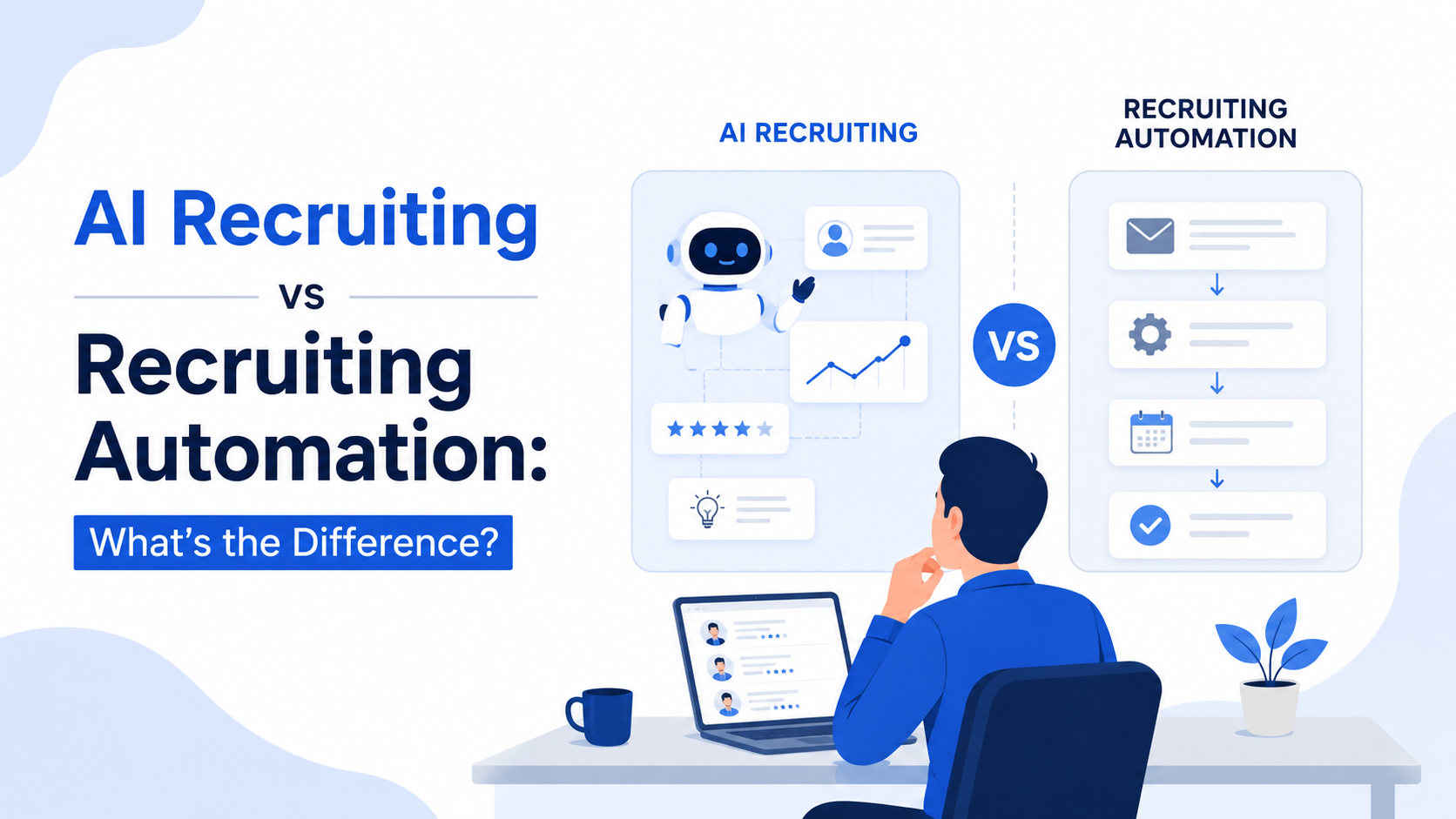
Recruiting automation executes predefined rules. It takes a human-defined process and runs it faster, more consistently, and at greater scale than a human could. Automated job posting takes a job description and distributes it to multiple boards according to a predefined configuration. Automated email sequences send messages to candidates at predefined intervals using predefined templates. Automated screening applies predefined criteria to every application and sorts candidates into yes, no, and maybe buckets. Automated interview scheduling offers time slots based on predefined availability rules. Every action the system takes was specified in advance by a human. The system does not decide what to do. It executes what it was told to do, faster and at greater volume.
This is genuinely valuable. Gartner analysis of recruiting automation ROI shows that well-implemented automation reduces administrative burden on recruiters by thirty to forty percent, shortens time-to-fill by eliminating coordination delays, and improves compliance by ensuring that required steps are not skipped. These are meaningful improvements that justify the investment in automation technology. But they are fundamentally different from what AI
delivers. Automation makes existing processes more efficient. AI changes the nature of the process itself. An automated screening tool applies the same criteria to every candidate regardless of context. An AI screening tool understands that a candidate who changed careers three years ago may be a stronger fit than their resume suggests because the AI has learned from thousands of similar career transitions which ones predict success.
The limitation of automation is that it cannot improve beyond the quality of the rules it was given. If the screening criteria are biased, the automated system will apply that bias at scale. If the email template is generic, the automated system will send generic messages at scale. If the sourcing query is too narrow, the automated system will miss qualified candidates at scale. Automation amplifies whatever rules and processes humans define, which means it amplifies both their strengths and their weaknesses. The problem of why AI tools have outdated candidate data candidate data being processed by automated systems illustrates this clearly. An automated outreach system will send messages to candidates whose data is no longer current, because the system does not know the data is stale. It follows its rules regardless.
What AI Recruiting Actually Does
AI recruiting learns, adapts, and improves. Rather than executing predefined rules, it builds models from data and uses those models to make predictions, generate recommendations, and take actions that were not explicitly programmed. An AI sourcing system does not apply a Boolean query that a recruiter constructed. It analyzes job requirements, identifies the underlying capability needs, searches for candidates whose profiles demonstrate those capabilities even when the language differs, and ranks them by predicted fit. The recruiter did not define the search logic. The AI inferred it from data. An AI engagement system does not send a template email on a schedule. It analyzes a candidate's background, determines what aspects of a role would be most relevant to them, generates a personalized message, selects the optimal send time based on response data from similar candidates, and adjusts its approach based on the candidate's response or lack thereof.
This learning capability is what separates AI from automation in every domain, and it is what makes AI recruiting structurally different from recruiting automation. Deloitte research on AI in talent acquisition identifies three characteristics that define true AI recruiting: the system improves its performance over time based on outcomes data, it handles novel situations that were not explicitly programmed, and it generates insights or recommendations that a human did not specify in advance. A system that meets all three criteria is AI. A system that meets none is automation. Many products in the market fall somewhere in between, which is where the confusion originates.
The practical difference in hiring outcomes is substantial. LinkedIn research comparing AI recruiting tools to automated recruiting tools finds that AI-powered platforms produce measurably better matching accuracy, higher candidate engagement rates, and shorter time-to-hire than automated platforms. The reason is straightforward. Automation applies the same
approach to every situation. AI adapts its approach to the specific context of each situation. For standard, high-volume roles where the hiring process is well-defined and the candidate pool is large, automation can deliver adequate results. For complex, specialized, or high-priority roles where context matters and the best candidates are not obvious from keyword matching, the adaptive capability of AI produces meaningfully better outcomes. The concern about should recruiters worry about AI replacing jobs often stems from a conflation of AI with automation. Candidates and recruiters worry that AI will replace human judgment, when what they are actually observing is automation replacing human execution of repetitive tasks. True AI augments judgment rather than replacing it.
The Compounding Value of True AI
The most important practical difference between AI recruiting and recruiting automation is not what happens on day one but what happens over time. An automated recruiting tool provides the same value on day one thousand as it provided on day one. The rules have not changed, the templates have not improved, and the screening criteria are identical. The only way to get more value from the tool is to manually update the rules, templates, and criteria, which requires human effort and expertise. An AI recruiting tool, by contrast, provides more value on day one thousand than on day one because it has learned from the outcomes of the previous nine hundred and ninety-nine days. Every hire, every candidate interaction, and every feedback signal has been incorporated into the system's models, making its predictions more accurate and its recommendations more relevant.
This compounding effect is the fundamental economic advantage of AI over automation. EY analysis of AI platform economics describes this as a learning return on investment. Traditional software delivers a fixed return that depreciates as the competitive environment changes. AI software delivers an increasing return as the system accumulates data and improves its models. For recruiting organizations, this means that the gap between AI recruiting and recruiting automation widens over time. On day one, the difference may be modest. After a year of continuous learning, the AI system is operating on a qualitatively different level than the automated system, producing better matches, more effective engagement, and more accurate predictions. McKinsey research on AI value compounding in enterprise software finds that this learning effect is the primary driver of long-term ROI for AI investments, and that organizations that measure AI value based on initial deployment performance significantly underestimate its long-term impact.
The compounding advantage also creates a competitive moat. An organization that deploys AI recruiting early has more data, better models, and stronger outcomes than a later adopter. The research on why referrals outperform cold outreach and referral network effects illustrates a similar dynamic. Organizations with strong referral programs build a virtuous cycle where more referrals lead to better hires, which lead to more employee engagement, which leads to more referrals. AI recruiting creates a data-driven version of this cycle: more data leads to better models, which lead to better hires, which lead to more data. The organizations
that build this cycle earliest will be difficult for late adopters to catch, because the quality gap will be reinforced by the data advantage.
How to Tell the Difference When Evaluating Tools
The most reliable way to distinguish AI recruiting from recruiting automation is to ask a specific question: does the system get better at its task without a human manually updating its rules? If the answer is yes, it has AI capabilities. If the answer is no, it is automation regardless of what the vendor calls it. This question cuts through marketing language because it focuses on the structural characteristic that defines the difference. A vendor might describe an automated screening tool as AI-powered because it uses natural language processing to extract information from resumes. But if the screening criteria themselves do not change based on hiring outcomes, the NLP is being used for information extraction, which is a form of automation, not for learning, which is the defining capability of AI.
This distinction matters when making purchasing decisions because it determines the kind of return on investment you should expect. Gartner guidance on AI vendor evaluation recommends that buyers ask vendors to demonstrate how their system improves over time, what data the system learns from, and what specific outcomes have improved for existing customers. Vendors of genuinely AI-powered platforms can answer these questions with specific examples and data. Vendors of automated platforms that are marketed as AI will struggle, because the system does not actually learn. The most important question to ask and the most important question is whether the tool gets smarter without human intervention.
Organizations should also examine the data architecture of the platforms they are evaluating. AI recruiting requires a data infrastructure that can support continuous model training, feedback collection, and prediction serving. Deloitte technology assessment frameworks recommend evaluating whether a platform has a dedicated machine learning pipeline, whether it collects outcome data from actual hires, and whether it has mechanisms for model retraining and improvement. If a platform stores candidate data in a traditional database and applies rules to that data, it is automation. If it builds and maintains predictive models that are continuously updated based on new data, it is AI. The architectural difference is visible in the technology stack, and organizations that know what to look for can distinguish the two even when vendor marketing obscures the difference.
Building a Real AI Recruiting Capability
For organizations that want to move beyond automation to genuine AI recruiting, the transition requires investment in three areas: data infrastructure, organizational readiness, and vendor selection. Data infrastructure is the foundation. AI systems require large volumes of high-quality data to learn effectively. Organizations with fragmented HR technology stacks, inconsistent data practices, and poor data governance will struggle to deploy AI recruiting
effectively regardless of which vendor they choose. SHRM guidance on AI readiness in talent acquisition recommends that organizations audit their data quality, integration capabilities, and feedback mechanisms before evaluating AI recruiting vendors. The vendor assessment should come second, because a great AI platform operating on poor data will underperform a good AI platform operating on clean, well-integrated data.
Organizational readiness is equally important. Recruiters who have spent their careers executing defined processes need to develop the skills to work alongside AI systems: interpreting AI recommendations, providing structured feedback, and focusing their time on the activities that require human judgment rather than on tasks the AI can handle. This transition requires training, coaching, and a deliberate shift in how recruiting performance is measured. Organizations that deploy AI recruiting but continue to measure recruiter performance on the volume of activities the AI now handles will create misaligned incentives that undermine the technology investment. LinkedIn research on recruiter AI adoption finds that the most successful implementations pair technology deployment with a structured change management program that redefines recruiter roles, updates performance metrics, and builds data literacy across the recruiting team.
The end goal is a recruiting operation where AI handles the high-volume, data-intensive, and repetitive aspects of hiring while recruiters focus on relationship building, strategic consulting with hiring managers, and the nuanced human judgments that determine whether a candidate is not just qualified but the right fit for the organization. This is not a futuristic vision. It is achievable with current technology, but only if organizations select genuinely AI-powered platforms rather than automated ones, invest in the data and organizational foundations that AI requires, and measure success based on hiring outcomes rather than process compliance. The difference between AI recruiting and recruiting automation is not a marketing label. It is the difference between a system that gets better over time and one that does not. For organizations making multi-year technology investments, that distinction is the most important factor in determining whether the investment pays off.