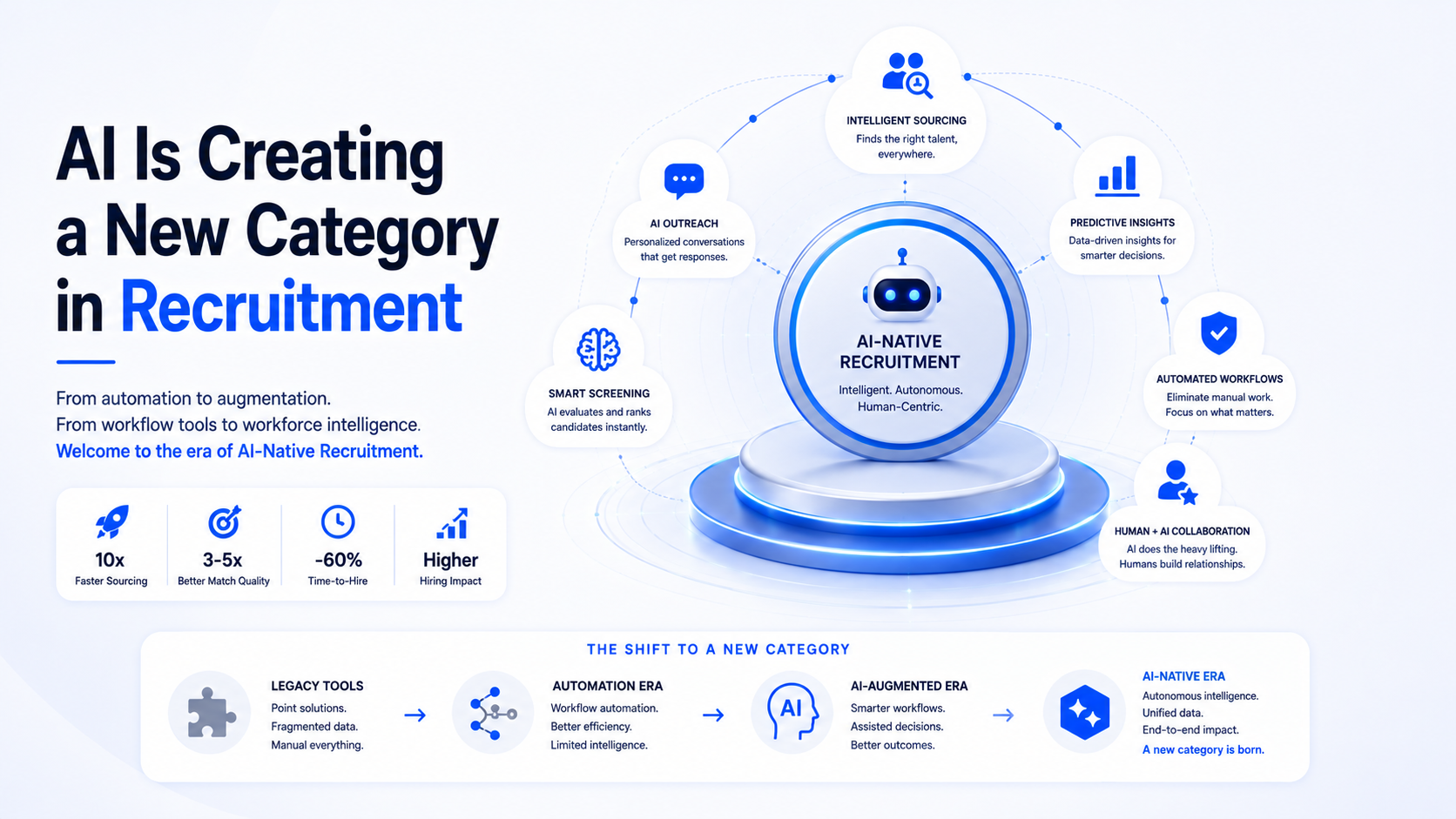
When David Okonkwo, Senior Director of Talent Acquisition at NovaTech Industries, attended a recruiting technology conference in late 2023, he expected to see the usual parade of incremental product updates dressed up as breakthroughs. Instead, he found himself in a keynote session watching a platform autonomously source, engage, score, and shortlist candidates for a live engineering role, all without a single human action after the initial job parameters were set. Okonkwo had spent twelve years managing recruiting technology stacks, and what he saw was not an evolution of the tools he knew but something fundamentally different: a system that did not just assist recruiters but operated as an independent agent within the hiring process. Within three months, he had initiated a pilot program, and within six months, his team was filling senior engineering roles thirty percent faster with higher hiring manager satisfaction scores. Okonkwo's experience illustrates a shift that is quietly reshaping the recruiting technology landscape: AI is not merely improving existing tools but creating an entirely new category.
Why This Is Not Just Another AI Feature Update
Every few months, a recruiting technology vendor announces a new AI feature. Sometimes it is a slightly smarter resume search. Other times it is an automated email sequence or a predictive scoring model. These incremental improvements are useful, but they do not represent a fundamental shift in how recruiting technology works. They are optimizations applied within the existing paradigm of recruiting software: a human recruiter initiates an action, and the software assists with execution. What is happening now is qualitatively different. A new category of AI-native recruiting technology is emerging that does not merely assist recruiters but autonomously manages significant portions of the hiring workflow, making decisions, taking actions, and adapting its behavior based on outcomes without requiring human direction for each step.
The distinction matters because categorical shifts in technology create entirely new competitive dynamics. When AI features are simply add-ons to existing tools, the vendors with the
largest installed bases and the deepest integration ecosystems tend to win. But when a new technology category emerges, the advantage shifts to organizations that can rethink their approach from the ground up rather than retrofitting new capabilities onto legacy architectures. McKinsey research on technology category creation shows that the companies that define a new category, rather than those that adapt to it, capture a disproportionate share of long-term market value. In recruiting, the question is whether the new AI-native category will be defined by existing ATS vendors adding AI layers or by new platforms built from the ground up around AI-first principles.
For talent acquisition leaders, the emergence of this new category demands a different evaluation framework. The criteria that mattered when selecting a traditional ATS, such as workflow configurability, reporting depth, and integration breadth, are still relevant but insufficient. Evaluating an AI-native recruiting platform requires assessing the quality of its decision-making, the sophistication of its learning mechanisms, and the degree to which it can operate autonomously without constant human oversight. This is a fundamentally different set of evaluation criteria, and organizations that apply legacy assessment frameworks to this new category of technology will systematically undervalue the most important capabilities.
From Tool-Assisted to AI-Orchestrated Hiring
The practical difference between traditional recruiting tools and the emerging AI-native category becomes clearest when you examine how a hire actually happens. In a traditional workflow, a recruiter posts a job, searches for candidates, sends outreach messages, screens responses, schedules interviews, collects feedback, and extends an offer. Each step is initiated and managed by a human, with technology providing support at each stage. The recruiter is the orchestrator, and the tools are instruments. In an AI-orchestrated workflow, the system manages this entire sequence autonomously. It identifies hiring needs based on workforce data, sources candidates proactively, engages them with personalized communication, scores and ranks them against role-specific criteria, and presents hiring managers with curated shortlists. The human role shifts from executing tasks to reviewing decisions and providing strategic input.
This shift from tool-assisted to AI-orchestrated hiring has profound implications for recruiter productivity and hiring quality. Deloitte analysis of early AI-native platform deployments shows that recruiting teams using orchestrated workflows handle two to three times more open requisitions per recruiter while simultaneously improving quality-of-hire metrics. The productivity gains come not from making individual tasks faster but from eliminating the coordination overhead that consumes so much of a recruiter's day. When the system handles the end-to-end workflow, recruiters are freed to focus on the activities that genuinely require human judgment: building relationships with passive candidates, advising hiring managers on role design, and making final hiring decisions.
The distinction between AI sourcing vs AI recruiting becomes especially important in this
new category because AI orchestration blurs the traditional boundary between these functions. In a legacy stack, sourcing is a separate function with separate tools from recruiting coordination. In an AI-native platform, the system moves candidates fluidly from identification through engagement to evaluation without the structural handoffs that plague traditional workflows. This is not just an efficiency improvement. It is a structural change in how the hiring process is organized, and it is one of the defining characteristics that separates the new AI-native category from legacy tools with AI features bolted on.
Autonomous Actions That Learn and Improve
The most significant technical differentiator of the new AI-native recruiting category is the ability to take autonomous actions that improve over time based on outcomes. Traditional recruiting automation follows rules that humans define. If a candidate does not respond within three days, send a follow-up. If a candidate scores above eighty, advance to the next stage. These rules are static. They do not adapt based on whether they are actually working. An AI-native system, by contrast, continuously evaluates the effectiveness of its actions and adjusts its behavior accordingly. It learns that follow-up messages sent on Tuesday mornings get higher response rates than those sent on Friday afternoons. It discovers that candidates with certain background patterns, even if their resumes do not contain the exact keywords in the job description, are more likely to succeed in the role.
This learning capability transforms the recruiting technology from a passive tool into an active participant in the hiring process. The system does not just execute instructions. It generates insights about what works and what does not, and it applies those insights to improve future actions. LinkedIn research on AI adoption in recruiting found that organizations using learning-based AI platforms see continuous improvement in key metrics over time, while those using static automation see initial gains that plateau within a few months. The compounding effect of continuous learning is what makes the new category fundamentally more powerful than traditional tools. how many follow-ups one hire needs exemplifies this principle: a system that learns the optimal follow-up cadence for different candidate segments will consistently outperform one that applies a uniform rule to every candidate.
The importance of autonomous learning extends beyond individual hiring workflows to the strategic level. When an AI-native platform processes hundreds or thousands of hiring outcomes across an organization, it builds a model of what successful hiring looks like that is far more nuanced than anything a human recruiter could articulate. It can identify patterns in candidate characteristics, sourcing channels, and engagement strategies that predict long-term success. These patterns are not obvious from any single hire but emerge from the aggregate data. EY has documented cases where AI-native platforms identified counterintuitive hiring signals, such as specific communication style patterns in early candidate interactions, that correlated strongly with long-term retention. These are insights that no static rule-based system could ever discover.
The Anxiety Question: Augmentation, Not Replacement
The emergence of an AI-native recruiting category inevitably raises the question of what happens to recruiters. The anxiety about should recruiters worry about AI replacing jobs is understandable and widespread. When a technology system can autonomously source candidates, draft outreach, score applications, and manage interview scheduling, it is reasonable to ask what role remains for human recruiting professionals. The answer, based on early deployments of AI-native platforms, is not that recruiters are replaced but that their role is fundamentally elevated. The administrative and coordinative tasks that have historically consumed the majority of a recruiter's time are automated, freeing recruiters to focus on the strategic and relational aspects of hiring that AI cannot replicate.
The recruiters who thrive in this new category are those who embrace the shift from task execution to strategic advisory. Instead of spending their day posting jobs, sending emails, and coordinating schedules, they advise hiring managers on role design and compensation strategy, build relationships with high-potential passive candidates, and make nuanced judgments about culture fit and team dynamics that require emotional intelligence and organizational context. Gartner research on the evolving role of recruiters in AI-augmented environments shows that the most effective recruiters in these settings spend sixty to seventy percent of their time on direct candidate and hiring manager engagement, compared to twenty to thirty percent in traditional tool-assisted environments. This is not a reduction in the value of recruiters. It is a dramatic increase, because the activities they are now focused on are precisely the ones that have the greatest impact on hiring outcomes.
Organizations that frame the transition to AI-native recruiting as a cost-reduction exercise through headcount reduction are making a strategic error. The platforms that deliver the best results are those deployed in conjunction with experienced recruiters who provide the human judgment and relationship skills that complement the AI's speed, scale, and pattern recognition. McKinsey has documented that enterprises achieving the highest ROI from AI recruiting technology are those that simultaneously invest in upskilling their recruiting teams, not those that cut recruiter headcount. The new category of AI-native recruiting is best understood as an amplifier of human recruiting capability, not a replacement for it.
How to Recognize a True AI-Native Platform
As the market for AI recruiting technology has expanded, virtually every vendor now claims AI capabilities, making it difficult for buyers to distinguish between legacy tools with AI features and genuine AI-native platforms. The difference is not in marketing language but in architectural fundamentals. A true AI-native platform is built around a continuous learning loop where every action the system takes generates data that is used to refine future actions. The AI is not a feature layer sitting on top of a traditional application. It is the core operating
principle of the platform. how to evaluate an AI sourcing tool is the critical first step: understanding the architectural differences between AI-native platforms and legacy tools with AI add-ons allows organizations to make purchasing decisions based on substance rather than marketing claims.
Several practical indicators distinguish AI-native platforms from legacy tools. First, the platform should demonstrate autonomous workflow management, meaning it can execute multi-step hiring processes without requiring a human to initiate each step. Second, it should show evidence of learning from outcomes, with documented improvements in matching accuracy, response rates, or quality-of-hire over time. Third, it should provide transparent explanations for its decisions, allowing recruiters to understand why candidates were ranked or prioritized in a particular way. Fourth, the data architecture should be unified, with a single candidate record that accumulates context across the entire hiring journey rather than scattered data across multiple modules. Gartner has published evaluation frameworks that map directly to these criteria, and they provide a useful starting point for organizations assessing whether a platform truly belongs to the new AI-native category.
The vendor landscape for this new category is still evolving rapidly. Some established ATS vendors are building AI-native capabilities into their existing platforms, while newer entrants are starting from scratch with AI-first architectures. Deloitte advises enterprise buyers to evaluate both approaches on their merits rather than assuming that newer means better or that established means more reliable. The key question is not how long a vendor has been in the AI recruiting space but how deeply AI is embedded in the platform's architecture and how effectively it delivers the autonomous, learning-based capabilities that define the new category.
The Strategic Window for Early Adoption
New technology categories follow a predictable adoption pattern. Early adopters face higher risk and steeper learning curves but gain significant competitive advantages as the technology matures. Fast followers avoid the early adoption risks but often find themselves playing catch-up as the early adopters build data advantages and organizational expertise that are difficult to replicate. The current moment in AI-native recruiting represents the early adoption phase, and the organizations that invest now in understanding, evaluating, and deploying these platforms will be positioned to capture outsized advantages as the category matures over the next two to three years.
The competitive advantage of early adoption in this category is particularly strong because of the learning-based nature of AI-native platforms. The longer a platform operates within an organization, the more it learns about that organization's specific hiring patterns, candidate preferences, and success factors. This means that an enterprise that deploys an AI-native platform today will have a meaningfully smarter system in two years than a competitor that waits and deploys the same platform later, because the early adopter's system will have accumulated two years of organizational learning. LinkedIn enterprise talent research confirms that data
accumulation is a significant source of competitive advantage in AI-driven hiring, and that this advantage compounds over time in ways that late adopters cannot easily replicate.
For talent acquisition leaders considering whether the timing is right to explore this new category, the practical question is not whether AI-native recruiting platforms will become standard but whether their organization can afford to be late in adopting them. SHRM guidance on emerging HR technology recommends establishing a formal evaluation process for new technology categories rather than waiting for market maturity, because the organizations that develop internal expertise during the early adoption phase are the ones that extract the most value when the technology becomes mainstream. The window for being an early adopter in AI-native recruiting is open now, and it will not remain open indefinitely.