The Enterprise Hiring Technology Investment Shift
Something changed in enterprise talent acquisition between 2023 and 2025. After years of incremental technology adoption — a new ATS module here, a sourcing tool subscription there — enterprise organizations began making significant, strategic investments in AI-powered hiring technology. The shift is visible in procurement patterns, budget allocations, and the public statements of CHROs at investor conferences. AI video interview platforms, in particular, have emerged as a priority investment category, moving from the "emerging technology" line item to the "core infrastructure" budget.
McKinsey's annual technology in organizations survey found that 47% of enterprises with 5,000+ employees now include AI hiring tools in their strategic technology roadmap, up from 18% in 2022. More significantly, 31% of those organizations have already allocated dedicated budget for AI video interview platform deployment, with an average first-year investment of $200,000 to $600,000 depending on organizational size and scope of implementation. These are not experimental pilot budgets. They are infrastructure investments that signal a strategic commitment to transforming how the organization evaluates and hires talent.
The investment thesis is not difficult to understand, but it requires looking beyond the surface-level pitch of "faster interviews." Leading enterprises are investing in AI video interview platforms for four interconnected reasons: they reduce the cost of hiring at scale, they improve the accuracy of hiring decisions, they prepare the organization for an increasingly strict regulatory environment, and they generate talent intelligence data that becomes a strategic asset over time. Each of these reasons is independently sufficient to justify the investment. Together, they create a compelling case that is difficult for any competitive enterprise to ignore.
Gartner's HR technology forecast projects that enterprise spending on AI hiring tools will grow at a compound annual rate of 28% through 2028, making it one of the fastest-growing categories in the HR technology stack. This growth is not driven by vendor marketing — it is driven by the documented experiences of early adopters whose hiring outcomes have measurably improved. When a Fortune 500 company reports a 40% reduction in time-to-fill, a 22% improvement in new-hire retention, and annual cost savings of $1.5 million from a single technology investment, other enterprises take notice. The question for talent acquisition leaders is no longer whether this investment is justified. It is whether their organization can afford the competitive consequences of not making it.
What "Leading Enterprises" Are Actually Buying
Before examining the investment logic, it is important to clarify what enterprises are investing in. The term "AI video interview" is used loosely in the market, and understanding the technology architecture is essential for evaluating investment decisions accurately.
The most basic category is one-way asynchronous video interviewing, where candidates record responses to predetermined questions. These platforms have been available since the mid-2010s and provide limited AI analysis — typically automated transcription and basic keyword matching. They solve the scheduling problem but deliver minimal evaluative intelligence. Several of the 60+ platforms listed on G2's video interviewing category fall into this category.
The second category is AI-analyzed live video interviews, where a human interviewer conducts the conversation and AI analyzes the recording afterward. This approach preserves the human interaction while adding post-hoc evaluation support. It is a meaningful improvement over unstructured video interviews but does not fundamentally change the interviewer-dependent nature of the evaluation.
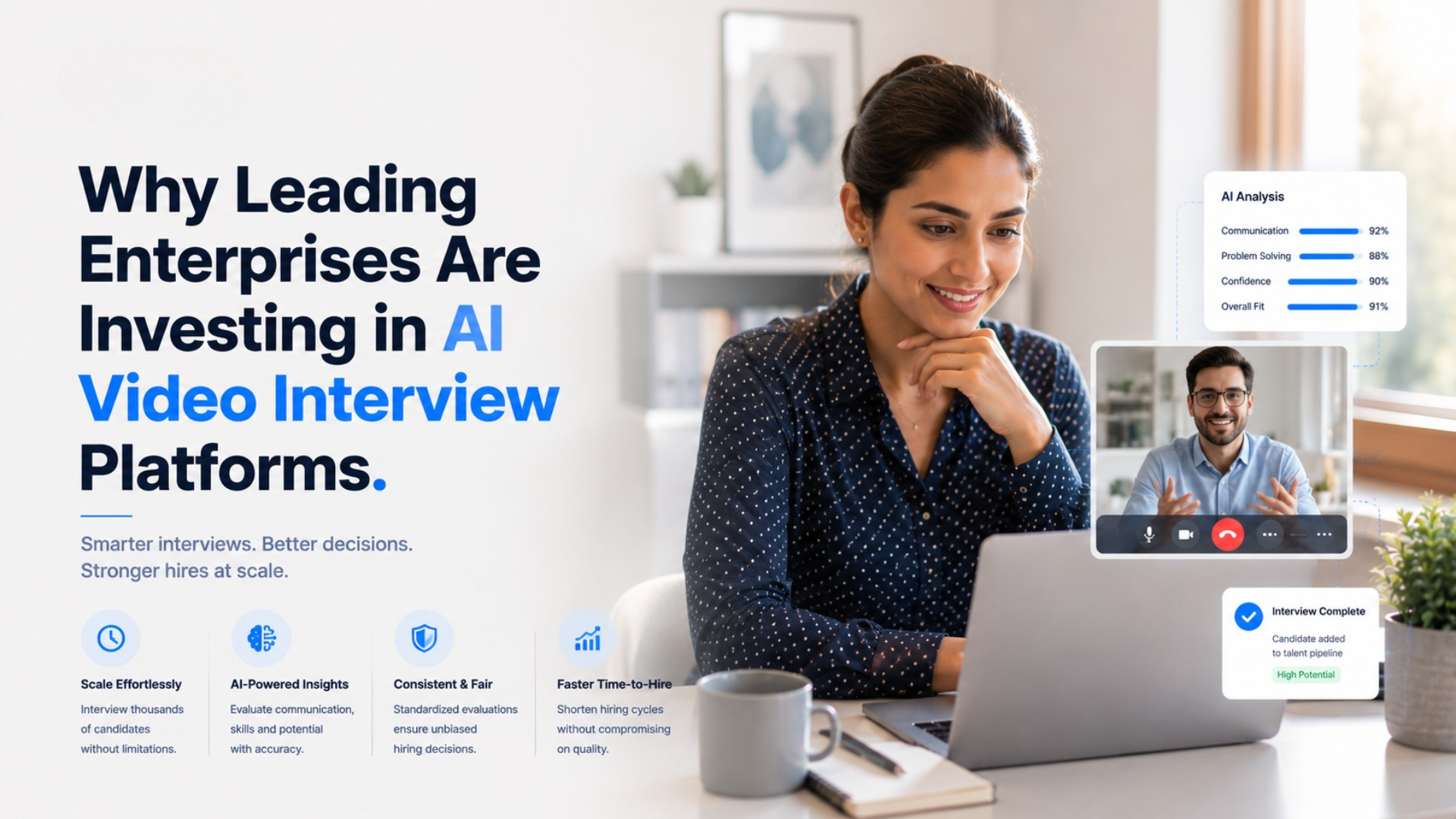
The third category — and the one driving the majority of enterprise investment — is end-to-end AI-powered hiring platforms that integrate sourcing, outreach, AI-conducted conversational screening, structured video evaluation, and pipeline analytics. These platforms do not merely add AI to the interview stage. They reimagine the entire top-of-funnel hiring process as an AI-native workflow. Huntlo.ai exemplifies this category, combining sourcing across 50+ platforms, multi-channel candidate engagement through email, LinkedIn, WhatsApp, and AI voice, conversational AI screening, and structured interview evaluation for a flat $99 per seat per month with no usage caps. For enterprises evaluating total cost of ownership, this integrated approach eliminates the integration overhead, data fragmentation, and vendor management complexity that plague multi-tool stacks.
Leading enterprises are predominantly investing in the third category. The reason is strategic: an AI video interview tool that operates in isolation from sourcing and pipeline management generates valuable data for a single stage of the hiring process, but an integrated platform generates data that compounds across the entire talent acquisition lifecycle. The enterprises making the largest investments are not buying interview tools. They are buying hiring infrastructure.
The Cost of Not Investing: Quantifying Competitive Talent Risk
Enterprise investment decisions are rarely driven by opportunity alone. They are driven by a clear-eyed assessment of the cost of inaction. For AI video interviews, the cost of not investing manifests across three dimensions: direct financial costs, competitive talent costs, and regulatory risk costs.
The direct financial cost of maintaining a traditional interview process at enterprise scale is substantial. Consider a typical enterprise hiring 8,000 employees annually across all levels, with an average of 4.5 phone screens per hire to produce a qualified shortlist. That is 36,000 phone screens per year. The fully loaded cost per phone screen — including recruiter time, scheduling overhead, and the opportunity cost of the recruiter not doing higher-value work — averages $100 to $150 in enterprise environments. The annual screening cost alone is $3.6 million to $5.4 million. AI video interviews reduce this cost by 50% to 70% by eliminating scheduling, automating evaluation, and reducing the number of screens required per hire. Deloitte's workforce cost analysis has documented that enterprises failing to adopt AI screening tools are carrying 35% to 50% higher per-hire screening costs than their AI-adopting competitors — a structural cost disadvantage that compounds annually.
The competitive talent cost is harder to quantify but potentially more damaging. When your organization takes 52 days to fill a role and your competitor takes 32 days, you are not just slower — you are losing candidates. LinkedIn's talent market data shows that the strongest candidates in any pipeline accept an offer within 10 to 14 days of entering an active search. If your hiring process takes 50+ days, your first-choice candidates are accepting offers from faster-moving competitors before you extend yours. The talent cost of a slow hiring process is not measured in recruiting metrics. It is measured in the quality gap between the candidates you hire and the candidates you could have hired if you had moved faster. Over a year, across thousands of hires, this quality gap compounds into a meaningful workforce capability differential.
The regulatory risk cost is the most rapidly growing dimension. New York City's Local Law 144, the EU AI Act, and similar legislation in California, Illinois, Maryland, and other jurisdictions are creating a compliance framework that effectively requires the kind of structured, auditable, data-driven hiring process that AI video interview platforms provide. Organizations that continue to rely on unstructured, unauditable interview processes face increasing regulatory exposure — fines, litigation risk, and the reputational damage that accompanies public enforcement actions. The International Association of Privacy Professionals (IAPP) estimates that enterprise organizations will spend an average of $2.3 million on AI hiring compliance by 2027, regardless of whether they adopt AI tools — the difference is that organizations with AI tools in place will spend that money on proactive compliance, while organizations without AI tools will spend it on reactive remediation and legal defense.
Speed as Revenue: How Faster Hiring Protects the Bottom Line
The most immediately quantifiable return on AI video interview investment is speed. Enterprise organizations that deploy AI video interview platforms report time-to-shortlist reductions of 40% to 65% and time-to-fill reductions of 25% to 40%. These are not marginal improvements — they represent a structural acceleration of the entire hiring pipeline that has direct financial implications.
The financial mechanism is straightforward. Every day a revenue-generating position remains vacant, the organization forgoes the revenue that position would generate. Bain & Company's analysis of hiring velocity estimates that for a typical enterprise, each day of vacancy in a revenue-generating role costs between $2,500 and $15,000 depending on the role level and industry. For an enterprise hiring 3,000 revenue-generating roles per year with an average pre-AI time-to-fill of 48 days, reducing time-to-fill by 12 days (a 25% reduction) recovers 36,000 vacancy days — a potential revenue impact of $90 million to $540 million annually.
Even applying conservative realization rates — acknowledging that not every vacancy day translates directly to lost revenue and that some vacancies are budgeted or planned — the financial impact is significant. If only 5% of recovered vacancy days translate to actual revenue, the annual impact for the example above ranges from $4.5 million to $27 million. For most enterprises, this revenue protection effect alone justifies the entire AI video interview platform investment several times over.
EY's workforce analytics practice has published case studies of enterprise clients achieving 3x to 7x ROI on AI video interview platform investments within the first year, driven primarily by the revenue protection effect of faster hiring. The ROI multiples increase in subsequent years as implementation costs decline and the organization's ability to leverage the technology's full capabilities matures. For CFOs evaluating the investment case, the speed-to-revenue argument is typically the most immediately compelling, because it translates a recruiting technology decision into language that finance teams understand: days of revenue recovered per dollar invested.
Quality at Scale: Why Interview Consistency Matters More at Enterprise Level
Speed without quality is a false economy, and leading enterprises understand this instinctively. The reason they are investing in AI video interviews — rather than simply cutting interview stages to go faster — is that the technology improves evaluation consistency at a scale that human interviewers cannot match.
At enterprise scale, the consistency problem is acute. An enterprise hiring 8,000 people per year across 200+ hiring managers conducting interviews is running 20,000 to 40,000 individual interview interactions annually. Each of those interviews is conducted by a different person, at a different time, under different conditions, using different implicit standards. The result is massive evaluative inconsistency. Two equally qualified candidates interviewed by different hiring managers may receive radically different assessments — not because their capabilities differ, but because the evaluation criteria and standards differ across interviewers.
SIOP's research on interview consistency has documented that inter-rater reliability in unstructured enterprise interview processes typically ranges from 0.15 to 0.30 — meaning that only 15% to 30% of the variance in interview scores reflects actual candidate differences, while 70% to 85% reflects interviewer-specific factors. AI video interview platforms, by applying consistent evaluation criteria to every candidate, increase inter-rater reliability to 0.50 to 0.65 — more than doubling the proportion of score variance that reflects genuine candidate differences.
The practical impact is substantial. Higher inter-rater reliability means that the candidates who advance to the offer stage are more consistently the strongest candidates in the pipeline. It means that hiring decisions are less influenced by which interviewer happened to be available on a given day. And it means that the organization can have greater confidence that its hiring outcomes reflect its actual requirements rather than the random distribution of interviewer subjectivity.
Harvard Business Review's analysis of structured hiring has noted that the quality advantage of structured evaluation compounds over time. Each cohort of hires selected through a more consistent process contributes to a stronger overall workforce, which improves organizational performance, which strengthens the employer brand, which attracts higher-quality candidates, which makes the next cohort of hires even stronger. This virtuous cycle is one of the most compelling long-term arguments for AI video interview investment: the quality returns are not linear — they are compounding.
Compliance as Competitive Advantage: The Regulatory Accelerant
The regulatory environment for AI in hiring is evolving rapidly, and leading enterprises are investing in AI video interview platforms in part because these platforms provide the structured, auditable evaluation processes that regulators are increasingly requiring. This is a counterintuitive but important dynamic: AI video interview platforms are not just subject to regulation — they are tools for achieving compliance with regulation.
New York City's Local Law 144, which requires annual bias audits for automated employment decision tools, effectively mandates the kind of structured evaluation data that AI platforms generate naturally. An organization using unstructured video interviews on Zoom has no mechanism to conduct the bias audit that the law requires, because there is no structured evaluation data to audit. An organization using an AI video interview platform has structured evaluation data for every candidate, enabling the statistical analysis that bias audits require. In this regulatory framework, the AI tool is not the compliance risk — it is the compliance solution.
The EU AI Act, which takes full effect in 2026, classifies AI systems used in employment decisions as "high-risk" and imposes requirements for conformity assessments, risk management systems, human oversight, transparency, and data governance. These requirements are far easier to meet with an AI video interview platform that provides built-in audit trails, evaluation documentation, and bias monitoring than with a traditional interview process where evaluation data exists only in fragmented recruiter notes. The European Commission's AI Act guidance specifically acknowledges that structured AI evaluation tools can support compliance when properly implemented and governed.
PwC's regulatory analysis of AI in hiring estimates that enterprises with AI-powered structured interview processes will spend 40% less on AI hiring compliance over the next five years compared to enterprises that attempt to comply using traditional interview processes retrofitted with manual documentation. The cost advantage comes from the difference between compliance that is embedded in the technology and compliance that must be layered on through manual processes after the fact.
For leading enterprises, compliance is not merely a cost center — it is a competitive differentiator. Organizations that can demonstrate rigorous, auditable, bias-monitored hiring processes have a stronger employer brand, lower litigation risk, and better access to diverse talent pools. In industries where regulatory scrutiny is intense — financial services, healthcare, government contracting — compliance-ready hiring processes are becoming a prerequisite for operating, not a nice-to-have.
The Data Dividend: Talent Intelligence as a Strategic Asset
Perhaps the most strategically significant reason leading enterprises are investing in AI video interview platforms is the talent intelligence data these platforms generate. Every AI-conducted interview produces structured evaluation data: competency scores, behavioral indicators, linguistic patterns, communication assessments, and comparative rankings. Over hundreds and thousands of interviews, this data accumulates into a talent intelligence asset that provides strategic insight no other recruiting technology can match.
The data dividend operates at multiple levels. At the tactical level, it improves individual hiring decisions by providing recruiters and hiring managers with structured, comparable evaluation data that enables better-informed shortlisting and offer decisions. At the operational level, it identifies patterns in hiring outcomes — which sourcing channels produce the strongest candidates, which interview questions most effectively differentiate top performers, which competency indicators most strongly predict success in specific role families. At the strategic level, it provides external talent market intelligence: awareness of shifting skill availability, changing candidate expectations, and evolving competitive dynamics in the talent landscape.
Mercer's talent strategy research has found that enterprises with mature talent intelligence capabilities — built on structured hiring data — make 28% faster hiring decisions and achieve 18% higher new-hire performance ratings. The advantage compounds because each search generates data that improves the next search. An organization that has conducted 10,000 AI-evaluated interviews has a talent intelligence asset that no amount of recruiter experience can replicate, because it is based on systematic, structured data rather than anecdotal memory.
This data advantage is particularly powerful when AI video interviews are integrated with AI-powered sourcing, as platforms like Huntlo.ai enable. When sourcing data — candidate engagement patterns, channel-specific response rates, outreach effectiveness — flows into the same system as interview evaluation data, the resulting intelligence is richer and more actionable than either data source could produce independently. An enterprise can see, for example, that candidates sourced through LinkedIn and engaged via AI voice calls produce higher interview scores than candidates sourced through job boards and engaged via email. This kind of cross-channel intelligence enables continuous optimization of the entire talent acquisition funnel.
Gallup's workforce analytics research has described talent intelligence as the "next frontier of competitive advantage in human capital management," comparing it to the data analytics revolution that transformed marketing and supply chain management in the previous decade. Enterprises that invest in AI video interview platforms today are not just improving their current hiring process. They are building the data infrastructure that will power their talent strategy for the next decade.
What Early Adopters Are Reporting: Evidence from the Field
The investment thesis for AI video interviews is supported by a growing body of evidence from enterprises that have completed implementation. The following patterns emerge consistently across industries and organizational sizes.
Time-to-fill reduction is the most immediately measurable outcome. A HireVue enterprise outcomes report analyzing data from 150+ enterprise clients found that average time-to-fill decreased by 34% in the first year of AI video interview adoption, with some organizations achieving reductions exceeding 50%. The magnitude of improvement correlated with the breadth of deployment — organizations that used AI interviews for all screening stages achieved larger improvements than those that limited AI to initial screening only.
Quality-of-hire improvements follow within 6 to 12 months. Because quality-of-hire is a lagging indicator — measured through performance reviews, retention data, and manager satisfaction — it takes longer to manifest than speed improvements. But the evidence is consistent. Korn Ferry's enterprise hiring benchmark study found that enterprises using AI-enhanced structured interviews reported a 19% improvement in new-hire performance ratings at the 12-month mark and a 16% improvement in 18-month retention. These improvements were attributed to the consistency and structure of AI evaluation, which produced better-aligned shortlists and more evidence-based hiring decisions.
Cost savings exceed initial projections. Enterprises typically project 30% to 40% screening cost reductions when building their investment case. Actual results frequently exceed these projections, averaging 45% to 60% cost reductions in year one, according to aggregated data from G2 enterprise user reviews. The better-than-expected performance is attributed to two factors: the elimination of scheduling overhead is larger than most organizations anticipate, and the reduction in candidate dropout (due to faster, more respectful processes) reduces the hidden cost of re-screening replacement candidates.
Diversity metrics improve without deliberate intervention. One of the most noteworthy findings is that enterprises deploying AI video interviews consistently report improvements in the diversity of their hired candidates — typically 15% to 25% increases in gender and ethnic diversity — without implementing any specific diversity-focused initiatives. The improvement is attributed to the AI's consistent application of role-relevant evaluation criteria, which eliminates the subjective "culture fit" assessments that have been shown to disproportionately disadvantage underrepresented candidates. The National Bureau of Economic Research (NBER) has published peer-reviewed research confirming this finding across multiple organizational contexts.
Candidate satisfaction is neutral to positive. Contrary to concerns that candidates would resist AI interviews, Talent Board's CandE benchmark data shows that candidate satisfaction with AI interview processes is equal to or higher than satisfaction with traditional interview processes at enterprise organizations, provided that the AI process is transparent, well-designed, and accompanied by clear communication. The key variable is not the technology itself but the candidate experience design.
The Competitive Talent Market Demands It
The talent market dynamics of 2026 create structural pressure on enterprises to improve their hiring speed and quality. The Bureau of Labor Statistics projects sustained demand for professional and management roles through 2032, with particular tightness in technology, healthcare, and advanced manufacturing. At the same time, the workforce is becoming more mobile, more selective, and less tolerant of slow, bureaucratic hiring processes.
HBR's analysis of talent competition describes a "winner-take-most" dynamic in the talent market, where organizations with superior hiring processes attract a disproportionate share of top talent. The mechanism is straightforward: top candidates have multiple options, they evaluate potential employers on the quality of their hiring experience, and they share their experiences with their professional networks. An enterprise known for a slow, disorganized hiring process develops a negative reputation that repels the very candidates it most wants to attract. An enterprise known for a fast, respectful, data-driven hiring process develops a positive reputation that draws top candidates — including passive candidates who are not actively searching but would respond to the right opportunity.
This reputational dynamic creates a self-reinforcing cycle. Enterprises with better hiring processes attract better candidates, which leads to better hires, which leads to stronger organizational performance, which strengthens the employer brand, which attracts even better candidates. Conversely, enterprises with poor hiring processes enter a downward cycle: weaker candidate pools, weaker hires, weaker performance, weaker brand, weaker candidate pools. AI video interviews are a tool for entering or accelerating the positive cycle — and for preventing the negative one.
The competitive calculus is particularly acute in industries where talent is the primary source of competitive advantage. In technology, consulting, financial services, and advanced manufacturing, the quality of the workforce is the single most important determinant of organizational performance. In these industries, a 10% to 15% improvement in hiring quality — which AI video interviews can deliver — translates directly into competitive advantage in the product market. Heidrick & Struggles' leadership market analysis has documented that technology companies with AI-enhanced hiring processes achieve 23% faster product development cycles, attributed to the higher quality of engineering and leadership hires that the improved process enables.
How AI Video Interviews Reduce Enterprise Hiring Costs
The cost reduction case for AI video interviews extends well beyond the screening cost savings discussed earlier. A comprehensive cost analysis should account for savings across the entire hiring lifecycle.
Recruiter productivity savings. AI video interviews free recruiters from the most time-consuming, lowest-value activity in their workflow: conducting repetitive initial phone screens. Lever's recruiting analytics estimates that enterprise recruiters spend an average of 35% of their time on initial screening activities. AI video interviews reduce this to approximately 10%, freeing 25% of recruiter capacity for higher-value activities — sourcing passive candidates, building hiring manager relationships, managing offer negotiations, and developing talent pipeline strategies. For an enterprise recruiting team of 50 people at a fully loaded cost of $150,000 per recruiter, this productivity recovery is worth approximately $1.9 million annually in reclaimed capacity.
Hiring manager time savings. Hiring managers at enterprise organizations are senior professionals whose time is extremely valuable. When AI video interviews produce structured shortlists with detailed evaluation data, hiring managers spend less time reviewing unstructured recruiter notes and more time conducting meaningful final-round interviews with well-qualified candidates. Enterprise clients report that hiring manager time invested in the interview process decreases by 30% to 40% per hire after AI video interview adoption. For a senior engineering manager earning $250,000 per year who spends 15% of their time on hiring, reducing that to 9% recovers approximately $150,000 in productive capacity per manager per year.
Candidate re-engagement cost savings. In traditional hiring processes, a significant percentage of shortlisted candidates withdraw before receiving an offer, typically due to process duration or competitive offers. These withdrawals create "re-screening costs" — the cost of identifying and evaluating replacement candidates to refill the shortlist. AI video interviews reduce candidate withdrawal rates by 25% to 35% by accelerating the process and improving the candidate experience, directly reducing re-screening costs. Jobvite's recruiting benchmarks estimate that re-screening costs add 15% to 20% to total screening expenditure in traditional enterprise hiring processes.
Agency and search firm fee reduction. Enterprises that improve their internal hiring capability through AI video interviews can reduce their reliance on external search firms and staffing agencies for roles that were previously outsourced due to internal capacity constraints. Given that retained search fees typically range from 25% to 35% of first-year compensation, reducing external search reliance for even a small percentage of hires produces significant savings. An enterprise that redirects 100 hires per year from external search firms to an AI-powered internal process, at an average starting salary of $120,000, saves approximately $3 million to $4.2 million in annual search fees.
Building a Future-Proof Hiring Infrastructure
The most forward-thinking enterprises are not just investing in AI video interviews as a point solution for current hiring challenges. They are investing in AI-powered hiring infrastructure that will form the foundation of their talent acquisition capability for the next decade.
This long-term perspective changes the investment calculus. When you evaluate AI video interviews as a one-year cost-benefit calculation, the case is strong. When you evaluate them as a multi-year infrastructure investment, the case becomes compelling. The platform you deploy today will generate talent intelligence data that improves with every search. The evaluation frameworks you develop will become more accurate and more valuable as they are refined against actual hiring outcomes. The organizational capability you build — in AI-literate recruiters, data-driven hiring managers, and structured evaluation processes — becomes a durable competitive asset.
SHRM's workforce planning research has identified "AI-enabled talent intelligence" as one of the top three strategic priorities for enterprise talent acquisition through 2028, alongside employer branding and skills-based hiring. The organizations that invest in this capability early will have a significant head start over those that wait, because the value of talent intelligence data compounds — the organization with 50,000 AI-evaluated interviews in its database has an asset that a new adopter cannot replicate, regardless of how much they invest.
This infrastructure perspective also changes how enterprises evaluate platform selection. The most important criterion becomes not just current capability but platform architecture, data model, extensibility, and vendor viability. A platform that can grow with the organization — adding predictive performance modeling, continuous talent relationship management, and integration with broader HR AI tools — is worth a premium over a platform that solves today's problem but cannot evolve to address tomorrow's. Huntlo.ai's integrated approach, combining sourcing, multi-channel outreach, AI screening, and interview evaluation on a single platform with flat-rate pricing, is designed precisely for this infrastructure use case — it grows with the organization's needs without requiring a technology stack overhaul.
The Investment Decision: Timing, Scale, and Expected Returns
For enterprise talent acquisition leaders preparing to make the case for AI video interview investment, the decision framework should address three questions: when to invest, at what scale, and what returns to expect.
Timing. The competitive evidence suggests that earlier investment produces larger returns, because the talent intelligence data advantage compounds over time. However, the organizational readiness requirements — stakeholder alignment, change management capacity, and governance infrastructure — mean that a poorly timed, rushed implementation can underperform a well-prepared implementation that launches three months later. The recommended approach is to begin stakeholder education and governance development immediately, pilot within 60 to 90 days, and begin scaling based on pilot evidence. Organizations that delay beyond 12 months risk significant competitive disadvantage as AI-enhanced hiring becomes the industry standard.
Scale. Enterprise implementations should follow the phased approach detailed in the enterprise implementation guide: pilot with a single business unit, expand to 3 to 5 business units based on pilot evidence, optimize based on aggregate data, and then scale enterprise-wide. Attempting enterprise-wide deployment without phased learning is the most common cause of implementation failure. Budget for the full multi-year journey, but allocate spending across phases based on evidence.
Expected returns. Based on aggregated data from enterprise adopters, expect the following returns on a well-executed implementation: 35% to 50% reduction in time-to-fill in year one, improving to 45% to 65% in year two as the organization's capability matures. Screening cost reductions of 45% to 60% in year one. New-hire quality improvements of 15% to 25% within 12 to 18 months, as measured by performance ratings and retention. ROI of 3x to 7x in year one, increasing to 5x to 10x in subsequent years as implementation costs decline and the talent intelligence data asset compounds. These returns are not aspirational — they represent the median outcomes reported by enterprises that have completed full implementation.
The Strategic Imperative
Leading enterprises are investing in AI video interview platforms because the evidence is clear, the returns are measurable, and the cost of inaction is growing. The organizations that have already made this investment are not looking back. They are building on their early advantage, deepening their talent intelligence capabilities, and widening the gap between their hiring outcomes and those of their competitors.
For the enterprises that have not yet invested, the question is not whether the technology will become standard — it will. The question is whether their organization will be leading the adoption or scrambling to catch up. In a talent market where the quality of your hiring process directly determines the quality of your workforce, and where the quality of your workforce directly determines your competitive position, delaying this investment is not a conservative strategy. It is the riskiest strategy available.
Related Topics:
Recruiting Compliance Differences: India vs USA vs UK
Do AI Recruiting Tools Work for Niche or Technical Roles?
Why Referrals Outperform Cold Outreach