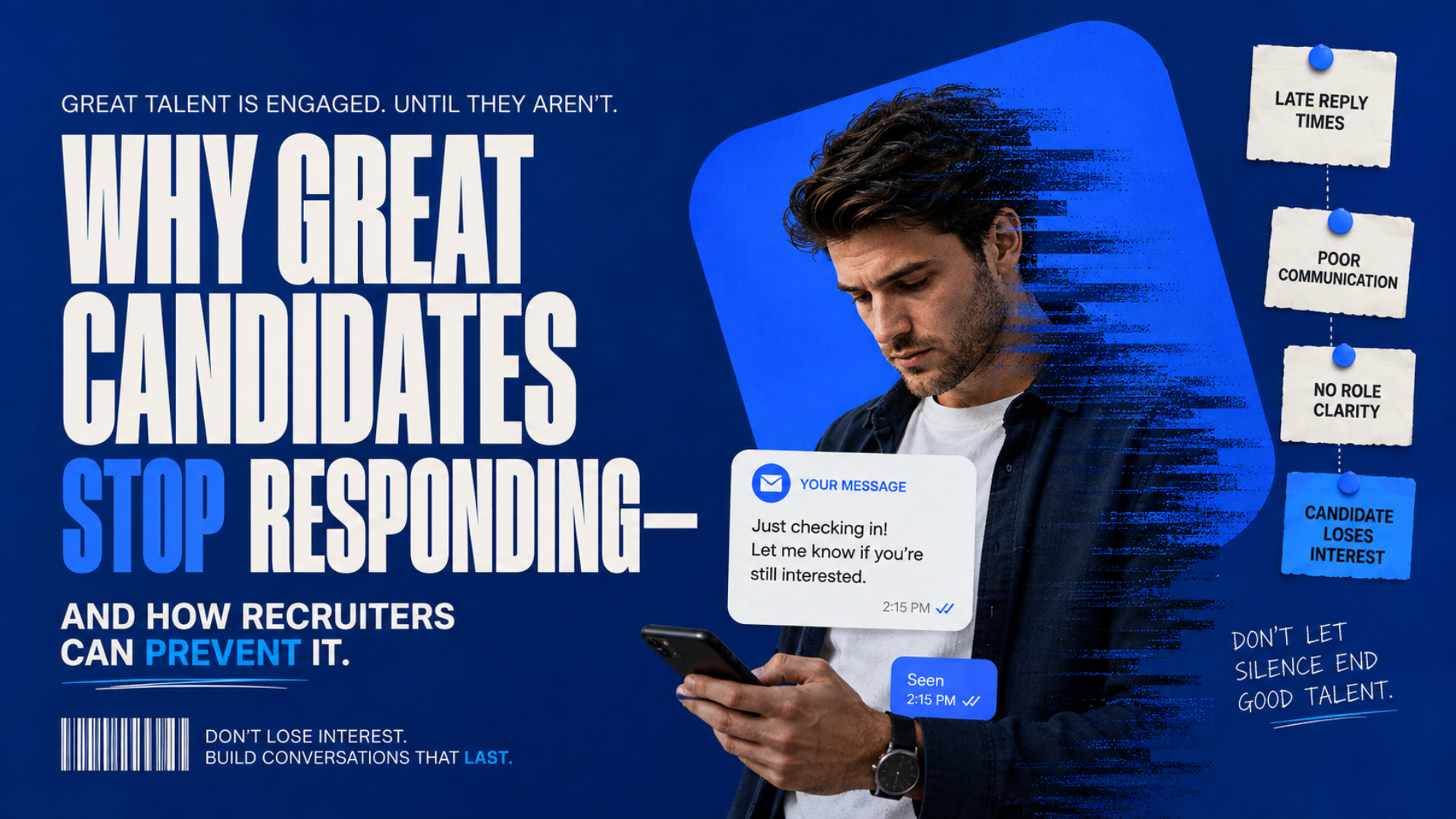
You spent three weeks identifying, courting, and finally engaging a passive candidate who perfectly matches the senior data scientist role your team desperately needs to fill. After an initial screening call that lasted forty-five minutes, both you and the candidate agreed the opportunity seemed like a mutual fit. You promised to send over the hiring manager's availability by Tuesday. Wednesday passes with no email. Thursday arrives, and you finally send the times late in the afternoon. The candidate replies with a polite "Thanks, I will look at these." Then, silence. A follow-up nudge on Monday goes unanswered. By Friday, you have been ghosted by a professional who was seemingly thrilled about the role just seven days prior. Recruiters often internalize this silence as a flaw in the candidate's professionalism, labeling it as ghosting and moving on to the next name on their spreadsheet. However, treating candidate silence as an inevitability is a fundamental mistake. When great candidates stop responding, it is almost always a symptom of a broken process, a communication misstep, or a failure of momentum on the recruiter's end.
The Illusion of Candidate Commitment
One of the most dangerous traps a recruiter can fall into is mistaking a candidate's initial curiosity for absolute, unwavering commitment. When a candidate first responds to an outreach message or agrees to a preliminary call, they are essentially opening a door to explore a possibility, not signing a binding contract. This distinction is especially critical when dealing with passive candidates who are already employed and generally satisfied in their current roles. Understanding the clear difference between AI sourcing and AI recruiting is essential here, because identifying a highly qualified name is entirely different from successfully managing the complex human psychology of a career transition.
When recruiters assume the candidate is locked in after one good conversation, they often ease off the gas, shifting their attention to other open requisitions or administrative tasks. The candidate, left alone with their thoughts, begins to rationalize staying put. The minor inconveniences of their current job suddenly seem much more tolerable than the massive life disruption of switching companies. According to data from LinkedIn's global talent trends, passive candidates require significantly more nurturing and a clearer value proposition than active job seekers because they have no immediate pain point forcing them to make a move. If you do not actively continue to sell the opportunity and build the relationship during the gaps between interviews, that initial spark of interest will inevitably fade into silence.
Communication Black Holes That Kill Momentum
The most pervasive reason great candidates stop responding is the dreaded communication black hole inherent in many traditional hiring processes. Recruiting is a deeply asynchronous activity characterized by sudden bursts of action followed by long periods of waiting. Hiring managers get stuck in back-to-back meetings, interviewers delay submitting their feedback, and scheduling conflicts push next rounds back by days or even weeks. For the recruiter, these delays are an understood reality of the job. For the candidate, however, silence is deeply unsettling and highly suggestive of disinterest.
When a candidate submits their availability or finishes an interview and hears nothing for five days, they do not assume the hiring manager is busy. They assume the company found someone better, decided not to hire for the role after all, or simply does not respect their time enough to send a quick update. Research highlighted in SHRM's talent acquisition resources consistently shows that a lack of timely communication is the primary driver of negative candidate experiences. There is a direct correlation between recruiter responsiveness and dropout rates, which is exactly why analyzing how many followups one hire actually needs is so critical. Recruiters must proactively close these communication gaps. Even if there is no tangible update to share, sending a brief message stating that feedback is still being gathered but the candidate remains a top priority prevents the candidate's imagination from filling the void with worst-case scenarios.
The Danger of Overcomplicated Hiring Workflows
Modern hiring teams have a habit of designing interview processes that are optimized for risk mitigation rather than candidate experience. What starts as a simple introductory chat quickly morphs into a six-stage gauntlet consisting of an initial recruiter screen, a technical assessment, a hiring manager interview, a panel behavioral interview, a take-home project, and a final executive conversation. For an entry-level candidate desperate for a job, this marathon might be tolerable. For a great, highly employed candidate, it is a massive deterrent.
Top-tier talent calculates the opportunity cost of their time very carefully. When you ask a senior director to block out five separate hours across four weeks for initial interviews, you are asking them to sacrifice their evenings and weekends to prepare. If the process drags on, the perceived value of the new opportunity diminishes with every passing week. Companies often invest heavily in new technology but end up with more tools but the same hiring problems because they layer complicated assessment stages over a fundamentally slow and bloated workflow. Data from McKinsey's hiring and workforce trends indicates that top performers drop out of overly complex hiring funnels at significantly higher rates than average performers. If your interview process is excessively long or redundant, candidates will simply accept counteroffers from their current employers or take offers from competitors who respect their time enough to make decisions quickly.
Rebuilding Engagement Through Automated Outreach
Preventing candidate silence requires shifting from a reactive communication style to a proactive, systematized approach. This is where recruiter outreach automation becomes an absolute necessity rather than a luxury. Human recruiters are juggling dozens of open roles and hundreds of candidates at any given time. Expecting them to manually send perfectly timed, personalized updates to every single prospect is a recipe for burnout and dropped balls. By implementing candidate outreach software, talent teams can build automated touchpoints that keep the candidate warm and informed, even when the recruiter is tied up in other meetings.
However, automation must be deployed strategically to avoid feeling robotic. The goal is not to spam the candidate with generic template emails, but to create a safety net that ensures no one falls through the cracks. For example, if an interviewer fails to submit feedback within forty-eight hours of an interview, the system should automatically trigger a polite check-in to the candidate acknowledging the delay. Using a platform that operates as an agentic AI recruiting tool versus just an automated one ensures that these automated messages can adapt to context, maintaining a human tone while removing the manual burden from the recruiter's shoulders. This guarantees that the candidate feels valued and informed throughout the entire journey.
Why Manual Follow-Ups Consistently Fail
Relying on memory and willpower to execute follow-ups is a flawed strategy. Recruitment is an inherently chaotic profession where priorities shift by the hour. A recruiter might fully intend to send a follow-up email to a strong candidate on Wednesday afternoon, but a sudden urgent requisition from the CEO pushes that task to Thursday. By Thursday, the candidate has already mentally checked out. Manual follow-ups are dependent on the recruiter's capacity, which is a finite and highly volatile resource.
Furthermore, manual processes make it nearly impossible to maintain consistency across your entire talent pipeline. One candidate might get a same-day response, while another waits a week for the exact same stage of the process. This inconsistency damages your employer brand and creates an unfair experience for candidates. To truly improve candidate response rates, teams must look at ways to automate the recruitment process comprehensively. When the follow-up cadence is systematized, every candidate receives the same high standard of communication, regardless of how busy the recruiting desk is on any given day.
Structuring Recruiting Sequences for Top Talent
Designing effective recruiting sequences requires a deep understanding of candidate psychology. A standard three-email drip campaign used for mass-market roles will not work on a senior executive or a highly specialized engineer. Top talent requires a nuanced approach that provides value at every touchpoint. The first message should confirm next steps clearly. The second touchpoint, sent a few days later, should offer additional context about the role, the team, or the company culture that wasn't covered in the interview. The third touchpoint should be a gentle check-in that respects their time.
By leveraging recruitment follow-up automation, these sequences are deployed flawlessly. The timing can be optimized based on data—perhaps waiting exactly seventy-two hours after an interview before sending the next communication. The content can be dynamically personalized using details gleaned from the initial screening call. As highlighted by Deloitte's human capital trends, candidates increasingly expect a consumer-grade digital experience when interacting with potential employers. Structured, automated recruiting sequences deliver exactly that, providing a steady cadence of relevant information that keeps the candidate engaged without making them feel harassed.
Transparency as a Retention Tool
One of the most effective, yet underutilized, strategies to prevent candidates from going silent is radical transparency. Recruiters often treat the hiring timeline as a closely guarded secret, only revealing the next step once the current step is complete. This lack of visibility forces candidates into a state of anxiety. They do not know where they stand, how many other people are interviewing, or when a final decision might be made.
Flipping this script by sharing the entire hiring roadmap during the very first call can drastically reduce dropout rates. Tell the candidate exactly what to expect: "We are currently finishing up first-round interviews this week, we will make decisions by next Tuesday, and final-round panels will take place the following week." When candidates have a clear timeline, they are far less likely to panic and accept another offer out of impatience. If a delay happens, as they inevitably do, the recruiter can point back to the original timeline and explain exactly where the bottleneck occurred. Transparency builds trust, and trust is the ultimate antidote to candidate ghosting. When candidates trust that the recruiter will keep them informed, they do not feel the need to protect themselves by going silent.