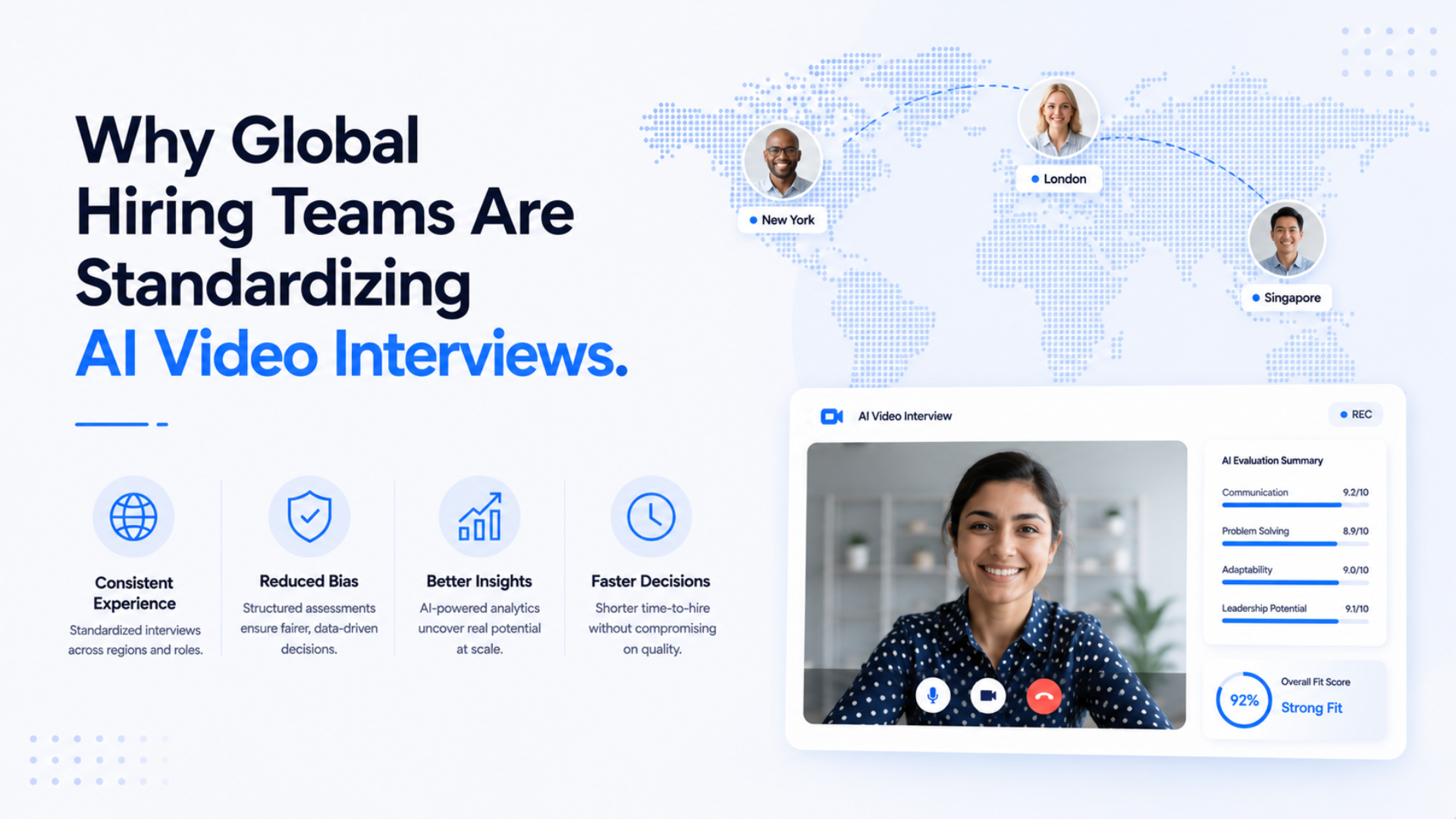
Why Global Hiring Teams Are Standardizing AI Video Interviews
A North American technology company is hiring software engineers in Bangalore, product managers in Berlin, and sales directors in Dubai — all in the same quarter. The Bangalore candidates are evaluated through a 30-minute technical phone screen conducted by an engineering manager who asks different questions to each applicant. The Berlin candidates complete a structured behavioral interview designed by the European HR team using a different competency model. The Dubai candidates go through a three-round process managed by a local search firm that applies its own cultural lens to every evaluation. When the VP of Talent reviews the three shortlists, there is no common framework, no comparable data, and no way to determine whether the strongest candidate is in India, Germany, or the UAE.
This scenario is not hypothetical — it is the daily reality for hundreds of global hiring teams, and it represents one of the most consequential and least discussed problems in modern talent acquisition. As organizations expand across borders, the lack of standardized assessment processes creates inconsistency, bias, compliance risk, and strategic blindness that undermine the entire premise of global hiring.
AI video interview technology has emerged as the primary mechanism for solving this problem. By providing a single platform that can be configured with consistent question frameworks, scoring rubrics, and compliance protocols across every geography, AI video interviews give global hiring teams something they have never had before: a unified, data-rich assessment layer that makes cross-border candidate evaluation reliable, comparable, and defensible.
The Structural Case for Standardization: Why Global Hiring Is Broken
The pressure to hire globally has never been greater. Gallup's global hybrid work data shows that 52% of full-time U.S. employees are in hybrid arrangements and 26% work fully remotely — figures that reflect a broader global shift toward borderless talent strategies. Forbes reports that 32.6 million Americans will work remotely by 2025, while global surveys indicate that approximately 66% of companies worldwide now offer some form of hybrid or remote work as a standard employment option.
This structural shift has transformed hiring from a regional activity into a global one. But the tools, processes, and frameworks used to evaluate candidates have not kept pace. Most global organizations still operate with fragmented assessment approaches that vary by region, function, and hiring manager preference — creating the kinds of inconsistencies that undermine hiring quality, expose the organization to legal risk, and damage the employer brand across markets.
The Inconsistency Problem
Inconsistency in global hiring is not just an operational annoyance — it is a strategic liability. When different regions use different interview formats, different questions, and different evaluation criteria, the resulting candidate assessments are fundamentally incomparable. A hiring manager in New York who evaluates candidates through unstructured conversations cannot meaningfully compare their assessments with those produced by a structured process in London or a referral-driven evaluation in Lagos.
This inconsistency has several concrete consequences. First, it makes it impossible to build accurate talent intelligence across the organization. If the assessment methodology varies by region, any attempt to compare candidate quality, identify skill gaps, or benchmark hiring outcomes across geographies is built on unreliable data. Second, it creates fairness concerns that can escalate into legal and reputational risks. Candidates who are evaluated through more rigorous processes in one region may be systematically disadvantaged compared to candidates assessed through less demanding processes in another — a form of geographic discrimination that is both ethically problematic and potentially illegal in many jurisdictions.
SHRM's 2025 Talent Trends research found that "in 2025, U.S.-only employers face stiffer recruiting challenges than their multinational peers, a reversal from 2024." This finding suggests that organizations with global hiring capabilities are gaining a competitive advantage — but only if those capabilities are supported by consistent, reliable assessment processes. Without standardization, the advantage of global reach is undermined by the disadvantage of global inconsistency.
The Scale Problem
Global hiring teams face a volume challenge that regional teams do not. A company hiring across fifteen countries may need to evaluate candidates for dozens of roles simultaneously — each in a different language, each subject to different employment regulations, and each competing for attention from a centralized talent acquisition team that is already stretched thin.
Traditional approaches to this challenge — hiring more recruiters in each region, engaging multiple local search firms, or simply accepting longer time-to-fill for international positions — all add cost without solving the fundamental assessment consistency problem. AI video interviews address both the scale and consistency challenges simultaneously: by providing a platform that can assess candidates asynchronously, in any time zone, using the same structured framework for every candidate regardless of location.
The Coordination Problem
Global hiring also creates a coordination challenge that is qualitatively different from regional hiring. When a role needs to be filled across multiple locations — a regional sales director position that could be based in any of five European offices, for example — the hiring team needs to evaluate candidates from multiple countries against a common set of criteria. Without a standardized assessment process, this requires extensive manual coordination: aligning interview questions across regions, reconciling different evaluation formats, and synthesizing qualitative feedback from multiple sources into a coherent comparison.
The iCIMS global talent recruitment strategy guide identifies "standardize your hiring process" as the very first recommendation for organizations building global recruitment capabilities — ahead of recruitment marketing, employer branding, or technology selection. This prioritization reflects a growing consensus among talent acquisition leaders that process standardization is the foundational enabler of effective global hiring.
The Bias Problem: Cross-Cultural Assessment Is Harder Than You Think
Perhaps the most compelling reason for global hiring teams to standardize AI video interviews is the pervasive and often underappreciated problem of cross-cultural assessment bias. Human interviewers are influenced by cultural assumptions in ways that are deeply embedded, frequently unconscious, and consistently damaging to hiring quality and diversity.
What the Research Shows
Avery's cross-cultural recruitment research — based on 750 interviews across 15 markets — found that "the biggest barrier to cross-cultural hiring isn't language or time zones" but rather hidden biases that systematically disadvantage candidates from different cultural backgrounds. The research identified patterns where interviewers unconsciously favored candidates whose communication styles, self-presentation approaches, and professional narratives matched the interviewer's own cultural norms — even when those norms were irrelevant to actual job performance.
An arXiv study on cultural bias in AI hiring evaluations conducted a systematic analysis of how large language models assess job interviews across cultural dimensions, using interview transcripts from 100 UK and 100 Indian job seekers. The study found measurable cross-cultural differences in AI-generated scores — a finding that underscores both the risk of unexamined assessment tools and the importance of deliberately designing AI systems to account for cultural variation in communication styles.
A peer-reviewed paper published by the NIH titled "Does AI Debias Recruitment?" analyzed the claims made by AI recruitment companies about bias reduction. The research found that while AI tools have the potential to reduce certain forms of bias — particularly the inconsistency and affinity bias that plague unstructured human interviews — they can also introduce new forms of bias if not carefully designed, audited, and calibrated for cross-cultural use.
CREST Research's analysis of AI in recruitment specifically noted that "Western AI interviewing technology may not consider cultural differences in facial expressions, and recent research suggests that the meaning" of nonverbal cues varies significantly across cultures. This finding has direct implications for global hiring teams: an AI video interview system designed and calibrated for a Western candidate pool may produce systematically biased assessments when applied to candidates from East Asian, South Asian, Middle Eastern, or African cultural contexts.
How Standardized AI Video Interviews Address Cross-Cultural Bias
Despite the risks, AI video interviews — when properly designed and deployed — offer significant advantages over unstructured human interviews for cross-cultural assessment. The key is standardization with cultural awareness, not standardization that ignores cultural difference.
First, standardized AI video interviews ensure that every candidate is asked the same questions in the same format. This eliminates the most common source of cross-cultural bias in traditional interviews: the tendency of interviewers to ask different questions based on the candidate's perceived background, adjust their questioning style based on assumptions about the candidate's cultural norms, or apply different implicit standards to candidates from different regions. A structured question framework ensures that a candidate in Nairobi faces the same assessment as a candidate in New York — and that any differences in their scores reflect genuine differences in their responses, not differences in the questions they were asked.
Second, AI-based scoring applies predetermined evaluation criteria consistently. SHRM Labs' research on structured interviewing and AI demonstrates that structured evaluation processes — whether AI-assisted or human-conducted — "help organizations reduce unconscious bias, improve hiring accuracy, and minimize costly recruitment errors." When the scoring criteria are explicitly designed to evaluate competencies rather than cultural markers (communication style, accent, self-promotion patterns), the assessment focuses on what candidates can do rather than how they present themselves.
Third, the data generated by standardized AI video interviews enables ongoing bias auditing. When every candidate completes the same assessment, the organization can analyze scoring patterns across demographic and geographic groups to identify potential biases and make targeted adjustments. This kind of continuous monitoring is impossible with unstructured interviews, where the lack of consistent data makes bias detection and correction largely guesswork.
Safeguard Global's best practices guide for interviewing international candidates confirms that "structured interviews reduce bias: standardized questions and scoring help hiring teams assess global talent fairly" — a straightforward principle that, when implemented through AI video interview technology, scales across any number of geographies without additional recruiter effort.
The Compliance Challenge: Why Global Assessment Demands Global Standards
Global hiring operates within a complex and rapidly evolving regulatory landscape. Data privacy laws, AI-specific regulations, employment discrimination statutes, and local hiring requirements vary dramatically across jurisdictions — and the consequences of non-compliance range from financial penalties to reputational damage to legal liability.
The GDPR Framework and AI Hiring
The European Union's General Data Protection Regulation (GDPR) establishes some of the most stringent requirements for how organizations collect, process, and store candidate data — including video interview recordings. Under GDPR, candidate consent must be freely given, specific, informed, and unambiguous. Organizations must have a lawful basis for processing personal data. Candidates have the right to access their data, request correction or deletion, and object to automated decision-making.
The Potomac Law Group's analysis of AI recruiting compliance notes that organizations "should conduct Impact Assessments before incorporating AI tools into your hiring process" and that "in many cases, both a Privacy Impact Assessment (or DPIA under the GDPR) and an AI Impact Assessment should be performed and documented." The analysis specifically highlights the Illinois Artificial Intelligence Video Interview Act as an example of jurisdiction-specific regulation that "requires consent from candidates for AI analysis of video footage."
The EU AI Act, which entered into force in 2024, introduces additional requirements for AI systems used in employment contexts. AI-powered interview tools are classified as high-risk systems under the Act, subjecting them to requirements around transparency, human oversight, accuracy, and bias testing. Organizations that deploy AI video interviews across EU member states must ensure that their tools meet these requirements — a compliance burden that is significantly easier to manage when a single, well-documented platform is used across all jurisdictions.
The Fragmentation Risk
When global hiring teams use different interview tools and processes in different regions, each tool creates its own compliance footprint. A European hiring team using one video interview platform must manage that platform's GDPR compliance separately from an Asia-Pacific team using a different platform, which in turn must manage its own compliance with local data protection laws in Singapore, Japan, Australia, and India. This fragmentation multiplies the compliance workload, increases the risk of gaps or inconsistencies, and makes it nearly impossible for the central talent acquisition function to maintain a clear picture of the organization's global compliance posture.
Standardizing on a single AI video interview platform consolidates the compliance footprint. Instead of managing multiple vendor relationships, multiple data processing agreements, and multiple impact assessments, the organization manages one. This consolidation does not eliminate the need for jurisdiction-specific compliance measures — GDPR requirements still apply to EU candidates, Illinois AI Video Interview Act requirements still apply to Illinois candidates — but it makes the compliance architecture coherent, auditable, and manageable.
Building a Compliance-First Assessment Framework
For global hiring teams, the compliance argument for standardization is not theoretical — it is operational. A standardized AI video interview platform allows the organization to implement compliance controls once and apply them consistently across all geographies. These controls include:
Candidate consent workflows that are automatically adapted to the regulatory requirements of the candidate's jurisdiction. A candidate in Germany sees a GDPR-compliant consent form with explicit data processing purposes; a candidate in Illinois sees a notice about the AI Video Interview Act; a candidate in a jurisdiction with no specific AI hiring regulation sees a simpler, more streamlined consent experience.
Data retention policies that automatically apply the appropriate retention periods based on the candidate's location and the applicable legal requirements. European candidate data may need to be deleted or anonymized within a specific timeframe, while data from other jurisdictions may be retained for longer periods in accordance with local laws and organizational talent pool strategies.
Audit trails that document every step of the assessment process — from question delivery to scoring to human review — in a format that can be produced in response to regulatory inquiries, candidate data access requests, or litigation holds. A single platform generates a single, consistent audit trail that is far easier to manage than the fragmented documentation produced by multiple tools.
The Operational Advantages: Speed, Cost, and Candidate Experience
Beyond the strategic arguments around bias and compliance, standardized AI video interviews deliver concrete operational advantages that matter to every global hiring team.
Time Zone Arbitrage Without Sacrificing Quality
One of the most practical benefits of AI video interviews for global hiring is the elimination of scheduling friction across time zones. When a hiring team in San Francisco needs to evaluate a candidate in Bangalore, a candidate in London, and a candidate in Tokyo, coordinating live interviews across these time zones can add weeks to the hiring timeline. Each scheduling round requires multiple email exchanges, compromises on timing that may disadvantage candidates in certain regions, and the ever-present risk of last-minute cancellations.
AI video interviews — particularly asynchronous (one-way) formats — eliminate this friction entirely. Candidates complete the interview at a time that works for them, in their own time zone, without any scheduling coordination. The hiring team reviews the recorded responses when it suits them. The result is a hiring process that moves at the speed of the fastest evaluation step rather than the speed of the slowest scheduling coordination.
For high-volume global hiring — such as a multinational technology company hiring hundreds of engineers across three continents — this time zone arbitrage can reduce time-to-shortlist by 50% or more. Candidates in every region move through the assessment process at their own pace, and the hiring team receives structured, comparable assessments from all regions simultaneously.
Cost Reduction Through Platform Consolidation
The financial case for standardization is straightforward. Global organizations that use different interview tools in different regions are paying for multiple vendor relationships, multiple training programs, multiple integration projects, and multiple administrative overheads. Each additional tool adds cost not just in licensing fees but in the hidden costs of configuration, maintenance, compliance management, and internal support.
Huntlo's pricing model — $99 per seat per month with no usage limits — makes the cost case for consolidation especially compelling. A global hiring team with ten seats can conduct thousands of AI video interviews across any number of countries, for any combination of campus, professional, and leadership roles, for a predictable monthly cost of $990. This flat pricing eliminates the per-interview or per-assessment fees that make it expensive to conduct thorough assessments in high-volume regions, and it removes the budget variability that makes multi-tool strategies so difficult to manage.
Consistent Candidate Experience Across Markets
In global hiring, the candidate experience is not just a matter of courtesy — it is a strategic asset. Candidates in every market talk to each other, share their experiences on social media and employer review platforms, and form impressions of the employer brand that influence future hiring outcomes. When the interview experience varies dramatically from one region to another — professional and structured in one market, casual and improvised in another, technology-driven in a third — the employer brand becomes fragmented and incoherent.
A standardized AI video interview platform delivers a consistent candidate experience that reinforces a coherent employer brand. Every candidate, regardless of location, encounters the same professional interface, the same clear instructions, the same structured assessment format, and the same respect for their time and effort. This consistency is particularly important for organizations competing for top talent in multiple markets, where even a single negative candidate experience can cascade into reputational damage that affects future hiring in that region.
Gartner's 2026 talent acquisition trends analysis identifies the need to "reshape talent assessment" as a top priority for organizations facing the combined pressures of AI disruption and cost constraints. A standardized AI video interview platform is one of the most tangible ways to deliver on this priority — creating an assessment experience that is consistent, efficient, and aligned with the organization's employer brand values.
How Global Teams Are Implementing Standardized AI Video Interviews
The move toward standardized AI video interviews in global hiring is not a theoretical future state — it is happening now, and the organizations leading this transition are following a recognizable set of implementation practices.
Defining a Global Competency Framework
The foundation of any standardized assessment program is a global competency framework — a set of clearly defined competencies that the organization uses to evaluate candidates for every role, in every region. This framework does not mean that every role is assessed against the same competencies; rather, it means that every role's assessment is drawn from a common competency library, using consistent definitions and consistent scoring criteria.
For a global technology company, this framework might include competencies like technical problem-solving, cross-functional collaboration, communication clarity, learning agility, and customer orientation. Each regional hiring team would select the competencies most relevant to their specific roles, but the definitions, scoring criteria, and question formats would be consistent across all regions.
This global competency framework serves as the translation layer between the organization's strategic talent needs and the specific interview questions asked in each market. It ensures that a "strong" score on communication clarity means the same thing whether the candidate is in São Paulo, Singapore, or Stockholm.
Designing Culturally Aware, Not Culturally Biased, Assessments
Standardization does not mean cultural insensitivity. The most effective global AI video interview programs are those that design assessments to be culturally aware — recognizing that communication styles, professional norms, and self-presentation approaches vary across cultures, and ensuring that the assessment evaluates competencies rather than cultural conformity.
This means avoiding questions that assume specific cultural knowledge (references to specific sports, idioms, or cultural events that may not translate across markets). It means calibrating the AI scoring to account for legitimate variations in communication style (for example, recognizing that candidates from some cultures may be more reserved in their self-presentation without that reserve indicating lower competence). And it means regularly auditing scoring patterns across geographic and cultural groups to identify and correct any systematic biases.
The arXiv study on cultural bias in AI assessments underscores the importance of this ongoing calibration, demonstrating that even well-designed AI systems can produce systematically different scores for candidates from different cultural backgrounds if not actively monitored and adjusted.
Implementing a Phased Global Rollout
Most organizations implement standardized AI video interviews through a phased rollout that begins with one or two pilot regions and expands systematically. This approach allows the talent acquisition team to refine the competency framework, calibrate the AI scoring, and build internal confidence before extending the platform to additional geographies.
A typical rollout sequence might begin with the headquarters region (where organizational context is strongest and stakeholder buy-in is easiest to secure), then extend to one or two culturally distinct regions where the platform's cross-cultural robustness can be tested under real conditions. Each phase includes parallel validation — running AI video interviews alongside existing assessment methods to compare results and identify any needed adjustments — before the platform becomes the primary assessment tool for that region.
Integrating with Regional ATS and Workflow Systems
Global standardization does not mean global uniformity in every aspect of the hiring process. Regional teams may still need to use different ATS platforms, different onboarding processes, and different offer management workflows to comply with local requirements. The AI video interview platform must integrate with these regional systems through Webhook-based integrations, API connections, or standardized data export formats that allow assessment data to flow into whatever systems each region uses.
Huntlo's Webhook-based ATS integration capabilities are designed for exactly this kind of multi-system global environment. Assessment data from any region can be routed to the appropriate ATS — whether Greenhouse in North America, Workday in Europe, or a local ATS in a specific market — without requiring the entire organization to standardize on a single hiring system. This flexibility allows the AI video interview to serve as the standardized assessment layer while regional teams maintain the workflow autonomy they need to operate effectively in their local contexts.
Huntlo: Global Standardization at a Fraction of the Enterprise Cost
Huntlo's platform is uniquely positioned to serve global hiring teams that need standardized AI video interviews without the complexity, cost, and vendor lock-in that characterize traditional enterprise solutions.
One Platform, 50+ Sourcing Channels, Every Market
Huntlo combines AI-powered sourcing across 50+ professional platforms and databases with multi-channel outreach (email, LinkedIn, SMS, WhatsApp, and AI voice calls), conversational AI screening, and structured AI video interviews — all within a single platform. For global hiring teams, this means the entire candidate journey, from initial sourcing through final assessment, is managed in one system, with consistent data and consistent processes across every market.
The platform's ability to source candidates from 50+ platforms is particularly valuable for global teams that need to reach talent in markets where the dominant professional networks differ. LinkedIn may be the primary sourcing channel in North America and Western Europe, but other platforms may be more effective in India, the Gulf states, Southeast Asia, or Latin America. Huntlo's multi-platform sourcing engine adapts to these market differences automatically, while the AI video interview assessment remains consistent.
Flat Pricing That Scales Globally
At $99 per seat per month with no usage limits, Huntlo's pricing model is designed for global deployment. A global talent acquisition team with seats in North America, Europe, and Asia-Pacific can conduct unlimited AI video interviews in every region for a predictable, budgetable cost. There are no per-interview fees that escalate with volume, no regional licensing surcharges, and no usage caps that constrain assessment depth in high-volume markets.
This pricing is especially significant for organizations that are building or expanding their global hiring capabilities. Traditional enterprise video interview platforms often charge $35,000 or more in annual fees, with additional per-interview or per-assessment charges that can escalate quickly in high-volume global deployments. Huntlo eliminates this cost barrier, making standardized AI video interviews accessible to organizations of every size — from Fortune 500 multinationals to mid-market companies making their first cross-border hires.
Built for the Markets That Matter
Huntlo's global relevance is reflected in its existing content and market coverage. The platform's analysis of Gulf hiring trends for 2026 and its deep-dive into how UK and India recruiting differ demonstrate an understanding of the market-specific nuances that global hiring teams must navigate. These regional insights inform the platform's design and configuration options, ensuring that it can be adapted to the specific requirements of diverse hiring markets without sacrificing the standardization that makes cross-border assessment reliable.
The Compliance Architecture: How Standardized Platforms Simplify Global Regulation
For global hiring teams, one of the most underappreciated benefits of a standardized AI video interview platform is the compliance architecture it enables. Rather than managing a patchwork of regional compliance obligations across multiple tools, the organization can build a unified compliance framework on a single platform.
Consent Management by Jurisdiction
A standardized platform allows the organization to implement jurisdiction-specific consent workflows that automatically adapt to the candidate's location. Candidates in GDPR-covered jurisdictions see comprehensive consent notices with explicit data processing purposes, data retention periods, and information about their rights under the regulation. Candidates in jurisdictions with AI-specific hiring laws see additional disclosures about the AI assessment methodology, their right to human review, and the criteria used to evaluate their responses. Candidates in jurisdictions with less prescriptive requirements see a streamlined consent experience that still meets the organization's internal ethical standards.
Data Residency and Sovereignty
Global hiring teams increasingly need to manage data residency requirements — regulations that require candidate data to be stored within specific geographic boundaries. The EU's GDPR, China's Personal Information Protection Law (PIPL), and various national data protection laws all impose some form of data residency or data transfer restriction.
A standardized AI video interview platform that supports configurable data residency policies allows the organization to specify where candidate data is stored and processed for each jurisdiction. European candidate data is stored in EU-compliant data centers. Indian candidate data is stored in India-compliant infrastructure. The assessment process remains consistent across all regions, but the data architecture adapts to meet local requirements.
Audit Readiness
Regulatory audits of AI hiring practices are becoming more common, and organizations that cannot demonstrate how their AI assessment tools work, what criteria they use, and how they ensure fairness and compliance face significant legal and reputational risk. A standardized AI video interview platform generates a single, comprehensive audit trail that documents every assessment — the questions asked, the candidate's responses, the AI-generated scores, and any human overrides or adjustments.
This audit trail is far easier to produce and defend when it comes from a single platform than when it must be assembled from multiple tools with different data formats, different retention policies, and different levels of documentation. For global hiring teams facing potential regulatory scrutiny in multiple jurisdictions, the ability to produce a coherent, consistent audit trail is not a nice-to-have — it is a strategic necessity.
The Strategic Future: From Standardized Assessment to Global Talent Intelligence
The organizations that are standardizing AI video interviews today are building the foundation for something far more valuable than consistent hiring processes: global talent intelligence. As assessment data accumulates across regions, roles, and candidate pools, it becomes possible to identify patterns that are invisible when each region operates with its own tools and processes.
Which competencies most strongly predict success in specific markets? Are there systematic differences in candidate quality across regions that reflect genuine talent distribution or assessment bias? Which interview questions are most effective at distinguishing high-performing from average-performing candidates in different cultural contexts? These questions can only be answered with the kind of standardized, comparable data that a unified AI video interview platform generates.
McKinsey's future of work research emphasizes that the organizations best positioned to thrive in the evolving global labor market are those that combine technological capability with strategic workforce intelligence — the ability to understand talent markets, predict hiring outcomes, and allocate recruiting resources based on data rather than intuition. A standardized AI video interview platform is the data collection infrastructure that makes this intelligence possible.
SHRM's Global Worker Project 2025 — a multi-report research initiative examining the experiences and expectations of the global workforce — reinforces the strategic importance of building assessment capabilities that work across borders. As the global talent market becomes more competitive and more complex, the organizations with the most sophisticated cross-border assessment capabilities will be the ones that attract and retain the best talent, wherever it is located.
The standardization of AI video interviews is not just a process improvement — it is a strategic investment in the organization's ability to compete for global talent on the basis of evidence, consistency, and fairness. The global hiring teams that make this investment now, while the technology is maturing and the competitive advantage is largest, will be the ones that define the next era of multinational talent acquisition.
Related Topics: