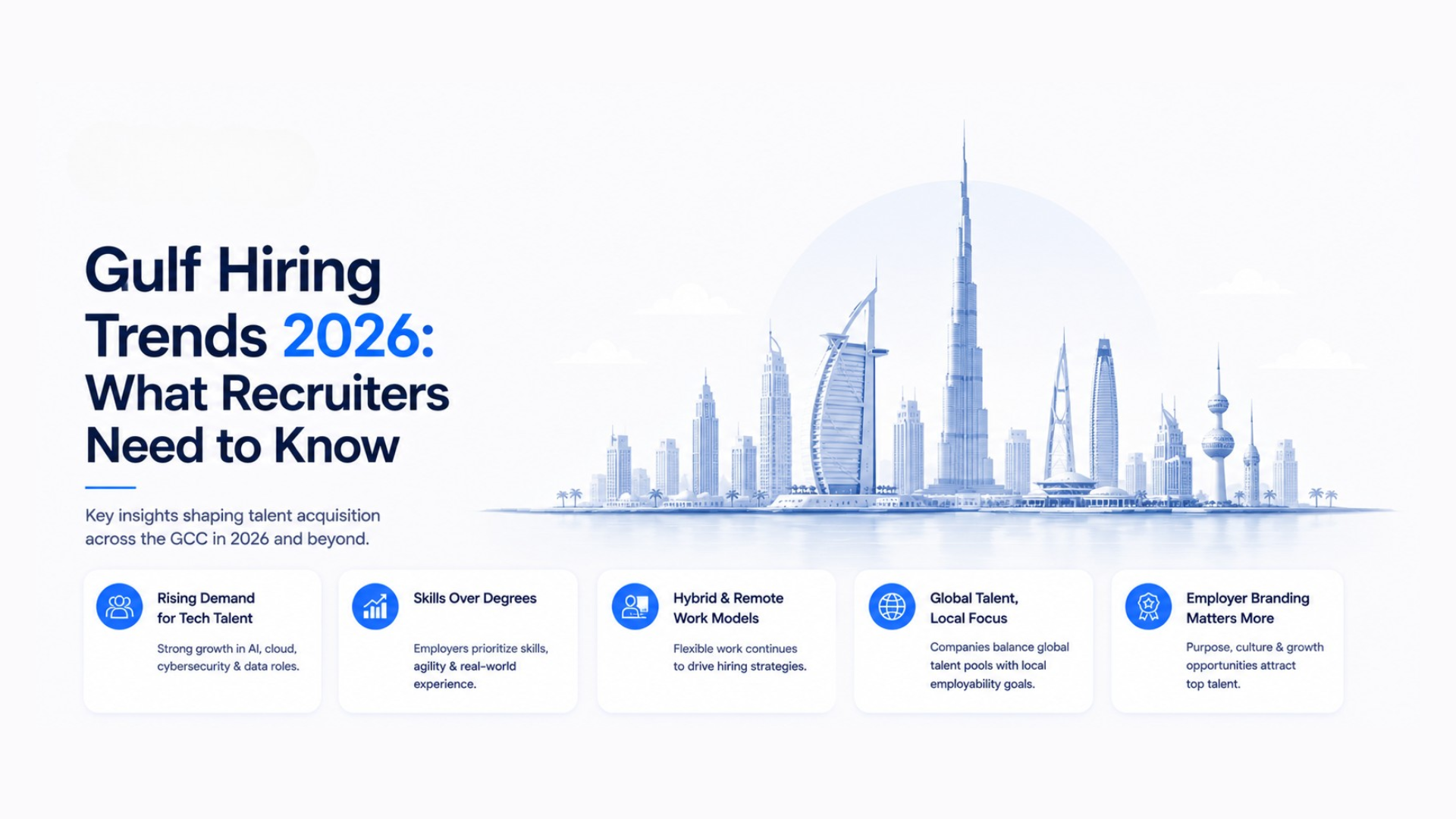
The Gulf region has always been a land of ambitious projects and rapid transformation, but the scale of hiring activity in 2026 is genuinely unprecedented. According to Gulf Talent's 2025-2026 Employment Report, the six GCC nations collectively need to hire an estimated 2.5 million skilled professionals over the next three years to fuel their economic diversification agendas. Saudi Arabia alone accounts for roughly half of that demand, driven by Vision 2030's giga-projects — NEOM, The Red Sea Project, Qiddiya, and Diriyah Gate — which are moving from planning and design phases into full-scale construction and operations, requiring tens of thousands of engineers, project managers, hospitality professionals, and technology specialists.
For recruiters — whether you're based in the Gulf, in India supplying talent to the region, or in Western markets sourcing for Gulf-based clients — understanding these trends isn't optional. It's the difference between building a thriving practice in one of the world's fastest-growing recruiting markets and watching from the sidelines as the opportunity passes. This guide breaks down the trends that matter, the roles that are hot, and the tools and strategies that will help you win in the Gulf in 2026.
The Macro Picture: Why 2026 Is a Pivotal Year for Gulf Hiring
Several structural forces are converging to make 2026 a breakout year for Gulf recruiting.
First, economic diversification is no longer a slogan — it's an operational reality. Saudi Arabia's non-oil GDP has been growing at 5-6% annually, according to the International Monetary Fund's GCC economic outlook, and the UAE's non-oil sector now accounts for over 70% of GDP. This diversification creates demand for talent in sectors that barely existed in the Gulf a decade ago: renewable energy, artificial intelligence, fintech, advanced manufacturing, entertainment, and digital healthcare. The hiring profiles for these industries are fundamentally different from the construction and oil-and-gas roles that historically dominated Gulf recruitment.
Second, nationalization policies are intensifying. Saudi Arabia's Saudization (Nitaqat) program, the UAE's Emiratisation initiative, Qatar's Qatarization policies, and similar programs in Oman and Bahrain are creating quotas and incentives for hiring local nationals. For recruiters, this means understanding how to source and qualify Gulf nationals for private-sector roles — a skill set that requires different sourcing strategies and candidate assessment approaches than recruiting expatriate talent.
Third, the region is becoming a global talent magnet, not just a regional labor market. The UAE's golden visa program and Saudi Arabia's premium residency programs are attracting senior professionals and entrepreneurs from Europe, North America, and Asia who previously wouldn't have considered Gulf opportunities. LinkedIn's Middle East workforce data shows record talent inflows into the UAE, with a 45% increase in international professionals relocating to the Emirates in 2024 compared to pre-pandemic levels.
Trend 1: India-to-GCC Hiring Pipeline Is Scaling Massively
The single most significant trend in Gulf recruiting is the massive and growing pipeline of talent flowing from India to the GCC. India has always been the largest source of expatriate labor for the Gulf, but the nature of that pipeline is changing dramatically. Historically dominated by construction labor, domestic workers, and entry-level roles, the India-to-GCC pipeline now increasingly carries skilled professionals — software engineers, healthcare workers, financial analysts, HR professionals, and hospitality managers.
According to the Ministry of External Affairs, Government of India, approximately 9 million Indians live and work in the GCC, and the number of skilled professionals among them is growing rapidly. Saudi Arabia and the UAE are the primary destinations, but Qatar — leveraging its post-World Cup infrastructure — and Oman are emerging as significant employers of Indian professional talent.
For Indian staffing agencies, this represents an enormous opportunity. Agencies that specialize in placing Indian professionals in Gulf roles — particularly for positions like work from home jobs at GCC-based companies, online jobs that support regional operations, and technology roles at the GCC's rapidly expanding digital ecosystem — are seeing placement volumes grow 30-50% year over year. The key to capturing this growth is having the right sourcing and outreach capabilities. Platforms like Huntlo, with their 50+ source integrations and multi-channel outreach, are particularly valuable for India-to-GCC recruiting because they allow Indian recruiters to source from both Indian platforms (Naukri, Indeed India) and international networks (LinkedIn) simultaneously, and then reach candidates through WhatsApp — the communication channel that Indian candidates and Gulf-based hiring managers both prefer.
The NASSCOM-Bain & Company report on GCC technology hiring highlights that GCC-based technology companies plan to increase their Indian workforce by 25-35% over the next two years, driven by the expansion of Global Capability Centers (GCCs — in this case, the acronym refers to Global Capability Centers, not Gulf Cooperation Council, though the overlap is telling). Many of these hires will be recruited from India and relocated to the Gulf, creating sustained demand for Indian staffing agencies that can manage cross-border recruitment at scale.
Trend 2: Remote and Hybrid Work Visas Are Creating New Hiring Models
The Gulf was once defined by its requirement that employees be physically present. That's changing rapidly. The UAE's remote work visa, Saudi Arabia's digital nomad initiatives, and similar programs in Qatar and Bahrain are allowing companies based in the Gulf to hire talent that lives outside the region.
This policy shift has profound implications for recruiters. First, it dramatically expands the candidate pool for Gulf-based roles. A Dubai-based fintech company can now hire a senior data scientist who lives in Bangalore, Istanbul, or Warsaw — and that candidate can work from their home country while being employed under UAE labor law. Second, it creates an entirely new category of roles: positions that are "based in the Gulf" for tax and regulatory purposes but are performed remotely by professionals in other countries.
For staffing agencies serving Gulf clients, remote work visas mean that the old model of physically relocating candidates — managing visas, housing, family logistics — is no longer the only path. You can now place candidates who stay in their home country but are legally employed by the Gulf entity. This reduces friction, accelerates time-to-hire, and opens the candidate pool to professionals who want Gulf salaries and career opportunities but aren't willing to relocate.
The challenge is sourcing for these hybrid arrangements. Candidates interested in remote Gulf employment aren't always actively searching traditional job boards. They may be passively browsing professional networks, responding to peer referrals, or engaging with content about remote work opportunities. AI sourcing tools that can identify passive candidates across multiple platforms and engage them through personalized multi-channel outreach are essential for this market. Huntlo's conversational AI screening is particularly useful here because it can qualify candidates on their willingness to work under Gulf employment terms, their time zone availability, and their equipment and connectivity situation — all critical factors for remote Gulf placements.
Trend 3: AI-Driven Recruitment Is Being Adopted Faster in the Gulf Than in Western Markets
Paradoxically, while the Gulf was historically a late adopter of recruiting technology, it is now adopting AI recruiting tools faster than many Western markets. According to Michael Page's Middle East Talent Trends 2025, 62% of Gulf-based employers plan to increase their investment in AI recruitment tools in 2026 — a higher percentage than in the US (48%) or UK (44%).
Several factors drive this accelerated adoption. Gulf organizations tend to be more centralized in their decision-making, so once leadership decides to adopt AI recruiting, implementation happens faster than in organizations with distributed decision-making. The scale of hiring in the Gulf — organizations hiring hundreds or thousands of professionals simultaneously for giga-projects and new city developments — makes the productivity gains from AI tools more immediately valuable. And the Gulf's relatively young workforce is more comfortable with AI-mediated communication than older, more established recruiting markets.
For recruiters operating in the Gulf, this rapid AI adoption means that clients increasingly expect AI-augmented recruiting. Staffing agencies that pitch manual sourcing processes to Gulf clients are losing ground to competitors who demonstrate AI-powered candidate discovery, automated multi-channel outreach, and data-driven pipeline management. Hays' GCC Recruitment Report notes that Gulf clients now evaluate staffing agencies partly on their technology capabilities, not just their recruiter expertise.
This is where tools like Huntlo deliver outsized value for Gulf-focused recruiters. The platform's ability to source from 50+ platforms, reach candidates across email, LinkedIn, WhatsApp, and AI voice, and screen candidates through conversational AI addresses the specific needs of the Gulf market: high-volume sourcing, multi-channel engagement (WhatsApp is essential), and scalable screening for the large candidate pools that giga-project hiring demands.
Trend 4: In-Demand Roles and Skills in the Gulf for 2026
Understanding which roles are hottest in the Gulf helps recruiters focus their sourcing efforts and build talent pools that deliver placements quickly.
Technology and Digital
The Gulf's digital transformation is the single biggest driver of professional hiring. Saudi Arabia's goal of creating 50,000 new tech jobs by 2030 and the UAE's ambition to become a global AI hub are creating intense demand for:
Software engineers and full-stack developers, particularly those experienced in cloud-native architectures, microservices, and AI/ML integration. The demand is so strong that Gulf News reported tech salary inflation of 15-25% annually for senior developers in the UAE and Saudi Arabia.
Data scientists and AI/ML engineers, as both governments and private companies invest heavily in AI capabilities. Saudi Arabia's SDAIA (Saudi Data and AI Authority) is a major employer, but private sector demand is growing even faster.
Cybersecurity professionals, driven by the Gulf's rapid digitalization and its position as a target-rich environment for cyber threats. The Middle East Information Security Summit has highlighted a regional cybersecurity talent gap of over 30,000 professionals.
DevOps and cloud infrastructure engineers, as organizations migrate on-premise systems to AWS, Azure, and Google Cloud, and as the UAE and Saudi Arabia develop their own sovereign cloud platforms.
For these roles, sourcing from India's massive technology talent pool is the primary strategy for most Gulf recruiters. Indian tech professionals are culturally compatible, English-proficient, and experienced in the technologies that Gulf organizations need. The challenge is identifying the right candidates among millions of profiles and reaching them before competitors do.
Healthcare
Gulf healthcare systems are expanding rapidly, with massive investments in new hospitals, medical cities, and healthcare technology. Saudi Arabia's Health Sector Transformation Program aims to privatize 60% of the country's healthcare services, creating demand for healthcare administrators, medical professionals, and health IT specialists.
Nurses represent the single largest hiring category. The Gulf employs over 250,000 expatriate nurses, primarily from India, the Philippines, and other South and Southeast Asian countries, and demand continues to grow as new facilities open. For staffing agencies, nurse recruitment is high-volume, relationship-intensive, and perfectly suited to AI-powered sourcing and WhatsApp-based candidate engagement.
Construction, Engineering, and Infrastructure
Despite the shift toward a knowledge economy, construction and infrastructure remain massive employers. Saudi Arabia's giga-projects alone require over 100,000 construction professionals, and the UAE's ongoing infrastructure development — from the Etihad Rail network to Abu Dhabi's urban expansion plans — sustains demand for civil engineers, project managers, quantity surveyors, and construction managers.
Finance and Fintech
The UAE's position as a global financial hub and Saudi Arabia's Financial Sector Development Program are creating demand for finance professionals, particularly those with fintech experience, Islamic banking expertise, and regulatory compliance knowledge. Dubai International Financial Centre (DIFC) and Abu Dhabi Global Market (ADGM) are actively recruiting financial technology talent from around the world.
Trend 5: WhatsApp Is the Dominant Recruiting Channel in the Gulf
If there's one thing every recruiter targeting the Gulf market must understand, it's this: WhatsApp is not optional. It is the primary communication channel for professional recruiting in the region.
Meta's regional data shows that WhatsApp penetration in the GCC exceeds 95% among working-age adults. For many candidate segments — particularly blue-collar workers, healthcare professionals, and mid-level technical staff — WhatsApp is the first and often only channel through which they engage with recruiters. Email open rates in the Gulf are significantly lower than in Western markets, and LinkedIn messaging, while growing, hasn't displaced WhatsApp for initial recruiter-candidate conversations.
For AI sourcing tools, this channel preference has direct implications. A platform that only automates email and LinkedIn outreach — like several well-known US-centric tools — will underperform in the Gulf because it's missing the channel where candidates are actually reachable. Huntlo's inclusion of WhatsApp outreach as a standard feature is a significant advantage for Gulf recruiters, allowing them to integrate WhatsApp into automated multi-channel sequences alongside email and LinkedIn.
The practical workflow for Gulf recruiting looks like this: source candidates across multiple platforms, initiate contact via the channel where the candidate is most reachable (often WhatsApp for Indian and Southeast Asian candidates, LinkedIn for Western professionals, email for GCC nationals), conduct initial screening through conversational AI, and then hand the qualified candidate to a human recruiter for relationship building and placement management. This multi-channel, AI-augmented workflow is exactly what Huntlo's platform is designed to support, and it matches the communication preferences of the Gulf market.
Trend 6: Compliance, Localization, and the Regulatory Landscape
Recruiting for the Gulf requires navigating a complex and evolving regulatory landscape that differs significantly from Western markets.
Nationalization Quotas
Every GCC country has some form of nationalization policy that requires or incentivizes private-sector employers to hire local nationals. Saudi Arabia's Nitaqat system assigns companies a color-coded compliance rating (Platinum, Green, Yellow, Red) based on their Saudi workforce percentage, with non-compliant companies facing restrictions on their ability to hire expatriate workers. The UAE's Emiratisation program has been strengthened with increased quotas for Emirati employment in the private sector, including mandatory targets for specific company sizes.
For recruiters, nationalization means building sourcing capabilities specifically for Gulf national candidates. These candidates often have different career expectations, compensation requirements, and decision-making processes than expatriate candidates. Sourcing them requires familiarity with local universities, government training programs, and professional networks that are distinct from the international platforms many AI tools prioritize.
Visa and Mobility Regulations
Gulf work visa processes remain complex, with variations between countries, free zones, and mainland jurisdictions. The UAE's free zone system alone has over 40 free zones, each with its own visa sponsorship rules, immigration processes, and labor law interpretations. Saudi Arabia has been reforming its labor mobility regulations as part of Vision 2030, making it easier for workers to change employers and reducing the power of the kafala (sponsorship) system, but the rules remain more restrictive than in most Western labor markets.
Recruiters who understand these regulatory nuances — and can advise candidates on visa processes, document requirements, and timeline expectations — provide significantly more value than those who treat Gulf placement as a simple sourcing exercise. AI tools handle the sourcing and initial engagement, but regulatory guidance and process management remain fundamentally human capabilities.
Data Protection
The UAE's Personal Data Protection Law and Saudi Arabia's Personal Data Protection Law are establishing data protection frameworks that affect how recruiting technology handles candidate information. Gulf-based recruiters need to ensure their AI sourcing tools comply with these regulations, particularly regarding cross-border data transfers and candidate consent.
Sourcing Strategies That Work in the Gulf Market
Based on the trends above, here are the sourcing strategies that are delivering results for Gulf-focused recruiters in 2026.
Build India-Specific Talent Pipelines
India remains the primary source of professional talent for the Gulf. Rather than sourcing from scratch for every role, successful Gulf recruiters build and maintain talent pipelines organized by skill set, experience level, and Gulf-readiness (candidates who have previously worked in the Gulf, candidates with family in the Gulf, and candidates actively seeking Gulf opportunities). Huntlo's talent pool management system is designed for exactly this use case — every sourced candidate is automatically captured, tagged, and made searchable for future roles. For a Gulf-focused agency, this means the second time you fill a similar role, your AI has a pre-qualified candidate pool to draw from, dramatically reducing time-to-fill.
Leverage Multi-Channel Outreach with WhatsApp at the Center
Design your outreach sequences with WhatsApp as the primary channel for Indian and Southeast Asian candidates and LinkedIn as the primary channel for Western professionals. Email serves as a supporting channel for both segments. Huntlo's multi-channel capability allows you to run parallel sequences across all three channels, with the AI automatically routing follow-ups to the channel where each candidate is most engaged.
Specialize by Industry Vertical
The Gulf market rewards specialization. Agencies that develop deep expertise in a specific industry — healthcare staffing, technology recruiting, construction labor supply, or hospitality hiring — build relationships, reputation, and candidate networks that generalists can't replicate. Choose one or two verticals, invest in understanding the specific requirements of that industry in the Gulf context, and build your sourcing and screening criteria accordingly.
Use AI Voice for High-Volume Roles
For roles like nursing recruitment, customer service hiring, and entry-level professional positions where large candidate pools need initial qualification, Huntlo's AI voice capability allows automated phone-based screening that reaches candidates who may not respond to text-based outreach. In markets where phone communication remains culturally important — and the Gulf is one such market — AI voice screening can significantly increase your qualified candidate pipeline.
Monitor Nationalization and Local Hiring Trends
As nationalization quotas tighten, the demand for sourcing Gulf national candidates will grow. Build relationships with local universities, government training programs, and professional associations in each GCC country. Supplement these relationships with AI sourcing that can identify Gulf nationals on professional networks and job boards.
The Role of AI Tools in Gulf Recruiting — Now and Next
AI recruiting tools are not a future consideration for Gulf-focused recruiters — they are a present-day competitive necessity. The agencies and TA teams that are winning the most Gulf placements in 2026 are those that have integrated AI into every stage of the recruiting workflow.
Huntlo's flat-rate pricing at approximately $99/seat/month (roughly ₹8,300 for Indian agencies and AED 363 for UAE-based agencies) provides Gulf-focused recruiters with enterprise-grade AI capabilities at a cost point that makes sense for the region's economics. When you consider that many Gulf-based staffing agencies operate on margins of 10-18%, and that AI tools can increase recruiter productivity by 30-50%, the ROI case is straightforward.
The multi-channel outreach is the standout capability for Gulf recruiting. No other tool at this price point combines email, LinkedIn, WhatsApp, and AI voice in a single platform with unified campaign management. For a market where WhatsApp dominates candidate communication and phone-based relationship building is culturally central, this multi-channel approach isn't a nice-to-have — it's the difference between reaching candidates and missing them.
As the Gulf's hiring volumes continue to scale through 2026 and beyond, the recruiters who thrive will be those who combine deep market knowledge with AI-powered operational efficiency. The opportunity is enormous, the talent demand is real, and the tools to capture it are available. The only question is whether you'll be the recruiter who adapts or the one who watches from the sidelines.
Related Topics
How GCCs Can Automate Hiring Workflows in 2026
How AI Sourcing Tools Are Reshaping Recruitment Agency Business Models
The Next Generation of AI Recruiting: What's Coming After Sourcing Automation