The same AI sourcing tool, configured the same way, can perform very differently depending on which market it's pointed at — and the reasons go well beyond language or time zone. UK and India represent two of the most active recruiting markets in the world, but they differ sharply on regulatory posture, dominant sourcing channels, candidate communication habits, and even how confident hiring leaders feel about AI itself. A recent YouGov survey conducted on behalf of HireRight found that globally, HR decision-makers expect AI to drive net workforce growth of 13% by the end of 2026, while UK HR leaders remain notably more cautious, less confident, and significantly less positive than their international counterparts, according to theHRDIRECTOR's coverage of the survey — a divide the same survey found holds specifically against faster-moving markets including India.
This guide walks through where UK and India recruiting genuinely diverge in 2026, and what those differences mean in practice for choosing, configuring, and deploying an AI sourcing tool correctly in each market rather than assuming a single global setup works everywhere.
The Regulatory Frameworks Are Structurally Different, Not Just Differently Worded
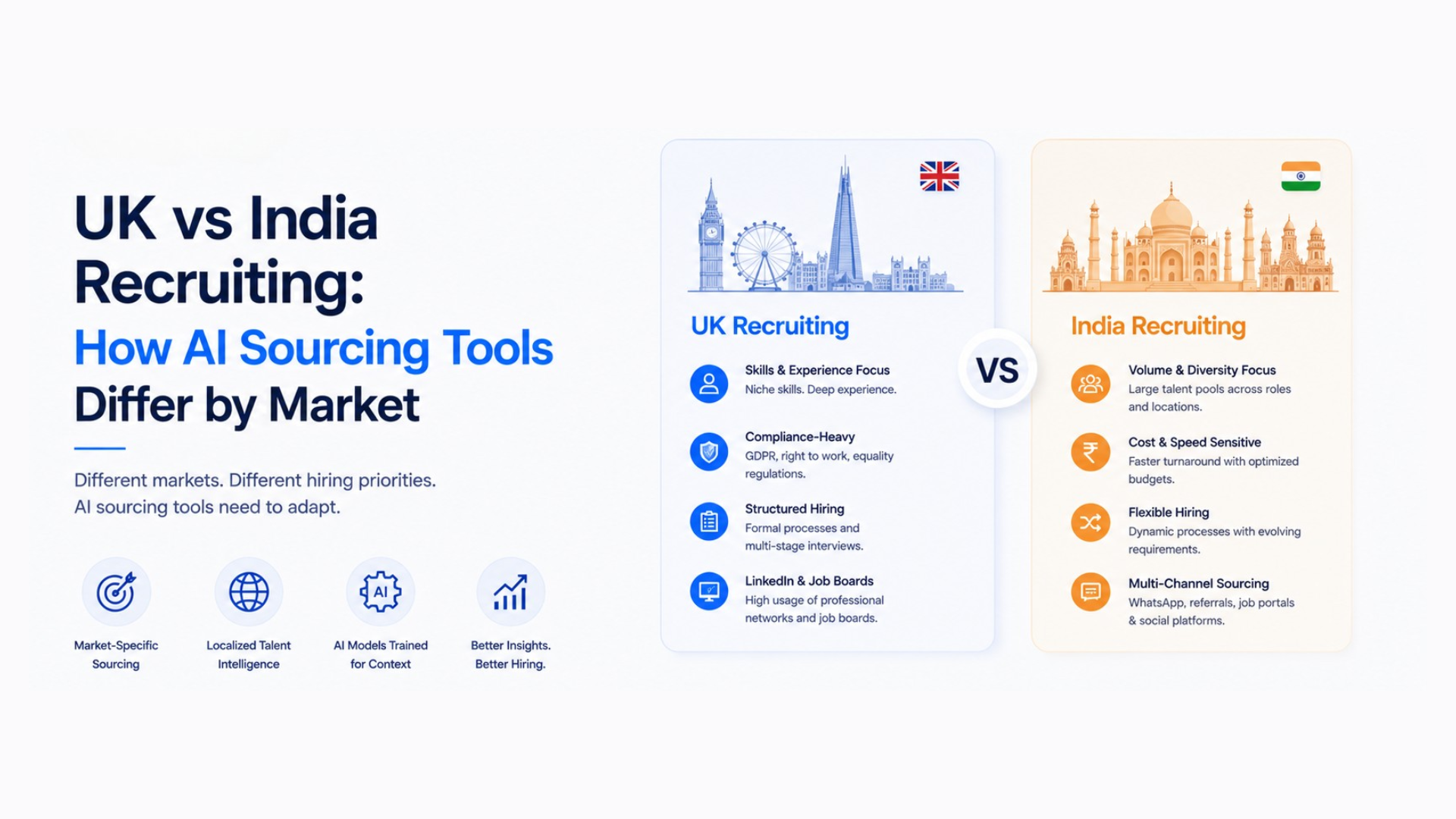
The most consequential difference between the two markets sits in how each regulates AI-assisted hiring decisions, and the frameworks are genuinely different in structure, not just in specific thresholds.
The UK operates under a hybrid regime following the Data (Use and Access) Act 2025, which replaced the old Article 22 of UK GDPR with new Articles 22A through 22D. According to Ropes & Gray's analysis of AI in recruitment across the EU and UK, this is described as a "lighter-touch" automated decision-making regime compared to the EU's approach, but it still requires that a controller taking a "significant decision" based solely on automated processing have a valid legal basis, and imposes additional restrictions when special category data is involved. Critically, the UK's Information Commissioner's Office has signaled that automated decision-making in recruitment specifically is a priority enforcement area, with a consultation on draft guidance that closed in May 2026 — meaning UK enforcement attention on this exact issue is actively sharpening, not settling into a stable status quo.
India's DPDP Act takes a structurally different approach. Rather than the UK and EU's detailed, decision-threshold-based ADM frameworks, the DPDP Act's Section 8 requirements around automated decision-making are comparatively general — requiring technical documentation, meaningful transparency to candidates, and genuine human oversight, but without the UK and EU's granular distinctions between decision types and special category data triggers. The DPDP Act also diverges sharply on breach notification: it requires reporting for all breaches regardless of severity within 72 hours, a stricter blanket standard than the proportionality-based approach common in UK and EU practice.
The practical implication for AI sourcing tools is that a platform built to satisfy UK ADM requirements — with careful human-in-the-loop gating specifically for decisions with "significant effect" — is solving a different compliance problem than a platform built for DPDP compliance, which cares more about breach notification speed and consent documentation than the UK's decision-threshold analysis. Treating "GDPR-compliant" and "DPDP-compliant" as interchangeable claims is a mistake worth avoiding directly when evaluating a vendor for both markets.
Data Hosting and Cross-Border Transfer Rules Point in Different Directions
Where candidate data can legally be hosted and processed also differs meaningfully between the two markets. For the UK, the EU-UK adequacy decision — renewed in December 2025 and valid through 2031 — means EU-hosted platforms remain a stable, compliant default, according to Spott's 2026 guide to AI recruiting software for UK agencies. US-hosted platforms, by contrast, require additional transfer safeguards and face more procurement scrutiny from UK clients, particularly larger enterprise clients running their own vendor security reviews.
India's approach under the DPDP Act is structurally different again — rather than the UK and EU's adequacy-based model requiring a receiving country to meet defined data protection standards, the DPDP Act uses what's often described as a "blacklist" model: transfers are permitted by default except to specific territories the government designates as restricted. This is more permissive on its face than the UK's adequacy framework, but the practical guidance from Indian compliance analysts is to treat it conservatively anyway, since the specific restricted-territory list is still being finalized and is expected to tighten over time rather than loosen.
Dominant Sourcing Channels Don't Overlap as Much as They Might Seem To
LinkedIn functions as the dominant professional network in both markets, but the surrounding sourcing ecosystem looks quite different. In the UK, Spott's agency-focused guide notes the UK has more recruitment agencies per capita than any other major market, with platforms like JobAdder built around the SEEK job-board ecosystem for board-driven sourcing, and specialist retained-search platforms like Ezekia serving firms that do executive search specifically and nothing else. The UK recruiting software market is also, by Spott's characterization, the most competitive in the world right now, with London-based startups, established Australian platforms, and US-built tools all competing directly for the same client base.
India's sourcing ecosystem centers on a different set of platforms entirely. Naukri remains the dominant inbound channel for Indian hiring generally, holding a candidate database well beyond what any single UK job board commands, alongside platforms like Apna and Internshala that serve segments the UK market doesn't have close equivalents for — Apna in particular serving a blue-collar and early-career segment at a scale the UK labor market structure doesn't produce in the same way.
Outreach Channel Norms Diverge Sharply, and This Is Where Most Global Tools Get It Wrong
This is arguably the single most consequential practical difference for how an AI sourcing tool should actually be configured for each market. UK recruiting outreach remains built primarily around email and LinkedIn InMail, with phone calls reserved for later-stage engagement once initial interest is established — a fairly conservative, professionally formal set of channel norms consistent with broader UK business communication culture.
India's outreach norms are meaningfully different. WhatsApp functions as a primary communication channel for Indian professionals across a wide range of seniority levels, not a secondary or informal one — meaning an outreach strategy built entirely around email-first sequencing, however well it performs in a UK context, tends to underperform in India simply because it isn't meeting candidates in the channel they actually check first. Regional language considerations compound this further: outreach and screening conducted in Hindi, Tamil, Telugu, or other regional languages measurably improves candidate response rates for roles that don't require English fluency, a consideration that has no direct UK equivalent given the UK's comparatively homogeneous primary business language.
The practical risk here is real: a global AI sourcing tool built and tuned primarily around UK, US, or broader Western outreach norms will often default to email-first sequencing everywhere, quietly underperforming in the Indian market not because the underlying AI is weaker, but because the channel assumptions baked into the product don't reflect how Indian candidates actually communicate.
Recruiting Market Structure and Talent Pool Dynamics
Beyond channels and compliance, the underlying shape of each labor market differs in ways that affect sourcing strategy directly. The UK's population and talent pool are considerably smaller and more mature than India's, with a comparatively aging workforce and specific regulatory considerations around contractor classification — IR35-adjacent rules that materially affect how UK companies structure and source contract talent, a consideration with no direct equivalent in Indian hiring, which has its own separate contract-labor framework entirely under India's Contract Labour Act.
India's talent pool dynamics run in the opposite direction on scale: the country produces roughly 1.5 million engineering graduates annually, and the ongoing geographic decentralization of hiring into Tier 2 and Tier 3 cities is actively expanding the addressable talent pool for companies willing to source there, a growth dynamic the UK market, with its comparatively fixed and slower-growing working-age population, simply doesn't have available to the same degree.
Pricing Expectations Reflect Genuinely Different Cost Structures
Software pricing in each market reflects underlying cost-of-living and market-size differences that are worth being explicit about rather than assuming a single global price point translates cleanly. Spott's UK guide puts credible AI recruiting software pricing in the range of roughly £65 to £200-plus per user per month for UK agencies in 2026. Indian pricing across comparable AI recruiting platforms runs considerably lower in absolute terms — commonly ₹4,000 to ₹50,000 per month depending on platform tier and company size, reflecting both lower average software budgets and the fact that many India-focused platforms price specifically for INR-denominated budgets rather than converting a USD or GBP price point directly.
What This Means for Choosing and Configuring an AI Sourcing Tool in Each Market
Pulling the differences together, a few concrete considerations should shape how a company evaluates or configures an AI sourcing tool differently depending on which market it's deploying into:
For UK deployments: prioritize a vendor with a clear, demonstrable answer on where the human-in-the-loop sits for any AI-assisted ranking or rejection decision, given the ICO's active enforcement focus on this exact question. Confirm data hosting sits within the EU-UK adequacy framework or an equivalent safeguard, rather than assuming a US-hosted platform's general "GDPR-compliant" marketing claim covers the specific UK ADM requirements introduced by the Data (Use and Access) Act 2025.
For India deployments: prioritize multi-channel outreach that treats WhatsApp as a primary channel rather than an optional add-on, evaluate regional language support directly for the specific cities and roles being sourced, and confirm the vendor's approach to breach notification meets the DPDP Act's stricter, no-severity-threshold 72-hour standard rather than a more lenient proportionality-based assumption carried over from GDPR practice.
For companies operating in both markets simultaneously: resist the temptation to assume one compliance posture or one outreach configuration serves both. The two markets' regulatory frameworks, dominant channels, and candidate communication norms are different enough that a single default configuration will almost certainly underperform in at least one of them — this is a genuine configuration problem worth solving deliberately, not an edge case.
Where a Tool Like Huntlo Fits Across Both Markets
The core capability that matters in both markets — natural-language sourcing that finds candidates beyond a single platform's index — doesn't change fundamentally between the UK and India. What should change is how outreach gets configured once candidates are found. Huntlo's multi-channel outreach across email, WhatsApp, and AI voice is built to be genuinely useful in exactly this kind of cross-market context, precisely because it doesn't force every market into an email-first default: a UK-focused recruiting team can lean on email and more formal outreach sequencing consistent with UK candidate expectations, while a team sourcing in India can lean into WhatsApp as the primary channel, addressing the specific gap most email-first global tools carry into the Indian market without adjustment.
It's worth being direct about what this doesn't solve on its own: neither Huntlo nor any AI sourcing tool resolves the underlying compliance posture a company needs for either market — UK ADM human-oversight requirements or DPDP breach-notification and consent documentation remain the hiring company's responsibility as the data controller or fiduciary in each jurisdiction, regardless of which sourcing tool sits underneath. What a well-configured multi-channel sourcing and outreach layer does provide is the flexibility to actually meet candidates in each market on the terms that market's candidates expect, rather than defaulting to whichever channel setup happens to work best for wherever the tool was originally built.
Frequently Asked Questions
Is a single AI sourcing tool ever a good fit for both UK and India recruiting simultaneously? Yes, provided it supports genuine multi-channel outreach and doesn't hard-code a single regional default. The bigger risk isn't the underlying AI matching capability — it's a tool that quietly defaults to UK/Western channel and compliance assumptions across every market it's deployed into without adjustment.
Which market has stricter AI hiring regulation right now, the UK or India? They're stricter in different, specific ways rather than one being uniformly stricter. The UK's ADM framework under the Data (Use and Access) Act 2025 is more granular about decision types and human oversight, with active ICO enforcement attention, while India's DPDP Act is comparatively more general on automated decision-making but notably stricter on breach notification, requiring reporting for all breaches regardless of severity.
Does WhatsApp outreach make sense for UK recruiting the way it does in India? Generally not to the same degree. UK candidate communication norms remain built more around email and LinkedIn, and WhatsApp outreach that would read as natural and expected in India could read as unusually informal or even intrusive for a UK professional audience, depending on the role and seniority level.
Should compensation and pricing benchmarks from one market be used to evaluate the other? No — software pricing, salary benchmarks, and cost-per-hire figures don't translate directly between the two markets given the different cost-of-living baselines and currency contexts, and using one market's figures to evaluate the other risks a badly miscalibrated budget or vendor comparison.
The Bottom Line
UK and India recruiting aren't variations on the same playbook with different job boards swapped in — they run on different regulatory logic, different dominant channels, different candidate communication norms, and different underlying talent market dynamics. An AI sourcing tool that performs well in one market can genuinely underperform in the other if it's deployed with the same default configuration rather than adjusted for the market it's actually operating in.
If your team is sourcing across both markets and channel configuration — not underlying AI matching quality — is the current gap, Huntlo's agentic AI sourcing and outreach platform supports the multi-channel flexibility both markets require, worth testing directly against an open role in each market with the free trial.