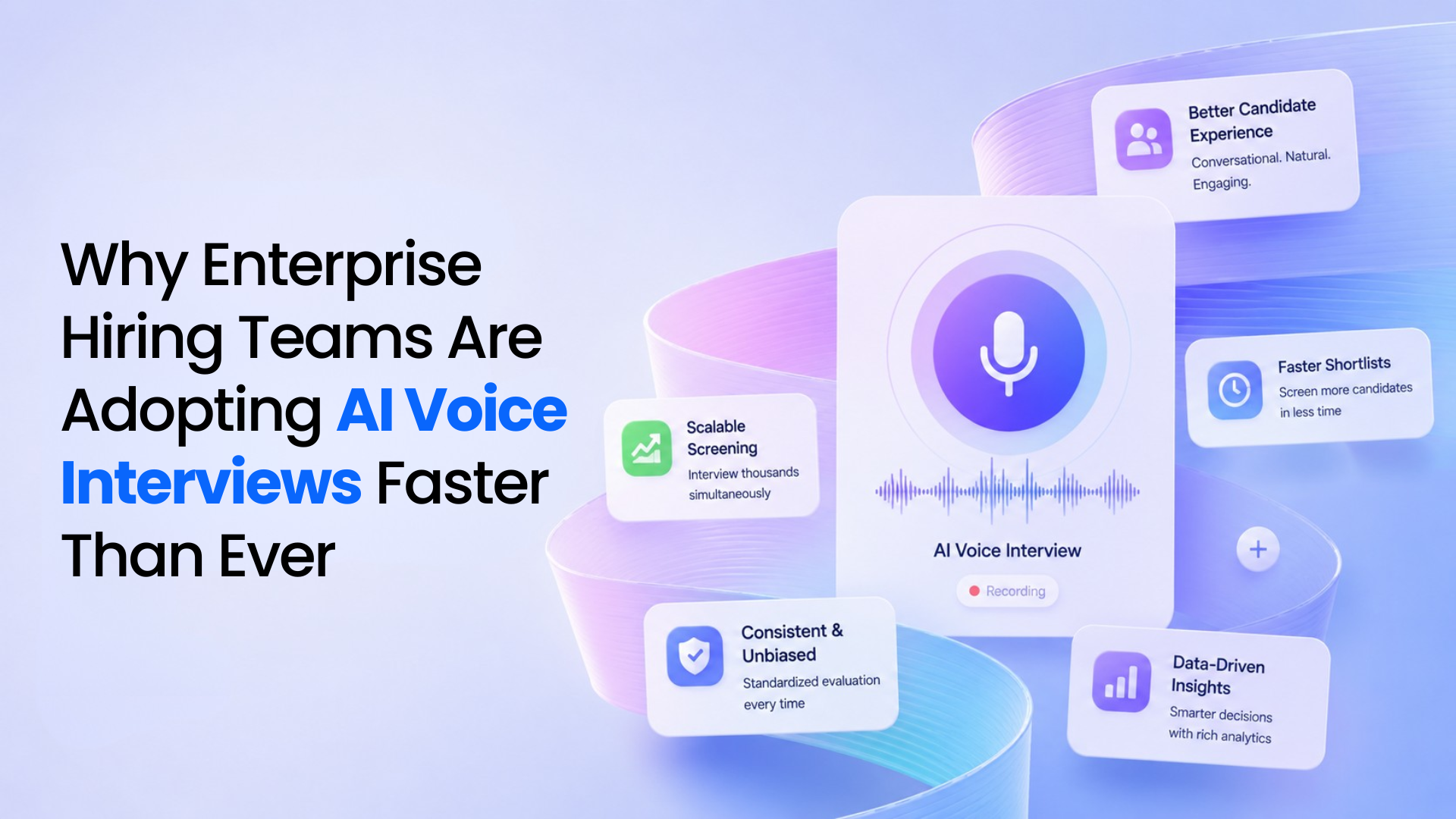
Three years ago, AI voice interviews were a niche experiment in a handful of forward-thinking companies. Today, they are becoming standard operating procedure in enterprise talent acquisition. The shift is not happening because of technology hype or vendor marketing. It is happening because enterprise hiring teams — organizations with 500 or more employees, multi-geography operations, and complex regulatory obligations — face a set of structural pressures that make traditional phone screening increasingly untenable. Those pressures have been building for years. What has changed is that AI voice interview technology has matured to the point where it can address them reliably, and the enterprise buyers who spent 2023 and 2024 evaluating these tools are now deploying them at scale.
Pressure One: Regulatory Compliance Is No Longer Optional
The single biggest accelerant of enterprise AI voice interview adoption is regulation. In the past two years, the regulatory landscape governing hiring technology has shifted from ambiguous guidance to enforceable requirements. The EU AI Act classifies AI-powered employment decision-making as a high-risk application with specific transparency, documentation, and bias-auditing obligations. New York City’s Local Law 144 requires bias audits for automated employment decision tools. Illinois, Maryland, and several other US states have enacted or proposed legislation governing AI in hiring. The International Association of Privacy Professionals now tracks over 30 distinct regulatory frameworks globally that touch AI-assisted hiring, and the number is growing every quarter.
For enterprise talent acquisition teams, this regulatory environment creates both a challenge and an opportunity. The challenge is that manual phone screens cannot satisfy the documentation and auditability requirements these regulations demand. Recruiter notes are unstructured, inconsistent, and impossible to systematically audit for bias. The opportunity is that AI voice interviews produce exactly the kind of structured, standardized, auditable evaluation records that regulators are asking for. Every question, response, and score is documented with timestamps and evaluation criteria. Bias audits that would
require months of manual review with traditional phone screen data can be conducted in hours with AI-generated evaluation data. Enterprise legal and compliance teams — who historically viewed AI hiring tools with skepticism — are increasingly the ones advocating for adoption, because AI voice interviews create a stronger compliance position than the manual processes they replace.
Pressure Two: The Volume Problem Has Exceeded Human Capacity
Enterprise organizations are hiring more people, across more locations, than at any point in recent history. LinkedIn’s global hiring trends data shows that enterprise employers (5,000+ employees) increased their average monthly open requisitions by 40% between 2022 and 2025, while their average recruiting headcount grew by only 12%. The math is straightforward: more roles, proportionally fewer recruiters, and a screening bottleneck that gets worse every quarter. Enterprise TA leaders are not adopting AI voice interviews because they want to be innovative. They are adopting them because the alternative — continuing to rely on manual phone screens at a scale those screens were never designed to handle — is producing measurable quality degradation, longer time-to-fill, and weaker hiring outcomes.
The volume problem is compounded by the geographic complexity of modern enterprise hiring. When a single company is recruiting for roles in six countries and twelve time zones, phone screen scheduling becomes a coordination burden that can add days to every candidate’s timeline. AI voice interviews, which candidates complete asynchronously at any hour, eliminate this scheduling overhead entirely. Deloitte’s global workforce research has found that time zone coordination adds an average of 3.8 days to cross-border hiring timelines — and that enterprises operating in five or more countries report time-to-fill metrics that are 45–60% longer than domestic-only hiring for equivalent roles. AI voice interviews collapse that gap by making screening independent of geography.
Pressure Three: Data Unification Demands Structured Evaluation
Enterprise organizations have been investing heavily in people analytics, workforce planning, and talent intelligence for the past five years. These initiatives require structured, comparable data about candidate quality, evaluation outcomes, and hiring decisions across the organization. Manual phone screens produce none of this. Recruiter notes vary in format, depth, and quality depending on the individual recruiter. There is no common evaluation framework, no standardized scoring, and no way to aggregate screening data across business units, geographies, or time periods. The result is that enterprise workforce planning teams are making strategic decisions based on incomplete and inconsistent hiring data.
AI voice interviews solve this data problem by generating structured evaluation records for every candidate — competency-level scores, response highlights, disposition recommendations, and completion metrics. This data flows directly into workforce analytics systems, enabling the kind of cross-regional talent mapping, pipeline analysis, and
quality-of-hire measurement that enterprise CHROs and CFOs have been asking for. Mercer’s talent strategy research has documented that enterprises with structured hiring data — the kind AI voice interviews produce by design — make workforce planning decisions 35–45% faster than those relying on unstructured screening data, because the analytical foundation is actually reliable.
Why Adoption Is Accelerating Now
Enterprise technology adoption follows a predictable curve: early experiments, pilot programs, and then a tipping point where the accumulated evidence of ROI becomes impossible to ignore. AI voice interviews are past the tipping point for enterprise TA. The reasons are converging simultaneously. First, the technology itself has improved significantly. Early AI interview tools were limited to basic keyword matching and rigid question flows. Current platforms evaluate response content, communication structure, problem-solving approach, and behavioral evidence with a sophistication that approaches — and in some structured dimensions exceeds — the consistency of human evaluators. SIOP’s review of video and voice interviewing in selection has confirmed that modern structured AI interview methodologies produce predictive validity coefficients that are competitive with or superior to traditional human-led screening.
Second, enterprise buyers have completed their evaluation cycles. The 2023–2024 period saw a wave of enterprise pilots and proof-of-concept deployments. Those pilots have now produced 12 to 24 months of operational data, and the results are compelling enough to drive broader rollouts. Gartner’s HR technology adoption research reports that enterprise adoption of AI screening tools grew by 65% year-over-year in 2025, with the majority of new deployments coming from organizations that completed successful pilots in the previous 18 months. Third, the competitive pressure is real. When one enterprise in a competitive talent market adopts AI voice screening and reduces its time-to-shortlist by 40–60%, competing employers who continue relying on manual phone screens start losing candidates to faster-moving competitors. The adoption decision is no longer framed as “should we try this?” but “can we afford not to?”
The Implementation Pattern Enterprises Are Following
Enterprise adoption is not random. It follows a consistent implementation pattern that has emerged from dozens of successful deployments. The first phase is a controlled pilot with two to three business units, typically high-volume functions like customer service, IT support, or operations. The pilot runs for 60 to 90 days with parallel processing: every candidate is screened by both an AI voice interview and a traditional recruiter phone screen, and the results are compared. This parallel phase serves two purposes: it validates the AI’s evaluation quality against the existing human standard, and it builds internal confidence among recruiting leaders and hiring managers who may be skeptical about AI-assisted evaluation.
The second phase is broader rollout across additional business units, with AI voice
interviews as the primary screening method and recruiter phone screens reserved for candidates who score above the shortlist threshold or for senior and specialized roles where human judgment remains the primary evaluation tool. This hybrid approach — AI for volume and consistency, humans for judgment and relationship building — is becoming the default operating model for enterprise TA. It reflects a mature understanding of what distinguishes genuinely capable AI recruiting platforms from basic automation: the best platforms enhance human decision-making rather than attempting to replace it, providing structured evaluation data that makes every subsequent human conversation more productive.
The third phase is integration with the broader hiring technology stack. Enterprises that initially deployed AI voice interviews as a standalone screening tool are now demanding integration with their ATS, their sourcing platforms, and their analytics systems. This is where many early deployments stall — the AI screening tool produces excellent evaluations, but moving candidate data between the screening tool and the ATS requires manual export and import, which erodes the time savings the AI was supposed to deliver. The enterprises getting the fastest ROI are the ones that chose integrated platforms from the start, or that are now migrating to integrated platforms as their pilots prove the value of AI screening and the limitations of fragmented tool stacks.
The Cultural Shift: From Resistance to Expectation
One of the most significant developments in enterprise AI voice interview adoption is the cultural shift among recruiting teams. Two years ago, the primary barrier to adoption was recruiter resistance — the concern that AI would reduce the recruiter’s role, make them less valuable, or eventually replace them entirely. That resistance has not disappeared, but it has evolved. As more recruiters have experienced AI voice screening in practice, the conversation has shifted from “will AI replace me?” to “how does AI make me more effective?” The reason is practical: recruiters who work with AI-generated scorecards consistently report that their human phone screens and hiring manager conversations are more productive, because they enter those conversations with structured evaluation data that tells them exactly what to focus on. As explored in Should Recruiters Worry About AI Replacing Their Jobs?, the recruiters who thrive alongside AI are the ones who leverage it as an intelligence tool — using AI-generated insights to inform better human conversations rather than treating AI as either a threat or a crutch.
Candidate acceptance has followed a similar trajectory. Early concerns that candidates would resist talking to an AI have largely not materialized. Candidates care about speed, responsiveness, and perceived fairness — and AI voice interviews deliver on all three. They can complete the interview at a convenient time, they receive faster feedback on their status, and they are evaluated against the same criteria as every other applicant. The Talent Board’s candidate experience benchmarking shows that candidate satisfaction scores for AI-screened enterprise hiring processes are now comparable to traditional processes, with particularly high marks for speed and convenience. The cultural norm is shifting: candidates increasingly expect the hiring process to be fast and technology-enabled, and enterprises that rely on slow, manual phone screens are starting to look outdated.
Why Enterprise Buyers Are Choosing Integrated Platforms
Enterprise TA leaders have learned a costly lesson from the last decade of recruiting technology investment: standalone tools that require manual integration create more problems than they solve. The legacy approach of buying a best-of-breed sourcing tool, a separate ATS, a standalone screening platform, and an independent interview scheduling system has left enterprise TA teams managing fragmented data, manual handoffs, and administrative overhead that consumes the time the tools were supposed to save. This is the same mistake organizations have made repeatedly with ATS investments, as explored in The ATS Mistake Companies Keep Repeating — pouring resources into a single system without addressing the broader workflow fragmentation that undermines hiring outcomes.
The enterprise buyers who are adopting AI voice interviews fastest are the ones choosing integrated platforms that combine sourcing, outreach, screening, and coordination into a single system. Huntlo delivers exactly this: AI-powered sourcing across 50+ platforms, multi-channel outreach through email, LinkedIn, and WhatsApp, AI voice interviews with structured scorecards, and automated interview scheduling — all within a unified platform with shared candidate data and no manual handoffs between stages. For an enterprise hiring team managing hundreds of requisitions across multiple business units and geographies, this integration is not a nice-to-have. It is the difference between AI voice interviews that actually accelerate hiring and AI voice interviews that add another disconnected tool to an already fragmented stack.
The enterprise adoption curve for AI voice interviews is steep and getting steeper. Regulatory pressure, volume demands, data unification requirements, and competitive dynamics are all pushing in the same direction. The organizations that move now — choosing integrated platforms, running structured pilots, and building internal AI competency — will have a significant hiring speed and quality advantage over those that wait. In enterprise talent acquisition, the cost of delay is measured in unfilled roles, lost candidates, and margin pressure from inefficient recruiting operations. AI voice interviews are no longer an experiment for enterprises. They are an operational necessity.
Related Topics:
What Makes an AI Recruiting Platform “Agentic” vs Just Automated?