Most hiring processes begin in one of two ways.
A candidate finds the company.
Or the company finds the candidate.
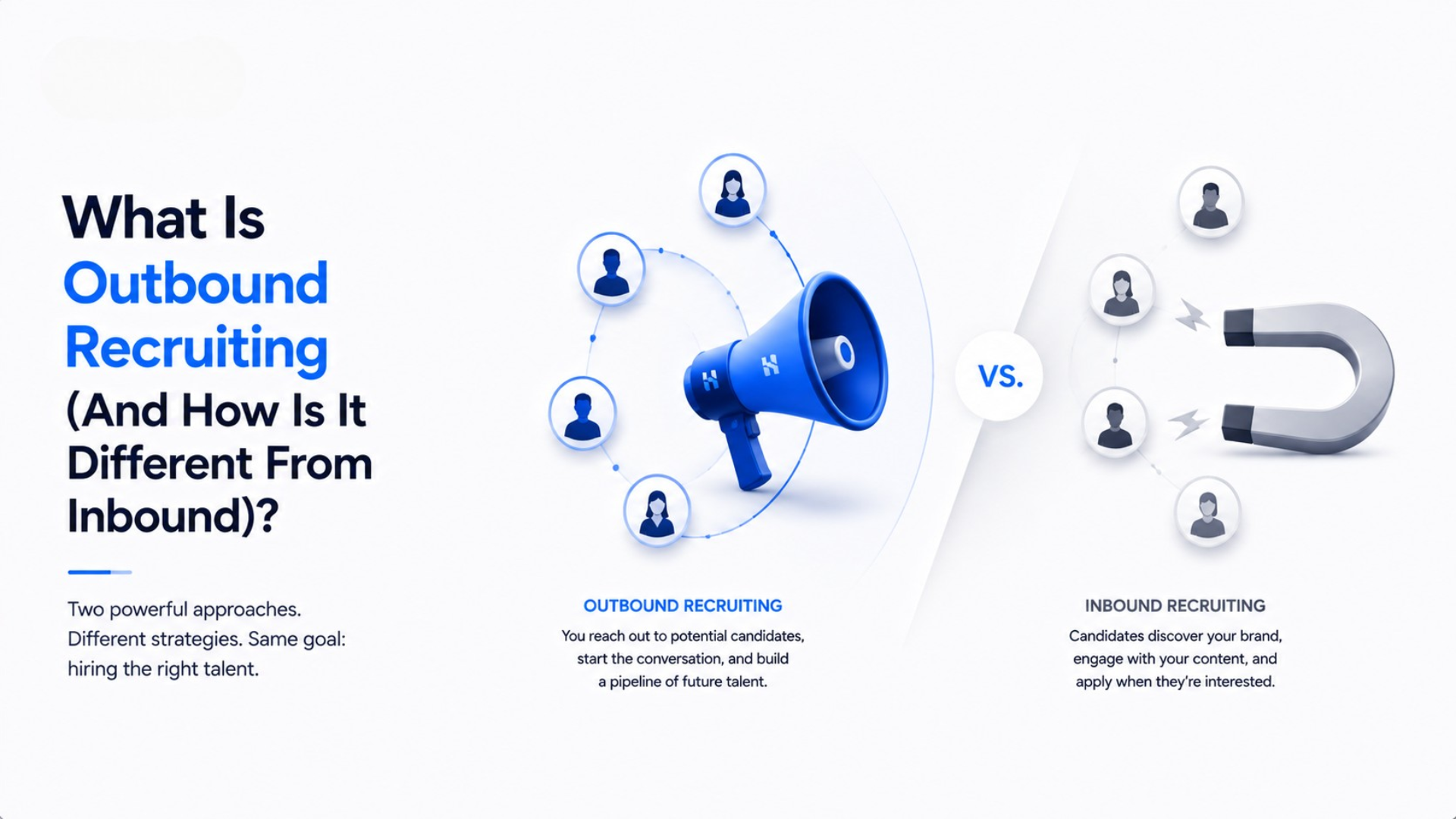
The first is inbound recruiting. An employer publishes a job, promotes its employer brand, distributes the opportunity, and waits for interested people to apply.
The second is outbound recruiting. The recruiting team identifies people who may be relevant to the role and proactively starts the conversation.
Both approaches can lead to strong hires.
But they create very different recruiting workflows.
Inbound recruiting begins with attention. The company needs the right candidates to discover the opportunity and decide to apply.
Outbound recruiting begins with identification. The recruiting team needs to understand who could be relevant, find those people, and give them a reason to consider a conversation.
That difference changes almost everything that follows.
It changes where the candidate comes from, when the recruiter becomes involved, how interest is created, what technology the team needs, and how much operational work happens before someone enters the formal hiring process.
Outbound recruiting is a proactive hiring strategy in which a company identifies, approaches, and engages potential candidates instead of relying only on people who apply for open roles.
The approach is especially important when the best candidate is unlikely to be actively looking for a job.
But outbound recruiting is not simply sending more messages to more people.
Done well, it is a coordinated process of understanding the role, identifying the right talent market, finding relevant candidates, creating thoughtful engagement, managing responses, and turning interest into a qualified hiring conversation.
What Is Outbound Recruiting?
Outbound recruiting, sometimes called outbound recruitment or proactive recruiting, is the process of actively identifying and engaging potential candidates for a role.
The candidate does not need to have applied.
They may not have visited the company’s careers page.
They may not even be actively searching for a new job.
The recruiting team begins the process.
Imagine a company needs to hire an experienced engineering leader for a specialized technical team.
An inbound approach would involve publishing the role and creating ways for suitable candidates to discover it.
An outbound approach begins by asking a different question:
Who already has the experience we need?
The recruiting team may identify relevant companies, career backgrounds, skills, locations, and adjacent profiles. Recruiters then search for potential candidates, evaluate relevance, decide who should be approached, and begin personalized outreach.
If a candidate is interested, the conversation can move toward qualification, screening, and the formal hiring process.
This makes outbound recruiting broader than candidate sourcing.
Sourcing finds potential candidates.
Outbound recruiting attempts to turn those potential candidates into actual hiring conversations.
That distinction matters because a list of profiles is not a pipeline.
A recruiter can identify 500 relevant people and still have no candidates if nobody is engaged, interested, or qualified.
Outbound recruiting includes the work required to close that gap.
What Is Inbound Recruiting?
Inbound recruiting is a hiring strategy designed to attract candidates and encourage them to apply.
The candidate initiates the direct relationship with the employer.
They may discover the company through a job board, careers page, social media, employee referral, event, search engine, employer-brand content, or another channel.
The company creates visibility and interest.
The candidate responds.
This model can be extremely effective.
A company with a strong employer brand may receive qualified applicants without recruiters having to find each person individually. A well-known organization can create a large pipeline simply by publishing a role.
Inbound recruiting can also create operational efficiency because candidates enter the process with at least some level of demonstrated interest.
They saw the opportunity and chose to apply.
The challenge is that the company has less control over who enters the pipeline.
A job can receive hundreds of applications while still failing to attract enough candidates with the experience the team actually needs.
This is one of the central differences between inbound and outbound recruiting.
Inbound recruiting creates a pool from the people who choose the company.
Outbound recruiting creates a pool from the people the company chooses to approach.
The Core Difference Between Outbound and Inbound Recruiting
The clearest difference is who makes the first move.
In inbound recruiting, the candidate comes to the employer.
In outbound recruiting, the employer goes to the candidate.
That sounds simple, but it creates two very different hiring systems.
An inbound process begins with attraction.
The company needs to create enough awareness and interest for relevant candidates to discover the opportunity. Once applications arrive, the recruiting team evaluates the available pool.
An outbound process begins with targeting.
The company defines the talent it wants to reach, identifies potential candidates, and starts conversations proactively.
The difference is similar to the distinction between inbound and outbound approaches in sales and marketing.
Inbound creates ways for interested people to discover the organization.
Outbound identifies specific people or accounts and approaches them directly.
The recruiting version follows the same basic principle.
But candidates are not sales leads.
A person’s career, privacy, time, and professional choices require a more careful approach than simply maximizing outreach volume.
Good outbound recruiting is therefore not a mass messaging strategy.
It is a targeted talent strategy.
Why Companies Use Outbound Recruiting
The strongest candidate for a role may never apply.
They may be employed.
They may not follow the company.
They may not use the job board where the role was published.
They may not know the company exists.
They may see the opening but assume they are not a fit.
They may be open to a better opportunity without actively searching for one.
An inbound-only hiring strategy cannot reliably reach all of these people.
This is why companies use outbound recruiting.
The strategy gives the hiring team more control over the talent pool.
Instead of waiting to see who applies, recruiters can identify people whose experience appears relevant and create an opportunity for a conversation.
This can be especially valuable for senior roles, specialized technical positions, hard-to-fill jobs, competitive talent markets, and situations where the available applicant pool is too narrow.
Outbound recruiting can also help companies build more intentional talent pools.
If an inbound process repeatedly produces candidates from the same channels or backgrounds, proactive sourcing can help recruiters search more broadly.
The value is not that outbound recruiting guarantees a better candidate.
It is that the company can look beyond the people who happened to apply.
How Outbound Recruiting Works
A strong outbound recruiting workflow begins before the first candidate search.
The recruiting team needs to understand the role.
That means more than copying the job description into a search box.
The recruiter needs to know which requirements are essential, which are flexible, what kind of experience is transferable, where relevant candidates may work, and what could make the opportunity attractive to someone who is not actively looking.
This becomes the search strategy.
The recruiter or sourcing system then identifies potential candidates.
The search may use job titles, skills, previous employers, industries, locations, career progression, projects, and other relevant signals.
The first results are rarely perfect.
Recruiters review the market, learn from the profiles they find, adjust the target, and refine the search.
Relevant candidates are then prioritized for engagement.
This is where outbound recruiting becomes more than sourcing.
The recruiter needs to decide why a particular person should care about the opportunity.
A generic message explaining that the company has an “exciting opportunity” is rarely enough.
The strongest outreach creates a credible connection between the candidate’s background and the reason for the conversation.
Responses then need to be managed.
Some candidates will be interested.
Some will decline.
Some will ask questions.
Some may be open to a conversation later.
Many will not respond.
The workflow needs to handle each outcome appropriately.
Interested candidates can move toward qualification or screening. Relevant context should continue with them as they progress into the formal hiring process.
This full journey—from role understanding to candidate conversation—is the real outbound recruiting workflow.
Outbound Recruiting Starts With Candidate Sourcing
Candidate sourcing is the foundation of outbound recruiting.
Before a recruiter can start a relevant conversation, they need to identify the right people.
Traditionally, this has been highly manual.
A recruiter converts the hiring requirement into keywords and filters, searches professional networks or talent databases, reviews profiles individually, adjusts the criteria, and creates a shortlist.
This can consume a large part of the recruiting process.
Modern sourcing automation reduces some of that work.
AI sourcing systems can help interpret job requirements, identify potential candidates, evaluate broader experience signals, prioritize profiles, and refine the search using recruiter feedback.
This makes outbound recruiting easier to scale.
But automated candidate discovery does not solve the entire problem.
A sourcing system can identify 100 relevant profiles.
The recruiting team still needs to decide who should be contacted, create appropriate outreach, manage follow-ups, interpret responses, and move interested people forward.
This is why outbound recruiting should not be reduced to candidate search.
Sourcing creates the opportunity.
The wider workflow turns that opportunity into a pipeline.
For a deeper explanation of the discovery stage, see What Is Candidate Sourcing Automation?, which explains how AI and software reduce the manual work involved in finding and organizing potential candidates.
Why Passive Candidates Matter in Outbound Recruiting
The phrase “passive candidate” is commonly used for someone who is not actively applying for jobs but may consider the right opportunity.
This group is central to outbound recruiting.
An active candidate has already entered the market.
They may be searching job boards, contacting recruiters, and applying to several companies.
A passive candidate may not be doing any of those things.
That does not mean they are impossible to hire.
Their willingness to move may depend on the role, company, timing, compensation, location, career progression, or another factor.
Outbound recruiting creates a way to discover that interest.
This is one reason the quality of the first interaction matters so much.
An inbound candidate already knows why the conversation is happening.
They applied.
An outbound candidate did not ask to enter the process.
The recruiter needs to earn the next step.
That makes relevance more important than volume.
The question is not simply whether the candidate matches the role.
The recruiter also needs to consider whether the role could plausibly matter to the candidate.
Outbound Recruiting Requires a Different Kind of Candidate Outreach
Inbound recruiting begins with existing interest.
Outbound recruiting needs to create enough interest for a conversation.
This changes the purpose of outreach.
The first message is not supposed to complete the hiring process.
It is supposed to create a relevant reason to talk.
The candidate should understand why they were contacted, what the opportunity is, and why the recruiter believes the conversation could be relevant.
Personalization can help, but personalization is often misunderstood.
Adding the candidate’s first name or mentioning their current company does not automatically make a message relevant.
Useful personalization is connected to the reason for the outreach.
Perhaps the candidate has experience building a particular kind of product.
Perhaps they have worked at the stage the hiring company is now entering.
Perhaps their career progression suggests the role could be a meaningful next step.
The strongest outreach connects candidate context with opportunity context.
This is also where outbound recruiting can fail at scale.
When teams automate sourcing and outreach without maintaining relevance, the workflow can become a spam engine.
More candidates are found.
More messages are generated.
More follow-ups are sent.
But fewer people feel that the conversation was intended for them.
Huntlo’s guide to when over-automating AI sourcing can hurt employer brand explores why scaling outreach without improving relevance can damage candidate experience and trust.
Outbound recruiting should increase the number of relevant conversations.
Not simply the number of messages.
Outbound Recruiting vs. Inbound Recruiting: Candidate Intent
One of the most important differences between the two models is candidate intent.
An inbound candidate has already taken an action.
They visited a job page.
They reviewed the opportunity.
They completed an application.
That does not guarantee they are highly interested, but it provides a clear signal.
An outbound candidate begins from a different position.
They may be satisfied in their current role.
They may know nothing about the hiring company.
They may not have thought about changing jobs.
The recruiter cannot assume the same level of intent.
This affects the early stages of the process.
An inbound workflow may move quickly toward evaluation because the candidate has already expressed interest.
An outbound workflow often needs an engagement stage first.
The candidate needs enough information to decide whether the conversation is worth continuing.
This is why treating outbound candidates exactly like applicants can create a poor experience.
The relationship begins differently.
The process should reflect that.
Outbound vs. Inbound Recruiting: Control Over the Talent Pool
Inbound recruiting gives candidates more control over entry into the pipeline.
The company creates the opportunity, but candidates decide whether to apply.
Outbound recruiting gives the recruiting team more control over who is considered.
The recruiter can deliberately search for people with particular experience, explore adjacent backgrounds, target specific talent markets, and approach candidates who would never have entered through the application process.
This control is one of the biggest advantages of outbound recruiting.
It is also one of its biggest responsibilities.
A proactive recruiting team decides who is found and who is approached.
If the search criteria are unnecessarily narrow, the talent pool will also be narrow.
If recruiters repeatedly target the same companies, titles, or backgrounds, outbound recruiting can reinforce existing patterns.
A broader search does not happen automatically.
It needs to be designed.
This is why the quality of the talent strategy matters before automation begins.
Software can scale the search.
It cannot guarantee that the search itself is wise.
Outbound vs. Inbound Recruiting: Speed and Workload
It is tempting to describe one strategy as faster than the other.
The reality depends on the role and the market.
Inbound recruiting can be extremely fast when the employer has a strong brand and the role attracts qualified candidates.
The company publishes the opening, receives relevant applications, and moves quickly into evaluation.
But inbound can also create a large screening burden.
A role may receive hundreds or thousands of applications, many of which are not relevant.
The recruiting team then spends time finding the strongest candidates inside the volume.
Outbound recruiting creates a different workload.
The pipeline may be smaller, but more work happens before a candidate expresses interest.
Recruiters need to search, evaluate, engage, follow up, and manage responses.
The company avoids reviewing a large applicant pool but takes responsibility for building the pipeline proactively.
Neither model is automatically more efficient.
The real question is where the work happens.
Inbound recruiting concentrates work after application.
Outbound recruiting creates more work before formal application.
This distinction is important when choosing recruiting technology.
An inbound-heavy team may prioritize applicant management and screening.
An outbound-heavy team may need stronger sourcing, outreach, response management, and workflow automation.
When Inbound Recruiting Works Best
Inbound recruiting is especially effective when enough qualified candidates already want to find the company.
Strong employer brands often benefit from this.
So do roles with large active candidate markets.
High-volume hiring can also rely heavily on inbound channels when the company needs to create awareness and process many interested applicants efficiently.
Inbound recruiting is attractive because candidate acquisition can scale without a recruiter identifying every person individually.
One job campaign can create many applications.
Content, employer branding, employee referrals, and careers-page visibility can continue generating interest over time.
The challenge is predictability.
The company cannot fully control who applies.
A role can generate significant traffic without generating the right talent.
This is why application volume should not be confused with pipeline quality.
Inbound works best when the organization can reliably attract enough of the candidates it needs.
When Outbound Recruiting Works Best
Outbound recruiting becomes more valuable when waiting is not enough.
A specialized role may have a small active candidate market.
A senior candidate may be unlikely to apply through a job board.
A new company may not yet have enough employer-brand awareness to attract the people it needs.
A recruiter may need to build a pipeline in a specific geography, industry, or talent segment.
In these situations, the company needs to create the market rather than wait for the market to arrive.
Outbound recruiting can also be useful when hiring requirements are highly specific.
Instead of reviewing a large applicant pool, recruiters can identify a smaller group of people with relevant backgrounds and approach them directly.
Staffing firms and recruitment agencies often depend heavily on this model because their value is tied to finding talent beyond the obvious applicant pool.
The same is true for executive search and other specialized recruiting models.
For these teams, sourcing is not a secondary activity.
It is the beginning of the business model.
Why Most Companies Need Both Inbound and Outbound Recruiting
Inbound and outbound recruiting are often presented as competing strategies.
For most companies, that is the wrong way to think about them.
A strong talent acquisition strategy can use both.
Inbound creates a way for interested candidates to discover the company.
Outbound gives the recruiting team a way to reach relevant people who did not apply.
The balance can change by role.
A well-known company hiring graduate analysts may receive more than enough qualified inbound interest.
The same company hiring a highly specialized technical leader may need a targeted outbound search.
A role can also use both strategies at the same time.
The company publishes the opening and begins receiving applications.
Recruiters simultaneously identify and engage people who appear relevant but have not applied.
The two pipelines can then enter the same broader hiring process.
The goal is not to choose one recruiting philosophy for every role.
It is to understand where the right candidates are likely to come from.
How AI Is Changing Outbound Recruiting
Outbound recruiting has historically been limited by recruiter capacity.
A person can run only so many searches.
Review only so many profiles.
Write only so many thoughtful messages.
Manage only so many follow-ups.
Track only so many conversations.
AI changes this because more of the repetitive workflow can be supported or automated.
AI sourcing systems can interpret role requirements and help discover relevant candidates.
AI can help evaluate broader experience signals rather than relying only on exact keywords.
It can support message creation using available candidate and role context.
Automated workflows can manage approved follow-ups.
AI can help classify responses and identify which conversations require recruiter attention.
Screening systems can help collect structured information before the recruiter spends time on a longer conversation.
The important change is not one AI feature.
It is the possibility of connecting the workflow.
This creates a new model of outbound recruiting.
Instead of a recruiter manually moving through search, outreach, responses, screening, and scheduling, software can coordinate more of the operational work between important human decisions.
That is where outbound recruiting begins to overlap with agentic AI recruiting.
From Outbound Recruiting Automation to Agentic Recruiting
Traditional recruiting automation works well when the next action is predictable.
If a candidate does not respond after a defined period, send an approved follow-up.
If a candidate books an interview, send a confirmation.
If a person asks to stop communication, end the workflow.
These rules can remove significant administrative work.
Agentic systems can potentially handle more contextual workflows.
One candidate may respond with interest.
Another may ask whether the role is remote.
Another may say the timing is wrong but ask to reconnect later.
Another may refer a colleague.
The workflow should not treat these responses as identical.
An agentic recruiting system can interpret what happened, preserve the relevant context, and coordinate an appropriate next action within the permissions defined by the recruiting team.
This does not mean AI should control the entire hiring process.
The goal is not maximum autonomy.
The goal is to reduce the manual coordination required between sourcing a candidate and moving a qualified person into a meaningful conversation.
That distinction is especially important in outbound recruiting because so much of the work happens before a candidate enters the traditional ATS workflow.
Outbound Recruiting and the AI Hiring OS
An applicant tracking system is usually designed around people who have entered a hiring process.
Outbound recruiting begins earlier.
The candidate may not have applied.
They may not have spoken with the company.
They may not know the opportunity exists.
This creates a large amount of pre-ATS work.
The team needs to understand the role, find candidates, evaluate relevance, begin outreach, manage follow-ups, interpret responses, build interest, and qualify potential candidates.
When each activity happens in a separate tool, the recruiter becomes the connection between them.
This is why outbound-heavy teams are a strong use case for an AI hiring operating layer.
An AI hiring OS can treat sourcing, engagement, response management, screening, and scheduling as connected parts of one workflow.
The objective is not to replace the recruiter.
It is to stop requiring the recruiter to manually trigger every operational transition.
The recruiter defines the hiring objective, sets the boundaries, reviews important outcomes, and makes consequential decisions.
The system handles more of the execution between those moments.
Where Huntlo Fits Into Outbound Recruiting
Huntlo is built around the operational problem at the center of outbound recruiting.
Finding a potential candidate is only the beginning.
The recruiting team still needs to create engagement, manage follow-ups, understand responses, qualify interest, and move the right people toward interviews.
When those stages operate in separate systems, the recruiter spends a significant amount of time connecting the workflow manually.
Huntlo approaches outbound hiring as a connected process.
Its agentic AI recruiting infrastructure is designed around candidate sourcing, personalized engagement, candidate communication, AI screening, and interview coordination.
The objective is not simply to give recruiters another database of profiles.
It is to help turn a hiring requirement into qualified candidate conversations with less manual orchestration.
This matters because the value of outbound recruiting does not come from how many people a team can find.
It comes from how effectively the team can move the right people from discovery to conversation.
For teams evaluating how AI changes this workflow, Huntlo’s guide to how AI sourcing tools fit into the future of talent acquisition explains why candidate discovery increasingly needs to connect with engagement and execution.
The same principle applies to teams comparing sourcing platforms. AI sourcing tools are not all the same because some systems stop after finding candidates while others extend further into the outbound workflow.
The Risks of Scaling Outbound Recruiting Poorly
Outbound recruiting becomes dangerous when teams confuse activity with progress.
More profiles found.
More messages sent.
More sequences launched.
More follow-ups automated.
These numbers can increase while recruiting quality gets worse.
Poor targeting creates irrelevant outreach.
Weak personalization makes candidates feel like database entries.
Aggressive follow-ups damage the employer brand.
Disconnected systems cause candidates to repeat information.
Automation without clear controls can continue workflows that should have stopped.
AI can make these problems larger because it reduces the cost of creating activity.
The right question is therefore not how much outbound recruiting can be automated.
The better question is which parts should be automated and under what conditions.
Search can be automated while recruiters supervise quality.
Message preparation can be supported while the team controls positioning.
Routine follow-ups can be automated within clear boundaries.
Responses can be organized while unusual situations are escalated to people.
Screening can collect structured information while consequential decisions remain human.
The strongest outbound recruiting systems use automation to remove repetitive work.
They do not use automation as an excuse to remove judgment.
How to Build a Better Outbound Recruiting Strategy
A better outbound strategy begins with a better definition of the target.
The team needs to understand what the role actually requires and where flexibility exists.
The next step is building the right talent market.
Recruiters should consider related titles, adjacent skills, transferable backgrounds, relevant companies, and different career paths instead of relying on one narrow profile.
Candidate relevance should then shape outreach.
The reason a person was selected should connect with the reason they are contacted.
The team also needs a clear response workflow.
What happens when someone is interested?
What happens when they ask a question?
What happens when they want to reconnect later?
What happens when they decline?
What happens when they do not respond?
These outcomes should not be managed as unrelated inbox events.
They are part of the outbound recruiting process.
Finally, the team should measure outcomes rather than activity alone.
A large number of messages does not prove that the strategy is working.
Relevant conversations, qualified candidates, pipeline progression, candidate experience, and eventual hires are more meaningful.
The best outbound recruiting strategy is not the one that creates the most activity.
It is the one that creates the right conversations efficiently.
The Future of Outbound Recruiting
Outbound recruiting is moving from manual prospecting toward intelligent workflow execution.
The first generation of tools helped recruiters search larger databases.
The next generation automated outreach and follow-ups.
Modern AI can interpret requirements, evaluate candidate context, support personalization, classify responses, and coordinate more of the work that follows.
The next shift is continuity.
Candidate sourcing should not end with a profile.
Outreach should not operate without the context behind the search.
A positive response should not disappear inside an inbox.
Screening should not begin as though nothing happened previously.
The future of outbound recruiting will be built around connected workflows.
Recruiters will still define the target.
They will still shape the talent strategy.
They will still handle important candidate relationships and make consequential decisions.
But they will spend less time manually connecting every stage of the process.
That is the larger opportunity behind AI in outbound recruiting.
Not more messages.
Not more activity.
Better execution between the hiring objective and the candidate conversation.
Conclusion: Outbound Recruiting Creates the Pipeline Instead of Waiting for It
Outbound recruiting is a proactive hiring strategy in which companies identify and engage potential candidates rather than relying only on people who apply.
Inbound recruiting begins when candidates discover the company and express interest.
Outbound recruiting begins when the company identifies people it wants to reach.
Neither strategy is universally better.
Inbound recruiting can be highly efficient when a company attracts enough qualified applicants.
Outbound recruiting becomes essential when the right candidates are unlikely to apply on their own.
The biggest difference is not simply who sends the first message.
It is how the entire recruiting workflow operates.
Inbound teams manage attention and applications.
Outbound teams build talent markets, source candidates, create engagement, manage responses, and turn interest into pipeline.
AI is changing how much of that work needs to be done manually.
Candidate sourcing can become more contextual.
Outreach can become more relevant.
Follow-ups can become more consistent.
Responses can become easier to manage.
Screening and scheduling can connect more closely with the work that came before.
The strongest future for outbound recruiting is not fully manual or fully autonomous.
It is a supervised system in which recruiters control the strategy and important decisions while software handles more of the repetitive execution.
Inbound recruiting waits for the right candidates to arrive.
Outbound recruiting goes and finds them.
Frequently Asked Questions
What is outbound recruiting?
Outbound recruiting is a proactive hiring strategy in which recruiters identify and contact potential candidates instead of relying only on people who apply for jobs.
What is inbound recruiting?
Inbound recruiting focuses on attracting candidates and encouraging them to apply through job postings, employer branding, referrals, content, careers pages, and other channels.
What is the main difference between inbound and outbound recruiting?
The main difference is who initiates the relationship. In inbound recruiting, the candidate approaches the employer. In outbound recruiting, the employer approaches the candidate.
Is candidate sourcing the same as outbound recruiting?
No. Candidate sourcing is the process of finding potential candidates. Outbound recruiting is broader and also includes engagement, follow-ups, response management, qualification, and progression into the hiring process.
What is a passive candidate?
A passive candidate is someone who is not actively applying for jobs but may consider the right opportunity.
When should companies use outbound recruiting?
Outbound recruiting is especially useful for specialized roles, senior positions, competitive talent markets, passive candidate searches, and situations where inbound applications are not producing enough qualified candidates.
Is outbound recruiting better than inbound recruiting?
Neither is always better. The right strategy depends on the role, employer brand, candidate market, hiring urgency, and availability of qualified applicants.
Can a company use inbound and outbound recruiting together?
Yes. Many companies publish roles to attract applicants while simultaneously sourcing and engaging relevant candidates who have not applied.
Can outbound recruiting be automated?
Parts of the workflow can be automated, including candidate discovery, prioritization, approved outreach, follow-ups, response organization, screening, and scheduling. Human oversight remains important.
How is AI changing outbound recruiting?
AI can help interpret hiring requirements, discover candidates, evaluate relevance, personalize engagement, manage responses, and coordinate more of the workflow between sourcing and interviews.
Related Topics
Explore how AI sourcing tools fit into the future of talent acquisition and why candidate discovery increasingly needs to connect with execution.
See why AI sourcing tools are not all the same when some platforms stop at search while others extend further into the outbound workflow.
Learn when over-automating outreach can hurt employer brand and why outbound automation should improve relevance before increasing volume.