Companies do not always want to build every recruiting capability internally.
Hiring demand changes.
A company may need 20 people this quarter and 200 next year. It may enter a new market without a local recruiting team. It may struggle to hire specialized talent. Its internal recruiters may be overwhelmed by a sudden increase in vacancies.
One option is to hire more internal recruiters.
Another is to use recruitment agencies for individual roles.
A third is the RPO model.
RPO, or recruitment process outsourcing, is a model in which an employer transfers responsibility for some or all of its recruitment process to an external provider that operates as an extension of the company’s talent acquisition function.
The provider may manage sourcing, candidate engagement, screening, interview coordination, recruitment operations, reporting, technology, employer-brand activity, and other parts of the hiring process.
The Recruitment Process Outsourcing Association defines RPO as a form of business process outsourcing in which an employer transfers all or part of its recruitment processes to an external provider. The provider may bring or manage people, technology, methodology, and reporting as part of the service.
This is what makes RPO different from simply sending a difficult vacancy to a recruitment agency.
An agency is usually paid to fill a role.
An RPO provider is usually responsible for operating part of the recruitment process.
AI is now changing how that process can be delivered.
Candidate discovery can happen faster. Existing talent databases can be searched more intelligently. Outreach and follow-ups can be automated. Candidate responses can be organized. Early screening can be supported by AI. Interview coordination can require less manual work.
The result is not simply a faster version of traditional RPO.
AI has the potential to change the amount of recruiting work each person can manage, the technology RPO providers need, the services they can offer, and the economics of the entire model.
What Is an RPO Model?
RPO stands for recruitment process outsourcing.
Under an RPO model, a company partners with an external provider to manage part or all of its recruiting process.
The exact scope can vary significantly.
One company may outsource the complete hiring process for a country. Another may use an RPO provider only for a major expansion. A third may need additional sourcing capacity for difficult roles. Another may want an external partner to operate recruitment across several business units.
What separates RPO from ordinary recruitment outsourcing is usually the depth of the relationship.
An RPO provider often works inside the client’s recruiting process rather than outside it.
The provider may use the employer’s brand.
Its recruiters may communicate with candidates as representatives of the client.
The team may work inside the client’s ATS.
The provider may follow the company’s hiring stages, service-level agreements, reporting requirements, and workforce plans.
The RPO team can therefore become difficult for candidates to distinguish from the company’s internal recruiting team.
That is intentional.
The provider is not simply supplying resumes.
It is helping operate the recruitment function.
How Does Recruitment Process Outsourcing Work?
An RPO engagement usually begins with the employer defining the hiring problem.
The company may have continuous recruitment demand, a sudden hiring increase, a difficult talent market, inconsistent recruiting processes, or a lack of internal capacity.
The RPO provider then agrees on the scope of responsibility.
In a broad engagement, the provider may manage the process from workforce planning and role intake through sourcing, screening, interview coordination, offer support, reporting, and onboarding-related activities.
In a narrower engagement, the provider may own only one part of the process.
The operating model is then designed around the client.
Recruiters may be assigned to specific functions or locations. Technology systems are connected. Hiring workflows are defined. Reporting standards are agreed. Candidate communication is aligned with the employer brand.
Once the model is running, the RPO provider is usually measured on more than individual placements.
Metrics may include time to fill, cost per hire, candidate quality, hiring-manager satisfaction, candidate experience, recruiter productivity, pipeline health, process compliance, and other outcomes.
This is why RPO is often described as a partnership rather than a transactional recruitment service.
The provider takes responsibility for how the recruiting process works.
What Does an RPO Provider Actually Do?
The answer depends on the contract.
An end-to-end provider may support almost the entire recruitment lifecycle.
The work can begin with understanding hiring demand and defining role requirements. The provider may then attract applicants, source passive candidates, manage talent pools, conduct outreach, screen candidates, coordinate interviews, support offers, maintain recruiting systems, and produce reports.
Some RPO providers also support employer branding, career-site strategy, recruitment marketing, assessment, technology selection, and workforce planning.
The exact boundaries vary.
The important point is that RPO is a service model, not one fixed list of recruiting tasks.
One employer may need additional recruiters.
Another may need an entire talent acquisition operating system.
A strong RPO model is therefore designed around the hiring problem rather than a generic service package.
This flexibility is one reason companies use RPO when recruitment demand becomes difficult to manage with a fixed internal team.
Why Do Companies Use RPO?
The most common reason is capacity.
Hiring demand is rarely perfectly stable.
A company may expand rapidly, launch a new business unit, enter a new country, win a major contract, or suddenly need skills that its internal recruiting team does not regularly hire.
Building a permanent internal recruiting team for temporary demand can be expensive.
RPO allows the company to add recruitment capacity without permanently increasing internal headcount.
Expertise is another reason.
An employer may be strong at hiring for its existing business but have little experience recruiting in a new geography or talent market.
An RPO provider can bring recruiters, sourcing expertise, processes, technology, and market knowledge.
Consistency also matters.
Large organizations may have different recruiting practices across business units or locations. An RPO model can create a more standardized process and shared reporting structure.
Technology can be another factor.
Recruiting teams increasingly need an ATS, sourcing systems, candidate engagement tools, analytics, scheduling software, and AI capabilities. An RPO provider may bring or operate part of this technology environment.
The value of RPO is therefore not simply cheaper recruiters.
It is flexible recruiting infrastructure.
What Are the Main Types of RPO Models?
There is no single RPO structure.
The model changes according to how much of the recruiting process the employer wants to outsource and for how long.
End-to-End RPO
End-to-end RPO is the broadest model.
The provider manages most or all of the recruitment process for a defined part of the organization.
This may include role intake, candidate sourcing, applications, screening, candidate communication, interview coordination, offer support, reporting, technology, and other recruitment operations.
The provider often works closely with hiring managers and internal HR teams.
This model is most useful when the employer wants a long-term external partner to operate a significant part of talent acquisition.
AI can have a large effect here because many different stages of the workflow contain repetitive work.
Project RPO
Project RPO is designed around a specific hiring initiative.
A company may need to hire hundreds of people for a new location.
It may be opening a business unit.
It may need a large number of people with a specific skill.
The demand is significant but temporary.
Instead of permanently expanding the internal recruiting team, the company uses an RPO provider for the project.
The engagement ends or reduces when the hiring requirement is complete.
AI can make project RPO especially scalable because the provider may need to increase candidate discovery, engagement, screening, and coordination quickly without building an equally large manual team.
Selective RPO
Selective RPO focuses on one part of the recruitment process.
The company may keep most recruiting activity internally but outsource sourcing, screening, recruitment marketing, interview scheduling, or another specific function.
This model is useful when the employer has one clear bottleneck.
For example, the internal recruiting team may be good at managing candidates after they enter the pipeline but lack enough capacity to find passive talent.
The company could use an external provider for candidate sourcing while retaining the rest of the process.
AI is making selective RPO more interesting because individual recruiting workflows can increasingly be automated or supported without outsourcing the entire function.
Recruiter-on-Demand
Recruiter-on-demand models provide temporary recruiting capacity.
The external recruiters may work closely with the internal team for a defined period.
This can help during hiring spikes, recruiter absences, new projects, or rapid expansion.
The model is usually more focused on additional people than complete process ownership.
AI changes the economics here as well.
If one AI-enabled recruiter can manage more sourcing, outreach, follow-ups, and coordination, companies may need fewer additional recruiters to handle the same increase in hiring demand.
RPO vs. Recruitment Agency
RPO providers and recruitment agencies both help companies hire.
The difference is usually the level of process ownership.
A traditional recruitment agency is generally engaged to fill specific roles.
The employer sends a vacancy.
The agency searches for candidates.
It presents suitable people.
The agency is paid according to the commercial agreement, often when a successful placement is made.
An RPO provider usually operates more deeply inside the employer’s recruitment process.
The provider may manage multiple vacancies, work under the employer brand, use the client’s systems, communicate directly with hiring managers, manage candidate experience, and report against broader recruitment outcomes.
The agency delivers candidates.
The RPO provider helps deliver the recruiting process.
The distinction is not absolute.
Some large agencies provide RPO services.
Some RPO providers also offer project hiring or other talent solutions.
But the difference in operating model remains useful.
An agency is usually a source of external candidates.
An RPO provider can become part of the talent acquisition infrastructure.
RPO vs. Staffing Agency
RPO and staffing also solve different problems.
Staffing firms often provide workers to client companies, particularly for temporary, contract, or contingent roles.
The staffing company may employ the worker and assign them to the client.
RPO is usually focused on operating the recruitment process for the employer.
The candidates are generally being hired by the client rather than supplied as part of the provider’s workforce.
This distinction matters because the service economics are different.
A staffing firm can earn revenue through the ongoing relationship between the worker and client.
An RPO provider is generally paid to deliver recruitment capacity, process ownership, or hiring outcomes.
AI affects both industries.
But the impact on RPO is particularly connected to recruiter productivity because so much of the service involves operating repeatable hiring workflows.
RPO vs. In-House Recruiting
An internal recruiting team works directly for the employer.
It usually has strong company context, close relationships with hiring managers, and direct understanding of the culture and organization.
An RPO team is external but integrated.
The provider brings additional capacity, technology, expertise, and process capability while working within the employer’s recruiting environment.
The choice does not always need to be one or the other.
Many companies use a hybrid model.
The internal talent acquisition team may retain strategy, executive hiring, employer brand, and key stakeholder relationships.
The RPO provider may manage high-volume hiring, specific geographies, sourcing, recruitment operations, or another defined area.
AI is likely to make these hybrid models more common.
Companies can decide more precisely which work needs internal judgment, which work can be supported by an external team, and which repetitive work can be handled by software.
Why the Traditional RPO Model Is Labour-Intensive
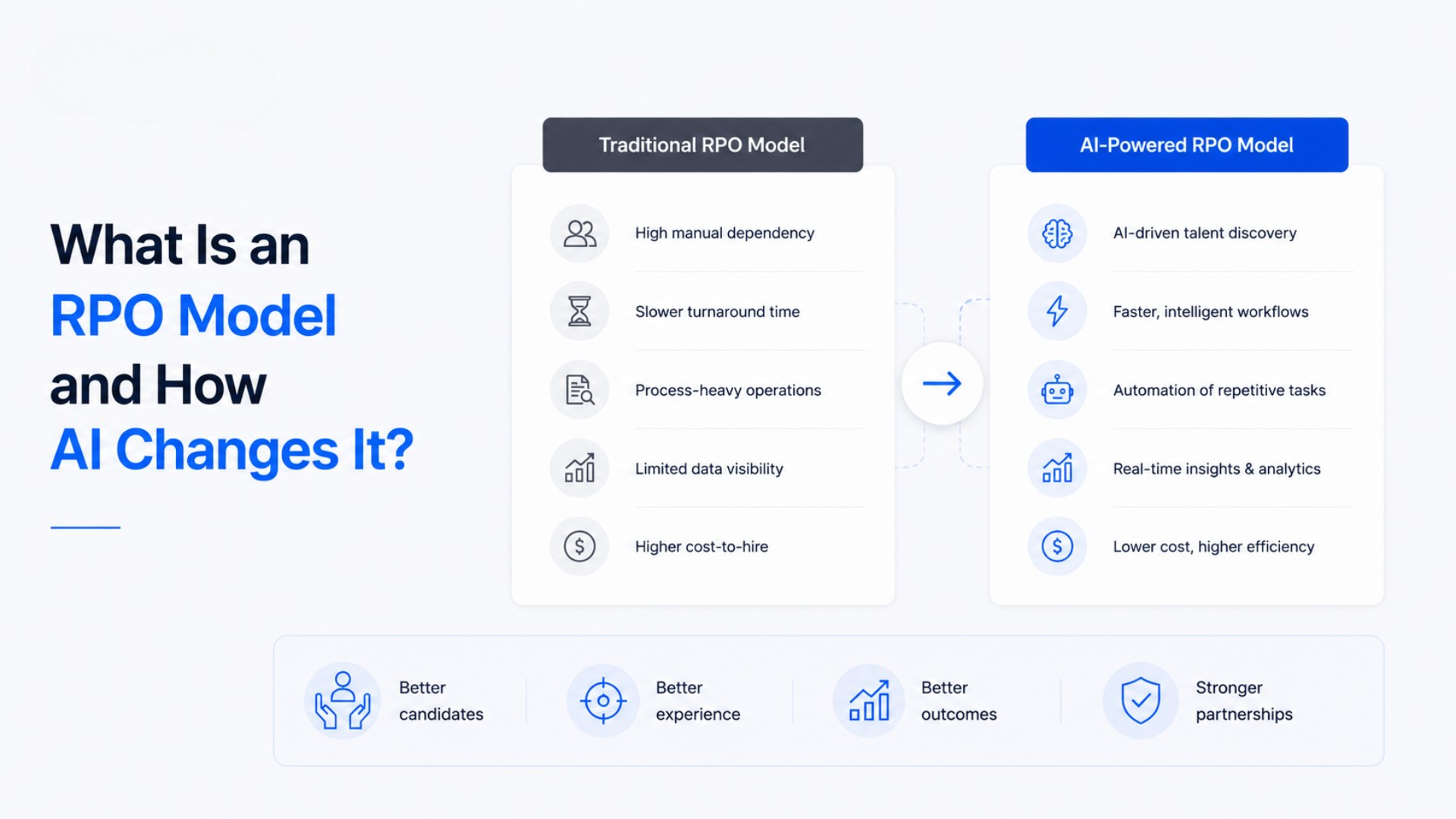
Traditional RPO scales mainly by adding people.
More requisitions require more recruiters.
More sourcing requires more sourcers.
More candidate conversations require more recruiter time.
More interviews require more scheduling work.
This creates a direct relationship between client growth and delivery headcount.
A recruiter can manage only a certain number of roles and candidate relationships.
When the workload increases, the RPO provider needs more people.
This creates several challenges.
Hiring and training recruiters takes time.
Quality can become inconsistent during rapid growth.
Margins can be pressured when a client requires large amounts of manual work.
Recruiters may spend significant time on administrative tasks instead of candidate and hiring-manager relationships.
AI changes this model because many of the repetitive steps between important recruiting decisions can now be supported or automated.
The result is a potential shift from headcount-based delivery toward technology-enabled recruiting capacity.
How AI Changes the RPO Model
The most important effect of AI on RPO is not one new feature.
It is a change in recruiter capacity.
A traditional recruiter may spend time translating job descriptions into searches, reviewing profiles, preparing outreach, sending follow-ups, organizing responses, screening candidates, scheduling interviews, updating systems, and producing reports.
AI can support more of this work.
The recruiter still needs to understand the role, evaluate candidate quality, manage important relationships, work with hiring managers, and make judgment calls.
But less time needs to be spent on repetitive execution.
This means an RPO provider can potentially manage more hiring activity without increasing delivery headcount at the same rate.
That changes the economics of the service.
The provider can increase recruiter productivity.
Clients can receive faster execution.
Recruiters can focus on higher-value work.
Technology becomes part of delivery capacity rather than simply a tool used by the delivery team.
AI Changes Candidate Sourcing for RPO Providers
Candidate sourcing has traditionally required significant recruiter time.
The recruiter interprets the role.
They identify relevant titles and skills.
They build Boolean searches.
They review profiles.
They refine the search.
They create a shortlist.
AI can reduce some of this work.
Modern sourcing systems can interpret hiring requirements, identify related titles and experience, search larger talent pools, and rank candidates according to estimated relevance.
This is especially important for RPO providers because sourcing activity is repeated across many clients and roles.
A small improvement in sourcing productivity can create a large operational effect when multiplied across the entire delivery organization.
Huntlo’s guide on AI sourcing for RPO providers explains why RPO teams should evaluate sourcing tools based on recruiter capacity, workflow integration, candidate engagement, and client delivery rather than candidate discovery alone.
The shift also reduces dependence on advanced manual search techniques. As explained in [What Is Boolean Search in Recruiting (And Why AI Tools Are Replacing It)?], recruiters increasingly can begin with the hiring requirement rather than manually translating every search into operators, synonyms, and exclusions.
AI Changes Candidate Outreach
Finding candidates is only the beginning of an RPO workflow.
Passive candidates need to be engaged.
Recruiters may need to prepare personalized messages, choose communication channels, manage follow-ups, and respond when candidates show interest.
This work becomes difficult at scale.
One RPO provider may be running thousands of candidate conversations across many clients.
AI can help prepare more relevant outreach, coordinate sequences, support communication across channels, and organize responses.
The value is not simply more messages.
RPO providers operate under client employer brands.
Poor outreach can damage the client relationship as well as the candidate experience.
AI needs to improve relevance before it increases volume.
This is why [What Is Multi-Channel Recruiting Outreach?] is closely connected to the RPO model. The provider may need to coordinate email, professional networks, phone, SMS, or other appropriate channels while preserving one candidate context.
For RPO providers, communication quality is part of service delivery.
AI Changes Candidate Screening
Screening is another major source of repetitive work.
Recruiters review resumes.
They conduct initial calls.
They confirm basic requirements.
They answer common questions.
They prepare notes.
They decide which candidates should move forward.
AI can support parts of this process.
It may summarize candidate information, compare experience with role requirements, support structured pre-screening, organize responses, and prepare information for recruiter review.
The benefit is speed.
A recruiter can spend more time on candidates who need deeper evaluation instead of repeating the same administrative questions across every applicant.
But screening is also one of the areas where AI needs careful controls.
Candidate evaluation can affect employment opportunities.
The system should not become an unexplained black box that automatically rejects people based on unclear assumptions.
Human review, transparency, job relevance, and appropriate governance remain important.
The role of AI should be to improve the workflow around recruiter judgment, not create the illusion that every hiring decision can be automated.
For a deeper explanation, see [What Is AI Candidate Screening and How Accurate Is It?].
AI Changes Candidate Rediscovery
RPO providers often inherit large amounts of existing candidate data.
The client may have years of applications inside an ATS.
The RPO provider may also build talent pools over the life of the engagement.
Traditionally, much of this data becomes difficult to reuse.
Recruiters search externally for new candidates even when relevant people already exist somewhere inside the system.
AI can improve candidate rediscovery.
A new role can be compared with previous applicants, sourced candidates, finalists, and CRM records.
Potentially relevant people can be surfaced before the team begins another external search.
This can reduce repeated sourcing work.
It can also improve the return on previous recruiting investment.
The company has already spent money attracting, finding, or evaluating these candidates.
A better system makes that history useful.
This is where [What Is a Candidate Pool and How Do You Build One?] and [What Is a Recruiting CRM? Definition and Key Features] become especially relevant to RPO delivery.
A strong RPO provider should not only fill today’s roles.
It should help the client build a more useful talent network over time.
AI Changes Recruitment Operations
A large amount of RPO work happens between major recruiting decisions.
Candidates need follow-ups.
Interviews need to be scheduled.
Hiring managers need updates.
Records need to be maintained.
Recruiters need reminders.
Reports need to be prepared.
Candidates move between systems and stages.
None of these tasks is individually dramatic.
Together, they consume significant delivery capacity.
AI and workflow automation can reduce this coordination burden.
The system can support reminders, organize communication, trigger appropriate actions, summarize activity, and help move information between stages.
This is where the impact of AI becomes larger than sourcing.
A faster candidate search may save a recruiter one hour.
A better workflow can reduce manual work throughout the entire hiring process.
For RPO providers managing large numbers of recruiters, clients, requisitions, and candidates, those small improvements compound.
AI Changes RPO Economics
Traditional RPO revenue and delivery are strongly connected to people.
A large client requires a large delivery team.
That creates a relatively predictable model.
More work requires more recruiters.
AI can weaken that relationship.
If one recruiter can manage more requisitions because sourcing is faster, outreach is supported, follow-ups are coordinated, responses are organized, and administrative work is reduced, the provider can increase capacity without increasing headcount at the same rate.
This can improve operating leverage.
The provider may be able to serve more clients with the same team.
It may improve margins.
It may offer faster service.
It may shift pricing away from recruiter headcount toward outcomes, capacity, projects, or technology-enabled delivery.
The competitive question changes.
The best RPO provider may no longer be the company with the largest recruiter workforce.
It may be the provider that combines recruiter expertise with the most effective recruiting infrastructure.
Does AI Replace RPO Recruiters?
AI is more likely to change the recruiter role than eliminate it.
RPO recruiting involves work that extends beyond search and administration.
Recruiters need to understand unclear hiring requirements.
They need to challenge unrealistic expectations.
They need to build relationships with hiring managers.
They need to evaluate candidate motivation.
They need to handle sensitive conversations.
They need to represent the client’s employer brand.
They need to make judgments when the process does not follow the expected path.
AI can support parts of this work.
It can also remove repetitive tasks around it.
The likely change is that recruiters spend less time acting as manual workflow coordinators.
The strongest recruiters may manage more roles, candidates, or clients because software handles more of the repeated execution.
This changes what an RPO provider should value when hiring and developing recruiters.
Search syntax and administrative speed may become less important.
Judgment, market understanding, communication, stakeholder management, and recruiting strategy may become more valuable.
AI-Native RPO vs. Traditional RPO
An AI-native RPO provider is not simply a traditional RPO company that buys an AI sourcing tool.
The difference is how the delivery model is designed.
A traditional provider may add AI to one stage while keeping the rest of the process unchanged.
Candidates are sourced faster.
Then recruiters manually export them.
Outreach happens in another system.
Replies are managed elsewhere.
Screening remains disconnected.
Interview coordination is manual.
The sourcing tool improved.
The operating model did not.
An AI-native RPO model looks at the entire workflow.
Where does the hiring requirement begin?
How are candidates discovered?
How does the system know why they are relevant?
How are they engaged?
What happens when they respond?
How are interested candidates qualified?
How does context move toward interviews?
Where does human review matter most?
The objective is not to automate every task.
It is to redesign the delivery process around what AI can now do.
The Risk of Over-Automating RPO
RPO providers face a particular automation risk because they recruit under another company’s brand.
A poorly targeted campaign does not only affect the provider.
It affects the client.
If AI sends irrelevant messages, continues following up after candidates decline, creates duplicate outreach, or provides a poor screening experience, the employer may suffer the reputational consequences.
This makes governance important.
RPO providers need clear rules around which actions can be automated, when human review is required, how candidate preferences are respected, and how errors are corrected.
The provider also needs to understand differences between clients.
A workflow appropriate for high-volume hiring may not be appropriate for executive recruitment.
A communication channel accepted in one market may be unusual in another.
AI can create scale.
The RPO provider still needs to provide judgment.
What Should Companies Look for in an AI-Enabled RPO Provider?
The first question should be how the provider actually uses AI.
Many companies now describe themselves as AI-powered.
The label reveals very little.
Employers should ask which parts of the recruitment workflow are supported, what recruiters still do manually, and how the technology improves measurable delivery outcomes.
The second question is integration.
Does the provider’s technology work with the client’s ATS, CRM, candidate pools, and reporting environment?
The third is candidate experience.
How does automation affect communication?
Can the workflow understand responses?
Does it stop inappropriate follow-ups?
The fourth is governance.
Where does human review happen?
How are AI-supported decisions monitored?
How does the provider handle candidate data?
The fifth is scalability.
Can the provider manage sudden hiring increases without simply adding large numbers of recruiters?
Finally, employers should look at outcomes.
The purpose of AI is not to create more recruiting activity.
It should improve speed, recruiter productivity, candidate quality, process consistency, or another meaningful hiring result.
Where Huntlo Fits Into the RPO Model
Huntlo is not an RPO provider.
It provides agentic AI recruiting infrastructure that RPO providers and recruiting teams can use to automate more of the work required to deliver hiring outcomes.
This distinction matters.
An RPO provider owns or operates the recruiting service.
Huntlo supports the infrastructure behind that service.
Candidate sourcing is one part of the workflow.
AI can help identify relevant people.
But the RPO provider still needs to engage candidates, manage follow-ups, understand responses, qualify interest, coordinate screening, and move the right people toward interviews.
When each of these activities happens in a different system, recruiters become the connection between the tools.
Huntlo’s approach is designed around reducing that manual orchestration.
For RPO providers, this can mean increasing recruiter capacity without simply increasing delivery headcount.
The provider can use AI to support candidate discovery, engagement, qualification, scheduling, and recruiting operations while recruiters focus more of their time on client relationships, candidate judgment, and complex hiring work.
Huntlo’s article on AI sourcing for RPO providers explains why the best technology for RPO should be evaluated around delivery scale rather than search quality alone.
The same shift is explored in How AI Sourcing Tools Are Reshaping Recruitment Agency Business Models, where the larger question is how AI changes recruiter productivity, operating leverage, and the economics of recruiting services.
How AI Changes the Client-RPO Relationship
AI also changes what clients may expect from RPO providers.
Historically, the provider’s value could be closely connected to recruiter capacity.
The client needed more hiring work completed.
The RPO provider supplied more recruiting resources.
As AI handles more repetitive execution, clients may expect faster delivery with smaller teams.
They may also expect more visibility.
If recruiting systems can track candidate activity, pipeline movement, response patterns, and workflow performance in real time, static monthly reporting may become less valuable.
Clients may want to understand what is happening now.
The provider may also become more of a technology partner.
RPO teams can help employers decide which recruiting work should remain human, which should be automated, and how systems should connect.
The strongest providers may therefore move beyond outsourced recruiting labour.
They may become operators of AI-enabled talent acquisition infrastructure.
Will Companies Still Need RPO When AI Recruiting Gets Better?
Yes, but the reasons may change.
A company does not use RPO only because recruiters perform manual tasks.
It may need market expertise.
It may need flexible capacity.
It may need help operating in new locations.
It may need process design.
It may need stakeholder management.
It may need someone accountable for hiring outcomes.
AI can reduce the amount of manual work required.
It does not automatically create an effective recruiting function.
In fact, as recruiting technology becomes more complex, some companies may need more help deciding how to use it.
The RPO provider of the future may deliver fewer manual hours and more operating capability.
The question will move from:
“How many recruiters can you provide?”
toward:
“How much hiring capacity can your system deliver?”
That is a much larger change than adding an AI search tool.
The Future of the RPO Model
The RPO market is likely to become more technology-driven.
Providers will still need recruiters.
But the ratio between recruiting activity and delivery headcount may change.
AI can handle more candidate discovery.
It can support more communication.
It can organize more responses.
It can reduce more administrative coordination.
Recruiters can spend more time on the parts of the process where human understanding creates the most value.
This may also create new competition.
Smaller RPO providers with strong AI infrastructure may be able to compete with larger firms.
Large providers may use technology to improve margins and standardize delivery.
Clients may demand more flexible pricing.
Recruiting teams may combine internal talent acquisition, RPO services, and AI infrastructure in new ways.
The winning model is unlikely to be completely human or completely automated.
It will combine recruiter judgment with systems that can execute more of the repetitive workflow.
Conclusion: AI Changes RPO From a Headcount Model to a Capacity Model
An RPO model allows a company to transfer some or all of its recruitment process to an external provider.
The provider may manage sourcing, candidate engagement, screening, interview coordination, recruitment operations, technology, reporting, and other parts of talent acquisition.
The traditional model scales largely through people.
More hiring demand requires more recruiting capacity.
More recruiting capacity usually requires more recruiters.
AI changes that relationship.
Candidate sourcing can happen faster.
Existing candidate data can be rediscovered.
Outreach can be supported across channels.
Follow-ups can be coordinated.
Candidate responses can be organized.
Screening and scheduling can require less repetitive work.
This means one recruiter may be able to manage more hiring activity.
For RPO providers, that changes delivery economics.
For clients, it changes expectations.
For recruiters, it changes where human expertise creates the most value.
The future RPO provider will not win simply by having more recruiters.
It will win by combining recruiting expertise, client understanding, candidate relationships, and AI infrastructure into a more effective hiring system.
The RPO model is not disappearing.
It is becoming more intelligent.
Frequently Asked Questions
What is an RPO model?
An RPO model is a recruitment arrangement in which an employer transfers responsibility for some or all of its recruiting process to an external provider.
What does RPO stand for?
RPO stands for recruitment process outsourcing.
What does an RPO provider do?
An RPO provider may manage sourcing, candidate engagement, screening, interview coordination, recruitment operations, reporting, technology, employer branding, and other parts of the hiring process.
What are the main types of RPO?
Common models include end-to-end RPO, project RPO, selective RPO, and recruiter-on-demand services.
What is the difference between RPO and a recruitment agency?
A recruitment agency usually focuses on filling specific roles. An RPO provider typically takes deeper responsibility for operating part or all of the employer’s recruitment process.
What is the difference between RPO and staffing?
Staffing firms often supply temporary or contract workers. RPO providers usually operate the recruitment process for people who will be hired by the client.
How does AI change RPO?
AI can improve candidate sourcing, rediscovery, outreach, response management, screening, scheduling, reporting, and other recruiting workflows. This can increase the amount of hiring activity each recruiter can manage.
Will AI replace RPO recruiters?
AI is more likely to change recruiter work than eliminate it. Recruiters can spend less time on repetitive coordination and more time on judgment, candidate relationships, hiring-manager communication, and complex recruiting decisions.
What is an AI-native RPO?
An AI-native RPO designs the recruiting delivery model around AI-supported workflows rather than simply adding an AI tool to one stage of a traditional process.
Is Huntlo an RPO provider?
No. Huntlo provides agentic AI recruiting infrastructure that RPO providers and recruiting teams can use to support sourcing, candidate engagement, qualification, scheduling, and recruiting operations.
Related Topics
Learn how AI is changing candidate discovery in What Is Candidate Sourcing Automation?
Understand the proactive hiring model behind many RPO sourcing workflows in What Is Outbound Recruiting (And How Is It Different From Inbound)?
Explore how RPO teams build reusable talent networks in What Is a Candidate Pool and How Do You Build One?
See how long-term candidate relationships are managed in What Is a Recruiting CRM? Definition and Key Features
Learn how AI is reducing manual search work in What Is Boolean Search in Recruiting (And Why AI Tools Are Replacing It)?