Recruitment Process Outsourcing (RPO) providers operate in one of the most demanding environments in talent acquisition.
Unlike internal recruiting teams that focus on a single organization, RPO providers often manage multiple hiring programs, diverse client requirements, and strict service-level agreements (SLAs) simultaneously.
Success depends on more than finding candidates.
RPO leaders are responsible for:
Meeting client hiring targets
Maintaining SLA performance
Managing recruiter productivity
Scaling recruiting operations efficiently
Delivering measurable hiring outcomes
This is why interest in AI sourcing for RPO providers has increased significantly.
However, the best-performing RPO organizations are discovering an important reality:
The greatest recruiting bottlenecks often occur after sourcing.
Candidate engagement, qualification, scheduling, and workflow management frequently consume more recruiter time than candidate discovery itself.
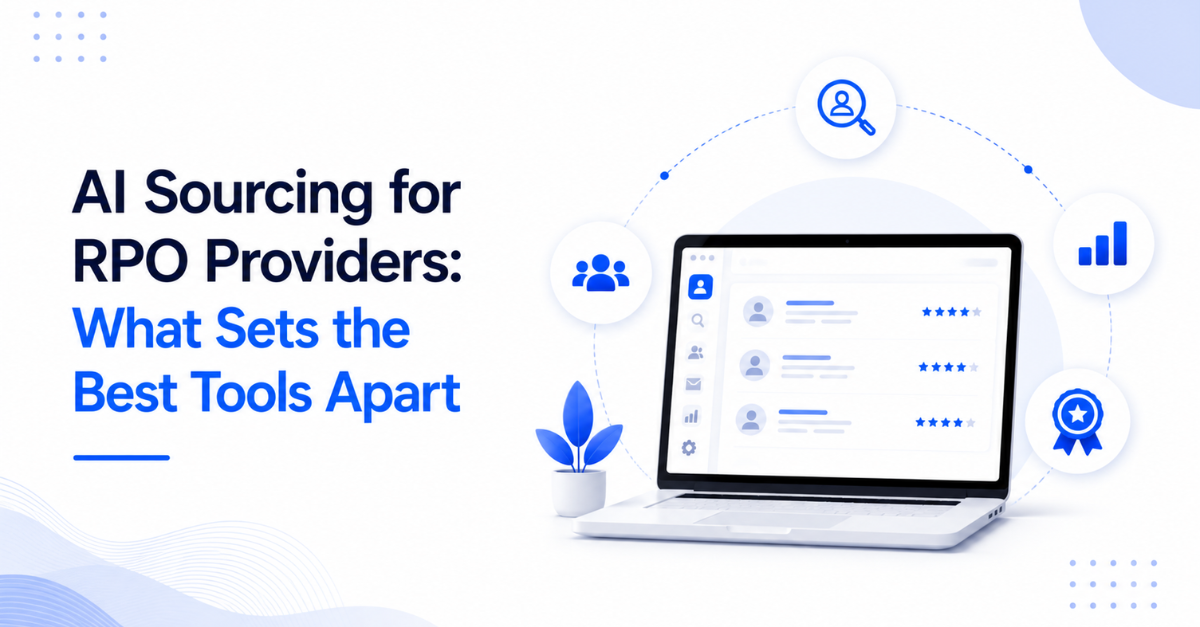
In this guide, we'll explore what sets the best AI sourcing and recruiting platforms apart for modern RPO delivery teams.
Why RPO Providers Have Different Technology Requirements
Most recruiting software is designed for individual recruiters or corporate talent acquisition teams.
RPO providers operate differently.
Client Expectations
Every client expects:
Fast hiring outcomes
Consistent communication
High-quality candidate pipelines
Accurate reporting
Strong recruiter responsiveness
Technology decisions directly impact the ability to meet these expectations.
Unlike internal recruiting teams, RPO providers must demonstrate value continuously across multiple client engagements.
SLA-Driven Recruiting
Many RPO contracts include performance metrics such as:
Time-to-submit
Time-to-fill
Candidate response rates
Interview completion rates
Hiring velocity
Meeting these metrics requires efficient recruiting operations at scale.
As hiring volumes increase, manual processes become difficult to sustain.
The Role of AI Sourcing in Modern RPO Delivery
AI sourcing tools have become an important part of the recruiting technology stack.
Faster Candidate Discovery
AI-powered sourcing enables recruiters to:
Identify relevant talent more quickly
Search across larger talent pools
Reduce manual sourcing effort
Surface qualified candidates faster
This helps recruiters spend less time searching and more time engaging candidates.
Larger Talent Pools
Modern sourcing platforms can expand visibility into:
Passive candidates
Niche skill sets
Specialized technical talent
Geographic hiring markets
For RPO providers managing multiple clients, broader candidate access can improve delivery consistency.
But candidate discovery alone does not guarantee successful outcomes.
What Sets the Best AI Sourcing Tools Apart
Many sourcing vendors make similar promises.
The best platforms differentiate themselves through operational impact.
Productivity Gains
Recruiter productivity is one of the most important evaluation criteria for RPO leaders.
Questions to ask include:
How much recruiter time is saved?
How many additional requisitions can recruiters manage?
Can teams support more clients without hiring additional recruiters?
The right platform should increase recruiter capacity, not simply generate more candidate profiles.
Automation Capabilities
The strongest solutions automate repetitive recruiting activities such as:
Outreach
Follow-ups
Candidate qualification
Scheduling
Status updates
Automation reduces administrative workload while improving delivery consistency.
Scalability
RPO firms must scale quickly when clients expand hiring programs.
Technology should support:
Increased hiring volumes
Additional recruiters
Multiple client accounts
Standardized workflows
Scalability becomes a competitive advantage during periods of rapid growth.
See how Huntlo helps RPO teams increase recruiter capacity without increasing recruiter headcount.
Beyond Sourcing: The Real Bottlenecks in RPO Recruiting
Many RPO organizations initially focus on sourcing efficiency.
Over time, they often discover larger bottlenecks elsewhere.
Candidate Engagement
Candidates frequently disengage due to:
Delayed outreach
Inconsistent communication
Missed follow-ups
Long response times
Maintaining engagement across thousands of candidates can be challenging for growing delivery teams.
Qualification
Recruiters spend significant time:
Screening applicants
Verifying qualifications
Assessing fit
Routing candidates
As hiring volumes increase, qualification becomes a major operational burden.
Scheduling
Interview coordination remains one of the most time-consuming recruiting activities.
Managing calendars across:
Candidates
Hiring managers
Client stakeholders
Recruiters
often creates unnecessary delays that affect SLA performance.
Candidate Engagement as a Competitive Advantage
One area where leading RPO providers increasingly differentiate themselves is candidate engagement.
Automated Outreach
AI-powered engagement workflows allow recruiters to:
Contact candidates faster
Personalize communication
Maintain consistent messaging
Increase response rates
This improves candidate experience while reducing manual effort.
Follow-Up Consistency
Follow-ups are critical to recruiting success.
Yet they are often overlooked during busy hiring periods.
Automation helps ensure:
Every candidate receives timely communication
Engagement remains consistent
Drop-offs decrease
Recruiter workload remains manageable
Organizations that maintain strong engagement often achieve better hiring outcomes than those relying solely on sourcing improvements.
Recruiting Workflow Automation for RPO Teams
Recruiting performance depends on more than candidate discovery.
Workflow execution is equally important.
Pipeline Movement
AI-driven workflow automation can help move candidates through stages faster by automating:
Candidate qualification
Status changes
Interview progression
Follow-up actions
This reduces delays while improving hiring velocity.
Administrative Task Reduction
Administrative work often consumes a surprising amount of recruiter time.
Automation can reduce effort spent on:
Scheduling
Reporting
Candidate tracking
Communication updates
Process coordination
The result is more recruiter capacity available for high-value activities.
Discover how Huntlo automates engagement, qualification, scheduling, and recruiting operations across client accounts.
Metrics RPO Leaders Should Evaluate
Technology investments should be measured through business outcomes.
SLA Performance
Key indicators include:
Time-to-submit
Time-to-fill
Candidate response rates
Interview completion rates
These metrics directly impact client satisfaction.
Recruiter Productivity
Measure improvements in:
Requisitions per recruiter
Candidates managed per recruiter
Placements per recruiter
Recruiter capacity
Higher productivity improves profitability and scalability.
Hiring Velocity
Hiring velocity often reflects overall recruiting efficiency.
Track:
Pipeline progression speed
Candidate conversion rates
Interview scheduling time
Offer acceptance timelines
The best platforms accelerate movement throughout the recruiting funnel.
AI Sourcing vs Agentic AI Recruiting Infrastructure
The recruiting technology market is evolving rapidly.
Finding Candidates
Traditional AI sourcing tools focus on:
Candidate discovery
Search automation
Talent matching
Sourcing efficiency
These capabilities improve the top of the funnel.
Executing Recruiting Workflows
Agentic AI Recruiting Infrastructure focuses on what happens after candidates enter the pipeline.
This includes:
Candidate engagement
Qualification workflows
Follow-up automation
Interview coordination
Recruiting operations automation
For RPO providers, this often creates greater business value than sourcing alone.
Client delivery success depends on moving candidates through the hiring process efficiently—not simply identifying them.
Building a Future-Proof Recruiting Technology Stack
RPO providers evaluating technology should prioritize long-term operational impact.
Vendor Selection Criteria
Look beyond sourcing features and evaluate:
Workflow automation
Candidate engagement capabilities
Recruiter productivity improvements
Reporting and visibility
Scalability
These areas often determine long-term success.
Long-Term Scalability
The best recruiting platforms help organizations:
Support more clients
Increase hiring volume
Improve recruiter leverage
Maintain delivery quality
without proportional increases in headcount.
Conclusion
Most conversations about AI sourcing focus on finding more candidates.
For RPO providers, that is rarely the primary challenge.
The real challenge is delivering consistent recruiting outcomes across multiple clients while maintaining recruiter efficiency and meeting SLAs.
The best AI sourcing tools are not necessarily the ones that generate the largest talent pools.
They are the ones that help recruiters move candidates through the hiring process faster, more consistently, and with less manual effort.
That is why the future of RPO technology extends beyond sourcing.
Leading providers are increasingly investing in automation across:
Candidate engagement
Qualification
Follow-ups
Scheduling
Recruiting operations
Platforms like Huntlo represent the next evolution of recruiting technology by providing Agentic AI Recruiting Infrastructure that automates recruiting execution at scale—not just candidate discovery.
Evaluate your recruiting workflows and identify opportunities to improve SLA performance. Schedule a strategy call with Huntlo today.
Frequently Asked Questions
What are the best AI sourcing tools for RPO providers?
The best platforms combine sourcing capabilities with candidate engagement, qualification automation, workflow management, and recruiting operations support.
How do RPO firms use AI recruiting technology?
RPO firms use AI to automate sourcing, outreach, screening, scheduling, follow-ups, and recruiting workflows while improving recruiter productivity.
What sourcing tool features matter most?
Recruiter productivity, automation capabilities, scalability, workflow support, and candidate engagement are often more important than sourcing features alone.
How can AI improve recruiter productivity?
AI reduces manual work by automating repetitive recruiting activities such as sourcing, qualification, communication, scheduling, and reporting.
What is recruiting workflow automation?
Recruiting workflow automation uses technology to streamline recruiting activities such as candidate progression, follow-ups, scheduling, and communication.
What is recruitment operations automation?
Recruitment operations automation focuses on improving administrative and operational efficiency across recruiting processes.
How do RPO firms scale recruiting delivery?
Successful RPO providers scale by automating recruiting workflows, standardizing processes, and increasing recruiter capacity through technology.
What is Agentic AI recruiting?
Agentic AI recruiting uses autonomous AI systems to execute recruiting workflows such as engagement, qualification, scheduling, and coordination.
How do RPO providers improve SLA performance?
Improving candidate response times, reducing scheduling delays, increasing recruiter productivity, and automating workflows all contribute to stronger SLA performance.
What comes after sourcing automation?
After sourcing automation, organizations increasingly focus on engagement automation, qualification workflows, scheduling, follow-ups, and recruiting operations automation.
Related Topic
AI Sourcing Tool Comparison Framework: 10 Criteria That Matter
How to Run a Pilot Test Before Choosing an AI Sourcing Tool
AI Sourcing Tools for Recruitment Team Leads: What to Prioritize