Recruiting teams have access to more talent data than ever before.
Candidate profiles contain career histories, skills, job titles, education, projects, and professional interests. Applicant tracking systems contain years of previous applications and hiring activity. HR systems contain information about the existing workforce. External labor market data can show where skills are concentrated, which roles are becoming harder to fill, and how demand is changing.
The problem is not a lack of data.
The problem is understanding what that data means.
A company may know that it needs 50 machine learning engineers, but still struggle to answer basic strategic questions. Where are those professionals located? Which adjacent skills could expand the talent pool? Which competitors employ similar people? Does the company already have employees who could move into these roles? Is the requirement realistic in the target location?
A recruiter searching profiles manually cannot answer all of those questions easily.
This is the problem a talent intelligence platform is designed to solve.
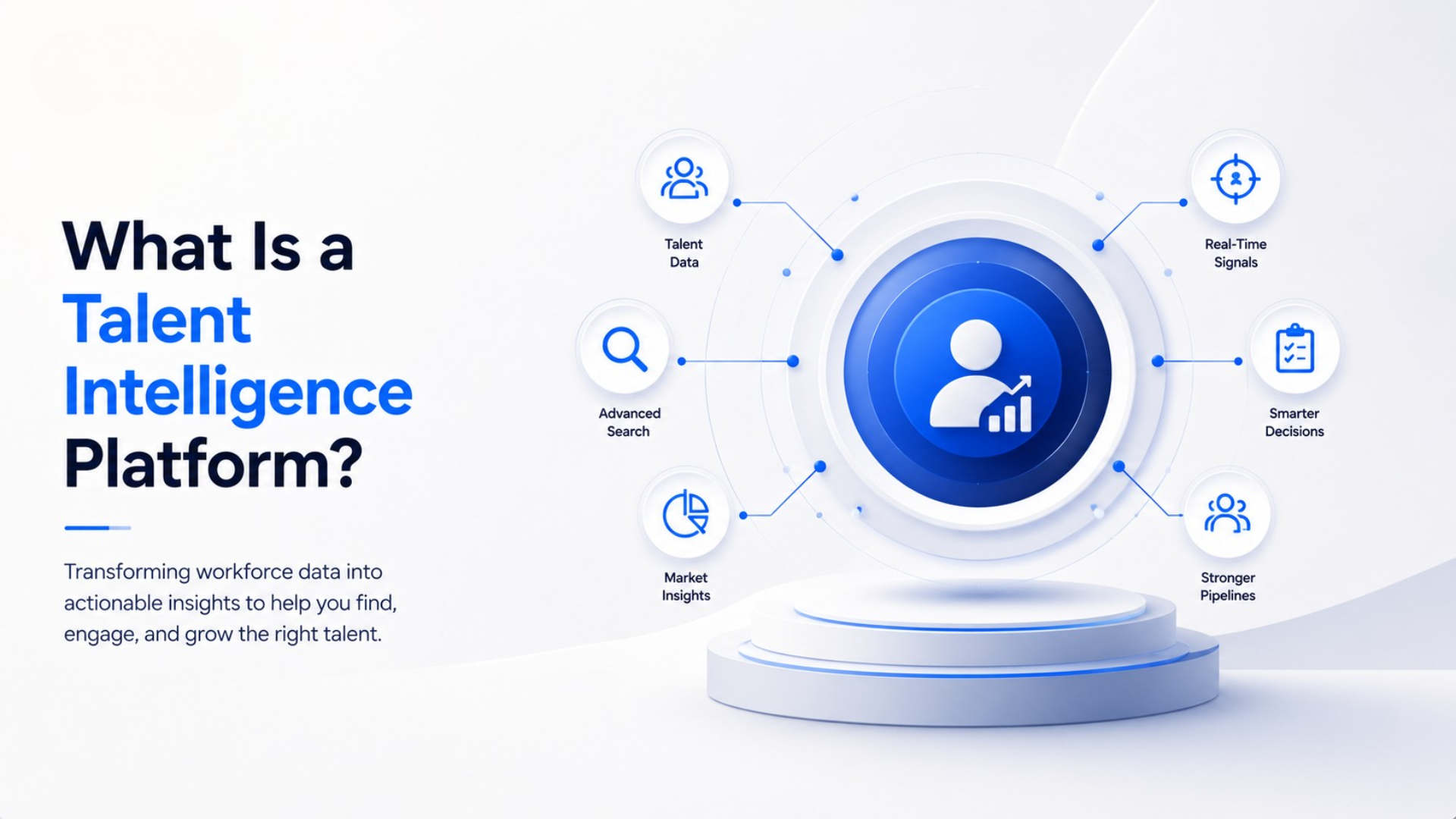
A talent intelligence platform is software that combines and analyzes information about candidates, employees, skills, organizations, and labor markets to help companies make better decisions about hiring and workforce strategy.
Instead of showing talent data as disconnected records, the platform attempts to turn that information into useful intelligence.
The shift is important.
Traditional recruiting software asks, “Who is in the database?”
Talent intelligence asks, “What does the available data tell us about the talent decision we need to make?”
What Is a Talent Intelligence Platform?
A talent intelligence platform is a software system that collects, connects, analyzes, and interprets internal and external talent data to support decisions across recruiting, workforce planning, skills development, and internal mobility.
The exact capabilities vary significantly between platforms.
Some products focus heavily on external talent markets. They help recruiting teams understand candidate supply, competitor talent pools, skills availability, and geographic trends.
Others focus more on internal workforce intelligence. They analyze employee skills, identify capability gaps, recommend internal mobility opportunities, and support workforce planning.
The broadest platforms attempt to connect both sides.
They combine information about the people already inside the organization with information about the external labor market.
That combination is central to the concept.
A company facing a skills shortage should not automatically assume that external hiring is the only answer. The organization may already have employees with adjacent capabilities who could be developed or moved into new roles.
At the same time, internal workforce data alone cannot show whether the company’s talent strategy is realistic compared with the wider market.
Talent intelligence creates context by connecting the two.
Lightcast describes talent intelligence as the strategic combination of real-time labor market data with internal information to inform talent decisions. That captures the core idea: internal data explains the workforce the company has, while external data helps explain the market in which the company is competing.
The result is not simply more data.
It is a better understanding of talent supply, skills, competition, and workforce possibilities.
Why Talent Intelligence Platforms Exist
Most organizations have historically managed talent information in separate systems.
The ATS knows who applied.
The HR information system knows who works for the company.
The recruiting CRM knows which candidates recruiters have contacted.
Performance systems may contain information about employee development.
Learning platforms know which courses people completed.
External databases contain professional profiles.
Labor market datasets show changes in job demand and skills.
Each system can be useful.
The problem is that no single record provides a complete picture.
Suppose a company wants to build a cybersecurity team in a new location.
The recruiting team can begin searching for candidates immediately. But search alone does not answer the strategic questions behind the hiring plan.
How many relevant professionals are available in that market?
Which employers currently employ them?
What skills commonly appear alongside the required capabilities?
Are the company’s job titles aligned with the language candidates actually use?
Could another city offer a stronger talent pool?
Does the company already employ people with transferable skills?
A talent intelligence platform is designed to answer these questions before or alongside execution.
This changes the role of data in recruiting.
Instead of using data only to report what happened after a hiring process, organizations can use it to shape the strategy before the search begins.
That is why talent intelligence sits between recruiting, workforce analytics, and strategic planning.
How Does a Talent Intelligence Platform Work?
A talent intelligence platform usually begins by bringing together multiple sources of talent information.
The first category is internal data.
This can include employee profiles, job histories, skills, applications, previous candidates, organizational structures, roles, performance information, and other permitted workforce data.
The second category is external data.
Depending on the platform, this may include professional profiles, job postings, company information, labor market trends, skills demand, geographic talent supply, and other public or licensed datasets.
The platform then attempts to normalize the information.
This is necessary because talent data is inconsistent.
The same skill can be described in different ways. Similar jobs can have completely different titles. Two companies can use the same title for very different responsibilities.
A “Customer Success Manager” at one organization may perform work that another company calls “Technical Account Management.” A “Software Engineer II” in one company may be equivalent to a “Senior Developer” elsewhere.
If a system treats every title and skill as an exact keyword, the intelligence will be limited.
Modern talent intelligence software therefore attempts to understand relationships.
It may recognize that skills are related, that certain career paths commonly lead to others, or that different job titles can represent similar work.
The platform then applies analytics, machine learning, AI, or a combination of methods to identify patterns and generate insights.
The final output may appear as talent market maps, candidate recommendations, skills insights, workforce dashboards, internal mobility suggestions, or strategic planning tools.
The important point is that the platform is not simply storing talent data.
It is attempting to interpret it.
What Data Does a Talent Intelligence Platform Use?
The quality of talent intelligence depends heavily on the quality and breadth of the data behind it.
Internal data can include current employees, former employees, applicants, previous candidates, skills profiles, job histories, organizational information, and internal career movement.
External data can include professional profiles, job postings, employer information, skills trends, education data, geographic patterns, and broader labor market signals.
These data sources answer different questions.
Internal information can show what capabilities already exist inside the organization.
External information can show how those capabilities compare with the market.
Imagine a company discovers that cloud security skills are becoming increasingly important to its strategy.
Internal data may show how many employees already have related experience.
External market data may show where professionals with those skills are concentrated, which employers compete for them, and how demand is changing.
The combination allows the organization to consider several strategies.
It may hire externally.
It may develop existing employees.
It may move people internally.
It may open roles in another location.
It may change the requirement to include adjacent skills.
This is why talent intelligence is broader than candidate search.
Search asks who matches a role today.
Talent intelligence can help the organization understand how to build the talent it will need next.
Talent Intelligence and Skills Intelligence
Skills are becoming one of the most important layers in talent intelligence.
Traditional workforce systems have been organized primarily around jobs.
A person has a title.
A role belongs to a department.
A job description contains a list of requirements.
The problem is that job titles are often poor representations of what people can actually do.
Two employees with the same title may have very different capabilities. Two people with different titles may share many of the same skills.
A skills intelligence layer attempts to create a more detailed view.
It identifies skills, connects related capabilities, maps them to roles, and helps the organization understand where those skills exist.
This can improve external hiring.
Instead of searching only for an exact title, recruiters can identify people with the underlying capabilities required for the work.
It can also improve internal mobility.
An employee may not appear to be an obvious match for a new role based on title alone, but their existing skills may show that the transition is realistic.
This is one reason talent intelligence platforms often use skills taxonomies or skills ontologies.
A taxonomy organizes skills into categories.
A more advanced ontology can also model relationships between skills, roles, and other concepts.
The objective is to help software understand that talent is not simply a collection of keywords.
Skills change.
New capabilities emerge.
Existing skills become more or less valuable.
A talent intelligence system therefore needs to keep its understanding of the labor market current. Lightcast, for example, says its skills taxonomy is updated every two weeks to reflect changing market signals.
The stronger the skills intelligence, the more useful the platform can become for hiring, development, mobility, and workforce planning.
Talent Intelligence vs. Talent Analytics
Talent intelligence and talent analytics overlap, but they are not identical.
Talent analytics usually focuses on measuring and analyzing workforce or HR data.
It may help organizations understand turnover, hiring performance, employee retention, internal mobility, or the effectiveness of talent programs.
Gartner describes talent analytics as giving HR professionals and business leaders a more data-driven approach to decisions involving talent acquisition, development, attrition, retention, and workforce planning.
Talent intelligence is usually broader.
It combines analysis with a wider understanding of internal talent and the external market.
A talent analytics dashboard may show that time to hire for data engineering roles has increased.
A talent intelligence platform may help explain why.
The available talent pool may be small in the target location.
Demand for certain skills may have increased.
Competitors may be hiring aggressively.
The job requirements may be narrower than necessary.
The company may have internal employees with adjacent capabilities.
Analytics shows the pattern.
Intelligence adds context that can shape the response.
The categories are increasingly converging, and many platforms provide both.
But the distinction remains useful.
Talent analytics is primarily about understanding data.
Talent intelligence is about using connected talent data to improve a decision.
Talent Intelligence Platform vs. ATS
An applicant tracking system and a talent intelligence platform serve different purposes.
The ATS is primarily a system of record for the hiring process.
It stores applications, candidate records, interview feedback, hiring stages, and other recruiting activity.
A talent intelligence platform is designed to analyze talent and market information.
The difference becomes clear when a company needs to hire for a difficult role.
The ATS can show how many people applied previously.
It can show which candidates moved through the process.
It may contain thousands of potentially useful profiles.
But the ATS does not necessarily tell the company how the external talent market has changed, where relevant skills are concentrated, or whether internal employees could fill the gap.
Talent intelligence adds a broader decision layer.
This does not mean it replaces the ATS.
Many organizations use both.
The ATS remains the official record of the hiring process, while talent intelligence helps recruiters and workforce leaders understand where to look, what skills matter, and how to shape the talent strategy.
The systems solve different problems.
The ATS manages the process.
Talent intelligence helps understand the talent landscape.
Talent Intelligence Platform vs. Candidate Sourcing Software
The distinction between talent intelligence and candidate sourcing is especially important.
A sourcing tool is primarily designed to help recruiters find people.
The recruiter provides a requirement.
The system returns potential candidates.
A talent intelligence platform can support sourcing, but its purpose is broader.
Before searching for candidates, it may help the team understand the market.
How large is the talent pool?
Which locations have the strongest supply?
Which employers contain relevant talent?
What adjacent skills should be considered?
Is the hiring requirement realistic?
These questions shape the search itself.
A candidate sourcing system is focused on finding people.
A talent intelligence platform is focused on understanding talent.
The two categories increasingly overlap because modern recruiting platforms can combine market intelligence with AI candidate discovery.
This is one reason the market can be confusing.
A product may describe itself as talent intelligence while primarily offering sourcing.
Another may use talent intelligence for workforce planning and internal mobility.
Another may combine both.
Buyers should therefore look beyond the category label.
The important question is what decision the platform actually helps the organization make.
For a closer explanation of the sourcing side of this market, Huntlo’s guide to What Is Candidate Sourcing Automation? explains how software and AI can reduce the manual work involved in finding and organizing potential candidates.
Talent Intelligence vs. Workforce Intelligence
Talent intelligence and workforce intelligence also overlap.
Talent intelligence usually focuses on people, skills, candidates, and talent markets.
Workforce intelligence often includes a wider view of how the organization should structure and deploy work.
That can include workforce costs, locations, productivity, organizational design, skills supply, and future capacity.
The distinction is not always consistent across vendors.
Some platforms use the terms almost interchangeably.
The more useful way to understand them is through the question being answered.
Talent intelligence asks:
Where are the skills we need, inside or outside the organization?
Workforce intelligence asks:
How should the organization build and deploy the workforce required by the business?
A mature talent strategy may need both.
What Can a Talent Intelligence Platform Do?
The capabilities vary widely, but most talent intelligence platforms support several related decisions.
They can help organizations understand external talent markets.
A company can examine where relevant skills are concentrated, which employers have similar talent, how demand is changing, and whether a hiring location makes sense.
They can improve candidate discovery.
Instead of relying only on exact keywords and job titles, the system can use broader relationships between skills, experience, roles, and companies.
They can support workforce planning.
Leaders can compare current capabilities with future business needs and identify where important gaps may emerge.
They can improve internal mobility.
Employees with relevant or adjacent skills can be identified for new opportunities, reducing the need to look externally for every role.
They can support skills-based talent decisions.
Organizations can look beyond job titles and understand the underlying capabilities required for work.
They can also improve talent strategy.
Instead of beginning every hiring project with a blank search box, recruiting teams can begin with a clearer understanding of the market.
This is the real value of the category.
The platform should help the organization make a better talent decision before it creates more recruiting activity.
A Practical Example of Talent Intelligence
Imagine a software company plans to build an AI engineering team.
The initial plan is to hire 30 people in the city where the company already has its largest office.
Without talent intelligence, the process may begin with recruiters opening roles and searching for candidates.
With talent intelligence, the company can examine the market first.
The platform may show that the local supply of experienced AI engineers is limited and competition is intense.
It may identify another city with a larger talent pool.
It may show that several adjacent skills are common among professionals who successfully move into the target roles.
Internal workforce data may reveal that some existing software engineers already have relevant machine learning experience.
The hiring strategy can now change.
The company might hire 15 people externally, develop 10 internal employees, and open five remote roles.
That is a talent intelligence decision.
The platform did not simply find candidates.
It changed the company’s understanding of the problem.
How AI Is Changing Talent Intelligence
Talent intelligence existed before generative AI.
Organizations have long used workforce analytics, labor market data, skills databases, and predictive models.
AI expands what platforms can do with that information.
Modern systems can interpret more unstructured data.
They can analyze job descriptions, professional profiles, career histories, and skills that are expressed in inconsistent ways.
They can help users ask questions in natural language rather than requiring every insight to be built as a report.
They can identify relationships that are difficult to see through manual analysis.
AI can also make talent intelligence more accessible.
Historically, sophisticated workforce analysis often required analysts, complex dashboards, or specialist research.
A recruiter or talent leader can increasingly ask a direct question and receive an explanation based on available data.
But AI does not solve the underlying data problem automatically.
If the information is incomplete, outdated, or biased, the resulting intelligence can still be poor.
A sophisticated model cannot create a reliable view of the workforce from unreliable data.
This is why organizations should evaluate talent intelligence platforms based not only on the AI interface but also on data quality, coverage, transparency, and governance.
The intelligence is only as useful as the information and assumptions behind it.
From Talent Intelligence to Talent Execution
Talent intelligence helps organizations understand what they should do.
But understanding is not the same as execution.
A platform may show that a particular city contains a strong talent pool.
Recruiters still need to find the right candidates.
A system may identify several hundred relevant people.
The recruiting team still needs to engage them.
The platform may show that certain candidates have promising backgrounds.
Someone still needs to manage responses, screening, follow-ups, and interviews.
This creates an important distinction in modern recruiting technology.
Talent intelligence helps teams understand the talent market. Recruiting execution helps them act on that understanding.
Many platforms are beginning to connect the two.
Candidate recommendations can move into sourcing workflows.
Market insights can shape outreach.
Skills data can improve screening.
AI agents can help coordinate the work that follows discovery.
This is where talent intelligence begins to overlap with the broader shift toward agentic AI recruiting.
The future is unlikely to be a choice between intelligence and execution.
The strongest systems will connect them.
Where Huntlo Fits Into the Talent Intelligence Landscape
Huntlo is not positioned primarily as a traditional enterprise talent intelligence platform.
Its focus is closer to agentic AI recruiting infrastructure and workflow execution.
That distinction matters.
A traditional talent intelligence platform may help an organization understand the market, map skills, analyze workforce gaps, or identify potential talent pools.
Huntlo focuses on what happens when a recruiting team needs to act.
The system is designed around candidate sourcing, engagement, qualification, follow-ups, and recruiting workflow automation.
This makes Huntlo relevant to a broader shift happening across recruiting technology.
Candidate discovery is becoming easier.
More platforms can identify potential talent.
The operational challenge increasingly becomes what happens after discovery.
Who should be contacted?
How should engagement happen?
What happens when someone responds?
How does an interested candidate move into screening?
How much of that workflow still depends on a recruiter manually moving between systems?
Huntlo’s analysis of how AI sourcing tools fit into the future of talent acquisition argues that sourcing alone is no longer enough. Candidate discovery creates value only when recruiting teams can turn relevant talent into engagement, qualification, and hiring progress.
This is the connection between talent intelligence and agentic recruiting infrastructure.
Intelligence tells the team where the opportunity is.
Execution turns that opportunity into a recruiting outcome.
Benefits of a Talent Intelligence Platform
The first major benefit is better talent decisions.
Recruiting teams can use a broader understanding of the market instead of relying entirely on assumptions or the results of one search.
The second benefit is better workforce visibility.
Organizations can understand the skills they already have and compare them with the capabilities they expect to need.
The third benefit is more strategic sourcing.
Recruiters can identify talent pools, companies, locations, and adjacent skills before beginning outreach.
The fourth benefit is stronger internal mobility.
Employees who might be overlooked because of their current job title can be identified through skills and experience.
The fifth benefit is better workforce planning.
Companies can make more informed decisions about whether to hire, develop, redeploy, or change the structure of work.
These benefits explain why talent intelligence extends beyond the recruiting department.
HR leaders, workforce planners, business leaders, and learning teams may all use the same intelligence for different decisions.
The Limitations and Risks of Talent Intelligence
Talent intelligence platforms can create the impression that workforce decisions are more objective than they really are.
Data does not remove judgment.
It changes the information available to the person making the decision.
The first risk is poor data quality.
Employee skills may be outdated.
External profiles may be incomplete.
Job titles may be misleading.
Market data may have gaps.
The second risk is false precision.
A platform may display a clear ranking, score, or prediction even when the underlying information is uncertain.
The third risk is bias.
Historical workforce and hiring data can reflect previous decisions and inequalities. Using that data without careful governance can reproduce those patterns.
The fourth risk is overreliance on visible signals.
Not every capability appears clearly in a profile or HR system.
The fifth risk is weak governance.
Organizations need to understand what data is being used, where it comes from, how it is processed, and how the resulting insights affect decisions about people.
Talent intelligence should improve human decision-making.
It should not create the illusion that a complex talent decision can be reduced to one score.
How to Evaluate a Talent Intelligence Platform
The first question is what decision the organization needs to improve.
A recruiting team trying to understand external talent markets has different requirements from an enterprise trying to build an internal skills strategy.
The second question is data.
What internal sources can the platform connect?
What external data does it use?
How frequently is that information updated?
How well does it cover the markets and roles that matter to the organization?
The third question is intelligence quality.
Can the platform understand related skills, adjacent experience, and inconsistent job titles?
Or does it mainly present keyword-based search behind a more sophisticated interface?
The fourth question is actionability.
Does the platform simply produce dashboards?
Can recruiters and workforce leaders use the insight to change a real decision?
The fifth question is workflow connectivity.
Can talent intelligence move into candidate sourcing, internal mobility, workforce planning, or recruiting execution?
The final question is governance.
Organizations should understand permissions, data handling, transparency, and how AI-generated recommendations are reviewed.
The best talent intelligence platform is not the one with the largest number of dashboards.
It is the one that helps the organization make better decisions about the talent problems that actually matter.
Is a Talent Intelligence Platform Right for Every Company?
Not necessarily.
Large enterprises often have the strongest use case because they have complex workforces, significant internal talent data, and many simultaneous hiring and planning decisions.
Companies hiring in highly competitive skill markets can also benefit because labor market intelligence can improve location and sourcing strategies.
Recruiting agencies may use external talent intelligence to map markets and identify candidate pools, although they may care less about internal mobility capabilities.
Smaller companies should evaluate the problem carefully.
If the primary challenge is simply finding and engaging candidates for a small number of roles, a focused AI sourcing and recruiting workflow platform may create more immediate value than a broad enterprise talent intelligence system.
The right category depends on the bottleneck.
If the problem is understanding the talent market, talent intelligence may be the answer.
If the problem is finding candidates, sourcing software may be enough.
If the problem is moving from candidate discovery to engagement, screening, and interviews, the organization may need broader recruiting automation or an AI hiring operating layer.
Software should be selected around the workflow problem, not the category label.
The Future of Talent Intelligence Platforms
Talent intelligence platforms are moving toward a more connected role in the workforce technology stack.
The first generation focused heavily on data and reporting.
The next generation added skills intelligence, AI matching, and predictive insights.
The emerging direction connects intelligence with action.
A system may identify a future skills gap and recommend internal employees who could be developed.
It may identify an external talent pool and trigger a sourcing workflow.
It may show that a hiring requirement is unrealistic and suggest adjacent skills or locations.
It may connect workforce planning directly with recruiting execution.
This is the larger shift.
Organizations do not need more dashboards that tell them they have a talent problem.
They need systems that help them understand the problem and act on it.
Talent intelligence will therefore become more valuable as it connects with sourcing, internal mobility, workforce planning, learning, and agentic workflows.
The future of the category is not simply better analysis.
It is intelligence that can move closer to execution.
Conclusion: Talent Intelligence Turns Talent Data Into Better Decisions
A talent intelligence platform combines internal workforce data, external labor market information, skills data, and AI to help organizations make better decisions about people.
It can help companies understand where talent exists, which skills are becoming important, how competitive a market is, whether internal employees could fill future roles, and how workforce needs may change.
This makes it different from an ATS.
The ATS records the hiring process.
It is different from candidate sourcing software.
Sourcing software helps find people.
It is different from talent analytics.
Analytics primarily measures patterns in workforce data.
Talent intelligence connects data and context to improve the decision.
The strongest value appears when that intelligence leads to action.
A company understands the market.
It changes the hiring strategy.
Recruiters target a better talent pool.
Internal employees are considered before unnecessary external hiring.
The workflow becomes more informed.
That is the purpose of a talent intelligence platform.
Not more data.
Better talent decisions.
Frequently Asked Questions
What is a talent intelligence platform?
A talent intelligence platform is software that combines and analyzes internal workforce data, external labor market information, skills data, and other talent signals to support hiring and workforce decisions.
What is talent intelligence?
Talent intelligence is the practice of using connected talent and labor market data to understand skills, candidates, employees, and workforce trends.
How does a talent intelligence platform work?
The platform combines data from internal and external sources, normalizes information such as job titles and skills, and uses analytics or AI to generate insights for recruiting and workforce planning.
Is a talent intelligence platform the same as an ATS?
No. An ATS primarily manages candidate records and hiring stages. A talent intelligence platform analyzes talent and market data to support decisions.
What is the difference between talent intelligence and candidate sourcing?
Candidate sourcing focuses on finding potential candidates. Talent intelligence helps organizations understand the wider talent market, skills, workforce, and strategic options.
What is the difference between talent intelligence and talent analytics?
Talent analytics measures patterns and performance in workforce data. Talent intelligence combines broader data and context to help guide talent decisions.
Can talent intelligence help with internal mobility?
Yes. Many platforms use skills and workforce data to identify employees who may be suitable for internal opportunities or development.
Can talent intelligence help with workforce planning?
Yes. Organizations can use it to identify skills gaps, understand external talent supply, and compare hiring with development or internal mobility strategies.
Does AI improve talent intelligence?
AI can help interpret unstructured information, identify relationships between skills and roles, and make complex talent data easier to explore. Its usefulness still depends on data quality and human oversight.
Does a talent intelligence platform replace recruiters?
No. It gives recruiters and workforce leaders better information for decisions. Human judgment remains necessary for strategy, candidate evaluation, and consequential employment decisions.
Related Topics
Explore how AI sourcing tools fit into the future of talent acquisition and why candidate discovery increasingly needs to connect with execution.
Compare broader recruiting technology categories in What Are the Best AI Recruiting Software Platforms in 2026?.
See whether AI sourcing is worth it for small recruitment teams when the real bottleneck may be execution rather than access to talent data.
Understand how AI sourcing tools are reshaping recruitment agency business models as candidate discovery and talent intelligence become more accessible.