Recruiting does not always begin with a broad search.
Sometimes the recruiter already knows exactly who they want to find.
They may have a candidate’s email address from a previous conversation. A hiring manager may share a LinkedIn profile and ask the recruiting team to investigate the person. An employee may refer someone by name. A recruiter may discover a promising professional through an event, community, portfolio, article, or another source and want to create a usable candidate profile.
This is where the idea of a “People Scout” becomes useful in AI recruiting.
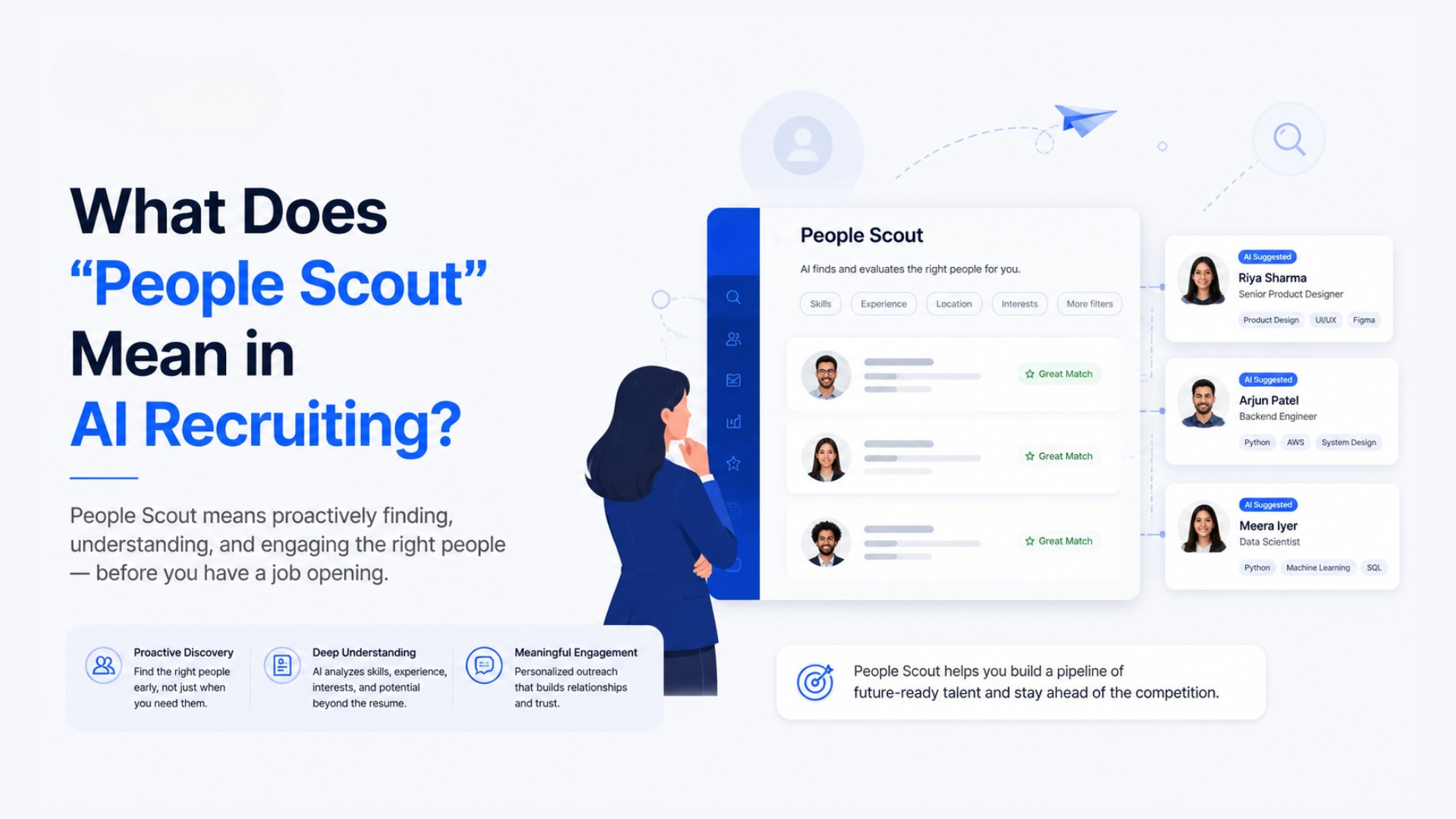
In AI recruiting, a People Scout can describe a targeted candidate lookup capability that helps recruiters find and enrich a specific person when they already know who they want to reach.
Instead of beginning with a broad hiring requirement and searching for many matching candidates, the recruiter begins with a known person.
The system may use an email address, professional profile, name, or another available identifier to locate the individual, collect relevant professional information, create a candidate record, and prepare the person for further recruiting activity.
The difference is simple.
Traditional candidate sourcing asks, “Who should we find for this role?”
People scouting asks, “We already know who we want to find. Can the system locate and understand this person?”
That makes People Scout a narrower capability than candidate sourcing, but an important one for recruiting teams that discover talent through many different channels.
What Does “People Scout” Mean?
“People Scout” is not yet a universal recruiting-industry category with one standard definition.
Different products may use similar language to describe different capabilities. The phrase can also create confusion because PeopleScout is the name of an established global talent acquisition and recruitment process outsourcing company.
In the context of AI recruiting software, however, people scouting can be understood as a targeted search for a known individual.
The recruiter is not asking the system to generate a large list of candidates based on a job description. The recruiter already has a starting signal.
That signal might be an email address.
It might be a LinkedIn profile.
It might be a person identified through a referral, community, event, company website, professional network, or another recruiting source.
The People Scout capability helps turn that signal into a usable candidate profile.
This can include locating the correct person, finding relevant professional information, connecting available profile data, and adding the candidate to a recruiting workflow.
The purpose is not broad talent discovery.
It is precise candidate lookup.
People Scout vs. PeopleScout: An Important Distinction
The wording can be confusing because PeopleScout is also the name of a global talent acquisition company.
PeopleScout provides recruitment process outsourcing, talent acquisition technology, workforce consulting, and related hiring services. It is a company and brand, not a generic name for targeted AI candidate lookup.
A “People Scout” feature inside recruiting software is a different concept.
In this article, the term refers to the product capability: finding or enriching a specific person when the recruiter already has enough information to identify who they are looking for.
The distinction is similar to the difference between a company name and a software feature name.
Recruiting teams researching the term should therefore look carefully at the context.
If “PeopleScout” appears as one word and refers to recruitment services or RPO, it is likely the company.
If “People Scout” appears as a product capability inside an AI recruiting platform, it may refer to targeted candidate lookup or profile discovery.
How Is People Scout Different From Candidate Sourcing?
The biggest difference is the starting point.
Candidate sourcing begins with a hiring need.
The company needs a senior React engineer, enterprise sales leader, finance manager, or another type of candidate. The recruiter defines the requirement and searches for people who may fit.
The output is usually a group of potential candidates.
People Scout begins with a person.
The recruiter may already have the individual’s email address or professional profile. The task is not to search the entire talent market for alternatives. It is to locate, understand, or enrich that particular candidate.
Imagine a hiring manager sends a recruiter a LinkedIn profile and says, “This person looks interesting. Can you add them to the search?”
A broad sourcing workflow would be unnecessary.
The recruiter does not need 100 matching profiles.
They need information about one person.
A People Scout lookup can help turn that known identity into a candidate record that can be reviewed and, when appropriate, added to a candidate pool or recruiting workflow.
This makes people scouting more precise than sourcing.
Sourcing discovers possibilities.
People scouting investigates a known possibility.
How Does a People Scout Lookup Work?
A People Scout workflow usually begins with a known candidate identifier.
The recruiter may enter an email address or provide a professional-profile link. Depending on the system and available information, the platform attempts to identify the correct individual and retrieve relevant professional data.
The system may then create or enrich a candidate profile.
That profile could include information such as current role, employer, previous experience, skills, professional links, location, and other relevant publicly available or appropriately sourced information.
The exact information depends on the platform, available data, permissions, and applicable privacy requirements.
The recruiter can then review the profile.
If the person appears relevant, they may be added to a candidate pool, connected to a role, moved into an outreach workflow, or saved for future consideration.
The key advantage is speed.
Without a targeted lookup tool, the recruiter may need to manually search across several platforms, confirm that multiple profiles belong to the same person, copy information into another system, and create the candidate record.
People scouting attempts to compress that work into one lookup.
Why Would a Recruiter Search for One Specific Person?
Recruiting software often focuses on large-scale candidate discovery, but many real recruiting workflows begin with individual signals.
A hiring manager may know a strong person from a previous company.
An employee may recommend a former colleague.
A recruiter may see someone speak at an industry event.
A candidate may be mentioned in a professional community.
An agency client may provide a name and ask whether the person is reachable.
A recruiter may have an old email address but no current candidate profile.
These situations do not require another broad talent search.
The recruiting team already has a candidate hypothesis.
The question is whether the person can be identified, understood, and added to the workflow efficiently.
This is especially important because modern recruiting happens across many sources.
Candidates are not discovered only through job applications or one professional network. Recruiters may encounter potential talent through referrals, public professional activity, events, portfolios, communities, previous databases, and hiring-manager suggestions.
A targeted lookup capability gives the recruiter a way to act on those individual discoveries.
People Scout vs. Candidate Search
Candidate search is usually designed to return several people.
The recruiter enters a requirement, applies filters, writes a Boolean query, or describes the ideal candidate in natural language. The search system then identifies profiles that appear relevant.
People Scout reverses the process.
The recruiter is not describing the type of person they want.
They are identifying the person directly.
This distinction affects the role of AI.
In broad candidate search, AI needs to interpret the hiring requirement and decide which people may match.
In a targeted lookup, the first challenge is identity resolution.
Is this the correct person?
Which available professional information belongs to them?
Can the system create a coherent profile from the known signal?
The second challenge is enrichment.
What relevant information can be added to help the recruiter understand the candidate?
The third challenge is workflow connection.
What should happen after the person is found?
The value is therefore not in returning a long search result.
It is in turning one known candidate signal into something the recruiting team can use.
People Scout vs. Candidate Enrichment
People scouting and candidate enrichment are closely related, but they are not always identical.
Candidate enrichment usually begins with an existing candidate record.
The recruiter may already have a name and email address but lack information about the person’s current role, company, experience, or professional profile. Enrichment adds information to make the record more complete.
People scouting can begin one step earlier.
The recruiter has a signal that identifies or points toward a person and wants the system to locate the candidate.
Once the person is found, enrichment may become part of the process.
A useful way to understand the relationship is:
People Scout finds the person.
Candidate enrichment makes the profile more useful.
In many AI recruiting systems, the two capabilities can happen inside the same workflow.
The distinction matters mainly because a candidate database can contain incomplete records. A recruiting team may know that a person exists without having enough information to evaluate or contact them effectively.
Targeted lookup and enrichment help close that gap.
People Scout vs. Candidate Rediscovery
Candidate rediscovery searches people the company already has inside its recruiting systems.
A new role opens, and the system examines previous applicants, CRM records, candidate pools, or historical sourcing activity to identify people who may now be relevant.
People Scout can operate differently.
The candidate may not already exist in the company’s systems.
The recruiter may have found them somewhere else and wants to bring them into the recruiting environment.
For example, a hiring manager may send a profile link for someone the company has never contacted.
That is not candidate rediscovery because there is no previous candidate relationship to rediscover.
It is a targeted new lookup.
The two capabilities can still work together.
A system should ideally check whether the person already exists before creating another record. If the candidate is already known, the recruiter should see the previous context rather than create a duplicate profile.
This is one reason identity resolution matters in modern recruiting software.
Finding the person is useful.
Knowing whether the company already knows the person is even better.
People Scout vs. Passive Candidate Sourcing
Passive candidate sourcing is the proactive process of finding people who are not actively applying for jobs.
A People Scout lookup can be part of passive sourcing, but the two terms describe different levels of the workflow.
Passive sourcing is a strategy.
People Scout is a targeted action.
A recruiter may use broad AI sourcing to identify 50 passive candidates who match a role. That is candidate discovery.
The same recruiter may separately receive one referral and use People Scout to locate that specific person.
Both candidates may eventually enter the same outbound recruiting workflow.
The difference is how they were found.
Broad sourcing begins with the role.
People scouting begins with the individual.
This distinction can help recruiting teams choose the right tool for the task instead of forcing every candidate discovery problem through one large search interface.
Where People Scout Fits in a Candidate Pool
A candidate pool becomes more useful when recruiters can add talent from different sources.
Some people may come from applications.
Others may be discovered through AI sourcing.
Some may be previous finalists or CRM records.
Others may enter through individual People Scout lookups.
Suppose an employee refers a former colleague by sharing their professional profile. The recruiter uses People Scout to locate the person and create a candidate record. After reviewing the profile, the recruiter may add the person to a specific candidate pool.
The lookup creates the record.
The candidate pool organizes the person around a hiring need.
This is an important distinction because candidate discovery and candidate organization are different tasks.
A People Scout feature should not become another isolated database.
The candidate needs somewhere useful to go after the lookup.
The strongest workflow connects targeted discovery with the wider recruiting system.
People Scout and Employee Referrals
Employee referrals are a natural use case for targeted candidate lookup.
Referrals often arrive with incomplete information.
An employee may send a name.
They may share a LinkedIn profile.
They may provide an old email address.
They may simply say, “I worked with someone at my previous company who could be a strong fit.”
The recruiter then needs to identify the person and understand whether they are relevant.
A People Scout capability can reduce the manual research required to turn the referral into a usable candidate record.
This does not mean the system should automatically treat every referral as qualified.
The recruiter still needs to evaluate the person against the role.
The value comes from removing unnecessary administrative work before that evaluation can happen.
The same principle applies to hiring-manager referrals.
Senior hiring managers often know people they would like the recruiting team to consider. A targeted lookup tool gives recruiters a faster way to investigate those suggestions without leaving the main recruiting workflow.
People Scout and Recruiting Agencies
Targeted candidate lookup can also be useful for recruitment agencies and staffing firms.
Agency recruiters frequently work with individual candidate signals.
A client may mention someone from a competitor.
A recruiter may receive a referral.
A previous candidate may share the name of a colleague.
A business-development conversation may reveal a potential hire.
The agency does not always need to launch another broad search.
It may need to find one person quickly.
This can be especially useful when recruiters work across large numbers of roles and candidate markets. Manual profile research can consume significant time when every individual lookup requires switching between several tools.
The value of People Scout in this context is not replacing sourcing.
It is reducing the friction around precise candidate investigation.
Broad AI sourcing helps build the market.
Targeted people scouting helps recruiters act on individual signals inside that market.
What Information Can an AI People Scout Find?
The exact information depends on the platform and the available data.
A targeted candidate lookup may help identify a person’s current role, company, location, previous experience, professional profiles, skills, and other relevant professional information.
Some systems may also connect available contact information or existing candidate records.
The important principle is that more data is not automatically better.
The system should collect and present information that helps the recruiter understand the candidate and manage the recruiting relationship appropriately.
Recruiting teams also need to consider where information comes from, how it is used, how long it is retained, and which privacy requirements apply.
A People Scout feature should not be evaluated only by how much information it can collect.
The more useful questions are whether it finds the correct person, whether the information is accurate enough to support recruiting work, and whether the profile connects cleanly with the rest of the workflow.
How AI Improves Targeted Candidate Lookup
Traditional candidate lookup can involve several manual steps.
The recruiter searches for the person.
They compare multiple profiles.
They confirm current employment.
They look for relevant experience.
They copy information into a recruiting system.
They check whether the candidate already exists somewhere else.
AI can reduce some of this work by connecting information, resolving identity, summarizing professional context, and creating a more usable candidate profile.
The technology can also help with relevance.
Once the person is found, AI can compare the available experience with the current hiring requirement and explain why the candidate may or may not deserve further attention.
This makes the lookup more actionable.
The system does not simply say, “Here is the person.”
It can help answer, “Why might this person matter for the role?”
The strongest use of AI is therefore not collecting the largest amount of information.
It is reducing the time between a candidate signal and an informed recruiting action.
The Risk of Mistaken Identity
Targeted people lookup creates an obvious risk: the system may find the wrong person.
Many people share the same name.
Professional information may be outdated.
An email address may no longer be current.
Different profiles may appear to belong to the same person when they do not.
This makes identity confidence important.
Recruiters should be able to review the profile before taking consequential action.
The system should not automatically assume that every piece of matching information belongs to the same individual.
The risk becomes more serious when lookup connects directly with outreach.
A mistaken profile match can create irrelevant communication, expose incorrect assumptions, and damage candidate trust.
Speed matters.
Correct identity matters more.
The Risk of Duplicate Candidate Records
Another common problem is duplication.
A recruiter finds a person through People Scout and creates a new candidate record.
The same person may already exist in the ATS from an application three years ago.
They may also be inside the recruiting CRM from a previous sourcing campaign.
A third record may exist in a candidate pool.
If the systems do not recognize the relationship, recruiters lose context.
One person becomes several disconnected profiles.
The team may send duplicate outreach.
Previous conversations may be missed.
Candidate preferences may not carry across the records.
This is why targeted lookup should connect with the company’s existing candidate data.
Before treating someone as completely new, the system should help determine whether a previous relationship already exists.
A candidate should have one understandable recruiting history, not several disconnected identities.
What Happens After People Scout Finds the Candidate?
This is the most important question.
Many recruiting tools are good at creating candidate records.
The operational work begins after the record exists.
The recruiter needs to decide whether the person is relevant.
If they are relevant, the candidate may need to be added to a role or candidate pool.
The team may need to begin outreach.
If the candidate responds, the system needs to manage the conversation.
Interested people may move toward screening.
Qualified candidates may need interviews.
A People Scout feature creates limited value if the recruiter still needs to export the profile and rebuild the entire workflow somewhere else.
This is the same problem seen across recruiting technology.
Candidate discovery is only useful when the team can act on the result.
The best targeted lookup capability should therefore connect with candidate pools, outreach, response management, screening, and the formal hiring process.
Where Huntlo’s People Scout Fits
Huntlo uses People Scout for a specific targeted lookup workflow.
When a recruiter already knows who they want to reach, they can use an email address or LinkedIn profile to find a single candidate profile.
This is different from Huntlo’s broader AI sourcing workflow.
Broad sourcing begins with a hiring requirement. The recruiter describes the type of person needed, and the system searches for matching candidates.
People Scout begins with a known person.
The recruiter already has the candidate signal and wants to turn it into a usable profile.
This distinction makes the feature useful for referrals, hiring-manager suggestions, candidates discovered outside the platform, previous contacts, and other individual recruiting signals.
Once the person is found, the value comes from connection with the wider workflow.
The candidate can become part of the recruiting environment rather than remaining an isolated profile link or email address.
This fits Huntlo’s broader approach to agentic AI recruiting.
Candidate discovery is not treated as the final result.
The wider workflow can connect sourcing signals with candidate pools, multi-channel engagement, screening, and interview coordination.
The goal is to reduce the manual work between finding a person and moving the right candidate toward a meaningful hiring conversation.
People Scout in an Agentic AI Recruiting Workflow
Agentic AI recruiting is built around multi-step workflow execution.
A traditional recruiting tool may complete one action and wait for the recruiter to move the information somewhere else.
An agentic system attempts to coordinate more of what happens between important human decisions.
People Scout can become an entry point into that workflow.
The recruiter provides a known candidate signal.
The system finds the person.
The candidate is reviewed.
If relevant, they can enter a candidate pool or outreach process.
A response can change the next action.
An interested candidate can move toward screening.
A qualified person can progress toward an interview.
The value is not that AI autonomously decides everything.
The value is that the recruiter does not need to manually rebuild the workflow after every small action.
Targeted candidate lookup becomes one starting point inside a larger recruiting system.
When Should Recruiters Use People Scout?
People Scout is most useful when the recruiter already knows who they want to find.
If the team has an email address, professional-profile link, referral, name, or another strong identifying signal, a targeted lookup may be more efficient than running a broad candidate search.
It is also useful when the person was discovered outside the main recruiting platform.
A hiring manager may send a profile.
An employee may make a referral.
A recruiter may identify someone through a professional community.
The targeted lookup helps bring that candidate into the recruiting workflow.
People Scout is less useful when the team does not know who it wants.
If the recruiter needs to discover the best candidates for a role across a wider talent market, broad candidate sourcing is the more appropriate starting point.
The choice depends on the question.
“Find people like this” requires sourcing.
“Find this person” requires targeted lookup.
How to Evaluate a People Scout Capability
The first question is identity accuracy.
Does the system reliably find the correct person from the available signal?
The second is profile quality.
Does the lookup return enough relevant professional context for the recruiter to understand who the candidate is?
The third is duplicate detection.
Can the system recognize when the person already exists in the company’s recruiting data?
The fourth is workflow connection.
Can the recruiter move the candidate into a pool, outreach process, screening workflow, or another appropriate next step without rebuilding the record elsewhere?
The fifth is data quality and governance.
Recruiting teams should understand what information is used, where it comes from, how it is maintained, and how candidate data is handled.
Finally, the team should measure whether the capability saves meaningful time.
A People Scout feature should reduce the manual research and data movement required to act on a known candidate signal.
If recruiters still need several other tools after the lookup, the workflow improvement may be limited.
The Future of People Scouting in AI Recruiting
Targeted candidate lookup is likely to become more intelligent and more connected.
The first generation of lookup tools focused on finding a profile or contact information.
AI can move the workflow further.
The system can help confirm identity, connect professional information, summarize relevant experience, check existing candidate records, compare the person with a hiring requirement, and recommend an appropriate next step.
The next stage is continuity.
A recruiter should be able to move from one candidate signal to a complete recruiting context without manually rebuilding the person across several systems.
If the candidate is already known, previous history should appear.
If the person is new, a usable profile should be created.
If they are relevant, the recruiter should be able to act.
If they respond, the workflow should adapt.
This is the larger direction of AI recruiting.
The value is moving from isolated actions toward connected execution.
Conclusion: People Scout Means Finding a Known Person, Not Searching the Whole Market
In AI recruiting, a People Scout can be understood as a targeted candidate lookup capability.
The recruiter already knows who they want to find.
They may have an email address, LinkedIn profile, referral, name, or another candidate signal.
The system helps locate the person, create or enrich a professional profile, and connect the candidate with the wider recruiting workflow.
This makes People Scout different from broad candidate sourcing.
Candidate sourcing asks who might fit the role.
People Scout starts with one known person.
It is also different from candidate rediscovery, which searches people already inside the company’s recruiting systems, and from candidate enrichment, which focuses mainly on adding information to an existing record.
The strongest use case is precision.
A hiring manager identifies someone interesting.
An employee makes a referral.
A recruiter discovers a potential candidate outside the main sourcing platform.
People Scout helps turn that individual signal into an actionable recruiting record.
The feature becomes more valuable when it does not stop there.
The candidate should be able to move into a pool, outreach workflow, screening process, or hiring pipeline without the recruiter manually rebuilding the context.
That is the larger opportunity for AI recruiting.
Not simply finding more people.
Making every useful candidate signal easier to act on.
Frequently Asked Questions
What does People Scout mean in AI recruiting?
In AI recruiting, People Scout can describe a targeted candidate lookup capability that helps recruiters find a specific person when they already have an email address, professional profile, name, or another identifying signal.
Is People Scout the same as PeopleScout?
No. PeopleScout is an established global talent acquisition and recruitment services company. A People Scout feature inside recruiting software can refer to a targeted candidate lookup capability.
What is the difference between People Scout and candidate sourcing?
Candidate sourcing begins with a hiring requirement and searches for multiple potential candidates. People Scout begins with a known person and attempts to find or enrich that specific candidate.
What information can a People Scout tool use?
Depending on the platform, a lookup may begin with an email address, LinkedIn profile, name, or another available candidate identifier.
Is People Scout the same as candidate enrichment?
Not exactly. People Scout focuses on locating a known person. Candidate enrichment focuses on adding useful information to an existing candidate record. The two processes can happen together.
Is People Scout useful for employee referrals?
Yes. A targeted lookup can help recruiters turn a referral name, email address, or professional profile into a usable candidate record for review.
Can People Scout replace AI candidate sourcing?
No. It solves a different problem. People Scout is useful when the recruiter already knows who they want to find. AI sourcing is useful when the team needs to discover potential candidates across a wider talent market.
What happens after a People Scout lookup?
A relevant candidate may be added to a candidate pool, connected to a role, moved into outreach, or saved for future consideration, depending on the recruiting workflow.
Related Topics
Explore what recruitment team leads should prioritize in AI sourcing tools and why multi-channel engagement should connect with response tracking and workflow automation.
Learn when over-automating outreach can hurt employer brand and why adding more channels should never become an excuse to increase irrelevant contact.
Explore what comes after sourcing automation as recruiting systems connect candidate discovery, engagement, qualification, and workflow execution.