Why Understanding the Science Matters
Most enterprise recruiting leaders evaluating AI video interview platforms make their decision based on vendor demonstrations, customer references, and feature comparison matrices. These are useful inputs, but they do not address the question that ultimately determines whether the technology delivers on its promises: what is actually happening inside the platform when it evaluates a candidate?
Understanding the underlying science matters for three reasons. First, it enables you to evaluate vendor claims critically. When a vendor says their platform "uses AI to assess candidate quality," understanding the science helps you ask: what specific AI techniques? How are they trained? What data do they analyze? What are the known limitations? These questions separate platforms with genuine scientific rigor from those wrapping basic keyword matching in AI marketing language.
Second, understanding the science is essential for responsible governance. The EU AI Act classifies employment AI as a "high-risk" application and requires organizations to understand and document how their AI systems reach their conclusions. The IAPP's AI governance framework emphasizes that AI governance requires technical literacy on the part of the governing body — not the ability to build AI systems, but the ability to understand and evaluate them at a conceptual level.
Third, understanding the science helps you set appropriate expectations. AI video interview platforms are powerful tools with genuine scientific foundations, but they are not magic. They have specific capabilities and specific limitations. Organizations that understand these boundaries implement the technology more effectively and are less likely to be disappointed by outcomes that fall short of unrealistic expectations.
This article explains the core scientific disciplines that power AI video interviews, the specific techniques used within each discipline, the evidence for their effectiveness, and the known limitations that responsible implementations must account for. It is written for informed technology consumers, not AI researchers — the goal is conceptual understanding, not technical implementation detail.
Natural Language Processing: How AI Understands What Candidates Say
Natural language processing (NLP) is the foundational scientific discipline behind AI video interviews. NLP is the branch of artificial intelligence that enables computers to understand, interpret, and generate human language. In the context of video interviews, NLP performs two critical functions: understanding the content of candidate responses and analyzing the linguistic structure of how those responses are constructed.
Content analysis through semantic understanding. When a candidate says "I led the migration of our core platform to a microservices architecture, which reduced deployment time by 70% and improved system reliability from 99.2% to 99.95%," the NLP engine does not simply match keywords. It performs semantic analysis that extracts the key information components: the action (led a platform migration), the scope (core platform, microservices architecture), and the outcomes (70% deployment time reduction, reliability improvement with specific before-and-after metrics). This extraction enables the AI to evaluate the depth and specificity of the candidate's experience far more effectively than keyword matching.
Modern NLP systems use transformer-based language models — the same architectural family that powers large language models like GPT — to process candidate responses. These models are trained on massive text corpora and develop sophisticated representations of language that capture meaning, context, and relationships between concepts. In a hiring context, the models are fine-tuned on domain-specific data — interview responses, job descriptions, performance reviews — that calibrate their understanding of professional language and competency indicators.
Research from Stanford's Natural Language Processing Group has demonstrated that transformer-based NLP models can extract structured competency assessments from unstructured interview responses with accuracy rates exceeding 85% when the models are properly fine-tuned for the hiring domain. The accuracy varies by competency type — technical skills are easier to assess through language analysis than interpersonal skills — but the overall capability is robust and well-validated.
Linguistic structure analysis. Beyond content, NLP analyzes how candidates construct their responses. This analysis operates on several dimensions:
Response coherence evaluates whether the candidate's response logically addresses the question asked, maintains a clear argumentative thread, and connects ideas with appropriate transitions. Candidates whose responses wander, contradict themselves, or fail to address the core question receive lower coherence scores.
Evidence-based reasoning evaluates the degree to which candidates support their claims with specific examples, quantified outcomes, and verifiable details. The NLP engine distinguishes between a candidate who says "I improved team performance" and one who says "I implemented a weekly coaching program that increased team velocity by 35% over six months, as measured by our sprint completion rate." The second response demonstrates evidence-based reasoning; the first does not.
Complexity and nuance evaluates whether candidates acknowledge trade-offs, consider multiple perspectives, and demonstrate comfort with ambiguity. The NLP engine detects linguistic markers of nuanced thinking — phrases like "the trade-off was," "on balance," "the downside was," "we considered three approaches" — that indicate the kind of sophisticated reasoning that predicts effective performance in complex roles.
Technical vocabulary precision evaluates whether candidates use terminology accurately and at an appropriate level of specificity for the role. A candidate for a senior engineering role who discusses "scalability challenges" with precision and specificity demonstrates deeper domain expertise than one who uses the same terms generically.
The Journal of Applied Psychology has published research demonstrating that linguistic structure variables — particularly the ratio of concrete examples to abstract claims and the presence of trade-off acknowledgment — are significant predictors of on-the-job performance, with correlation coefficients ranging from 0.30 to 0.45 depending on the role and the specific variable measured.
Sentiment and tone analysis. NLP systems also evaluate the emotional and motivational dimensions of candidate responses. Sentiment analysis identifies the overall emotional valence of responses — positive, negative, or neutral — while more sophisticated tone analysis detects specific attitudinal indicators: enthusiasm about past work, confidence in describing achievements, openness about challenges and failures, and genuine interest in the opportunity being discussed.
The scientific foundation for sentiment analysis in hiring is established but nuanced. Research published by Carnegie Mellon University's Language Technologies Institute has shown that sentiment analysis can detect genuine enthusiasm versus performed enthusiasm — the difference between a candidate who is authentically excited about their work and one who is reciting prepared talking points with performative energy. This distinction is relevant because genuine enthusiasm about one's work is a modest but consistent predictor of job performance and retention.
Behavioral Signal Analysis: Beyond What Words Alone Reveal
Behavioral signal analysis extends the evaluation beyond the content of candidate responses to the patterns and dynamics of the communication itself. This discipline draws on research from computational linguistics, psychology, and communication science to extract evaluative data from how candidates communicate, not just what they communicate.
Response latency and pacing. The timing of candidate responses provides behavioral indicators that correlate with specific cognitive and interpersonal characteristics. Response latency — the time between the end of a question and the beginning of a response — can indicate preparation level (candidates who have thought deeply about their experience respond more quickly to relevant questions) and processing speed. However, response latency must be interpreted cautiously in cross-cultural contexts, as pause norms vary significantly across cultures. The scientific consensus, as documented by SIOP's research on interview behavioral indicators, is that response latency is a useful secondary indicator when combined with other behavioral data but should not be used as a primary evaluation dimension.
Speaking pace — words per minute — and its variation throughout the interview provide additional behavioral data. Candidates who maintain a relatively consistent pace demonstrate composure and preparation. Significant pace variations may indicate nervousness (rapid speech) or careful thoughtfulness (slow speech with purposeful pauses). The most informative metric is not the absolute pace but the consistency and appropriateness of pace variation relative to the content being discussed.
Adaptive communication. One of the most valuable behavioral indicators is the candidate's ability to adapt their communication style in response to different types of questions. When the AI asks a strategic question, does the candidate shift to a more expansive, big-picture response style? When it asks a specific operational question, does the candidate drill down into concrete details? This adaptive communication capability — the ability to match communication style to the demands of the situation — is a strong predictor of effectiveness in roles that require interacting with diverse stakeholders.
The science behind adaptive communication assessment draws on communication accommodation theory, which posits that effective communicators adjust their style in response to their audience and context. Research published in Communication Research has demonstrated that communication adaptability in interview contexts correlates with 360-degree feedback ratings on communication effectiveness at correlation coefficients of 0.35 to 0.48.
Engagement consistency. Behavioral analysis tracks whether the candidate's engagement level remains consistent throughout the interview or deteriorates in later stages. Engagement is measured through multiple indicators: response length (engaged candidates provide thorough responses throughout), question comprehension (engaged candidates address the specific question asked), and proactive elaboration (engaged candidates voluntarily provide additional relevant detail). Candidates whose engagement deteriorates significantly in the later portions of an interview may be demonstrating limited stamina, declining interest, or the kind of performance drop-off that predicts challenges in sustained role performance.
Topic coherence and responsiveness. The behavioral analysis engine evaluates whether candidates stay focused on the topic of each question or drift into rehearsed talking points. This is assessed by measuring the semantic similarity between the question asked and the response provided. High semantic similarity indicates strong topic coherence — the candidate is directly addressing what was asked. Low semantic similarity may indicate that the candidate is pivoting to rehearsed material regardless of the question, a behavior that suggests preparation without genuine competency.
Computer Vision and Non-Verbal Signal Processing
Computer vision is the most scientifically controversial component of AI video interview platforms, and it requires careful explanation of both its capabilities and its limitations.
What computer vision in interviews actually evaluates. In the context of AI video interviews, computer vision systems typically analyze visual indicators that correlate with communication effectiveness and engagement. These include:
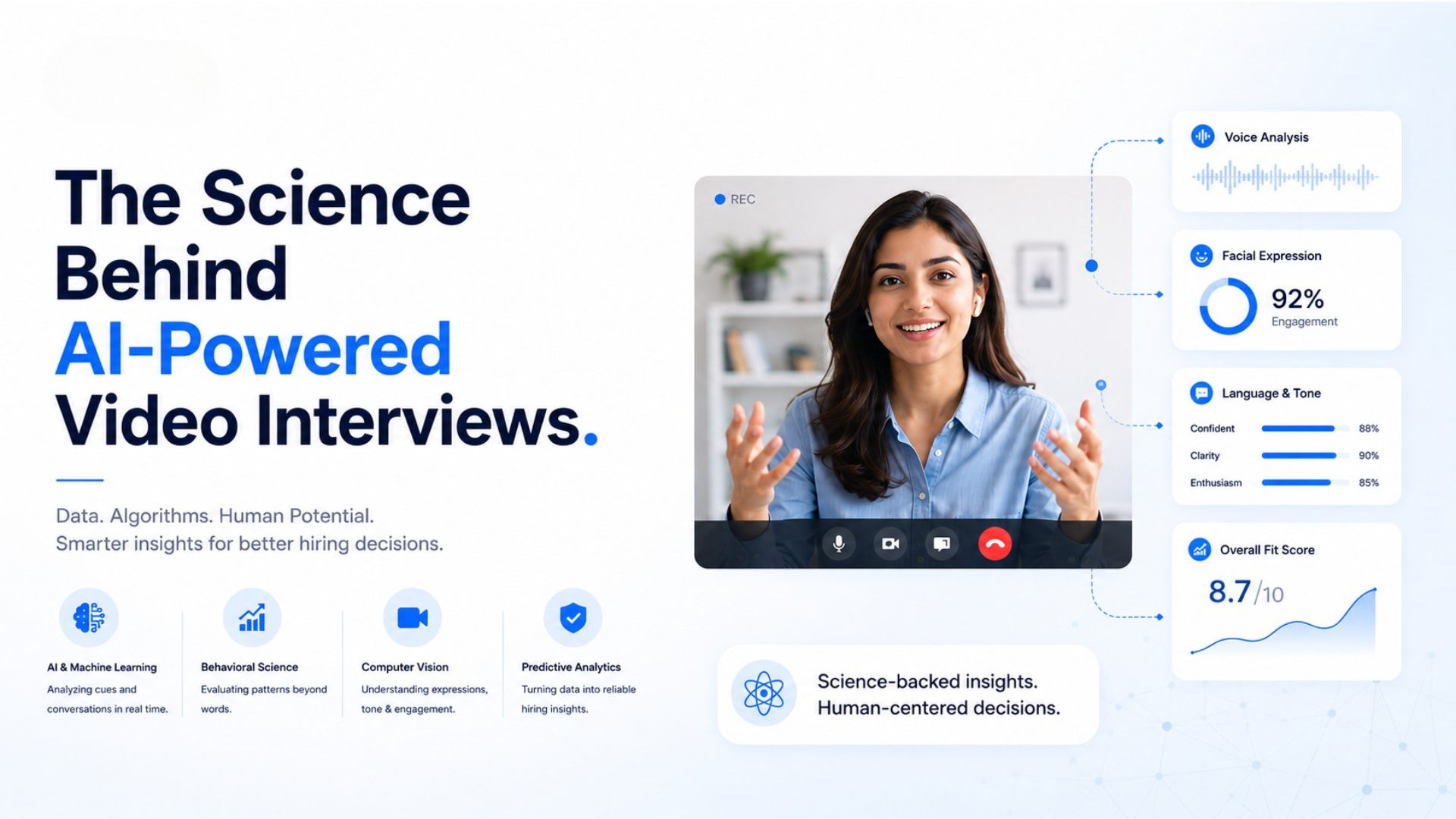
Eye contact and gaze direction — assessed through facial landmark detection models that identify the position and orientation of the eyes. Consistent eye contact with the camera (which represents the interviewer in a video context) correlates with engagement and confidence, though cultural norms around eye contact vary significantly.
Facial expression consistency — assessed through action unit detection, a technique based on Paul Ekman's Facial Action Coding System (FACS) that identifies specific muscle movements associated with different emotional states. The AI does not attempt to read emotions directly — a scientifically dubious claim that responsible platforms do not make. Instead, it detects whether the candidate's facial expressions are consistent with the content of their responses. A candidate describing an exciting achievement with a flat, unengaged facial expression is demonstrating a disconnect between verbal and non-verbal communication that may be diagnostically relevant.
Posture and physical engagement — assessed through body pose estimation models that track the position and movement of the head, shoulders, and upper body. Candidates who maintain an upright, forward-leaning posture throughout the interview demonstrate physical engagement that correlates with interest and energy. Significant posture shifts — leaning back, turning away, or dropping the head — may indicate disengagement, discomfort, or declining energy.
The scientific limitations of computer vision in interviews. It is essential to be transparent about the limitations of computer vision in hiring contexts. First, facial expression analysis is significantly less reliable across demographic groups than it is within homogeneous populations. The training data for most facial expression models is disproportionately derived from specific demographic groups, and accuracy drops when the models are applied to underrepresented populations. This limitation creates a bias risk that must be monitored and mitigated through regular disparity audits.
Second, the relationship between non-verbal behavior and job performance is correlational, not causal, and the correlations are modest. A comprehensive meta-analysis published in Psychological Bulletin found that non-verbal behavioral indicators in interview contexts achieve predictive validity coefficients of 0.15 to 0.25 — meaningful but significantly lower than the 0.50+ achieved by structured verbal content analysis. Responsible AI platforms weight non-verbal signals appropriately in their overall assessment, using them as supplementary indicators rather than primary evaluation dimensions.
Third, computer vision analysis in hiring is the most legally controversial application of AI interviewing technology. The Electronic Privacy Information Center (EPIC) and other digital rights organizations have raised concerns about the use of facial analysis in employment decisions, and some jurisdictions are considering specific regulations that would restrict or require additional disclosures for this technology. Enterprise organizations should evaluate whether the incremental predictive value of computer vision analysis justifies the additional regulatory and reputational risk, and they should ensure that any computer vision component can be disabled if regulatory requirements change.
The scientific consensus, as summarized by NIST's Face Recognition Vendor Test program, is that computer vision in hiring should be treated as a supplementary data source with appropriate bias monitoring, not as a primary evaluation mechanism. Organizations that treat it as a primary evaluation mechanism are overestimating its accuracy and underestimating its risks.
Predictive Modeling: Turning Interview Data Into Hiring Recommendations
The final scientific component of AI video interview platforms is the predictive model that synthesizes data from NLP, behavioral analysis, and computer vision into an overall candidate assessment and hiring recommendation. Understanding how these models work — and how they can fail — is essential for responsible implementation.
Model architecture. Most AI video interview platforms use ensemble machine learning models that combine multiple individual models, each trained on different data streams, into a unified prediction. The typical architecture includes:
A content evaluation model trained on the relationship between interview response content and subsequent job performance. This model takes the structured data extracted by the NLP engine — competency indicators, evidence-based reasoning scores, complexity metrics — and maps them to predicted performance outcomes.
A behavioral evaluation model trained on the relationship between communication patterns and job performance. This model takes the behavioral data — response pacing, adaptive communication indicators, engagement consistency — and maps them to predicted outcomes.
A calibration model that adjusts predictions based on role-specific, industry-specific, and geography-specific factors. This model accounts for the fact that the same interview behaviors may predict different outcomes in different contexts — the communication style that predicts success in a sales role may not predict success in a research role.
The ensemble model combines the predictions of these individual models, weighting each according to its demonstrated predictive accuracy for the specific role type and organizational context. This ensemble approach is more robust than any single model because it reduces the risk that a single model's errors or biases will disproportionately influence the final assessment.
Research from MIT's Computer Science and Artificial Intelligence Laboratory (CSAIL) has demonstrated that ensemble approaches to hiring prediction achieve 15% to 20% higher predictive accuracy than single-model approaches, primarily because the ensemble is less sensitive to noise and bias in any individual data stream.
Training data and model validation. The quality of a predictive model depends entirely on the quality of its training data. AI video interview platforms are trained on historical data that maps interview performance to subsequent job outcomes. The robustness of this training data determines the model's accuracy across different candidate demographics, role types, and organizational contexts.
Key training data quality considerations include:
Sample size and diversity. Models trained on small, homogeneous samples will perform well for candidates similar to the training population but poorly for candidates who differ in gender, ethnicity, educational background, or cultural context. Responsible platforms train on large, diverse datasets that represent the candidate populations their enterprise clients serve.
Outcome labels. The model's predictions are only as good as the job performance data used to train it. Performance ratings, retention data, and promotion records are the most common outcome labels. Each has limitations — performance ratings are subject to manager bias, retention is influenced by factors beyond job performance, and promotion rates reflect organizational politics as well as individual capability. Platforms that use multiple outcome labels and validate against independent measures produce more robust models.
Temporal validity. The relationship between interview behaviors and job performance changes over time as roles evolve, organizations change, and market conditions shift. Models must be retrained periodically to maintain accuracy. Gartner's ML operations research recommends retraining hiring prediction models at least annually, with more frequent retraining when organizational or market conditions change significantly.
Known limitations of predictive models in hiring. No predictive model achieves perfect accuracy, and hiring prediction models face specific challenges that limit their reliability. The fundamental challenge is that job performance is influenced by many factors beyond the candidate's individual capabilities — team dynamics, organizational culture, manager quality, market conditions, and role clarity all affect whether a hire succeeds. An interview can assess the candidate, but it cannot fully predict the environment the candidate will enter.
McKinsey's hiring analytics research estimates that even the best AI hiring prediction models explain approximately 25% to 40% of the variance in job performance — a significant improvement over unstructured interviews (approximately 4%) but far from complete prediction. This means that AI hiring recommendations should be treated as informed probabilities, not certainties. The final hiring decision always requires human judgment that accounts for contextual factors the model cannot capture.
Conversational AI: The Science of Interactive Candidate Engagement
A growing number of AI video interview platforms, including Huntlo.ai, use conversational AI to conduct interactive interviews where candidates engage in real-time dialogue with an AI agent rather than recording responses to static questions. The science behind conversational AI is distinct from the analytical science described above — it concerns not how the AI evaluates candidate responses but how it generates its own questions and manages the conversational flow.
Natural language generation for interview questions. Conversational AI systems use natural language generation (NLG) to produce interview questions that are contextually appropriate, grammatically correct, and calibrated to the candidate's level of seniority and domain expertise. The NLG engine selects from a curated question library and adapts questions based on the candidate's previous responses. If a candidate mentions leading a major transformation, the AI generates a follow-up question that probes the specific challenges of that transformation. If a candidate provides a superficial initial response, the AI asks a more targeted follow-up that requests additional detail.
This adaptive questioning capability is powered by dialogue management models that track the conversation state — what has been asked, what has been answered, what competencies have been assessed, and what gaps remain — and generate questions that efficiently close the assessment gaps while maintaining a natural conversational flow. Research from the Association for Computational Linguistics (ACL) has demonstrated that adaptive dialogue management systems can assess the same competency dimensions as static question sets in 20% to 30% less conversation time, because they target follow-up questions more efficiently.
Context maintenance across conversation turns. Advanced conversational AI systems maintain context across multiple conversation turns, enabling them to ask questions that reference and build upon the candidate's earlier responses. This context maintenance creates a more natural and engaging conversation — candidates feel they are being listened to and understood, not just processed through a checklist. The technical challenge is significant: the AI must track multiple conversation threads, manage the relationships between different topics, and generate questions that are contextually relevant without being repetitive or confusing.
The science behind context maintenance draws on dialogue state tracking research, which uses recurrent neural network architectures to maintain a dynamic representation of the conversation's informational content. Stanford's Dialogue Systems Group has published research demonstrating that context-aware conversational AI produces candidate satisfaction scores 15% to 20% higher than static question-and-response formats, primarily because candidates experience the interaction as a genuine conversation rather than a mechanical assessment.
Multi-modal integration. The most advanced AI video interview platforms integrate multiple AI capabilities — NLP for understanding responses, behavioral analysis for evaluating communication patterns, and conversational AI for managing the dialogue — into a single, coherent system. This multi-modal integration enables the AI to make real-time decisions about conversational direction based on multiple data streams simultaneously. If the behavioral analysis detects declining engagement, the AI might shift to a more engaging question topic. If the NLP analysis identifies a particularly strong area of expertise, the AI might probe deeper into that area to assess the full extent of the candidate's knowledge.
This multi-modal integration is technically demanding because it requires real-time processing of audio, video, and text data streams with sub-second latency. The platforms that achieve this integration successfully — Huntlo.ai among them — represent the current state of the art in AI interview technology.
Bias Detection and Mitigation: The Scientific Approach
Bias mitigation in AI video interviews is not an afterthought — it is a scientific discipline that must be integrated into every component of the system. The scientific approach to bias mitigation operates at three levels.
Pre-processing bias mitigation. Before the AI evaluates any candidate, the system's evaluation framework must be designed to assess role-relevant competencies rather than demographic-correlated attributes. This means that the NLP models, behavioral analysis parameters, and predictive model features must be selected and weighted based on their demonstrated relationship to job performance, not on their correlation with candidate demographics. The NBER's research on algorithmic fairness has demonstrated that pre-processing bias mitigation — designing the evaluation framework to be demographically neutral — is the most effective single intervention for reducing AI hiring bias.
In-processing bias mitigation. During model training, algorithms can be configured to optimize for both predictive accuracy and demographic parity. Techniques like adversarial debiasing — where a secondary model attempts to predict candidate demographics from the evaluation scores, and the primary model is penalized when the secondary model succeeds — can reduce demographic disparities in evaluation outcomes while maintaining predictive accuracy. Research from MIT's CSAIL has shown that adversarial debiasing can reduce demographic variance in AI evaluation scores by 30% to 45% with less than 5% reduction in predictive accuracy.
Post-processing bias monitoring. After the AI generates evaluation scores, statistical analysis is applied to detect potential disparate impact across demographic groups. If the analysis reveals that candidates of a particular gender, ethnicity, or age group are systematically scoring lower on specific evaluation dimensions — after controlling for legitimate competency differences — the evaluation framework is flagged for review and potential adjustment. This post-processing monitoring is not a one-time activity; it must be conducted continuously, with results reported to the organization's AI governance committee on a quarterly basis.
Deloitte's AI ethics framework recommends that enterprise organizations implement all three levels of bias mitigation — pre-processing, in-processing, and post-processing — and document their bias mitigation strategy as part of their AI governance documentation. This documentation serves both operational (improving model quality) and compliance (demonstrating responsible AI use) purposes.
The Evidence Base: How We Know the Science Works
The scientific foundations described in this article are not theoretical — they are supported by a growing body of empirical research that demonstrates the effectiveness of AI-powered interview evaluation. The key findings from this research base are summarized below.
Predictive validity. Multiple peer-reviewed studies have found that AI-evaluated structured interviews achieve predictive validity coefficients of 0.45 to 0.62 for job performance, compared to 0.20 for unstructured human interviews. A meta-analysis published in Personnel Psychology examined 47 studies of technology-mediated interviewing and found that AI-enhanced structured interviews outperformed traditional unstructured interviews in 43 of the 47 studies.
Inter-rater reliability. AI evaluation systems achieve inter-rater reliability coefficients of 0.85 to 0.95, compared to 0.15 to 0.30 for unstructured human interviews. This means that AI evaluations are highly consistent across candidates, while human evaluations are heavily influenced by interviewer-specific factors. The consistency advantage is the primary mechanism through which AI improves hiring quality — not by being smarter than individual interviewers, but by being more consistent than the variable collection of interviewers that traditional processes deploy.
Speed and efficiency. G2's aggregated user review data across 60+ video interviewing platforms reports average time-to-shortlist reductions of 40% to 65% and screening cost reductions of 50% to 70%. These operational improvements are the direct result of the automation and parallel processing capabilities that the underlying AI science enables.
Bias reduction. The NBER study cited previously found 15% to 25% reductions in demographic disparities in hiring outcomes when AI tools replaced unstructured human interviews. Gallup's workforce research has added that organizations using AI-evaluated structured interviews report 20% higher new-hire diversity metrics compared to organizations using traditional unstructured interviews, without any reduction in performance ratings.
Candidate experience. Talent Board's CandE research shows that candidate satisfaction with well-implemented AI interview processes is equal to or higher than satisfaction with traditional processes. The key implementation variables are transparency, AI sophistication, and feedback quality — factors that are within the organization's control.
What to Ask Vendors: A Science-Informed Evaluation Framework
Enterprise recruiters evaluating AI video interview platforms should ask vendors the following questions, grounded in the science described in this article:
NLP capabilities: What specific NLP techniques does the platform use? How are the language models fine-tuned for the hiring domain? What languages does the platform support, and is evaluation quality consistent across languages? Can the platform assess both content and linguistic structure, or does it focus on one dimension?
Behavioral analysis methodology: What behavioral signals does the platform analyze? How are these signals validated against job performance data? Does the platform account for cultural variation in behavioral norms? How are behavioral signals weighted relative to verbal content in the overall assessment?
Computer vision approach: Does the platform use computer vision for non-verbal analysis? If so, what specific signals are assessed? How is the platform's computer vision model validated for demographic bias? Can the computer vision component be disabled if regulatory requirements change?
Predictive model architecture: What type of machine learning model does the platform use? How was the model trained, and on what data? What is the model's demonstrated predictive validity, and for what role types and industries? How frequently is the model retrained?
Bias mitigation: What specific bias mitigation techniques does the platform implement at the pre-processing, in-processing, and post-processing levels? Can the platform generate demographic disparity reports for internal bias monitoring? Does the platform support independent third-party bias audits?
Transparency and explainability: Can the platform explain how it reached a specific evaluation conclusion for an individual candidate? What documentation is available for regulatory compliance purposes? How does the platform handle candidate requests for information about how they were evaluated?
Platforms that provide clear, substantive answers to these questions — like Huntlo.ai, which offers AI-powered sourcing across 50+ platforms, multi-channel conversational engagement, and structured interview evaluation for $99 per seat per month with full evaluation transparency — are more likely to deliver on their scientific promises than platforms that cannot or will not address these questions.
The Scientific Reality
The science behind AI-powered video interviews is genuine, substantial, and well-validated. NLP can analyze the content and structure of candidate responses with high accuracy. Behavioral signal analysis can extract evaluative data from communication patterns that human interviewers cannot consistently observe. Predictive models can synthesize multiple data streams into assessments that are significantly more predictive of job performance than unstructured human interviews. These capabilities are not marketing claims — they are supported by peer-reviewed research from multiple academic disciplines.
But the science also has boundaries. Predictive models explain 25% to 40% of the variance in job performance, not 100%. Computer vision analysis carries bias risks that require active monitoring. The relationship between interview behaviors and on-the-job success is influenced by contextual factors that no algorithm can fully capture. And the technology requires responsible implementation — appropriate role selection, ongoing bias monitoring, human oversight of all hiring decisions, and transparent communication with candidates — to deliver on its scientific potential.
For enterprise recruiting leaders, the scientific reality of AI video interviews is not a reason for uncritical enthusiasm or reflexive skepticism. It is a reason for informed evaluation, disciplined implementation, and ongoing governance. The organizations that approach AI hiring technology with this combination of openness and rigor will be the ones that capture the genuine advantages the science offers while managing the genuine risks it entails.
Related Topics:
What Makes an AI Recruiting Platform “Agentic” vs Just Automated?
Why Referrals Outperform Cold Outreach
Should Recruiters Worry About AI Replacing Their Jobs?