The Leadership Hiring Paradox: Highest Stakes, Lowest Structure
There is a persistent paradox at the heart of enterprise hiring that almost no organization acknowledges. The most consequential hiring decisions an enterprise makes — decisions about who will lead teams, departments, business units, and entire organizations — are made through processes that are dramatically less rigorous, less structured, and less evidence-based than the processes used for the least consequential hiring decisions.
Consider the contrast. A junior software engineer candidate at a technology company might face four to six rounds of structured interviews, a coding assessment, a behavioral interview with anchored scoring, a panel evaluation, and a calibration meeting before receiving an offer. A VP of Engineering candidate at the same company might face two unstructured conversations with the CTO and the CEO, a reference check, and an informal dinner — with no standardized evaluation criteria, no scoring rubric, and no structured comparison to other candidates.
This inversion is not rare. It is the norm. A 2024 Korn Ferry analysis of 200 enterprise leadership hiring processes found that only 18% used any form of structured interview for leadership positions above the director level, compared to 73% for individual contributor roles. The study found that the average leadership hire was evaluated through 2.3 interview rounds, compared to 4.7 for mid-level roles — and that only 12% of leadership interview rounds used pre-defined competency scoring.
The consequences of this structural deficiency are severe. McKinsey's 2024 Leadership Hiring report estimated that 40-50% of leadership hires fail within the first 18 months — defined as voluntary departure, involuntary termination, or being rated "below expectations" in performance reviews. The direct cost of a failed leadership hire, including search fees, severance, productivity loss during the vacancy, and the cost of the replacement process, ranges from 2x to 10x the leader's annual compensation, according to EY's 2024 Executive Hiring Cost Analysis. For a VP-level role with total compensation of $400,000, a single failed hire can cost the enterprise $800,000 to $4 million.
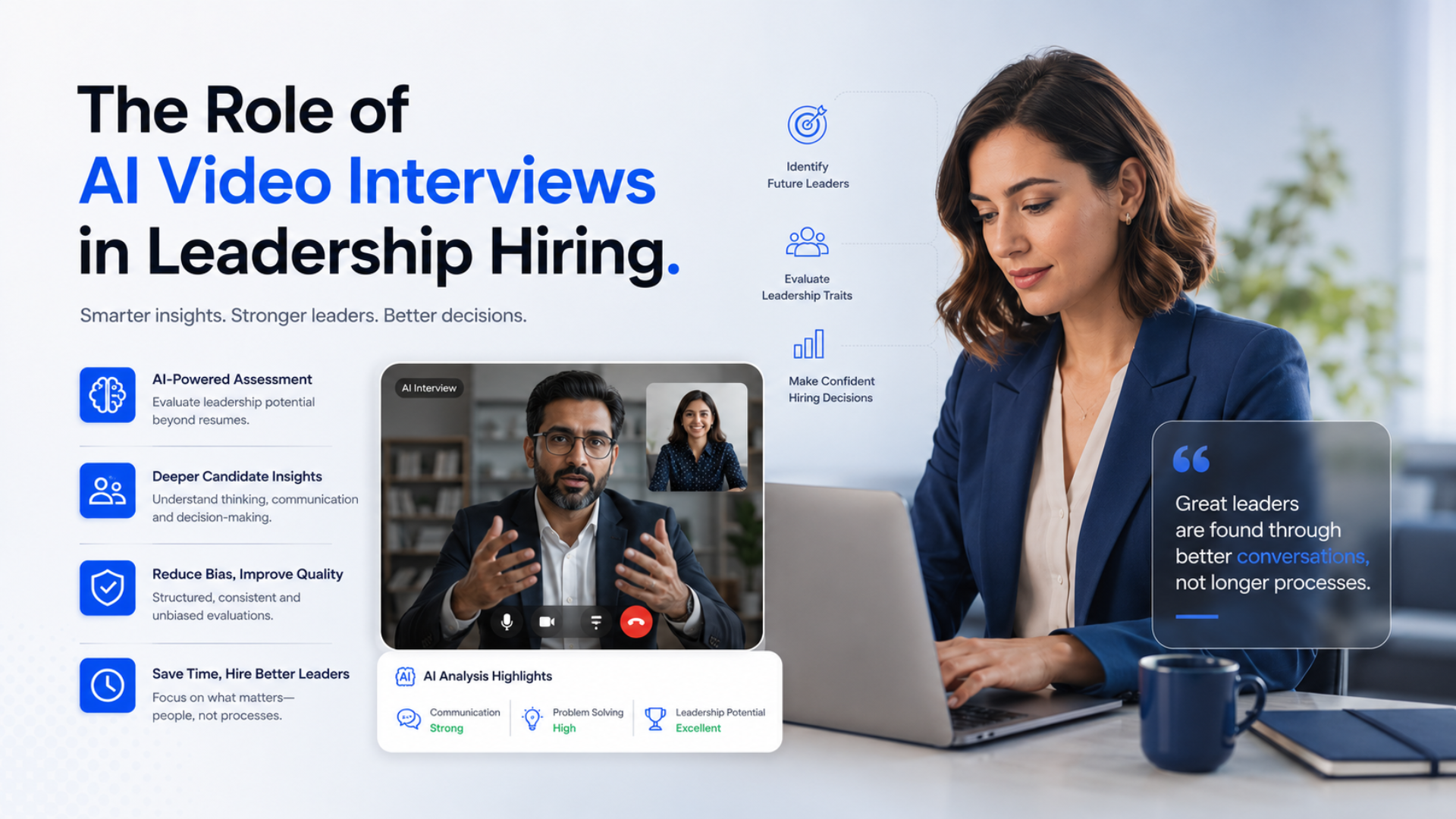
AI video interviews represent a practical mechanism for injecting structure, consistency, and data-driven evaluation into leadership hiring without sacrificing the depth, nuance, and executive-level discourse that leadership assessment requires. This article examines how.
Why Leadership Hiring Resists Standardization
Understanding why leadership hiring resists standardization is essential to understanding why AI video interviews are needed and how they must be designed differently for leadership contexts than for high-volume or mid-level hiring.
The "I'll know it when I see it" fallacy. Hiring managers and executives frequently believe that leadership assessment is an art that cannot be reduced to structured criteria. They argue that leadership is too complex, too contextual, and too dependent on intangible qualities — "executive presence," "strategic vision," "gravitas" — to be evaluated through standardized questions and scoring rubrics. This belief is understandable but empirically unsupported. A comprehensive SIOP meta-analysis published in 2024 found that structured interviews predicted leadership performance with validity coefficients of 0.48-0.59 — lower than for some technical roles but still substantially higher than the 0.20-0.30 validity of unstructured executive conversations.
Power dynamics suppress process discipline. When the CEO is the hiring decision-maker, the HR and TA professionals who would normally enforce process discipline often lack the organizational authority to insist on structured evaluation. The hiring process becomes whatever the CEO and the candidate agree to — which is typically an unstructured conversation that feels comfortable but produces unreliable evaluation data. A Harvard Business Review analysis of C-suite hiring processes found that TA professionals described feeling "unable to influence" the evaluation methodology in 78% of executive-level searches.
Confidentiality constraints limit evaluator pools. Leadership searches are often conducted under strict confidentiality, which limits the number of evaluators who can participate. When only two or three people evaluate a candidate, there is no opportunity for the kind of multi-rater calibration that supports reliable assessment. AI video interviews can provide an additional structured evaluation perspective without expanding the human evaluator pool or compromising confidentiality.
Executive search firms perpetuate unstructured approaches. Many enterprises outsource leadership hiring to executive search firms, which often use proprietary assessment methodologies that are not standardized across the client organization and that produce evaluation data that stays within the search firm rather than flowing into the enterprise's talent intelligence infrastructure. A 2024 Deloitte survey of 150 CHROs found that 62% described their executive search firm's evaluation reports as "insufficiently detailed" or "not comparable to internal hiring data."
The Specific Failures of Unstructured Leadership Evaluation
Unstructured leadership hiring produces a predictable pattern of failures that are well-documented in the research literature and familiar to any enterprise TA leader who has managed a leadership search.
The charisma trap. Unstructured leadership evaluation disproportionately rewards charismatic, verbally fluent candidates — candidates who present well in conversation, tell compelling stories, and create strong interpersonal rapport. While charisma is not irrelevant to leadership, research consistently shows that it is a poor predictor of leadership effectiveness. A 2023 study in the Academy of Management Journal found that charismatic candidates received 34% higher overall ratings in unstructured executive interviews but were only 8% more likely to be rated as high-performing leaders after 18 months on the job. The gap between interview performance and actual leadership effectiveness was largest for candidates who scored high on verbal fluency but low on strategic thinking and team-building competencies — precisely the candidates that unstructured evaluation most systematically over-rates.
Confirmation bias through narrative. Executive interviewers typically enter the conversation with a narrative about the candidate formed from the resume, the recruiter's briefing, and the interviewer's own expectations. In unstructured conversations, interviewers unconsciously steer the discussion toward themes that confirm this narrative — asking probing questions about strengths they expect to find and superficial questions about weaknesses they prefer not to examine. A 2024 study in the Journal of Organizational Behavior found that confirmation bias was 47% stronger in executive-level unstructured interviews than in structured interviews at any level, driven by the higher stakes and stronger pre-existing narratives that characterize leadership hiring.
Cultural homogeneity reinforcement. Leadership hiring is one of the most powerful mechanisms through which organizational culture is reproduced — or not. When leadership evaluation is unstructured, the primary selection criterion becomes "cultural fit," which in practice means similarity to the existing leadership team. A McKinsey Diversity Matters analysis found that companies in the bottom quartile for leadership diversity were 2.4 times more likely to use unstructured interviews for leadership positions than companies in the top quartile — suggesting that unstructured evaluation is both a symptom and a cause of leadership homogeneity.
Inability to compare candidates objectively. When three or four leadership candidates are evaluated through unstructured conversations with different interviewers asking different questions, there is no valid basis for comparison. The candidate who met with a more probing interviewer may appear weaker than the candidate who met with a more conversational interviewer — not because they are actually less qualified, but because they faced a more demanding evaluation. This comparison problem is especially damaging when the hiring committee must make a final selection among multiple strong candidates, a scenario that is common in leadership hiring.
How AI Video Interviews Bring Structure to Leadership Assessment
AI video interviews can address these failures by introducing the structural elements that leadership hiring currently lacks — without replacing the human judgment that remains essential for senior-level assessment. The key is designing the AI interview component as a complement to human evaluation, not a substitute for it.
Structured competency assessment as the first evaluation layer. In a well-designed leadership hiring process, the AI video interview serves as the first structured evaluation layer — a consistent, evidence-based assessment that every candidate completes before advancing to human-led executive conversations. The AI evaluates responses against a leadership competency framework that includes the dimensions most predictive of leadership success: strategic thinking, decision-making under ambiguity, stakeholder management, team development, change leadership, and communication clarity.
This structured first layer serves multiple purposes. It provides a consistent baseline that enables objective cross-candidate comparison. It generates structured evaluation data that human evaluators can use to prepare for their own conversations — focusing their limited time on probing areas where the AI identified strengths, concerns, or gaps. And it creates a data record that supports calibration, adverse impact analysis, and continuous improvement of the leadership hiring process.
Huntlo.ai's conversational AI screening engine supports this approach through configurable competency frameworks and multi-round structured conversations that can probe leadership competencies with the depth and nuance that executive assessment requires. The How Does an AI Hiring OS Connect Sourcing, Screening, and Interviews article on the Huntlo blog describes how this end-to-end architecture works for leadership-level hiring pipelines.
Eliminating the charisma-skill conflation. AI video interviews evaluate the content of candidate responses — the reasoning, the evidence, the specificity — rather than the presentation style. A candidate who speaks with modest charisma but demonstrates exceptional strategic thinking will receive high scores on the relevant competencies, while a highly charismatic candidate with shallow strategic reasoning will not. This content-focused evaluation directly addresses the charisma trap that undermines unstructured leadership assessment.
A 2025 Mercer study of AI-assisted leadership hiring at 12 enterprise organizations found that AI screening scores correlated 0.54 with 18-month leadership performance ratings, compared to 0.31 for unstructured human interview ratings in the same organizations. The improvement was driven primarily by the AI's ability to distinguish between charismatic presentation and substantive competence — a distinction that human evaluators in unstructured conversations consistently failed to make.
Enabling confidential, multi-rater data without expanding the evaluator pool. AI video interviews can provide a structured evaluation perspective that supplements human evaluators without requiring additional people to participate in the process. For highly confidential searches where only the CEO and one or two board members are involved, the AI provides an additional structured data point that can be used to validate or challenge the human evaluators' impressions. This is particularly valuable when the human evaluator pool is small and the risk of individual bias is correspondingly high.
Creating a leadership talent intelligence database. Every AI video interview generates structured evaluation data that can be stored, analyzed, and compared across candidates, roles, and time periods. Over multiple leadership searches, this data accumulates into a leadership talent intelligence database that reveals patterns: which competencies are most frequently associated with successful leadership hires, which interview questions produce the most discriminating evaluations, and how the organization's leadership talent pipeline compares to its strategic needs. This kind of institutional learning is impossible when leadership evaluation data lives in unstructured notes, individual memories, and search firm reports that are not integrated into the organization's talent systems.
Designing AI Video Interviews for the Unique Demands of Leadership Assessment
AI video interviews for leadership hiring must be designed differently than AI video interviews for high-volume or mid-level roles. The following design principles, drawn from SIOP guidance on executive assessment and Korn Ferry's leadership evaluation methodology, ensure that the AI interview is appropriate for senior-level candidates.
Use scenario-based and situational questions, not behavioral recollection. Mid-level interview questions often ask candidates to describe past experiences ("Tell me about a time when..."). This format works well for candidates with 3-10 years of experience but is limiting for senior leaders whose most relevant experiences may involve confidential strategic decisions, competitive dynamics, or personnel matters that cannot be discussed in a recorded format. Scenario-based questions — presenting a realistic leadership challenge and asking the candidate to walk through their decision-making process — are more appropriate for senior candidates because they evaluate thinking and judgment without requiring disclosure of confidential information.
Allow extended response depth. Leadership candidates should not be constrained to the 2-3 minute response windows typical of high-volume AI interviews. Huntlo.ai's platform supports configurable response times that allow leadership candidates to develop complex, multi-layered responses that demonstrate strategic thinking depth. The best AI leadership interviews allow 5-8 minutes per response for complex strategic scenarios, enabling candidates to demonstrate the kind of nuanced thinking that leadership roles require.
Design multi-round conversations, not single-question assessments. Effective leadership assessment cannot be accomplished through a single round of questions. Huntlo.ai's conversational AI supports multi-round structured interviews where follow-up questions are dynamically selected based on the candidate's previous responses — probing deeper into areas of strength, exploring areas of ambiguity, and challenging assumptions. This creates a structured conversation that approaches the depth of a human-led interview while maintaining the consistency and documentation advantages of AI evaluation.
Calibrate the competency framework to leadership level. The competencies evaluated in a leadership AI interview must reflect the actual demands of the target role. Entry-level and mid-level competency frameworks emphasize individual task performance and team contribution. Leadership competency frameworks must emphasize strategic influence, organizational change, stakeholder management, and executive decision-making. Using the wrong competency framework is one of the most common failures in leadership AI interview design — and one of the easiest to avoid.
Include strategic communication assessment. Leadership effectiveness is inseparable from communication effectiveness. The AI interview should evaluate not only what the candidate says but how they structure their reasoning, prioritize among competing considerations, communicate trade-offs, and frame complex issues for different audiences. These communication competencies are among the strongest predictors of leadership success and are well-suited to NLP-based evaluation.
The Business Case: The Financial Impact of Better Leadership Hiring
The financial case for improving leadership hiring quality is among the strongest in all of talent acquisition. The costs of leadership hiring failure are large, visible, and directly attributable to the hiring process — making the ROI of better leadership assessment unusually clear.
Direct failure costs. A failed leadership hire triggers a cascade of direct costs: executive search firm fees (typically 25-33% of first-year compensation), severance packages, legal review, productivity loss during the vacancy, and the cost of conducting a replacement search. For a VP-level role with total compensation of $400,000, EY estimates total failure costs of $800,000 to $1.5 million. For C-suite roles, failure costs can exceed $5 million.
Indirect organizational costs. Beyond the direct financial impact, a failed leadership hire inflicts organizational damage that is harder to quantify but potentially more consequential: team disruption, loss of key reports who followed the failed leader, strategic momentum lost during the transition period, erosion of organizational confidence in the leadership selection process, and damage to the employer brand among senior talent in the market. A Bain & Company analysis estimated that the indirect costs of a failed senior leadership hire are 2-3 times the direct costs — suggesting that the total cost of a single C-suite failure can exceed $10 million.
Opportunity cost of suboptimal selection. Even when a leadership hire does not fail outright, unstructured selection processes frequently result in suboptimal rather than optimal outcomes — choosing the best-available candidate from a shallow evaluation rather than the truly best candidate who would have been identified through more rigorous assessment. McKinsey research found that the performance differential between a top-quartile and median leadership hire is 15-25% in terms of team performance, strategic execution, and stakeholder satisfaction. For a business unit generating $100 million in revenue, this differential represents $15-25 million in annual value — a return that dwarfs the cost of implementing structured leadership assessment.
The Building a Business Case for AI Sourcing Tools to Your Leadership article on the Huntlo blog provides a detailed framework for quantifying these costs and presenting a compelling financial case for AI-augmented leadership hiring to executive stakeholders.
Real-World Implementation: How Enterprises Are Using AI for Leadership Hiring
Early adopters of AI video interviews for leadership hiring are demonstrating that the approach is both practical and impactful. Three enterprise case studies illustrate the range of implementations.
A Fortune 500 technology company implemented AI video interviews as the first evaluation layer for all VP-level and above hiring. Candidates complete a 45-minute structured AI interview covering strategic thinking, change leadership, stakeholder management, and decision-making under ambiguity. The AI evaluation data is provided to the human interview panel before their conversations, enabling them to focus their limited time on probing areas of interest identified by the AI. Within 18 months, the company reported a 31% reduction in leadership hiring failures (defined as departures or below-expectations ratings within 24 months), a 22% improvement in new-leader 360-degree feedback scores at the 12-month mark, and a 40% reduction in the time senior executives spent on initial screening conversations — time that was redirected to more strategic talent activities.
A global financial services firm used AI video interviews to bring consistency to its previously fragmented regional leadership hiring process. The firm's 12 regional offices had each operated independent leadership evaluation processes with different standards, different evaluators, and different criteria. By implementing a centralized AI video interview as the first evaluation layer for all regional leadership roles, the firm created a consistent baseline that enabled cross-regional comparison for the first time. Within a year, the firm identified a significant disparity in leadership evaluation standards between regions, implemented targeted calibration, and reduced inter-regional scoring variance by 44%. The firm also discovered that two regions had been systematically undervaluing strategic thinking competencies — a finding that would have been invisible without standardized evaluation data.
A healthcare system used AI video interviews to evaluate CEO candidates for its hospital network. The confidentiality requirements of the search limited the human evaluator pool to three board members, creating a significant bias risk. The AI video interview provided an additional structured evaluation perspective that the board used to validate their impressions and identify areas requiring deeper probing. The selected candidate received the highest AI evaluation scores on strategic thinking and stakeholder management — the two competencies the board had identified as most critical for the role — and was rated as "exceeding expectations" in the first annual performance review.
The Executive Search Firm Integration Challenge
Many enterprises rely on executive search firms for leadership hiring, and integrating AI video interviews into the search firm relationship requires careful navigation. Search firms may perceive AI evaluation as a threat to their proprietary assessment methodology, a disruption to their client relationship, or an unnecessary complication in a process they consider their core competency.
The most successful integration approaches treat the AI video interview as a complement to — not a replacement for — the search firm's assessment. The AI provides structured, consistent, and data-rich evaluation that supplements the search firm's qualitative judgment, industry expertise, and relationship-based assessment. The search firm's consultant can use the AI evaluation data to prepare more targeted human interviews, identify competency areas requiring deeper exploration, and provide the client with more structured and defensible hiring recommendations.
Enterprises that have successfully integrated AI video interviews with executive search firms report that the AI data actually strengthened the search firm relationship by providing a common evidence base for evaluation discussions, reducing the subjective disagreements that sometimes characterize leadership hiring decisions, and creating a more collaborative partnership between the enterprise's TA team and the search firm. The How Staffing Agencies Can Manage Multiple Client Mandates With AI article on the Huntlo blog discusses how AI tools are creating new models of collaboration between enterprises and their external hiring partners.
How Huntlo.ai Supports Leadership-Level AI Video Interviews
Huntlo.ai's platform is designed to support leadership-level assessment with the same structural rigor it brings to high-volume hiring, while accommodating the unique requirements of senior-level evaluation.
The conversational AI screening engine delivers structured leadership assessment through video, voice, and text channels, with configurable response times, multi-round conversation capabilities, and dynamic follow-up question selection that enables the depth of probing that leadership assessment requires. The competency framework is fully configurable, allowing enterprises to define leadership-specific evaluation dimensions — strategic thinking, change leadership, stakeholder management, executive decision-making — with behavioral anchors calibrated to the organization's leadership level and context.
The platform's integration with 50+ sourcing platforms ensures that leadership candidates from diverse sourcing channels — including executive search firms, professional networks, internal pipeline development, and direct outreach — enter the same standardized evaluation pipeline. Webhook-based ATS integration means that leadership evaluation data flows directly into the enterprise's talent systems, creating the institutional knowledge base that supports continuous improvement in leadership hiring.
The talent pool management capabilities are particularly valuable for leadership hiring, where candidates are often sourced proactively over extended time periods and may be evaluated across multiple leadership searches. Huntlo.ai's talent pool preserves AI evaluation data from previous interactions, allowing recruiters and hiring managers to track a leadership candidate's profile and evaluation history across multiple opportunities — a capability that is essential for building the kind of long-term leadership talent intelligence that supports strategic workforce planning.
The flat pricing model of $99 per seat per month with no usage caps is especially relevant for leadership hiring, where per-candidate or per-interview pricing would create a strong incentive to limit structured assessment to a narrow candidate pool. Leadership hiring already suffers from insufficiently broad candidate evaluation; per-interview pricing would exacerbate this problem. Huntlo.ai's uncapped model ensures that every leadership candidate can receive the same structured assessment without financial constraints.
What Is Agentic Recruiting and Why It Matters for Leadership Hiring
The next evolution of AI in leadership hiring is the move from automated tools to agentic systems — AI platforms that can pursue complex hiring goals across multiple steps, reason about what should happen next, and execute multi-stage workflows with minimal human intervention. What Is Agentic Recruiting? A Plain-English Guide (2026) on the Huntlo blog provides a comprehensive explanation of this evolution and its implications for enterprise recruiting.
For leadership hiring, agentic AI represents a significant advancement because leadership searches are inherently multi-stage, multi-stakeholder processes that require coordination across sourcing, screening, evaluation, scheduling, and decision-making. An agentic AI platform can manage this complexity — identifying potential leadership candidates, conducting initial outreach, administering structured AI interviews, synthesizing evaluation data, preparing briefing materials for human evaluators, and managing the workflow logistics that currently consume enormous amounts of TA and executive assistant time.
The key distinction is that agentic AI does not just automate individual tasks — it orchestrates entire hiring workflows, making decisions about sequencing, prioritization, and escalation based on the organization's hiring criteria and the specific characteristics of each search. For leadership hiring, where the process complexity is highest and the process infrastructure is weakest, this orchestration capability addresses a critical gap.
Governance and Ethics: Responsible AI in the Most Consequential Hiring Decisions
The stakes of leadership hiring demand the highest standards of AI governance. When an organization uses AI to help decide who will lead teams, manage budgets, and shape strategy, the ethical obligations are correspondingly elevated.
Transparency with candidates. Senior candidates expect — and should receive — clear disclosure about how AI is used in the evaluation process, what data is collected, how it is evaluated, and who has access to the results. The EU AI Act requires this transparency for high-risk AI systems including hiring tools, and best practice exceeds the regulatory minimum by providing candidates with a clear, respectful explanation of the AI's role as one evaluation input among many.
Human decision-making authority. AI evaluation should inform leadership hiring decisions, never make them. The final decision for any leadership position must rest with human evaluators who can consider the full context — including factors that the AI cannot assess, such as organizational culture dynamics, team composition, strategic timing, and the subjective judgment of experienced leaders. This human-in-the-loop principle is both an ethical best practice and, increasingly, a legal requirement under frameworks like New York City's Local Law 144 and the EU AI Act.
Bias auditing at leadership level. Leadership hiring is not exempt from the bias risks that affect all AI hiring tools. Regular bias audits should examine whether AI evaluation scores show disparate impact across demographic groups, whether the competency framework reflects the full range of leadership styles that contribute to organizational success, and whether the interview questions are culturally accessible to candidates from diverse backgrounds. SHRM's 2025 AI Ethics in Recruitment guidelines recommend that AI systems used in leadership selection receive enhanced governance scrutiny given the disproportionate impact of leadership hiring decisions.
Data security for senior candidate information. Leadership candidates include senior executives, board members, and C-suite leaders whose personal and professional information is highly sensitive. AI video interview platforms must meet the highest standards of data security, encryption, and access control to protect this information. Huntlo.ai's platform architecture includes enterprise-grade security controls appropriate for the sensitivity of leadership-level candidate data.
The Competitive Advantage of Leadership Hiring Excellence
In a talent market where leadership quality is the most significant differentiator between high-performing and average-performing organizations, the enterprises that hire leaders most effectively will outperform their peers by every meaningful measure. McKinsey's 2024 Leadership Matters report found that organizations in the top quartile of leadership hiring quality were 2.4 times more likely to outperform their industry peers on financial metrics, 1.8 times more likely to be rated as "highly innovative" by employees, and 3.1 times more likely to be ranked among their industry's "best places to work."
AI video interviews are not a complete solution to the leadership hiring challenge. They are one tool in a broader toolkit that includes executive search, assessment centers, reference analysis, and human judgment. But they are a tool that addresses the most fundamental weakness in current leadership hiring: the absence of structured, consistent, and evidence-based evaluation at the stage where the stakes are highest.
For enterprises that are serious about improving leadership hiring quality — not as a one-time initiative but as a sustained operational commitment — AI video interviews provide the structural foundation that makes continuous improvement possible. By generating consistent evaluation data, enabling objective cross-candidate comparison, and supporting the kind of institutional learning that transforms leadership hiring from an art practiced by individuals into a capability built into the organization, AI video interviews help enterprises hire leaders who perform, stay, and build the kind of organizations that attract more exceptional leaders.
Related Topics
Building a Business Case for AI Sourcing Tools to Your Leadership — A detailed framework for quantifying leadership hiring costs and presenting a compelling financial case for AI-augmented assessment to C-suite and board-level stakeholders.
How Does an AI Hiring OS Connect Sourcing, Screening, and Interviews — How end-to-end AI hiring platforms unify sourcing, structured screening, and interview evaluation into a single integrated workflow for leadership-level pipelines.
What Is Agentic Recruiting? A Plain-English Guide (2026) — The evolution from automated tools to agentic AI systems that can orchestrate complex, multi-stage leadership hiring workflows with minimal human intervention.