A typical staffing agency recruiter manages 20 to 30 open requisitions at once, and each placement requires 15 to 20 qualified submittals to close, according to GoPerfect's 2026 comparison of AI sourcing agents for staffing agencies. At traditional manual sourcing speeds of two to three candidates a day, that same research is blunt about the math: hitting placement targets across that volume is close to impossible without either adding headcount or fundamentally changing how sourcing gets done.
What makes this genuinely harder than a comparable in-house hiring workload isn't just the volume — it's the structure underneath it. As Bullhorn's 2026 breakdown of recruitment software features puts it directly, a staffing agency recruiter isn't managing one relationship at a time; they're managing three simultaneously for every open role — the candidate, the client, and the placement connecting them — and doing that across a dozen or more concurrent client mandates multiplies the coordination burden in a way a single in-house recruiting desk never has to deal with. This guide covers how AI actually changes that math for agencies managing multiple client mandates at once, where the specific bottlenecks sit, and where human judgment still has to stay firmly in the loop.
Why Multi-Client Mandate Management Is a Structurally Different Problem
Before getting into specific fixes, it's worth being precise about what makes running several client mandates simultaneously harder than running several open roles for a single employer. An in-house recruiter managing multiple open reqs is still working for one hiring organization, with one candidate experience standard, one employer brand, and one system of record. An agency recruiter working the same number of open roles is doing so across multiple distinct client relationships, each with its own hiring bar, its own candidate presentation expectations, its own commercial terms, and — critically — its own pool of candidates that shouldn't be crossed with another client's search without deliberate thought.
This is exactly the coordination problem Aqore's 2026 staffing industry trends report frames around what it calls the "fragmentation problem" — disparate CRM, ATS, payroll, and compliance tools that create operational blind spots, which the same report estimates costs agencies 15-25% in margin leakage when left unaddressed. For a single-client hiring team, a fragmented tech stack is an efficiency problem. For an agency running several client mandates through the same fragmented stack, it's also a data-integrity and client-trust problem, since candidate crossover or a missed status update on a given mandate is far more visible and far more damaging to a specific client relationship than an equivalent slip inside a single company's own hiring process.
The Bottleneck Chain: Why Fixing One Stage Alone Rarely Solves the Problem
A useful way to think about where AI actually helps is to trace the full chain a candidate moves through on any given mandate, since a bottleneck at any single stage delays everything downstream of it. Intervuebox's 2026 analysis of staffing agency hiring bottlenecks lays this out explicitly: a slow sourcing stage delays outreach, which delays screening, which delays pre-screening calls, which delays interviews, which delays assessment, which delays the offer — and by the time that chain finally resolves, the candidate who was worth developing three weeks ago may have already accepted a competing offer. That analysis notes candidates are frequently off the market within 10 days of becoming available, which puts real pressure on every stage in the chain, not just the first one.
This has a direct implication for how an agency should approach AI adoption across multiple mandates: fixing sourcing speed alone, while leaving screening or scheduling as a manual bottleneck, doesn't actually shorten the end-to-end mandate timeline as much as it might appear to on paper. The research consistently recommends a staged approach instead — Intervuebox's analysis specifically suggests starting with whichever bottleneck offers the fastest, most measurable ROI (often pre-screening or scheduling), proving the case internally, and expanding outward from there, rather than attempting to automate the entire chain simultaneously across every open mandate at once.
Sourcing and Outreach: Where Volume Pressure Is Most Acute Across Multiple Mandates
Sourcing is where the sheer arithmetic of running several mandates simultaneously hits hardest, since every additional open client requisition adds another parallel search a recruiter has to run without proportionally more hours in the day. Atlas's 2026 comparison of AI recruitment tools for staffing agencies frames the core value proposition specifically around this constraint: AI recruitment software helps agencies manage high volumes of candidates and client activity without increasing headcount, by automating the repetitive, admin-heavy tasks — updating records, logging communication, scheduling — that otherwise limit how many concurrent mandates a single recruiter can realistically run well.
Voice AI screening has become a particularly visible example of this shift specifically because of how directly it affects the speed-to-first-contact race described above. RecruitBPM's 2026 guide to AI in talent acquisition for staffing agencies notes that voice AI recruiters are already operational at several major staffing firms, conducting initial screening calls around the clock — asking about availability, salary expectations, and role-specific qualifications immediately after a candidate applies or responds, rather than the candidate waiting days for a human callback. The competitive implication for agencies running multiple mandates simultaneously is direct: if a competing agency's AI voice screen reaches a shared candidate within minutes of a response while your team follows up two days later, the mandate outcome is often already decided regardless of relationship quality or fee structure.
Keeping Client Mandates Properly Segregated as Volume Scales
Running AI-assisted sourcing and outreach across many concurrent client mandates raises a specific operational risk that a single-employer hiring process doesn't have to manage: candidate and client crossover. A candidate sourced for one client's confidential search shouldn't be accidentally engaged for a second client's role without deliberate consideration, and a client shouldn't be able to see or infer another client's specific hiring activity through a shared system.
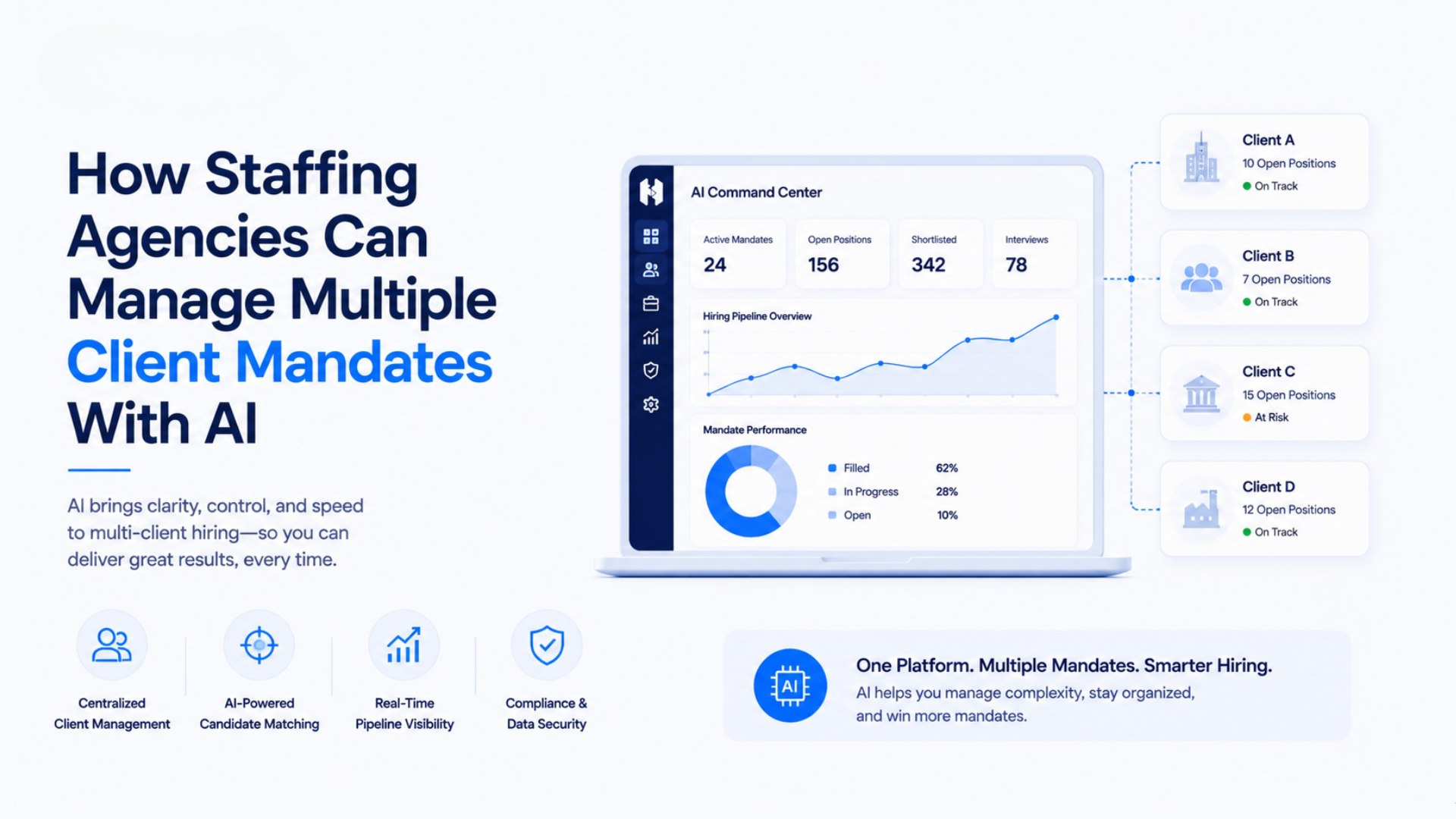
The practical fix, consistent with how the strongest agency-focused platforms are built, is running each client mandate as its own contained workspace — its own sourcing session, its own outreach sequences, its own reply tracking, and its own pipeline visibility — rather than pooling all active candidates and clients into a single undifferentiated view. Bullhorn's own recruitment software research frames this as a collaboration requirement as much as a compliance one: shared visibility into who's already been contacted on a given mandate is what stops two recruiters on the same team from independently calling the same candidate about the same client's role in the same week — a specific, avoidable failure mode that becomes more likely, not less, as an agency adds recruiters and mandates simultaneously without a system enforcing that separation.
The Compliance Layer Gets More Complicated, Not Less, Across Multiple Clients
Running AI-assisted hiring processes across several client mandates simultaneously means an agency's compliance exposure isn't singular — it potentially spans every jurisdiction each client mandate touches. RecruitBPM's research flags two requirements specifically relevant here: the EU AI Act's obligations for general-purpose AI, which took effect for hiring-relevant systems in August 2026, and New York City's Local Law 144, which requires an annual bias audit and candidate notification before using automated employment decision tools — a requirement that applies to any agency placing candidates into NYC-based roles, regardless of where the agency itself is headquartered.
This matters more for agencies than for a single in-house hiring team specifically because an agency's various client mandates can span multiple regulatory jurisdictions simultaneously, meaning a single AI tool deployed uniformly across all mandates needs to satisfy the strictest applicable requirement across that entire client portfolio, not just the requirements of the agency's home jurisdiction. RecruitBPM's research is direct about the operational consequence: choosing an AI recruiting vendor with built-in compliance features has stopped being optional and become a baseline requirement for operating responsibly across a multi-client, multi-jurisdiction footprint in 2026.
Candidate perception adds a related pressure worth taking seriously. The same research cites survey data finding that 66% of job seekers say they would not apply to companies that use AI to make hiring decisions — though it's careful to note the actual objection is more specific than a blanket rejection of AI involvement: candidates aren't opposed to AI supporting the process, they're opposed to AI replacing the human relationship entirely. For an agency, whose entire commercial value proposition often rests on relationship quality and candidate trust across every client mandate it runs, this distinction is worth building into how AI gets positioned to candidates directly — as a tool that gets a recruiter to them faster, not as a replacement for the recruiter relationship itself.
The Human-AI Division of Labor That Actually Holds Up at Multi-Mandate Scale
A consistent finding across current staffing industry research is that AI works best across multiple concurrent mandates when it's deployed for a specific, well-defined share of the work rather than attempting to run the entire process autonomously. Aqore's 2026 industry trends report puts a specific figure on this: agentic AI in 2026 independently manages roughly 80% of transactional recruitment tasks — sourcing, screening, interview scheduling, and compliance documentation — while the recruiter's remaining focus concentrates on the roughly 20% of activity that generates the most value: relationship-building, cultural fit assessment, and high-stakes negotiation, the parts of the job that don't scale cleanly through automation regardless of how many mandates are running simultaneously.
Kinematic Labs' 2026 guide to AI for staffing agencies reinforces this with independent survey data: 93% of hiring managers report that human involvement remains essential in the hiring process even with AI handling the transactional workload, a figure the same guide interprets as evidence that the winning model isn't "AI replacing recruiters" but recruiters shifting their time toward the work that's genuinely difficult to automate — closing, cultural assessment, and the client-side relationship management that determines whether a mandate gets repeated business.
This division of labor becomes especially important across multiple simultaneous mandates specifically because recruiter attention is the scarcest resource in the system. If AI reliably absorbs the transactional 80% across every open mandate, a recruiter's finite relationship-building hours can be allocated based on which mandates most need a human touch at any given moment — rather than being consumed by administrative tasks on every mandate equally, regardless of which ones actually need the recruiter's direct attention that day.
Measuring Whether AI Is Actually Helping Across Multiple Mandates
Kinematic Labs' research offers a specific, disciplined approach worth adopting directly: measure one metric first — typically time-to-first-response or time-to-interview — before expanding an AI tool's scope across additional mandates or additional stages of the funnel. If that specific metric doesn't improve within roughly 30 days of adoption, the guidance is direct: don't expand the tool's scope further until the underlying issue is diagnosed, since agencies that skip this discipline consistently end up carrying expensive AI licenses without any real accountability for whether they're actually moving mandate outcomes.
Bias auditing deserves specific mention as a metric category, not just a compliance checkbox. Kinematic Labs' research cites survey data finding that only 29% of organizations currently audit their AI hiring tools for demographic bias in shortlist outcomes, while agencies that do run well-audited AI tools report 25% more diverse candidate pools as a direct result — a meaningful business outcome for agencies whose clients increasingly ask about diversity metrics as part of the mandate itself, not simply a defensive compliance measure.
Where a Tool Like Huntlo Fits
The specific structural requirement this guide has described throughout — running each client mandate as its own contained sourcing and outreach effort, with pipeline visibility that doesn't bleed across clients, while still running fast enough to compete for candidates who are off the market within days — is directly reflected in how Huntlo is built for agency use specifically. Each open client mandate gets its own campaign workspace, with agentic AI sourcing across 50+ public platforms, autonomous email and WhatsApp outreach, and pipeline visibility scoped to that specific client — rather than pooling every active search into one undifferentiated view a recruiter has to manually keep separated by memory and discipline alone.
For an agency managing multiple simultaneous mandates, this means the sourcing and first-outreach stages — the ones consuming the largest share of manual recruiter time across the highest volume of concurrent searches — run autonomously per mandate, with follow-up sequences that continue automatically for non-responders and halt the moment a candidate engages. That doesn't replace the recruiter judgment this guide has emphasized throughout — closing, cultural fit assessment, and the client relationship itself remain squarely human work — but it directly addresses the volume-and-segregation problem that makes running many client mandates simultaneously so much harder than running the same number of open roles for a single employer.
Frequently Asked Questions
How many client mandates can a single recruiter realistically manage with AI support? There's no fixed number, since it depends heavily on role complexity and mandate seniority, but current agency data on manual sourcing capacity — roughly two to three candidates a day per recruiter without AI support — suggests the ceiling on unassisted mandate volume is considerably lower than what AI-supported sourcing and outreach can sustain across the same headcount.
Does using AI across multiple client mandates increase the risk of candidate or client crossover? It can, if mandates aren't run in properly segregated workspaces. The risk isn't inherent to AI itself — it's a system design question, and platforms built specifically for multi-client agency use address it by scoping sourcing, outreach, and pipeline visibility to each individual mandate rather than pooling everything into a shared view.
Should an agency worry about candidates rejecting AI-assisted outreach outright? The research suggests the concern is more specific than a blanket rejection — candidates object to AI replacing the human relationship entirely, not to AI supporting a recruiter's process. Positioning AI as the mechanism that gets a recruiter to a candidate faster, rather than as a replacement for that recruiter relationship, tends to align with what candidates actually report being comfortable with.
What's the fastest way for an agency to know if an AI tool is actually working across its mandates? Pick one specific, measurable metric — time-to-first-response or time-to-interview is the most commonly recommended starting point — and track it for about 30 days before expanding the tool to additional mandates or additional stages of the hiring funnel. If that metric doesn't move, the tool's scope shouldn't expand until the underlying issue is understood.
The Bottom Line
Managing multiple client mandates simultaneously has always been a structurally harder problem than managing multiple open roles for a single employer, because every additional mandate adds not just volume but a fully separate client relationship, candidate pool, and compliance context that needs to stay properly segregated from every other mandate running in parallel. AI genuinely changes the math here — but specifically for the transactional 80% of the work, sourcing, outreach, screening, and scheduling, while the relationship-driven work that actually closes placements and retains client accounts stays firmly human.
If sourcing and outreach volume across several concurrent client mandates is the current bottleneck limiting how many searches your team can run well at once, Huntlo's agentic AI sourcing and outreach platform is built specifically around per-client mandate workspaces — worth testing directly against your next open client requisition with the free trial.