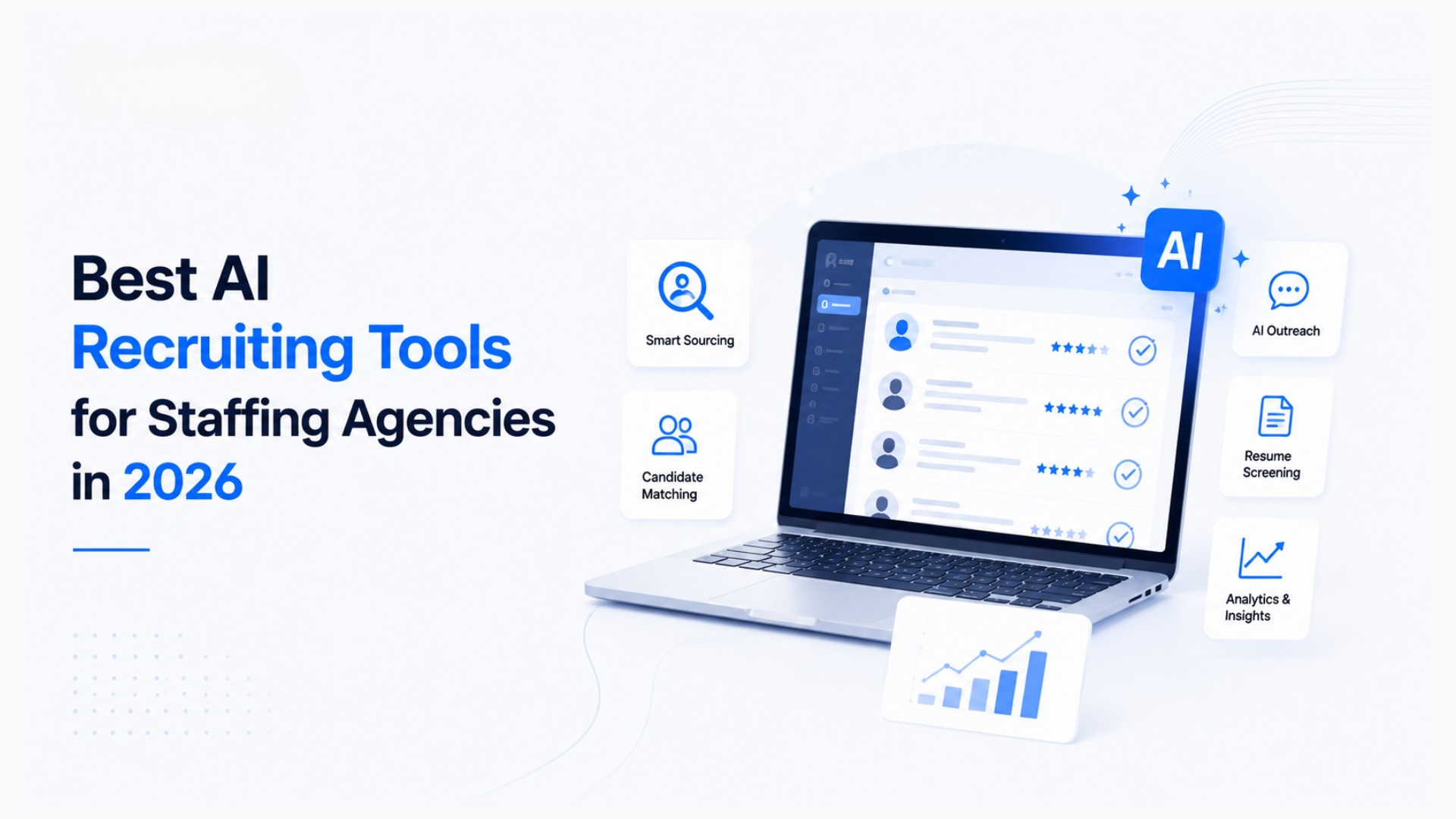
Staffing agencies don't have the luxury of slow hiring. Every open requisition comes with a client SLA, a recruiter juggling 20-30 other reqs, and a placement fee on the line. In an industry where revenue is a direct function of submittals per week, the agencies pulling ahead in 2026 are the ones that have quietly rebuilt their tech stack around AI — not as an experiment, but as infrastructure.
The data backs this up. Bullhorn's GRID 2026 Industry Trends Report found that top-performing staffing firms are four times more likely to be using AI, and 78% of firms that grew revenue by more than 25% were running AI across their recruiting workflows. This isn't about automating one task in isolation — it's about rebuilding sourcing, outreach, screening, and placement as a connected pipeline.
This guide breaks down the AI recruiting tools actually worth evaluating if you run a staffing desk in 2026 — what each one does well, where it falls short, and how to think about building a stack instead of collecting point solutions.
Why AI Recruiting Tools Matter More for Agencies Than In-House Teams
Most "best AI recruiting tools" lists are written for corporate HR teams managing inbound applicants. Staffing agencies operate differently — outbound, high-volume, and juggling multiple client mandates at once. A tool built for a single hiring manager's inbox doesn't translate well to a desk running 15 open reqs across five clients.
The core economics of a staffing desk make this urgent. A recruiter sourcing manually can typically surface 2-3 qualified candidates a day. That caps most desks at one or two placements a month per recruiter — nowhere near what agencies need to hit revenue targets. AI sourcing and outreach tools change that math by compressing the hours recruiters spend on Boolean search strings, manual list-building, and one-by-one outreach into minutes, freeing recruiter time for the parts of the job that actually close deals: relationship-building and candidate conversations.
At the same time, the market has gotten noisy. There are now well over 300 tools marketed as "AI recruiting software," and a large share of them are thin wrappers around general-purpose language models with a recruiting-flavored UI. The tools worth paying for solve a specific bottleneck — sourcing, outreach, screening, or scheduling — and integrate cleanly with the ATS your team already lives in.
What to Look for in an AI Recruiting Tool for Staffing Agencies
Before comparing tools, it helps to have a short checklist. Based on how staffing agencies actually use these platforms, the criteria that matter most are:
ATS/CRM integration depth — Does it sync bidirectionally with Bullhorn, JobAdder, Loxo, or Crelate, or does it create a second system recruiters have to update manually?
Multi-client / multi-mandate support — Can each open req or client mandate run as its own workspace with its own pipeline visibility?
Outreach channels — Email alone is no longer enough. WhatsApp, SMS, and AI voice are increasingly standard for candidate engagement.
Sourcing breadth — Does it search beyond LinkedIn to pull from technical profile sites, portfolios, and other public platforms?
Time to value — Can a recruiter get usable output in the first week, or does it require weeks of setup and training?
Evidence of ROI — Look for concrete numbers (time-to-fill, reply rates, submittals per recruiter) rather than vague productivity claims.
With that framework in mind, here's how the leading tools stack up.
The Best AI Recruiting Tools for Staffing Agencies in 2026
1. Huntlo — Best for Agentic AI Sourcing and Multi-Channel Outreach
Huntlo is built specifically around the outbound reality of agency recruiting: new reqs land daily, clients expect a pipeline within hours, and recruiters can't afford to bounce between LinkedIn tabs, spreadsheets, and a separate outreach tool. Huntlo's agentic AI recruiting infrastructure consolidates that entire motion into one workspace.
Recruiters describe the ideal candidate in plain English instead of building Boolean strings, and Huntlo's AI agents source across 50+ public professional platforms — not just LinkedIn — before scoring and ranking candidates by fit. From there, outreach runs autonomously across email, WhatsApp, and AI voice screening, with automated follow-up sequences for non-responders and reply-driven qualification, so a submittal-ready pipeline builds itself while a recruiter is on other calls.
For agencies specifically, every client mandate gets its own campaign workspace — sourcing sessions, outreach sequences, reply tracking, and pipeline visibility per client — which solves one of the most common failure points in agency tech stacks: reqs and outreach getting tangled across clients.
Best for: Staffing and recruitment agencies managing multiple concurrent client mandates that need sourcing, outreach, and screening in one system rather than three. Standout feature: Natural-language sourcing across 50+ platforms combined with autonomous email, WhatsApp, and AI voice outreach in a single workflow. Pricing: 7-day free trial (3 active roles, 30 candidate searches); paid plans start at $99 per seat/month.
2. Bullhorn (with Bullhorn AI Assist) — Best for Agencies Already Standardized on Bullhorn
Bullhorn remains the market-leading ATS for staffing firms, and its AI add-ons now build candidate search, match scoring, and email generation directly into the screens recruiters already use. Bullhorn's own AI matching surfaces candidates whose actual capabilities fit the role, not just whose resume has the right keywords according to the company's 2026 AI tools roundup.
Best for: Agencies that want to layer AI onto an existing Bullhorn instance with minimal switching costs. Trade-off: Native features are strong, but firms often still need a dedicated sourcing or outreach layer for outbound-heavy desks.
3. Crelate — Best All-in-One ATS/CRM for Small-to-Mid-Size Agencies
Crelate combines ATS, CRM, and job distribution in a single platform built specifically for agency operations. Recent AI additions handle candidate-to-requisition matching, and the platform posts to 50+ job boards in one click. According to GoPerfect's 2026 comparison, Crelate's sweet spot is small-to-mid-size agencies with five to thirty recruiters.
Best for: Boutique agencies that want one platform rather than stitching together point solutions.
4. Recruit CRM — Best ATS+CRM for Embedded AI Features
Recruit CRM pairs a staffing-specific ATS/CRM with embedded AI resume parsing, candidate summary generation, and job-to-candidate matching. In hands-on testing by SelectSoftwareReviews, the AI resume parser structured a mixed stack of PDF and Word resumes quickly and accurately, and the job-candidate matching tool returned legitimately strong top candidates using adjustable importance sliders.
Best for: Agencies that want deal-tracking, sales-pipeline features, and third-party candidate submissions built around AI-assisted screening.
5. Recruiterflow — Best for AI Agents Handling Admin Work
Recruiterflow positions itself as an AI-first ATS/CRM built for recruitment agencies, with what it describes as the largest suite of AI agents in the category for handling administrative recruiter work. Per Recruiterflow's own comparison, the platform is built to help agency recruiters "double productivity" by offloading repetitive admin tasks to AI agents.
Best for: Agencies looking to reduce recruiter admin load without adopting a separate point solution.
6. JobTalk AI — Best for Agentic Voice Screening at Scale
JobTalk AI focuses on autonomous outreach and AI voice screening in 30+ languages, with ATS writeback into systems like JobDiva. Independent testing from JobTalk's own comparison guide found that voice AI platforms handling screening calls autonomously cut recruiter phone time by 60-80% and processed three to five times more candidates per week than manual screening.
Best for: High-volume desks where phone screening is the primary bottleneck.
7. CoRecruit — Best for AI Notetaking and ATS Data Hygiene
CoRecruit focuses on a single, high-friction problem: capturing recruiter calls and pushing clean notes directly into the ATS without a visible meeting bot. In its own 2026 buyer's survey, of surveyed agency users ranked AI notetaking as the single most important feature in their recruiting AI stack, and 73% reported saving more than four hours a week after adoption.
Best for: Agencies whose biggest problem is stale or incomplete ATS data rather than sourcing volume.
8. Sense — Best for Contractor and Candidate Engagement at Scale
For agencies with a large contract or temp workforce, an engagement layer matters as much as a sourcing tool. Sense specializes in automated, personalized candidate and contractor communication at scale — nurture campaigns, redeployment outreach, and check-ins that keep a bench warm between assignments.
Best for: Staffing firms with a sizable temp or contractor population that need ongoing engagement, not just initial placement.
9. hireEZ / SeekOut — Best for Deep Web Sourcing
Both platforms specialize in pulling candidate profiles from across the open web — LinkedIn, GitHub, portfolio sites, and more — rather than relying on a single network. According to Recruiterflow's tool roundup,hireEZ's AI-powered search features help recruiters find seven times more qualified candidates in less time.
Best for: Niche or technical searches where LinkedIn alone doesn't surface enough qualified candidates.
10. Manatal — Best Budget-Friendly Option for Small Agencies
Manatal offers AI sourcing, profile enrichment across 20+ platforms, and access to 2,500+ job boards at a lower price point than most competitors on this list. Per PeopleManagingPeople's independent review, Manatal is a good fit for in-house HR teams and staffing agencies at small to mid-sized companies that need an affordable, AI-driven ATS to manage high-volume hiring.
Best for: Smaller agencies or new desks that need AI sourcing without a large software budget.
How to Build an AI Recruiting Stack Instead of Collecting Tools
Buying every tool on this list is a fast way to end up with more admin, not less. Most agencies don't need ten platforms — they need three or four that work together cleanly:
One ATS/CRM as the system of record — Bullhorn, Crelate, Loxo, JobAdder, or similar.
One AI sourcing and outreach layer — this is where a tool like Huntlo replaces manual LinkedIn searching, list building, and follow-up emails with an autonomous, multi-channel workflow.
One intelligence layer for call capture and notetaking that writes back into the ATS automatically.
One engagement layer if the agency manages a meaningful contractor or bench population.
Start with the tool that removes your biggest bottleneck first — usually sourcing and outreach volume, since that's the stage where recruiter hours are most easily replaced by automation — then layer in specialized tools only as adoption and measurable ROI justify it. As Greenhouse's 2026 buyer's guide puts it, a lot of the category is "AI theater" — what matters is whether a tool holds up in daily recruiter use after week one, not how it looks in a demo.
Frequently Asked Questions
Do AI recruiting tools actually reduce time-to-fill for staffing agencies? Independent testing suggests yes, when the tool matches the agency's real bottleneck. Tools combining voice AI with sourcing automation have been shown to reduce time-to-fill by an average of 34%, compared with tools that only add post-interview analytics.
Should a staffing agency replace its ATS with an AI sourcing tool? No — most agencies pair the two. An ATS like Bullhorn or Crelate remains the system of record, while a sourcing and outreach platform like Huntlo fills the gap of proactively finding and engaging passive candidates the ATS never sees.
Is AI recruiting software only useful for high-volume staffing desks? It helps most at high volume, but even boutique and executive search firms benefit from AI sourcing tools that surface passive, niche candidates who wouldn't otherwise apply.
The Bottom Line
The staffing agencies pulling ahead in 2026 aren't the ones with the most software subscriptions — they're the ones that picked a lean, connected stack and used it to turn recruiter hours back into submittals. If your biggest bottleneck is sourcing and outreach volume across multiple client mandates, Huntlo's agentic AI platform is purpose-built to fix exactly that, with a 7-day free trial to test it against your own open reqs before committing.
Related Topics
How Agentic AI Is Changing Candidate Sourcing for Staffing Agencies
Email vs. WhatsApp vs. AI Voice: Choosing the Right Outreach Channel for Candidate Engagement
How to Build a Lean AI Recruiting Tech Stack Without Overspending