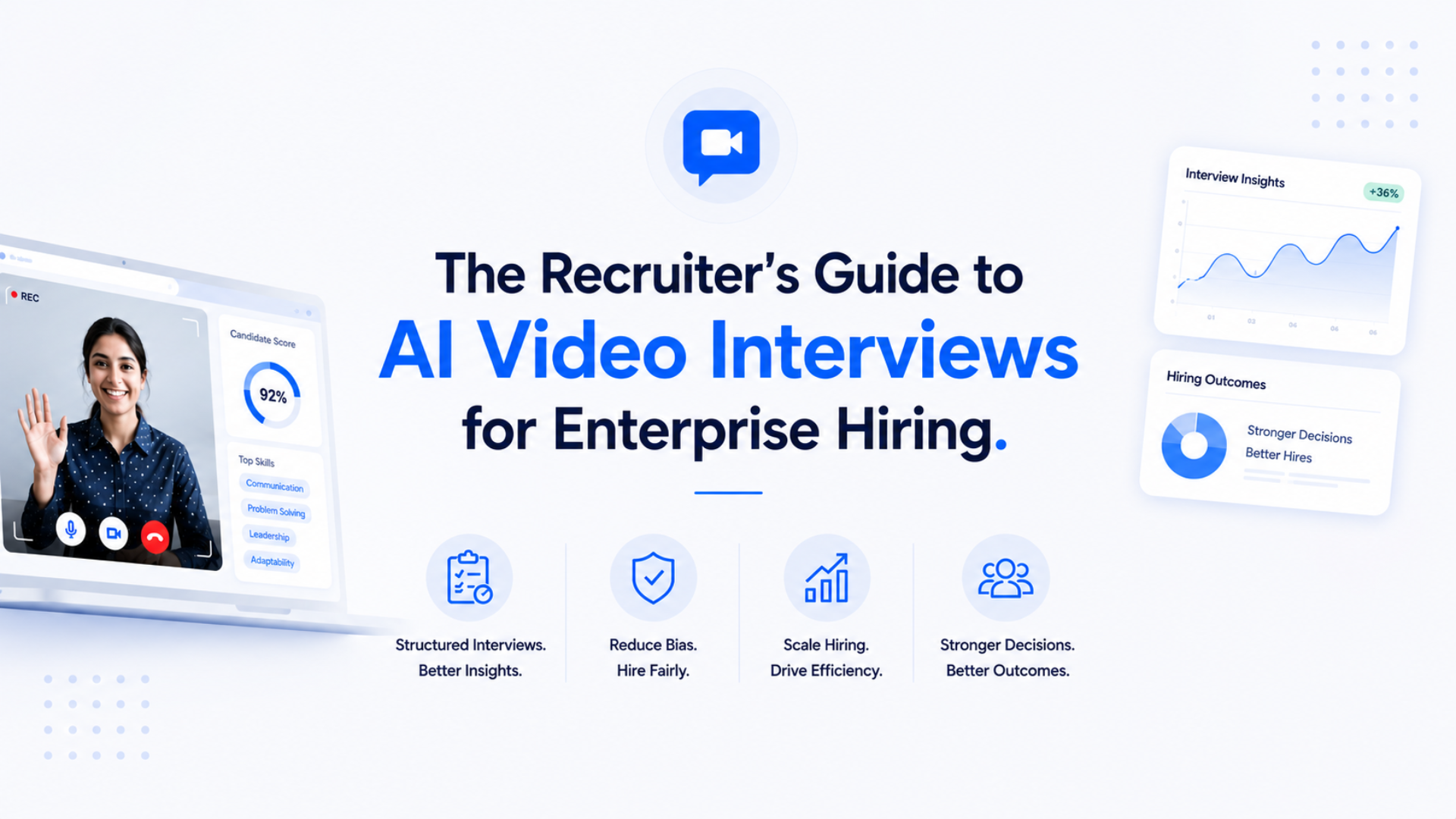
The Recruiter's Guide to AI Video Interviews for Enterprise Hiring
The math facing enterprise recruiters has become unsustainable. According to SHRM's 2025 State of Recruiting report, the median time-to-fill has settled at roughly six weeks for both executive and non-executive roles, while application volumes per requisition have doubled or tripled in many industries. The average U.S. time-to-fill now stands at 44 days, a 33% increase from 33 days just three years ago. Meanwhile, Gallup's research on talent identification consistently shows that only about one in ten candidates possesses the natural talent combination required to truly excel in a given role — meaning recruiters must evaluate enormous volumes of applicants to surface the few who will drive outsized performance.
For the enterprise recruiter, this translates into a daily reality of drowning in resumes, scheduling backlogs that stretch weeks ahead, phone screens that consume hours but yield surface-level insights, and hiring managers who wonder why the pipeline always feels thin despite thousands of applications. The old playbook — post a job, wait for applications, screen resumes, schedule phone calls, coordinate panel interviews — was built for a different era. Today's hiring velocity demands a fundamentally different approach to the top of the funnel.
AI video interviews represent that approach. Rather than replacing recruiter judgment, these tools augment it by automating the most repetitive, lowest-signal parts of the early screening process and delivering richer, more structured candidate data than a resume or phone screen ever could. This guide is built for the recruiter who needs to understand not just what the technology does, but how to deploy it effectively within the constraints and complexities of enterprise hiring.
Who This Guide Is For
This guide is written for three primary audiences within enterprise talent acquisition. First, individual recruiters who want to understand how AI video interviews can help them manage larger candidate volumes without sacrificing quality — and who need practical, actionable guidance rather than vendor marketing materials. Second, recruiting managers and talent acquisition leaders who are evaluating AI video interview platforms for their teams and need a framework for vendor selection, implementation planning, and change management. Third, HR technology and operations professionals who are responsible for compliance, data governance, and ATS integration and need to understand how AI video interviews fit into the broader enterprise HR technology ecosystem.
Regardless of your specific role, the goal of this guide is to move beyond the hype cycle around AI in hiring and provide a grounded, evidence-based understanding of what AI video interviews can and cannot do, where they create the most value, and how to deploy them responsibly and effectively. The enterprises that will gain the greatest competitive advantage from this technology are not the ones that adopt it first, but the ones that adopt it most thoughtfully — with clear objectives, rigorous assessment design, strong change management, and ongoing optimization.
The Enterprise Hiring Crisis: Why Traditional Screening Cannot Keep Up
Enterprise organizations operate at a scale that makes traditional recruiting workflows increasingly untenable. A mid-size enterprise with 500 open requisitions might receive between 50,000 and 150,000 applications per quarter. Even with aggressive resume screening tools, human recruiters can realistically conduct meaningful phone screens with perhaps 15 to 25 candidates per day. At that throughput, it would take a single recruiter roughly 40 working days just to phone-screen 1,000 candidates — and that is before accounting for scheduling complexity, no-shows, follow-up conversations, and the inevitable re-screening that occurs when hiring managers disagree with initial assessments.
The consequences of this bottleneck are severe and well-documented across the talent acquisition industry. Vacant positions remain open longer, directly impacting revenue and team productivity. Research consistently shows that unfilled positions cost organizations thousands of dollars per day in lost productivity and delayed project timelines — and that figure compounds across dozens or hundreds of concurrent open requisitions. Hiring managers, frustrated by slow response times, begin building their own shadow pipelines — often sourcing candidates through personal networks in ways that bypass diversity protocols and create inconsistent candidate experiences. Top candidates, who typically have multiple competing offers, drop out of processes that drag on for weeks. And recruiters themselves burn out at alarming rates, with the profession reporting among the highest turnover rates in corporate functions.
The quality dimension of this crisis is equally concerning. When recruiters are pressured to move candidates through the pipeline quickly, they default to surface-level evaluations: a quick scan of the resume, a fifteen-minute phone screen that barely scratches the surface of the candidate's capabilities, and a handoff to the hiring manager with minimal context. This superficial screening means that interviews with the hiring team are often the first time a candidate's skills and fit are evaluated with any real depth — wasting expensive hiring manager time on candidates who could have been filtered earlier, and missing high-potential candidates whose resumes did not clearly signal their true capabilities.
SHRM's 2025 Talent Trends research reveals that extended time-to-hire metrics have become a top concern for talent acquisition leaders, with organizations increasingly turning to technology-enabled solutions to compress hiring timelines without compromising candidate quality. The same research notes that training existing employees to fill hard-to-fill positions is now among the top ten most utilized recruiting strategies — a tacit acknowledgment that the external hiring pipeline is not keeping up with organizational demand.
McKinsey's research on AI in the workplace estimates that AI adoption in talent management grew 20% in 2024 alone, with 67% of organizations now recognizing its strategic value. Yet the gap between recognizing value and actually deploying effective AI tools remains wide, particularly at the screening and interview stage where the most significant productivity gains are available. The global AI video interview market is projected to grow at a CAGR of 17.1% through 2031, signaling that the tipping point for widespread adoption is approaching rapidly.
The core problem is not that recruiters lack skill or effort. It is that the design of traditional screening workflows was never optimized for the volume, speed, and consistency that enterprise hiring now demands. AI video interviews address this structural mismatch by decoupling the candidate evaluation moment from the recruiter's calendar, delivering structured assessments at scale, and providing data-rich candidate profiles that enable more informed downstream decisions.
How AI Video Interviews Actually Work: A Technical Primer for Recruiters
Understanding the technology is essential for recruiters who need to evaluate vendors, configure assessments, and explain the process to candidates and hiring managers. AI video interviews come in two primary formats, and the distinction matters significantly for how they are deployed.
Asynchronous (one-way) video interviews are the format most commonly used for initial screening at scale. The candidate receives a link, typically via email, and records responses to pre-set questions within a defined time window. Questions may be text-based, video-based (where a hiring manager or recruiter records the prompt), or a combination. The candidate typically has a fixed amount of time to review each question and a fixed amount of time to record their response — commonly one to three minutes per answer. The entire exercise usually takes the candidate 15 to 30 minutes to complete.
Synchronous (live) AI-assisted video interviews involve a real-time conversation between the candidate and an AI-powered agent or a human interviewer supported by AI analysis tools. In these sessions, the AI may generate follow-up questions in real time based on the candidate's responses, provide the interviewer with suggested probing questions, or analyze both verbal and non-verbal cues to produce a post-interview assessment report. This format is more commonly used for later-stage evaluations or roles where conversational fluency and real-time problem-solving are critical competencies.
The AI analysis layer is where the technology delivers its primary value. Modern AI video interview platforms typically evaluate candidate responses across multiple dimensions. Natural language processing algorithms analyze the content of verbal responses, assessing relevance, depth of experience, problem-solving structure, and alignment with job-specific competencies. Sentiment analysis and vocal tone analysis can provide additional signals about enthusiasm, confidence, and communication clarity. Some platforms incorporate facial expression analysis, though this particular capability has drawn significant scrutiny from regulators and ethicists and should be approached with caution.
The output for recruiters is typically a structured scorecard that rates candidates across predefined competency dimensions, highlights specific evidence from their responses that supports each rating, and flags areas where follow-up probing would be valuable. The most sophisticated platforms also provide comparative analytics — showing how a candidate's profile compares to historical high performers in similar roles — and can integrate these scores directly into the ATS for downstream workflow management.
Critically, the quality of AI video interview output is directly proportional to the quality of the question design and scoring rubric. A poorly configured assessment will produce meaningless scores regardless of how sophisticated the underlying technology is. This is why recruiter expertise in job analysis, competency modeling, and structured interview design remains essential even as the technology handles delivery, collection, and initial analysis.
It is also worth understanding what AI video interview platforms generally do not do. They do not make hiring decisions — they produce screening scores and candidate profiles that inform human decision-making. They do not evaluate technical skills through coding exercises or work sample tests, although some platforms integrate with those assessment types. They do not assess personality traits or psychological profiles with clinical precision, and reputable vendors are transparent about the limitations of their assessment capabilities. Recruiters who approach AI video interviews with realistic expectations — as a structured screening tool that produces richer, more consistent data than resume review or unstructured phone screens — are more likely to deploy them successfully than those who expect the AI to serve as an all-purpose hiring oracle.
The Evidence Base: Why Structured Video Assessments Outperform Traditional Screening
Recruiters who are skeptical of AI video interviews often raise legitimate concerns about whether technology-mediated assessments can truly capture candidate quality. The research evidence, however, is strongly supportive — not because AI is magical, but because AI video interviews enforce the principles of structured assessment that decades of industrial-organizational psychology have shown to be the most valid predictors of job performance.
A landmark body of research documented by the NIH's National Library of Medicine demonstrates that structured interviews consistently reduce bias, increase diversity, and produce more accurate hiring outcomes compared to unstructured conversational interviews. The predictive validity of structured interviews — their ability to forecast on-the-job performance — ranges between 0.55 and 0.70, making them among the strongest single predictors of job performance available to hiring teams. By comparison, unstructured interviews, the format most phone screens default to, typically achieve validity coefficients in the 0.20 to 0.38 range.
Harvard Business Review's analysis of structured versus conversational interviews reinforces this point, noting that it is critical to avoid the financial burden of making a wrong hire — a cost that research consistently estimates at 30% to 200% of annual salary depending on the role level. HBR highlights that structured approaches systematically outperform conversational ones because they ensure every candidate is evaluated against the same criteria with the same scoring framework, eliminating the variance that plagues unstructured evaluations.
SHRM's research on eliminating bias in hiring specifically examines how AI-powered structured interview platforms can reduce unconscious bias by standardizing the evaluation criteria, removing visual and auditory distractions that influence human judgment, and producing auditable scorecards that can be reviewed for patterns of disparate impact. The key insight is that AI does not eliminate bias entirely — no tool can — but it dramatically reduces the opportunity for bias to enter the process compared to unstructured human-only evaluations.
The Cambridge University research on structured interview validity further explores how the consistency of structured assessments, when properly implemented, creates a more reliable foundation for hiring decisions than even experienced interviewer intuition. For enterprise recruiters managing hundreds of requisitions, this evidence base provides a compelling rationale: AI video interviews are not a speculative experiment but a well-supported method for improving the quality and fairness of screening at scale.
What This Means for Recruiter Productivity: The Numbers That Matter
The productivity case for AI video interviews is not theoretical — it is quantifiable and significant. To understand the impact, consider the economics of a typical enterprise screening workflow before and after AI video interview implementation.
Before AI video interviews, an enterprise recruiter handling 30 open requisitions might receive an average of 150 applications per role, totaling 4,500 applications. After initial resume screening, which might eliminate 70% of applicants, the recruiter is left with 1,350 candidates who warrant phone screens. At 30 minutes per phone screen (including scheduling, the call itself, and documentation), that represents 675 hours of screening work — roughly 17 weeks of full-time effort for a single recruiter. In practice, most recruiters can only screen a fraction of these candidates, meaning qualified individuals are lost in the volume.
After implementing AI video interviews, the same recruiter sends an automated video interview invitation to the same 1,350 qualified candidates. Based on typical completion rates of 50% to 70%, approximately 800 candidates complete the video interview. The AI platform evaluates all 800 responses within hours, producing structured scorecards that allow the recruiter to identify the top 15% to 20% of candidates — roughly 120 to 160 individuals — for live conversation. The recruiter's screening time drops from 675 hours to approximately 80 to 100 hours of reviewing AI-generated scorecards and conducting focused follow-up conversations with pre-qualified candidates. That represents an 80% to 85% reduction in time spent on initial screening.
The Deloitte 2026 Talent Acquisition Technology Trends report highlights that organizations deploying AI-driven screening and assessment tools are seeing measurable improvements across multiple dimensions: faster time-to-present, higher offer acceptance rates (because candidates experience a more responsive process), and improved recruiter satisfaction as they shift from repetitive screening to strategic advisory work with hiring managers.
The AI adoption data further supports this productivity narrative. According to HireVue's global survey, AI adoption among HR professionals surged from 58% to 72% between 2024 and 2025, with the most commonly cited benefit being time savings in the screening phase. The broader AI in recruitment market is expected to grow from $0.8 billion in 2023 to $2.6 billion by 2033, reflecting a compound annual growth rate of 12.4%, as reported by Market.us. This growth is being driven not by hype but by demonstrable ROI in recruiter productivity and hiring quality.
For the enterprise recruiter, the practical implication is clear: AI video interviews do not just save time at the margins. They fundamentally restructure the screening workflow, allowing recruiters to evaluate five to ten times more candidates with greater consistency and depth than manual phone screening permits. This is not about replacing recruiters — it is about giving them the tools to do the work they were hired to do at the scale the enterprise requires.
Designing Effective AI Video Interview Assessments for Enterprise Roles
The effectiveness of an AI video interview program depends almost entirely on assessment design. Enterprise recruiters need to think like assessment architects, building structured interview experiences that generate meaningful, job-relevant data. Here is a framework for designing assessments that work across different role types and seniority levels.
The foundation of any effective AI video interview assessment is a clear competency model. Before writing a single question, the recruiting team must identify the three to five core competencies that most strongly differentiate high performers from average performers in the target role. These competencies should be grounded in actual job analysis — reviewing performance data, interviewing top-performing incumbents, and consulting with hiring managers about what success looks like in the first 90 days, six months, and year.
For each competency, the assessment should include at least one question that directly elicits evidence of that competency through a behavioral or situational prompt. Behavioral questions ("Tell me about a time when you had to manage a project with competing priorities under a tight deadline — what was the situation, what actions did you take, and what was the outcome?") draw on past experience and are particularly effective for roles requiring demonstrated expertise. Situational questions ("Imagine you join a team where two senior colleagues have fundamentally different approaches to solving a critical technical problem. How would you navigate that dynamic?") test judgment and problem-solving approach and are valuable for roles where adaptability and interpersonal skill are paramount.
The number of questions matters. Research suggests that four to six well-designed questions provide sufficient data for a reliable assessment without causing candidate fatigue. Each question should allow 60 to 90 seconds of thinking time and 90 to 180 seconds of recording time, depending on the complexity of the prompt. The entire assessment should be completable in 20 to 30 minutes.
Scoring rubrics must be defined before the assessment goes live, not after. For each question, the recruiting team should establish clear evaluation criteria — what does an excellent response look like versus a competent one versus a weak one? These rubrics should be shared with the AI platform's configuration so that the algorithm's evaluation aligns with the organization's actual performance standards. The most common mistake enterprise teams make is launching AI video interviews without investing in rubric design, then wondering why the scores feel generic or disconnected from what hiring managers actually care about.
Role-specific calibration is another critical design element. An AI video interview for a software engineering role should probe technical problem-solving, system design thinking, and collaboration patterns. An assessment for a sales role should test persuasion, resilience, customer empathy, and commercial acumen. An assessment for a finance role should evaluate analytical rigor, attention to detail, ethical judgment, and communication clarity. Using a one-size-fits-all assessment across all enterprise roles undermines the technology's value and produces scores that hiring managers will quickly learn to ignore.
Enterprise organizations should also consider the candidate's perspective in assessment design. The SHRM research on candidate experience consistently shows that candidates who feel respected and fairly evaluated during the hiring process are more likely to accept offers, refer others, and speak positively about the employer brand — regardless of whether they receive an offer themselves. Clear instructions, practice questions, transparent communication about how the AI evaluation works, and a reasonable time window for completion all contribute to a positive candidate experience.
Integrating AI Video Interviews into the Enterprise Hiring Workflow
AI video interviews do not exist in isolation. Their value is maximized when they are embedded within a comprehensive enterprise hiring workflow that spans sourcing, screening, assessment, interview, and offer management. Recruiters need to think about integration at three levels: technology integration, process integration, and people integration.
Technology integration means ensuring that the AI video interview platform connects seamlessly with the organization's existing technology stack. For most enterprises, this means integration with the Applicant Tracking System (ATS) so that candidate data, interview invitations, completion status, and assessment scores flow automatically between systems without manual data entry or export-import gymnastics. Gartner's analysis of the talent acquisition technology landscape emphasizes that AI candidate discovery, automated screening, and personalized candidate experiences are now table-stakes features in enterprise recruiting suites, and the ability to orchestrate these capabilities through integrated workflows is a key differentiator.
Huntlo's platform approach is instructive here. With 50+ platform sourcing capabilities, AI conversational screening, and Webhook ATS integration, Huntlo is designed to connect sourcing, screening, and assessment into a unified workflow. A recruiter can source candidates from multiple platforms, trigger an AI video interview as part of the screening sequence, receive structured assessment scores, and advance top candidates through the pipeline — all within a single platform at $99 per seat per month with no usage limits. This model eliminates the fragmentation that plagues enterprises using separate tools for sourcing, screening, interviewing, and pipeline management.
Process integration means rethinking the stages of the hiring workflow to incorporate AI video interviews at the right point. For most enterprise organizations, the optimal placement is between initial resume screening and the first live human conversation. The resume screen narrows the pool to candidates who meet baseline qualifications. The AI video interview then evaluates these candidates on competencies that resumes cannot capture — communication ability, structured thinking, cultural alignment, and motivation — producing a ranked shortlist for recruiter review. Only candidates who pass both the resume screen and the AI video interview advance to a live phone or video conversation with the recruiter, followed by panel interviews with the hiring team.
This staged approach has several advantages. It ensures that every candidate who reaches a human interviewer has been pre-qualified on both paper credentials and demonstrated competencies. It reduces the number of live interviews recruiters must conduct, freeing time for higher-value activities like sourcing, hiring manager consultation, and offer negotiation. And it creates a structured data trail that supports diversity auditing, process optimization, and continuous improvement of the assessment itself.
People integration is often the most overlooked dimension but is arguably the most important. Recruiters must understand how the AI video interview works, how to interpret its scores, and how to communicate the process to candidates and hiring managers. Hiring managers must understand what the scores mean — and what they do not mean — so they can use them appropriately in decision-making without either over-relying on them or dismissing them. And candidates must feel that the process is fair, transparent, and respectful of their time and effort.
Compliance and Ethical Considerations: Navigating the Regulatory Landscape
Enterprise recruiters deploying AI video interviews operate within an increasingly complex regulatory environment. The U.S. Equal Employment Opportunity Commission (EEOC) has held public hearings specifically examining the use of AI and automated systems in hiring, with EEOC commissioners expressing concern about the potential for AI tools to "codify and scale individual bias" if not properly designed and monitored. The EEOC's guidance on AI in hiring requires employers to ensure that their AI screening tools do not produce disparate impact on protected groups and that candidates with disabilities are provided reasonable accommodations.
For enterprise recruiters, compliance means taking several concrete steps. First, ensure that the AI video interview platform provides an audit trail — a record of what questions were asked, how candidates were scored, and what criteria were used. This audit trail is essential both for internal diversity analysis and for demonstrating good-faith compliance if the organization's hiring practices are ever challenged. Second, conduct regular adverse impact analyses to verify that the AI assessment is not systematically disadvantaging candidates based on race, gender, age, disability, or other protected characteristics. Third, provide clear accommodation pathways for candidates who cannot complete a video interview due to disability, technology limitations, or other barriers — offering alternative assessment formats such as phone interviews or written responses.
The Cadient Talent analysis of recruitment compliance further highlights that enterprises operating across jurisdictions must comply not only with U.S. federal regulations like the EEOC but also with state-level laws (such as New York City's Local Law 144 requiring bias audits of automated employment decision tools) and international frameworks like the EU AI Act and GDPR, which impose additional requirements around transparency, consent, and data minimization.
Enterprise recruiters should also be prepared to explain the AI video interview process to candidates in clear, non-technical language. Best practice is to provide candidates with a written explanation of what the AI evaluates, how their data will be used, how long it will be retained, and what their rights are regarding the data. Transparency builds trust, and trust improves both candidate experience and the quality of the data the AI receives — candidates who understand and trust the process are more likely to give genuine, thoughtful responses rather than performing what they think the algorithm wants to hear.
The ethical dimension extends beyond legal compliance. Recruiters have a professional responsibility to ensure that the tools they use treat candidates with dignity and respect. This means avoiding AI features that make candidates uncomfortable (such as facial expression analysis, which many candidates find intrusive and which has questionable scientific validity), providing practice questions so candidates can familiarize themselves with the format, and ensuring that the assessment experience is designed to elicit the candidate's best work rather than to trip them up or create artificial pressure.
Enterprise recruiters should also consider the equity implications of AI video interviews. Candidates from different socioeconomic backgrounds may have unequal access to quiet recording spaces, high-quality cameras, reliable internet connections, or the technology literacy needed to navigate an unfamiliar assessment format. While video interviews can broaden access by removing geographic and scheduling barriers, they can also introduce new inequities if organizations do not account for these differences. Best practice is to offer multiple ways for candidates to complete the assessment — including the option to use a mobile phone, complete the interview at a testing center or library, or request an alternative format — and to ensure that the evaluation criteria focus on the substance of the candidate's responses rather than on production quality or environmental factors.
The VidCruiter analysis of ADA and EEOC compliance in digital interviewing provides practical guidance on achieving fair hiring practices while maintaining the efficiency benefits of AI-assisted evaluation, emphasizing that compliance and quality are not opposing forces but complementary objectives when the technology is deployed thoughtfully.
A Phased Implementation Roadmap for Enterprise Teams
Deploying AI video interviews across an enterprise hiring organization is not a flip-the-switch operation. It requires a structured, phased approach that builds organizational capability, demonstrates value, and scales progressively. Here is a roadmap that enterprise recruiters and talent acquisition leaders can adapt to their specific context.
Phase 1: Foundation (Weeks 1-4)
The foundation phase focuses on preparation and alignment. Begin by selecting a pilot use case — a high-volume role type where the current screening bottleneck is most acute and the potential for time savings is largest. Common starting points include early-career or campus recruiting programs, customer service or operations roles with high application volumes, or technical roles where screening phone calls consistently consume disproportionate recruiter time.
During this phase, the recruiting team should also conduct a thorough competency analysis for the pilot role, define scoring rubrics, configure the AI video interview platform, and build integration with the ATS. Stakeholder alignment is critical: brief hiring managers on what the AI video interview does, how scores will be used, and what the pilot's success metrics are. Prepare candidate communication templates that explain the process clearly and provide support resources.
Phase 2: Pilot (Weeks 5-12)
Launch the AI video interview for the selected pilot role and closely monitor results. Key metrics to track include candidate completion rates (target: 55% or higher), time-to-present reduction (how much faster do qualified candidates reach hiring managers compared to the previous workflow), score distribution (are scores meaningfully differentiating candidates, or is everything clustering in the middle?), and candidate feedback (solicit qualitative feedback from candidates about their experience).
During the pilot, the recruiting team should conduct regular calibration sessions — reviewing AI scorecards alongside candidate resumes and, where possible, subsequent interview performance — to verify that the AI assessment is identifying the candidates that hiring managers ultimately want to advance or hire. Discrepancies between AI scores and human evaluations are not necessarily failures; they are learning opportunities that can improve question design, rubric calibration, or score interpretation.
Phase 3: Expansion (Weeks 13-24)
Based on pilot results, expand the AI video interview program to additional role types and business units. Prioritize expansion into roles where the pilot demonstrated the strongest value — the biggest time savings, the highest score-hiring outcome correlation, or the most positive candidate feedback. As the program scales, invest in building a library of role-specific assessment templates that can be quickly configured and deployed for new requisitions.
This phase should also include the development of recruiter training materials. Every recruiter who will use the platform should understand not only how to operate it but how to design effective assessments, interpret scores appropriately, and communicate with hiring managers about what the data means. Consider designating "AI interview champions" within each recruiting team who receive advanced training and serve as internal resources for their peers.
Phase 4: Optimization (Months 7-12 and Beyond)
Once the AI video interview program is operational across multiple role types, the focus shifts to continuous optimization. This includes regularly refreshing assessment questions to prevent answer-sharing among candidate networks, analyzing historical score data to refine scoring rubrics and competency models, conducting ongoing adverse impact analyses to ensure continued compliance, and exploring advanced features like AI-generated follow-up questions, multilingual assessments, and integration with skills-based hiring frameworks.
Gartner's 2025 analysis of the talent acquisition suite market projects a five-year CAGR of 16.7% for recruiting technology, driven largely by AI-native capabilities. Enterprises that build robust AI video interview programs now will be better positioned to adopt emerging capabilities as the technology continues to evolve, including more sophisticated conversational AI agents, deeper integration with skills ontologies, and predictive analytics that combine interview data with performance outcomes.
Measuring Success: KPIs That Matter for AI Video Interview Programs
Enterprise recruiting leaders need clear metrics to evaluate whether their AI video interview program is delivering value. The following KPIs should be tracked from the outset and reviewed at regular intervals.
Screening Efficiency Metrics: The most immediate and easily measurable impact of AI video interviews is screening throughput. Track the number of candidates screened per recruiter per week before and after implementation. Track the time elapsed between application receipt and first human review. Track the percentage of the applicant pool that receives a substantive evaluation — with traditional phone screening, this percentage is often below 20%; with AI video interviews, it should exceed 60%.
Quality of Hire Metrics: The ultimate measure of any screening tool's value is whether it identifies candidates who perform well after being hired. Track new hire performance ratings at 90 days, six months, and one year for candidates who were screened through the AI video interview versus those who were not (in the pilot phase, some candidates may go through both paths). Track early attrition — candidates who leave within the first year — as a proxy for screening accuracy. If the AI video interview is working as intended, candidates who score well on the assessment should have meaningfully higher performance ratings and lower early attrition rates.
Diversity and Inclusion Metrics: One of the strongest arguments for AI video interviews is their potential to reduce bias in screening. Track the demographic composition of candidates who advance through the AI screening stage compared to the applicant pool. Track the demographic composition of candidates who receive offers and who accept. If the AI assessment is functioning without disparate impact, these compositions should be proportionally consistent. Any significant deviations should trigger a review of the assessment design and scoring algorithms.
Candidate Experience Metrics: Track candidate completion rates (what percentage of invited candidates actually complete the video interview), Net Promoter Score or equivalent satisfaction surveys, offer acceptance rates (candidates who had a positive screening experience are more likely to accept offers), and candidate withdrawal rates (a spike in withdrawals after the AI interview stage may signal a poor candidate experience). The Survale research on candidate experience ROI demonstrates that organizations investing in candidate experience see measurable returns in candidate conversion, offer acceptance, and employer brand strength.
Recruiter Satisfaction Metrics: Track recruiter Net Promoter Score, time spent on administrative tasks versus strategic activities, and recruiter retention rates. If the AI video interview program is working, recruiters should report spending less time on scheduling and repetitive screening, more time on strategic activities like sourcing, candidate relationship building, and hiring manager advisory, and higher overall job satisfaction.
Common Pitfalls and How to Avoid Them
Enterprise teams deploying AI video interviews for the first time often encounter predictable challenges. Being aware of these pitfalls — and knowing how to address them — can significantly accelerate the path to value.
Pitfall 1: Launching Without Proper Assessment Design. The single most common failure mode is treating the AI video interview platform as a black box that will somehow produce good results regardless of input quality. This leads to generic questions, undefined scoring criteria, and scores that hiring managers dismiss as irrelevant. The solution is to invest in assessment design before launching: conduct job analysis, define competencies, write targeted questions, and build detailed scoring rubrics. The AI platform is an evaluation engine, not an assessment designer.
Pitfall 2: Over-Reliance on AI Scores. Some organizations make the opposite error, treating AI-generated scores as definitive hiring decisions rather than screening inputs. This leads to candidates being rejected or advanced solely on the basis of an algorithmic score, without human review of the underlying evidence. The solution is to position AI video interview scores as one data point in a multi-signal evaluation process. Recruiters and hiring managers should always review the specific evidence — the actual video responses and the AI's rationale for its ratings — before making advancement decisions.
Pitfall 3: Ignoring Candidate Communication. A significant number of candidate complaints about AI video interviews stem not from the technology itself but from poor communication about the process. Candidates who receive a cryptic email with a video interview link and no explanation of what to expect or why the organization is using this format are understandably frustrated. The solution is to invest in clear, warm candidate communication that explains what the AI video interview is, why the organization uses it, what candidates can expect, how long it will take, and what happens next. Providing practice questions and a technical support channel further reduces anxiety and improves completion rates.
Pitfall 4: Neglecting Compliance from Day One. Some organizations treat compliance as an afterthought — launching their AI video interview program first and worrying about bias audits, accommodation procedures, and data retention policies later. This approach creates legal risk and can force painful retroactive changes. The solution is to build compliance into the program from the design phase: ensure the platform provides audit trails, establish adverse impact monitoring protocols, create accommodation workflows, and prepare candidate disclosure documentation before the first candidate receives an interview invitation.
Pitfall 5: Failing to Calibrate Across Hiring Teams. In large enterprises, different hiring teams may interpret and use AI video interview scores differently, leading to inconsistent hiring standards across the organization. The solution is to establish cross-team calibration sessions where recruiters and hiring managers from different business units review sample candidate assessments together and align on score interpretation and advancement thresholds. This calibration should be ongoing, not a one-time exercise, as team composition and role requirements evolve over time.
The Future of AI Video Interviews in Enterprise Recruiting
The current generation of AI video interview technology represents an early stage in what will be a rapidly evolving capability set. Several trends are likely to shape the next generation of tools and transform how enterprise recruiters use them.
Conversational AI agents that conduct real-time, adaptive video interviews are already emerging and will become more sophisticated over the next two to three years. Unlike current asynchronous platforms that ask fixed questions, these agents will dynamically adjust their line of questioning based on candidate responses — probing deeper into areas of strength, redirecting when responses are vague, and creating a more natural and insightful conversation. For enterprise recruiters, this means the quality of AI-generated candidate data will improve significantly, potentially making AI-conducted interviews valuable not just for screening but for mid-funnel evaluation stages that currently require live human interviewers.
Multilingual and cross-cultural assessment capabilities will become increasingly important as enterprises continue to hire across borders. Next-generation AI video interview platforms will support real-time multilingual question delivery and response analysis, enabling global enterprises to use consistent evaluation criteria across all geographies while assessing candidates in their preferred language. This capability addresses one of the persistent challenges in global hiring: how to maintain evaluation consistency across regions without imposing a single-language requirement that disadvantages non-native speakers.
Predictive analytics that combine AI interview data with downstream performance outcomes will create a feedback loop that continuously improves assessment accuracy. As enterprises accumulate data linking interview scores to actual on-the-job performance, AI systems will be able to identify which specific question types, competency dimensions, and evaluation criteria are most predictive of success for each role type. This data-driven calibration will make assessments more targeted and effective over time, moving beyond generic competency models toward role-specific, evidence-based evaluation frameworks.
Skills-based hiring frameworks will increasingly intersect with AI video interview technology. As organizations move away from credential-based screening (degrees, job titles, years of experience) toward skills-based evaluation, AI video interviews will be configured to assess specific, verifiable skills rather than broad competencies. A candidate applying for a data analytics role, for example, might be asked to walk through their approach to a specific data problem, with the AI evaluating not just their communication skills but the technical accuracy and logical structure of their analytical reasoning.
Integration with talent intelligence platforms will create more holistic candidate profiles. AI video interview data will be combined with sourcing data, skills assessments, work sample results, and reference feedback to produce multi-dimensional candidate profiles that give hiring teams a far richer picture than any single assessment can provide. This integration will be particularly valuable for enterprise organizations that hire at scale across multiple role families and need to make rapid, well-informed decisions about candidate deployment.
Regulatory evolution will continue to shape the technology's capabilities and constraints. The EU AI Act, which classifies AI-powered employment decision tools as high-risk systems subject to strict transparency and accountability requirements, is likely to influence global standards. In the U.S., state and federal regulators are expected to issue increasingly specific guidance on AI in hiring. Enterprise recruiters should expect that the platforms they use will need to adapt to evolving regulatory requirements, and should prioritize vendors that demonstrate proactive compliance investment.
For the enterprise recruiter, the strategic implication is clear: AI video interviews are not a temporary trend but a permanent shift in how organizations evaluate talent at scale. Building expertise in assessment design, AI tool evaluation, and data-driven hiring processes is not optional professional development — it is core competency for the next generation of talent acquisition professionals.
Conclusion: From Skepticism to Strategic Advantage
The journey from skepticism to strategic advantage with AI video interviews follows a predictable arc. Recruiters who initially view the technology with suspicion — "Will this replace me?" "Can a machine really evaluate a human being?" — typically become its strongest advocates once they experience the practical benefits: the ability to evaluate five times more candidates without working longer hours, the satisfaction of presenting hiring managers with better-prepared shortlists, the relief of eliminating scheduling chaos from the screening process, and the confidence of having structured, auditable data supporting every advancement decision.
The recruiters who thrive in the AI-augmented enterprise hiring environment will be those who invest in understanding the technology deeply enough to configure it effectively, interpret its outputs critically, and communicate its value to the stakeholders around them. They will be the ones who design assessments that generate truly useful candidate data, who spot when the AI is missing something important, and who use the time freed from repetitive screening to build stronger relationships with candidates, hiring managers, and business leaders.
AI video interviews are not a replacement for the recruiter's judgment, relationships, or strategic thinking. They are a tool that amplifies all three by handling the volume-dependent, repeatable parts of the screening process with greater consistency and scale than any human team could achieve alone. For the enterprise recruiter willing to invest in learning and deploying this technology thoughtfully, the reward is a hiring operation that is faster, fairer, more data-informed, and more strategically valuable to the organization it serves.
Related Topics:
How Enterprise Teams Streamline Sourcing, Screening, and Hiring - https://www.huntlo.ai/blog/how-enterprise-teams-streamline-sourcing-screening-and-hiring
How Does AI Interview Screening Score Candidates? - https://www.huntlo.ai/blog/how-does-ai-interview-screening-score-candidates
Should Recruiters Worry About AI Replacing Their Jobs? - https://www.huntlo.ai/blog/should-recruiters-worry-about-ai-replacing-their-jobs