The phone screen has been the gateway to the hiring process for decades. A recruiter calls, asks a set of questions, makes some notes, and decides whether the candidate moves forward. It is the most universal step in global recruiting — used by startups, enterprises, staffing agencies, and government employers alike. It is also the most inefficient. The phone screen consumes more recruiter time than any other single hiring activity, produces the least structured data, and varies more in quality from one recruiter to another than any other step in the funnel. AI phone calls are changing this dynamic by delivering structured, consistent, on-demand screening that produces better evaluation data in a fraction of the time. This is not an incremental improvement to the phone screen. It is a fundamentally different approach to the first conversation between an employer and a candidate.
What an AI Phone Call Actually Is
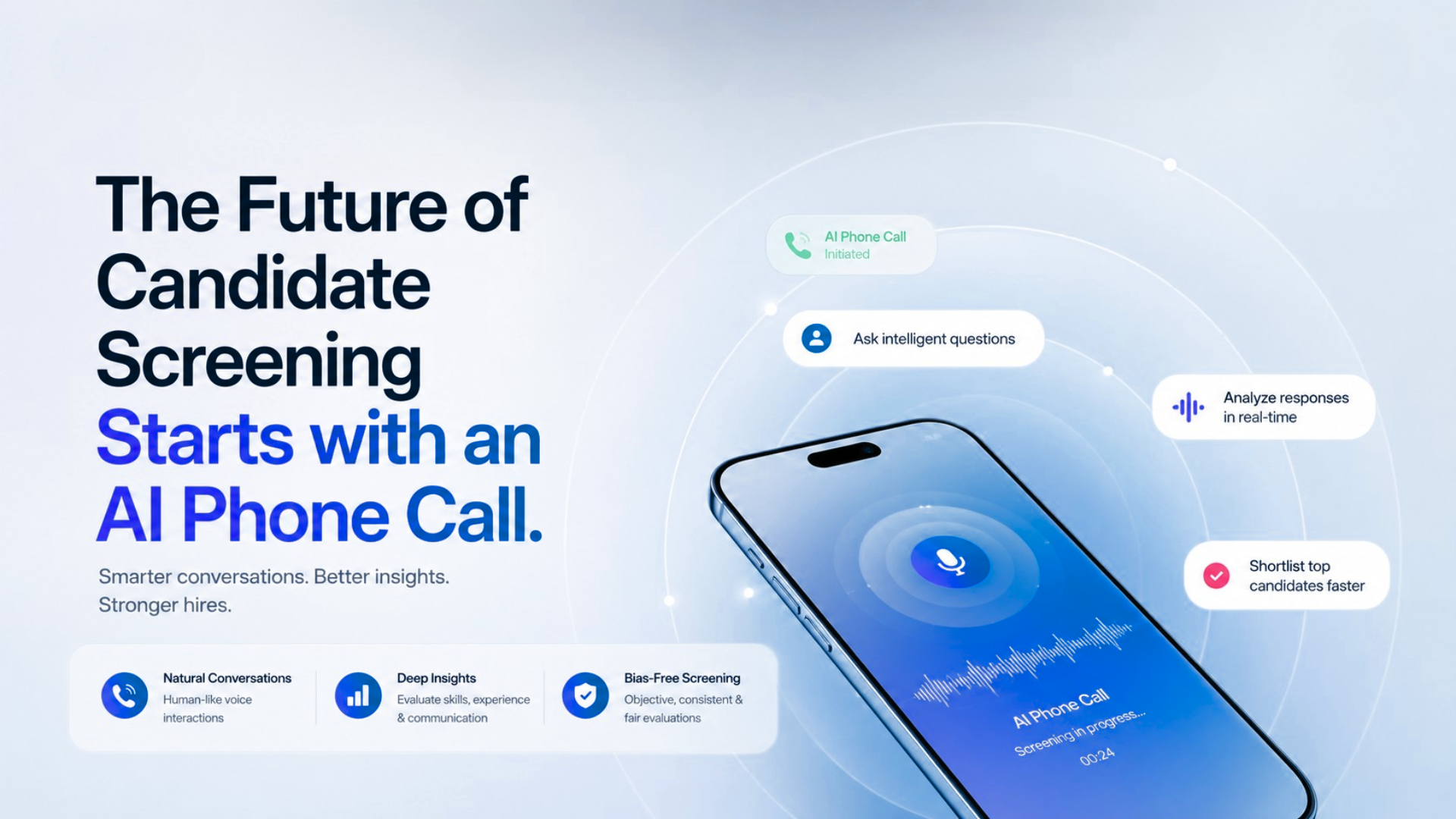
An AI phone call in the context of candidate screening is a structured voice conversation between a candidate and an AI agent. The candidate receives a link or a phone number, initiates the call at their convenience, and answers a series of role-specific questions posed by the AI. The AI evaluates each response in real time, assessing communication clarity, structured thinking, role-specific knowledge, behavioral evidence, and problem-solving approach. The output is not a binary pass-fail. It is a detailed scorecard: competency-level ratings, key response highlights, areas of strength, potential concerns, and a recommended disposition that a recruiter reviews in five to eight minutes instead of spending 45 to 60 minutes conducting the screen manually.
The technology behind this has advanced significantly in the past two years. Early AI interview tools relied on simple keyword matching and rigid question flows that candidates found mechanical and recruiters found unreliable. Current platforms use natural language understanding that can evaluate the substance of a candidate’s response — not just whether they mentioned specific keywords, but whether their answer demonstrated the underlying competency the question was designed to assess. The AI adapts its follow-up questions based on the candidate’s previous responses, creating a conversation that feels more natural and produces more informative evaluations. As explored in What Makes an AI Recruiting Platform “Agentic” vs Just Automated?, the platforms delivering the most value are those where the AI demonstrates genuine reasoning and adaptation during the conversation, not just predetermined script execution.
Why the Phone Screen Was Always the Weakest Link
The traditional phone screen has three structural weaknesses that have been tolerated for years because no alternative existed. The first is inconsistency. Two recruiters screening candidates for the same role will ask different questions, evaluate different criteria, and apply different passing thresholds. The candidate who gets the more rigorous recruiter is held to a higher standard than the candidate who gets the more lenient one. This is not a recruiter failure — it is an inevitable consequence of depending on individual human judgment for a process that is supposed to produce standardized outcomes. SIOP’s comprehensive review of interview methodologies has documented that unstructured phone screens have inter-rater reliability coefficients as low as 0.20 to 0.35, meaning that two recruiters evaluating the same candidate often reach different conclusions about whether that candidate should advance.
The second weakness is scaling friction. Phone screens require two people to be available at the same time — a constraint that becomes increasingly problematic as hiring volumes grow, as teams span multiple time zones, and as candidates expect faster response times. The scheduling overhead alone adds days to the screening process. The third weakness is data poverty. A phone screen produces recruiter notes — unstructured, variable in quality, and impossible to aggregate. An organization that conducts 5,000 phone screens in a quarter has no structured dataset from those screens that can be analyzed for trends, bias, or quality-of-hire correlation. The data exists only in individual recruiter memories and note-taking habits, which is to say it barely exists at all.
The AI Phone Call Advantage: What Changes Practically
An AI phone call addresses all three structural weaknesses simultaneously. Consistency: every candidate for a given role is asked the same questions and evaluated against the same criteria, regardless of when they are screened or which recruiter manages the requisition. Scalability: the AI is available 24 hours a day, seven days a week, across every time zone, with no scheduling required. Candidates complete the call at their convenience, and recruiters receive completed evaluations without a single calendar coordination email. Data richness: every AI phone call produces a structured scorecard that can be
aggregated, analyzed, and used to continuously improve the screening framework.
The practical impact on recruiting operations is substantial. Gartner’s HR technology research reports that organizations using AI voice screening reduce time-to-shortlist by 40–60% for high-volume roles. The time savings are not just a convenience — they directly affect hiring outcomes. LinkedIn’s hiring trends data shows that the probability of a candidate accepting an offer drops by approximately 8–12% for every week the hiring process extends beyond the expected timeline. Faster screening means faster shortlists, faster interviews, and faster offers — which means more offers accepted and fewer candidates lost to competing employers who moved faster.
The data advantage compounds over time. As an organization accumulates AI phone call evaluations across hundreds or thousands of candidates, it can analyze which screening criteria actually predict on-the-job success for specific roles. A competency that seemed important during initial framework design might turn out to have minimal correlation with performance, while a dimension that was given lower weight might be strongly predictive. This kind of evidence-based screening optimization is impossible with manual phone screens but becomes natural with structured AI-generated evaluation data. The screening framework gets better with every hire — a continuous improvement loop that human processes cannot match.
The Candidate Experience Shift
One of the most significant aspects of the AI phone call’s rise is its effect on candidate experience. The assumption has long been that candidates would resist AI-led conversations and prefer human interaction. The data tells a different story. Candidates consistently report that AI phone calls feel less adversarial and lower-pressure than traditional recruiter screens. There is no judgment in the moment, no performance anxiety about impressing a specific person, and no concern about whether the recruiter is having a good day or a bad day. The candidate can complete the call at a time when they are well-rested and prepared, rather than fitting it into a scheduled slot that may conflict with their work or personal obligations.
The Talent Board’s CandE benchmarking data shows that candidate satisfaction scores for AI-screened processes have converged with — and in several categories surpassed — traditional phone screen processes. The two dimensions where AI screening consistently scores higher are speed (candidates can complete the screen within hours of applying rather than waiting days for a phone slot) and perceived fairness (candidates recognize that every applicant is being evaluated against the same standard). These are not minor advantages. In competitive talent markets where top candidates have multiple opportunities in progress, speed and perceived fairness are often the difference between a candidate who continues your process and one who withdraws.
The Recruiter’s New Role in an AI-First Funnel
The most important question about AI phone calls is not what the AI does — it is
what the recruiter does differently when the AI handles the initial screening. The answer is that the recruiter’s role shifts from conducting repetitive first-round evaluations to performing higher-value activities that require human judgment, relationship skills, and strategic thinking. A recruiter who spends 60% of their week on phone screens and 40% on candidate engagement, hiring manager consultation, and offer management is restructured by AI phone calls into a recruiter who spends 15% of their week reviewing AI scorecards and 85% on the activities that actually differentiate great recruiters from adequate ones.
This shift is not theoretical. It is what recruiters who have adopted AI screening consistently report. They spend more time on candidate relationship building — the kind of personalized, trust-based engagement that makes top candidates choose one opportunity over another. They spend more time advising hiring managers on evaluation criteria and shortlist strategy, because they have structured AI data to inform those conversations rather than relying on gut feel. They spend more time on the candidates who genuinely warrant deeper human exploration — the borderline cases, the senior roles, the passive candidates who need a real human conversation, not a standardized screen. As discussed in Should Recruiters Worry About AI Replacing Their Jobs?, this is the future of the profession: recruiters who leverage AI to handle volume while investing their human capabilities in the interactions that machines cannot replicate.
Data Quality: The Hidden Advantage of AI Screening
One dimension of AI phone calls that receives less attention than it deserves is data quality. Recruiting has historically operated as a relationship-driven, intuition-based profession. Decisions about which candidates to advance, which criteria matter, and what good looks like have been made primarily on individual recruiter judgment. This approach works at small scale but becomes unreliable at the scale that modern hiring demands. When an enterprise evaluates 10,000 candidates per quarter across multiple business units and geographies, intuition-based screening produces inconsistent outcomes that are impossible to audit, optimize, or improve systematically.
AI phone calls generate a different kind of data. Every candidate interaction is captured, structured, and scored against the same framework. Over time, this data reveals patterns that are invisible in manual processes: which competencies predict success for specific role families, which questions produce the most discriminating responses, how screening outcomes vary across geographies or candidate sources, and where bias might be entering the process. This data-driven approach to screening optimization is what separates organizations that are genuinely improving their hiring quality from those that are simply processing more candidates. However, the quality of these insights depends entirely on the quality of the candidate data flowing into the AI system — a challenge explored in Why Do Some AI Recruiting Tools Have Outdated Candidate Data?, where the importance of fresh, accurate candidate information as a foundation for AI-driven recruiting decisions is examined in detail.
The Platform That Makes AI Phone Calls Work at Scale
An AI phone call is only as valuable as the system it is connected to. A standalone AI screening tool that produces excellent scorecards but requires manual candidate import, separate outreach tools, and a disconnected ATS workflow creates administrative overhead that undermines the time savings the AI was supposed to deliver. The organizations seeing the most impact from AI phone calls are using integrated platforms where sourcing, outreach, screening, and scheduling operate as one workflow with shared candidate data.
Huntlo delivers this integrated approach. Its AI sourcing engine searches across 50+ platforms simultaneously, its multi-channel outreach engages candidates through email, LinkedIn, and WhatsApp with persistent follow-up sequences, its AI voice screening conducts structured phone calls that produce detailed evaluation scorecards, and its scheduling system coordinates next-round interviews without manual intervention. A candidate sourced through Huntlo can be engaged, screened, and advanced through the pipeline within a single platform — no data export, no tool switching, no handoff friction. For recruiting teams of any size — from solo recruiters managing 30 requisitions to enterprise TA teams processing thousands of candidates per quarter — this integration is what transforms AI phone calls from a promising technology into an operational necessity.
The future of candidate screening does not start with a resume keyword match or an ATS knockout questionnaire. It starts with a conversation — an AI phone call that evaluates every candidate consistently, produces structured data that improves with every hire, and frees recruiters to invest their time in the human interactions that close great hires. The technology is ready. The question is whether the platform delivering it is integrated enough to deliver on that promise.
Related Topics:
What Makes an AI Recruiting Platform “Agentic” vs Just Automated?
Why Do Some AI Recruiting Tools Have Outdated Candidate Data?