Why Enterprise Adoption of AI Video Interviews Is Different
The majority of content about AI video interviews is written for the mid-market perspective: a single talent acquisition team, a manageable number of hiring managers, and a relatively contained technology stack. For enterprise organizations — those with 500, 5,000, or 50,000 employees — the adoption challenge is structurally different. You are not choosing a tool for a team. You are selecting a technology platform that must serve multiple business units, comply with regulations in multiple jurisdictions, integrate with enterprise HCM systems that may include Workday, SAP SuccessFactors, Oracle HCM Cloud, or ServiceNow, and win the buy-in of hundreds of hiring managers who have been conducting interviews their own way for years.
SHRM's enterprise talent acquisition research reports that the average enterprise organization operates 12 to 18 distinct hiring processes across its business units, each with its own interview formats, evaluation criteria, and technology tools. This fragmentation is not accidental — it reflects the legitimate diversity of roles, cultures, and operational requirements across a large organization. A semiconductor engineering hiring process at Intel has different evaluation needs than a retail store manager hiring process at the same company. The challenge is not to impose uniformity but to introduce AI video interview capabilities that accommodate this diversity while delivering the consistency, speed, and data advantages that justify the technology investment.
Enterprise adoption also carries higher stakes. A poorly implemented AI video interview program at a 200-person company affects a few hundred candidates per year. At a 20,000-person company with 30% annual turnover, the same implementation affects tens of thousands of candidates, generates enormous volumes of evaluation data, and creates legal and reputational exposure if the technology produces biased or inconsistent outcomes. Gartner's HR technology research estimates that the total cost of an enterprise AI hiring technology implementation — including platform fees, integration, training, change management, and ongoing governance — ranges from $150,000 to $500,000 in year one. That investment demands a rigorous business case, a disciplined selection process, and a phased implementation approach that manages risk while building organizational capability.
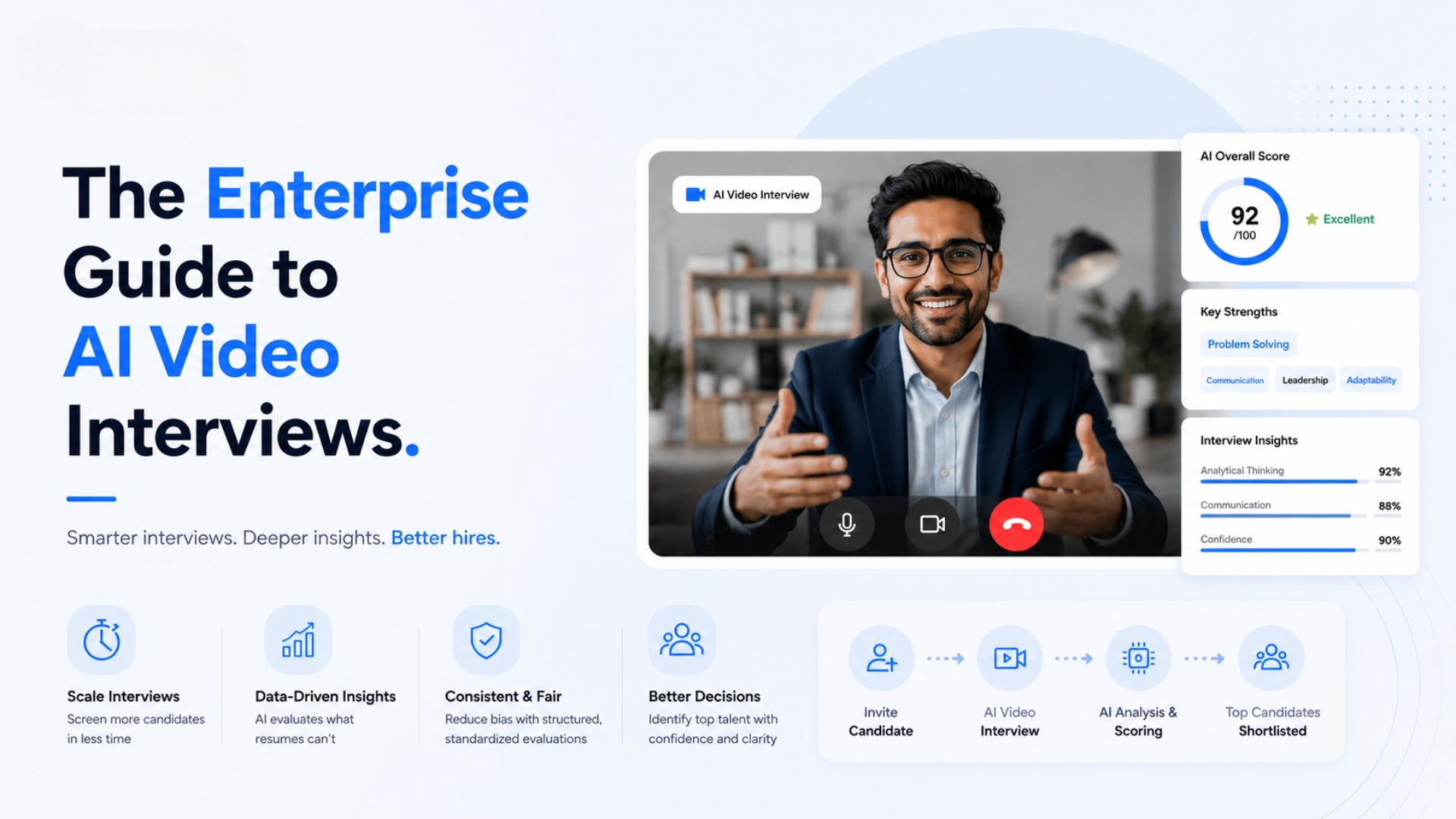
This guide addresses each of these dimensions in sequence. It is written for the VP of Talent Acquisition, the Head of Recruiting Operations, the HR Technology leader, and the business unit HR partners who will be responsible for making AI video interviews work at enterprise scale. The goal is not to sell you on the technology — the evidence for its effectiveness is well-established and available elsewhere. The goal is to give you the operational framework to implement it successfully.
Building the Business Case: From Intuition to Investment Thesis
Every enterprise technology initiative begins with a business case, and AI video interviews are no exception. But the business case for AI hiring technology is often poorly constructed, relying on vague claims about "efficiency" and "candidate experience" without the quantitative rigor that CFOs and procurement teams require. A compelling enterprise business case for AI video interviews should address four dimensions: cost reduction, revenue protection, quality improvement, and risk mitigation.
Cost reduction is the most straightforward dimension to quantify. Begin with your current screening costs. Calculate the fully loaded cost per phone screen — recruiter salary and benefits allocated to screening time, plus the administrative overhead of scheduling, plus the opportunity cost of the recruiter's time (what they could be doing instead). For most enterprise organizations, this figure ranges from $75 to $150 per screen. Multiply by your annual screening volume. An enterprise hiring 5,000 employees per year with an average of 5 phone screens per hire — a conservative estimate given typical conversion rates — conducts 25,000 phone screens annually, at a cost of $1.9 million to $3.75 million. AI video interviews can reduce this cost by 50% to 70% by eliminating scheduling overhead, automating evaluation, and reducing the number of screens required to produce a qualified shortlist. McKinsey's hiring technology analysis has documented that enterprise organizations achieving full AI screening adoption report average annual savings of $800,000 to $2.1 million in screening costs alone.
Revenue protection addresses the cost of vacant positions. Deloitte's workforce analytics estimates that a vacant revenue-generating position costs between $7,000 and $10,000 per day in lost productivity. If your average time-to-fill is 45 days and you hire 2,000 revenue-generating roles per year, the total annual cost of vacancies is $630 million to $900 million. AI video interviews typically reduce time-to-fill by 25% to 40%, translating to a reduction of 11 to 18 days per hire. For 2,000 roles, that is 22,000 to 36,000 recovered days — a potential revenue protection impact of $154 million to $360 million annually. Even if you apply a conservative realization rate of 5% to 10% (acknowledging that not all vacancy days translate directly to lost revenue), the financial impact is substantial.
Quality improvement is harder to quantify but no less important. The cost of a bad hire is well-documented: the U.S. Department of Labor estimates that a bad hire costs approximately 30% of the employee's first-year earnings. For an enterprise hiring 5,000 people at an average starting salary of $85,000, a 1% improvement in hiring accuracy — preventing 50 bad hires — saves approximately $1.3 million in first-year costs alone, before accounting for the downstream costs of turnover, team disruption, and management time. AI video interviews improve hiring accuracy through structured evaluation, consistent criteria, and data-driven shortlisting. SIOP's research on structured interviews demonstrates that structured interview processes — which AI video platforms enforce — achieve predictive validity coefficients 2.5 times higher than unstructured interviews.
Risk mitigation addresses the regulatory and reputational exposure associated with inconsistent or biased hiring practices. Enterprise organizations face growing regulatory scrutiny of their hiring processes, with New York City's Local Law 144 requiring bias audits for automated employment decision tools, the EU AI Act classifying employment AI as "high-risk," and similar legislation advancing in California, Illinois, and other jurisdictions. AI video interview platforms that provide structured, auditable evaluation processes with built-in bias monitoring help organizations meet current compliance requirements and prepare for the regulatory environment that is coming. The cost of non-compliance — legal defense, regulatory fines, and reputational damage — far exceeds the cost of implementing compliant technology.
Platform Selection: A Framework for Enterprise Evaluation
The AI video interview platform market has expanded rapidly, with G2 now listing over 60 platforms in the video interviewing category. For enterprise buyers, this abundance creates a selection challenge that goes beyond feature comparison. You are not just choosing a product — you are choosing a technology partner whose platform architecture, data practices, compliance posture, and roadmap will affect your recruiting operations for years.
Integration architecture is the first and most non-negotiable criterion. An AI video interview platform that cannot integrate cleanly with your existing HCM stack will either require expensive custom integration work or will operate as a data silo that undermines the technology's value proposition. Evaluate integration capabilities in three dimensions: ATS integration (bidirectional data flow with your applicant tracking system), HCM integration (connecting interview evaluation data to the broader employee lifecycle systems), and sourcing integration (connecting the interview platform to your sourcing channels and candidate engagement tools). Platforms that offer native integrations with enterprise HCM systems and well-documented APIs for custom integrations will produce far better outcomes than standalone tools that require middleware or manual data transfer.
This is where platforms like Huntlo.ai offer a distinct enterprise advantage. Rather than operating as a single-purpose video interview tool that requires integration with a separate sourcing platform, a separate ATS, and a separate outreach tool, Huntlo.ai provides an integrated platform that combines sourcing across 50+ platforms, multi-channel outreach (email, LinkedIn, WhatsApp, AI voice), AI-powered conversational screening, and structured video interview evaluation in a single system. For enterprise organizations managing complex technology stacks, reducing the number of vendor relationships and integration points is not merely convenient — it is a significant operational and security advantage.
Scalability and pricing model is the second critical criterion. Enterprise hiring volume fluctuates seasonally, and the platform's pricing model must accommodate these fluctuations without creating budget uncertainty. Per-candidate or per-interview pricing models are particularly problematic for enterprise organizations because they make costs unpredictable and create perverse incentives to limit candidate evaluation scope. Flat-rate pricing models — like Huntlo.ai's $99 per seat per month with no usage caps — provide cost predictability and align the platform's economics with the recruiting team's operational needs. When evaluating pricing, calculate the total cost of ownership over three years, including platform fees, implementation costs, training expenses, integration maintenance, and internal governance overhead.
Data security and compliance infrastructure is the third non-negotiable criterion. Enterprise organizations process candidate data subject to GDPR, CCPA, SOC 2, and an expanding patchwork of jurisdiction-specific regulations. The platform must demonstrate robust security controls including data encryption at rest and in transit, role-based access controls, comprehensive audit logging, and clear data retention and deletion policies. Request the platform's SOC 2 Type II report, GDPR compliance documentation, and any relevant third-party security assessments. The International Association of Privacy Professionals (IAPP) provides excellent resources on the evolving regulatory landscape for AI in hiring that can inform your evaluation criteria.
AI transparency and explainability is a criterion that will become increasingly important as regulatory requirements expand. The platform should be able to explain, in terms that recruiters and hiring managers can understand, how its AI models reach their evaluations. This does not mean full algorithmic transparency — which may be commercially protected — but it does mean clear documentation of what the AI evaluates, how it weights different factors, and what evidence supports each evaluation conclusion. Platforms that cannot provide this level of explanation will face increasing regulatory and reputational risk, and enterprise organizations that deploy them will share that risk.
Vendor viability and roadmap is the final criterion. Enterprise technology implementations represent multi-year commitments, and the platform vendor must demonstrate the financial stability, customer base, and product roadmap to be a reliable long-term partner. Evaluate the vendor's funding, customer retention rates, enterprise reference customers, and product development velocity. A platform with strong enterprise adoption and an active development roadmap is more likely to continue investing in the capabilities you will need as your AI hiring program matures.
Legal and Compliance Framework: What Enterprise Legal Teams Need to Know
Enterprise legal and compliance teams play a critical role in AI video interview adoption, and their concerns — while sometimes perceived as obstacles by recruiting teams — are legitimate and must be addressed directly. The legal landscape for AI in hiring is evolving rapidly, and enterprise organizations have more at stake than smaller companies due to their scale, public visibility, and exposure to class-action litigation.
The current regulatory framework centers on four themes: transparency, auditability, non-discrimination, and human oversight. New York City's Local Law 144, which took effect in July 2023, requires employers using automated employment decision tools to conduct annual bias audits by independent auditors, publish summary audit results, and notify candidates that AI tools are being used in their evaluation. The law applies to tools that "substantially assist or replace discretionary decision making" in hiring — a definition that encompasses most AI video interview platforms. The European Union's AI Act, which classifies employment AI as a "high-risk" application, imposes similar requirements including mandatory conformity assessments, risk management systems, human oversight mechanisms, and detailed documentation of AI system design and performance.
The Equal Employment Opportunity Commission (EEOC) has issued guidance on the application of existing anti-discrimination laws to AI hiring tools, emphasizing that employers remain responsible for the hiring decisions made using these tools — the technology does not create a legal safe harbor. This means that if an AI video interview platform produces evaluations that disproportionately disadvantage candidates based on protected characteristics, the employer is liable, not the vendor. This liability allocation makes it essential that enterprise organizations conduct their own bias monitoring, rather than relying solely on vendor-provided assurances.
For enterprise legal teams, the practical recommendation is to establish an AI hiring governance framework before deploying AI video interviews at scale. This framework should include: a formal policy on the use of AI in hiring decisions, approved use cases and prohibited applications, requirements for candidate notification and consent, a schedule for regular bias audits, a process for investigating candidate complaints about AI evaluation, and clear documentation of human oversight in all hiring decisions. Harvard Law School's Program on Corporate Governance has published excellent frameworks for AI governance in enterprise settings that can be adapted to the hiring context.
Implementation Roadmap: The Phased Approach
Enterprise implementations of AI video interviews fail when they attempt to deploy too broadly, too quickly, to too many stakeholders simultaneously. The most successful implementations follow a phased approach that builds organizational capability incrementally, generates internal evidence of effectiveness, and creates internal champions who drive adoption across the broader organization.
Phase 1: Pilot (Months 1-3). Select a single business unit, role family, or hiring team to serve as the pilot group. The ideal pilot has several characteristics: moderate hiring volume (enough candidates to generate meaningful data but not so many that the pilot becomes operationally overwhelming), a supportive hiring manager who is willing to experiment, and a recruiting team that is enthusiastic about the technology. During the pilot phase, run AI video interviews alongside your existing interview process for every candidate, generating parallel data that allows you to compare AI evaluations with human interviewer assessments. Track key metrics: time-to-screen, time-to-shortlist, candidate completion rates, candidate satisfaction scores, interviewer satisfaction scores, and — once pilot hires are onboarded — early performance indicators.
The pilot phase is not about proving the technology works in general. It is about proving that the technology works in your specific organizational context, with your candidates, your roles, and your evaluation criteria. The evidence generated during the pilot is the foundation for securing broader organizational buy-in.
Phase 2: Expansion (Months 4-8). Based on pilot results, expand AI video interviews to two to three additional business units or role families. During this phase, begin developing organization-wide competency frameworks and interview question libraries that can be shared across business units while accommodating role-specific customization. Invest in training for hiring managers in the expanded business units, focusing on how to interpret AI evaluation reports, how to integrate AI data into their decision-making process, and how to provide feedback that improves the system over time.
The expansion phase is where most enterprise implementations encounter their first significant challenges: hiring manager resistance, inconsistent adoption across teams, and the discovery that the pilot's success did not fully translate to different organizational contexts. Anticipate these challenges and address them proactively. Assign a dedicated implementation lead for each business unit, establish regular check-in cadences, and create feedback mechanisms that allow hiring managers to surface concerns before they harden into opposition.
Phase 3: Optimization (Months 9-14). With AI video interviews operating across multiple business units, the focus shifts from deployment to optimization. Analyze aggregate data from all interviews to identify patterns: which competency indicators most strongly predict success in different role families, which interview questions produce the most differentiating responses, and how AI evaluation accuracy compares across different candidate demographics. Use these insights to refine competency frameworks, calibrate AI parameters, and develop best practices documentation that supports ongoing improvement.
The optimization phase also involves integrating AI interview data with your broader talent analytics infrastructure. If your organization has a talent analytics or people analytics function, this is the stage where interview evaluation data becomes a strategic input to workforce planning, succession planning, and organizational development. Mercer's talent strategy practice has documented that organizations that integrate interview data into their talent analytics ecosystems achieve 25% higher accuracy in workforce planning forecasts, because they have direct, structured data on the competencies and capabilities of their actual hires rather than relying on resume-derived proxies.
Phase 4: Enterprise Scale (Months 15+). The final phase extends AI video interviews across the entire organization, including international operations. This phase requires careful attention to regulatory compliance across jurisdictions, localization of interview content and AI parameters for different cultural contexts, and governance structures that maintain quality and consistency at scale. It also requires investment in advanced capabilities: predictive performance modeling, continuous talent intelligence, and integration with other AI-powered HR tools such as onboarding, performance management, and career development platforms.
Change Management: Winning Over Hiring Managers
In enterprise organizations, the most common reason AI video interview implementations fail is not technology limitations — it is hiring manager resistance. Hiring managers at enterprise companies are often senior leaders with decades of hiring experience and strongly held beliefs about how to evaluate candidates. Asking them to change their interview process, interpret AI-generated evaluation reports, and trust algorithmic assessments alongside their own judgment requires a deliberate, sustained change management effort.
Prosci's change management research demonstrates that organizational change initiatives succeed when three factors align: a clear business case, active executive sponsorship, and effective engagement with the people affected by the change. For AI video interviews, the business case is the combination of speed, quality, and compliance advantages documented earlier. Executive sponsorship should come from the CHRO or a senior business leader who can communicate the strategic importance of the initiative. But the most critical factor — and the one most often neglected — is effective engagement with hiring managers themselves.
Effective hiring manager engagement follows a specific sequence. First, acknowledge their expertise. Hiring managers are not wrong to value their interview experience. They have hired successfully for years, and many of them have excellent judgment. The message is not "AI is better than you" — it is "AI makes your judgment more effective by giving you better data." Second, demonstrate, don't tell. Show hiring managers real comparison data from your pilot phase: here is how the AI evaluated this candidate, here is how the human interviewers evaluated the same candidate, and here is how the candidate performed after being hired. Evidence from your own organization is exponentially more persuasive than vendor case studies or industry research. Third, give hiring managers control. The AI provides data and recommendations, but the hiring decision is always theirs. Emphasize that AI augments their judgment — it does not replace it. Hiring managers who feel they are losing control will resist. Hiring managers who feel they are gaining a powerful new tool will adopt.
Heidrick & Struggles' research on leadership adoption of technology found that enterprise organizations achieving 80%+ hiring manager adoption of AI interview tools share two characteristics: they invested in hands-on training workshops where hiring managers practiced using AI evaluation reports with real (anonymized) candidate data, and they designated "AI Champions" — respected hiring managers within each business unit who could provide peer coaching and address concerns from a position of credibility.
The Technology Stack: Integration Architecture for Enterprise
Enterprise AI video interview adoption does not happen in a vacuum. The platform must integrate with an existing technology ecosystem that typically includes an ATS (Greenhouse, Lever, iCIMS, Workday Recruiting), an HCM system, sourcing tools, background check providers, and various point solutions for specific hiring activities. The quality of these integrations determines whether AI video interviews become a seamless part of the recruiting workflow or yet another disconnected tool that recruiters must log into separately.
The integration architecture should follow three principles. First, data should flow bidirectionally. Candidate data from the ATS should flow into the video interview platform, and evaluation data from the interview platform should flow back into the ATS, creating a complete candidate record in a single system of record. Second, integrations should be real-time or near-real-time. Batch data transfers that update overnight introduce latency that undermines the speed advantages of AI video interviews. Third, the integration layer should support extensibility. Your technology stack will evolve, and the integration architecture should accommodate new tools and data sources without requiring a complete rebuild.
For enterprise organizations using ATS platforms like Greenhouse or Lever, the integration typically operates through standard REST APIs and webhook configurations. When a candidate advances to the interview stage in the ATS, a webhook triggers the AI interview platform to initiate the interview process. When the AI interview is complete, the evaluation data is posted back to the ATS candidate record, where it is available to recruiters and hiring managers alongside all other candidate data. This seamless flow eliminates the context-switching and manual data transfer that plague disconnected tool stacks.
EY's HR technology consulting practice has documented that enterprise organizations with well-integrated recruiting technology stacks — where data flows automatically between sourcing, screening, interviewing, and decision-making tools — achieve 30% faster hiring cycles and 22% lower recruiting technology costs per hire compared to organizations with fragmented tool stacks. The integration advantage is not just operational convenience — it is a measurable source of competitive advantage in the talent market.
Measuring Success: Enterprise KPIs and Benchmarking
Enterprise AI video interview programs must be measured against a comprehensive set of key performance indicators that capture both operational efficiency and hiring quality. The following KPI framework provides a starting point, but should be customized to reflect your organization's specific strategic priorities.
Operational efficiency KPIs include time-to-screen (average elapsed time from candidate application to completed AI interview), time-to-shortlist (average elapsed time from application to hiring manager presentation), screening cost per candidate (total screening costs divided by candidates screened), and recruiter capacity (number of candidates a recruiter can effectively evaluate per week). Benchmark these metrics against your pre-implementation baseline and track improvement over 12 to 18 months. LinkedIn's hiring benchmarks provide industry-level benchmarks for time-to-fill and screening costs that can contextualize your results.
Hiring quality KPIs include new-hire performance ratings (at 90 days, 6 months, and 12 months), new-hire retention rates (at 6, 12, and 18 months), hiring manager satisfaction scores (measured after each hire), and quality-of-hire composite scores (combining performance, retention, and manager satisfaction into a single metric). These lagging indicators take time to develop, but they are the ultimate measure of whether the AI video interview program is achieving its core purpose. Gallup's meta-analysis of hiring quality metrics provides frameworks for constructing quality-of-hire composite scores that are statistically valid and practically meaningful.
Candidate experience KPIs include candidate Net Promoter Score (cNPS), interview completion rate (percentage of invited candidates who complete the AI interview), candidate satisfaction with the interview process, and candidate withdrawal rate at the interview stage. Track these metrics separately for different candidate segments — active versus passive candidates, domestic versus international, different seniority levels — to identify whether the AI interview experience is equitable across your candidate population.
Compliance KPIs include bias audit results (demographic disparity metrics across AI evaluation scores), candidate notification compliance (percentage of candidates who received required AI usage disclosures), and adverse impact analysis (disparate impact ratios across protected groups). These metrics should be reviewed quarterly by your legal and compliance team and documented for regulatory reporting purposes.
ROI metrics tie all of the above together into a financial framework. Calculate annual cost savings from reduced screening time, annual revenue protection from faster time-to-fill, annual quality improvement savings from reduced bad hires, and annual compliance cost avoidance. Compare the total benefit to the total cost of ownership (platform fees, implementation, training, governance) to produce a clear ROI figure that justifies continued and expanded investment. PwC's HR technology ROI framework provides a template for this calculation that is well-suited to enterprise AI hiring technology investments.
Multi-Channel AI Sourcing: The Enterprise Advantage
Enterprise organizations have a unique opportunity to amplify the value of AI video interviews through multi-channel AI sourcing at a scale that smaller organizations cannot match. When an enterprise is sourcing for hundreds of roles simultaneously across multiple business units and geographies, the efficiency gains from AI-powered multi-channel outreach are multiplicative rather than merely additive.
Platforms like Huntlo.ai source from 50+ platforms simultaneously and engage candidates through email, LinkedIn, WhatsApp, and AI voice calls — all from a single platform. For an enterprise organization, this means that a talent pool of millions of potential candidates across dozens of role families can be engaged, screened, and evaluated through a unified AI-powered workflow. The AI learns from every interaction, continuously improving its ability to identify high-potential candidates and engage them effectively.
The enterprise advantage in multi-channel AI sourcing is particularly pronounced for passive candidate engagement. Passive candidates — those who are not actively applying but would consider the right opportunity — represent the highest-quality segment of any talent pool, but they are also the hardest to reach through traditional methods. AI-powered outreach that delivers personalized, relevant messages across multiple channels can engage passive candidates at a scale that manual recruiter outreach cannot match. Korn Ferry's passive candidate research has found that 85% of the workforce is open to hearing about new opportunities but is not actively applying — a massive talent pool that AI multi-channel sourcing can access and AI video interviews can evaluate.
The integration between multi-channel sourcing and AI video interviews creates a compounding data advantage. Every candidate interaction — from the first outreach message to the final interview evaluation — generates structured data that improves both current and future hiring decisions. Over time, this data asset becomes one of the most valuable strategic capabilities in the talent acquisition function, enabling predictive hiring models that identify the candidates most likely to succeed in specific roles based on patterns observed across thousands of previous hires. The Bureau of Labor Statistics projects that data-driven talent acquisition will become a core competency for HR managers within the next decade, and organizations that build this competency through AI-powered sourcing and interviewing will have a significant and durable competitive advantage.
Governance: Ensuring Long-Term Success
Enterprise AI video interview programs require ongoing governance to maintain their effectiveness, ensure compliance, and adapt to evolving organizational needs and regulatory requirements. Without intentional governance, AI hiring tools tend to degrade over time: evaluation criteria drift, interviewer calibration erodes, and the technology becomes another neglected system that once held promise but now produces diminishing returns.
Establish an AI Hiring Governance Committee that includes representatives from talent acquisition, legal and compliance, HR technology, diversity and inclusion, and at least one business unit hiring manager. The committee should meet quarterly to review program performance metrics, evaluate bias audit results, assess regulatory developments, and approve changes to AI parameters or evaluation frameworks. This cross-functional governance structure ensures that the AI video interview program remains aligned with organizational values, legal requirements, and business objectives.
Document everything. The evaluation frameworks, AI parameters, bias audit results, candidate complaint investigations, and governance committee decisions should all be documented in a centralized, accessible repository. This documentation serves multiple purposes: it supports regulatory compliance, it enables institutional learning as the program matures, and it provides a defense if the organization's hiring practices are ever challenged legally. Organizations that invest in comprehensive documentation during the implementation phase avoid enormous remediation costs if compliance issues arise later.
The National Bureau of Economic Research (NBER) has published research demonstrating that organizations with formal AI governance frameworks for hiring achieve 20% better outcomes on bias metrics compared to organizations that deploy AI hiring tools without governance structures. The governance advantage is not theoretical — it is a measurable, documentable improvement that directly reduces legal and reputational risk.
The Enterprise Imperative
Enterprise organizations that delay AI video interview adoption are not standing still — they are falling behind. The competitive dynamics of the talent market ensure that organizations with faster, more accurate, and more equitable hiring processes attract better candidates, make better hires, and build stronger workforces. Every quarter of delay is a quarter in which competitors with AI-enhanced hiring processes are outperforming you in the war for talent.
The technology is mature, the evidence is robust, and the implementation framework is well-understood. The remaining barrier is organizational — the willingness to invest in a technology transition that requires upfront effort but delivers compounding returns. For enterprise talent acquisition leaders, the question is no longer whether to adopt AI video interviews. It is how quickly they can execute a disciplined implementation that captures the full value of the technology while managing the real risks that enterprise-scale adoption entails.
Related Topics:
Why Do Some AI Recruiting Tools Have Outdated Candidate Data?
What’s the Best Way to Evaluate an AI Sourcing Tool Before Buying?
Agency Owners Are Solving Different Problems Than Recruiters Think