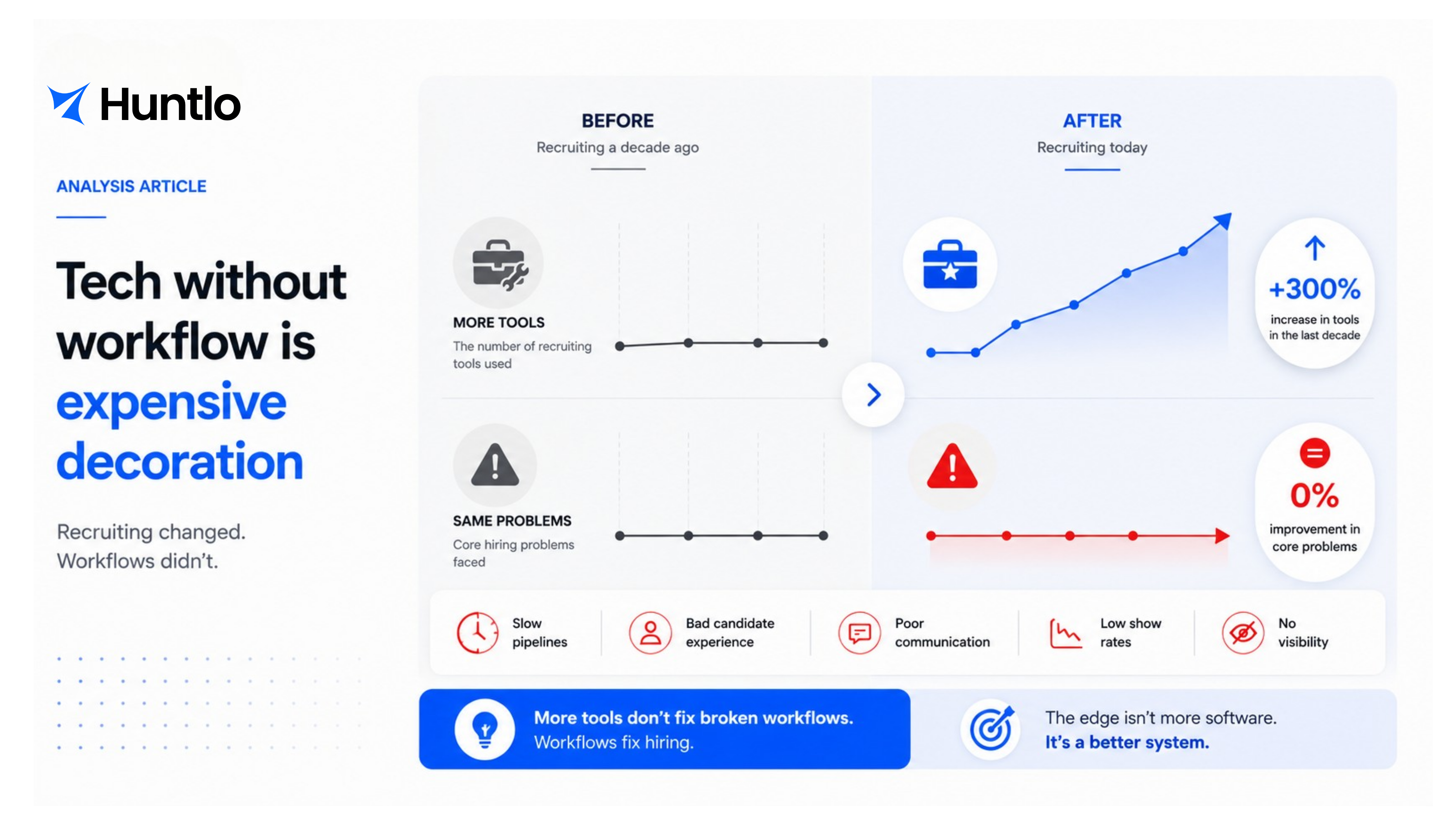
There is a phrase that circulates quietly in recruiting leadership circles, usually spoken in hallway conversations at conferences or in private Slack channels, never in official presentations. The phrase is: "We have all the tools. We just cannot hire." It is spoken with a mixture of frustration, confusion, and something that sounds almost like grief — the grief of having done everything the market told you to do, invested everything the analysts recommended, and still falling short. The tools are there. The budget was spent. The training was completed. And the requisitions are still open, the candidates are still unresponsive, and the hiring managers are still unsatisfied.
This phrase — "We have all the tools. We just cannot hire." — contains the entire explanation for why more tools will not fix the problem. Notice what it does not say. It does not say "We have all the wrong tools." It does not say "Our tools are outdated." It does not say "We need better AI." It says we have the tools, and we still cannot hire. The tools are present. The capability to use them effectively is absent. And that absence of capability is the real problem — a problem that no additional software purchase can solve.
Capability vs. Tooling: The Distinction That Changes Everything
In every profession, there is a distinction between having tools and having capability. A kitchen filled with professional-grade equipment does not make someone a chef. A garage full of power tools does not make someone a carpenter. A studio full of cameras and lighting equipment does not make someone a photographer. In each case, the tools enable the professional to work at their best, but the professional's skill, knowledge, and judgment are what actually produce the result. The tools amplify capability; they do not create it.
Recruiting is no different. A team with strong recruiting capability — clear processes, skilled recruiters, effective hiring manager partnerships, and a culture of continuous improvement — will produce good hiring outcomes with almost any reasonable set of tools. Such a team might use a basic ATS, a LinkedIn Recruiter subscription, and email for outreach, and they will still fill requisitions, place candidates, and satisfy clients, because their capability ensures that the fundamentals of recruiting are executed well: good job requirements, good candidate identification, good outreach, good screening, and good follow-through.
A team with weak recruiting capability — undefined processes, undertrained recruiters, adversarial hiring manager relationships, and no culture of improvement — will struggle regardless of their technology. Give this team the most sophisticated AI sourcing platform on the market, and they will use it to send more generic messages to more poorly qualified candidates faster. The AI will faithfully execute a bad process at scale, producing a larger volume of poor outcomes. The tool is not the bottleneck. The team's capability to recruit effectively is the bottleneck.
McKinsey's organizational capability research finds that in every business function they study — sales, marketing, operations, customer service, and yes, HR — the variance in performance between high-capability and low-capability teams is 3-5 times larger than the variance explained by technology differences. The best teams with average technology consistently outperform average teams with the best technology. This is a counterintuitive finding in an industry that spends billions on technology, but it is consistent across functions, industries, and geographies.
The implication for recruiting is clear: before investing in another tool, invest in capability. Build the processes, develop the skills, and create the culture that allows recruiting to work well. Then, and only then, select a tool that amplifies that capability. Huntlo is designed to be that amplifier — a single platform that takes a team's recruiting capability and multiplies it through AI-powered sourcing, multi-channel outreach, conversational screening, and talent pool management. But the platform assumes that the underlying capability exists. It cannot create it from nothing.
The Implementation Gap: What Happens After the Purchase
One of the most striking findings in enterprise technology research is the size of the "implementation gap" — the difference between what a tool is capable of doing and what organizations actually use it to do. According to G2's software utilization study, the average recruiting tool is used at approximately 35% of its capability. That means that for every feature the vendor built, only about one-third is actively used by the customer. The remaining two-thirds of the tool's capability is either unknown to the users, considered too complex to configure, or deemed unnecessary for the team's current process.
The implementation gap is where most of the waste in recruiting technology spending occurs. A team pays 100% of a tool's subscription price but receives only 35% of its value. If the tool costs $200/seat/month, the effective value received is approximately $70/seat/month — meaning the team is overpaying by $130/seat/month for capability it is not using. Multiply this across a team of 10 recruiters and 4-5 tools, and the annual waste is staggering: easily $60,000-100,000 per year in unused software capability.
Why is the implementation gap so large? The primary reason is that implementing a new tool effectively requires more time, effort, and expertise than most teams allocate. According to Prosci's change management research, the average enterprise software implementation requires 15-20 hours of training per user to achieve basic proficiency and 40-60 hours to achieve full proficiency. For a 10-person recruiting team adopting a new AI sourcing tool, that is 150-200 hours for basic proficiency and 400-600 hours for full proficiency. Most teams allocate 5-10 hours of initial training and then expect recruiters to learn the rest on the job. The result is that most recruiters learn enough to do their current workflow in the new tool but never discover the advanced features that would actually transform their process.
The implementation gap is even larger when tools are added to a fragmented stack. When a new tool must be integrated with three or four existing tools, the implementation effort doubles or triples, because each integration point requires configuration, testing, and ongoing maintenance. The team's limited implementation bandwidth is spread across multiple integrations rather than focused on getting maximum value from a single platform.
This is one of the strongest arguments for consolidation. A team that adopts a single, comprehensive platform like Huntlo can invest its entire implementation bandwidth in learning and optimizing one system, rather than spreading that bandwidth across six or seven. At $99/seat/month with no usage caps, Huntlo provides a platform deep enough to reward full proficiency — its AI sourcing, multi-channel outreach, conversational screening, and talent pool management features all connect and compound on each other, so that the more deeply the team uses the platform, the more value it generates. There is no implementation gap between features, because all the features live in the same integrated environment.
The Skill Deficit: Recruiters Who Cannot Use What They Have
Even when tools are implemented correctly, there is a deeper problem: many recruiters lack the skills to use their tools effectively, regardless of which specific tools they have. This skill deficit manifests in several ways that have nothing to do with technology.
The first skill deficit is in candidate evaluation. Many recruiters, particularly those who are early in their careers or who have been trained primarily in administrative recruiting functions, cannot reliably distinguish a strong candidate from a weak one based on a profile review. They rely on keyword matching — looking for specific technologies, job titles, or companies on a candidate's profile — without understanding the nuance of how skills, experience, and career trajectory combine to indicate a good match. This skill deficit means that even the best AI matching tool will produce candidate shortlists that the recruiter cannot effectively prioritize, because the recruiter cannot apply the judgment needed to separate the truly excellent candidates from the merely adequate ones.
The second skill deficit is in hiring manager relationship management. Effective recruiting requires a genuine partnership between the recruiter and the hiring manager — a relationship where the recruiter provides market intelligence, pushes back on unrealistic requirements, and manages expectations about timeline and candidate availability. Many recruiters, particularly in agency settings, have been trained to be order-takers rather than strategic partners: they receive a job description, they source candidates, they submit candidates, and they hope for the best. This order-taker approach produces poor outcomes regardless of the technology behind it, because the fundamental problem — misaligned or unrealistic hiring expectations — is never addressed.
The third skill deficit is in candidate engagement. As discussed in earlier articles, the ability to write personalized, compelling outreach messages, to conduct engaging screening conversations, and to manage candidate relationships over time are human skills that technology can support but not replace. A recruiter who cannot write a good message will not suddenly write good messages just because an AI tool generates a first draft. A recruiter who cannot conduct an engaging phone screen will not become a better interviewer because a chatbot handles the initial screening. The human skills of recruiting — communication, empathy, judgment, relationship-building — remain the foundation of effective hiring, and they are developed through training, practice, and mentorship, not through tool adoption.
SHRM's recruiter competency model identifies six core competencies for effective recruiting: talent sourcing, candidate engagement, hiring manager consultation, offer negotiation, workforce planning, and data-driven decision making. Notice that only one of these six competencies — talent sourcing — is directly technology-dependent. The other five are fundamentally human skills. A technology investment that focuses exclusively on sourcing while neglecting the other five competencies will produce at best a 16% improvement in overall recruiting effectiveness — because it is addressing only one of six critical capability areas.
For recruiting leaders, the implication is that training budgets should be weighted heavily toward developing human competencies rather than technology skills. Yes, recruiters need to know how to use their platform effectively. But they also need to know how to evaluate candidates, manage hiring manager relationships, engage passive talent, negotiate offers, and use data to make better decisions. These are the skills that determine whether a recruiter is effective, and they are the skills that tools cannot teach.
The Process Vacuum: Where Tools Go to Die
The most common fate of a new recruiting tool is not failure — it is irrelevance. The tool is purchased, implemented, and used for a few weeks or months with initial enthusiasm. Then, gradually, usage declines. Recruiters revert to their old habits, the tool's dashboards go unmonitored, and the subscription becomes a "zombie license" that auto-renews every month without anyone actively using it. According to Zylo's SaaS waste report, approximately 25-30% of all SaaS licenses in enterprise organizations are zombie licenses — tools that are paid for but not meaningfully used. In recruiting, where tool adoption is often driven by individual champion enthusiasm rather than organizational mandate, the zombie license rate may be even higher.
The reason tools become zombies is that they are deployed into a process vacuum. A new AI sourcing tool is purchased, but no one has defined how it fits into the team's existing workflow. When does the recruiter use this tool versus the other sourcing tool? How do candidates from this tool flow into the outreach workflow? How are screening results from this tool documented and shared with hiring managers? Without clear answers to these process questions, the new tool exists in isolation — an island of capability that is not connected to the mainland of the team's actual workflow.
The process vacuum is particularly damaging for AI-powered tools, because AI tools require structured inputs to produce good outputs. An AI matching algorithm can only match candidates effectively if it receives well-defined job requirements. An AI personalization engine can only generate relevant outreach messages if it has accurate, detailed candidate profiles. An AI screening bot can only screen effectively if it has clear screening criteria. When the upstream process — requisition definition, candidate data management, screening criteria development — is not well-defined, the AI tool receives poor inputs and produces poor outputs, which reinforces the team's impression that the tool "does not work" and accelerates its slide into zombie status.
This is why consolidating onto a single platform like Huntlo is so powerful: it forces process definition. When sourcing, outreach, screening, and talent pool management all live in the same platform, the team cannot avoid defining how these functions connect. The platform's workflow naturally pushes the team toward process clarity, because the tool's integrated design makes the connections between stages visible and manageable. Recruiters cannot pretend that screening is someone else's problem when the screening conversation happens in the same platform where they manage the candidate pipeline. The platform makes the entire process visible, which makes it easier to define, measure, and improve.
The Measurement Mirage: Tracking the Wrong Things
Another reason more tools do not produce better hiring outcomes is that most recruiting teams measure the wrong things. They track activity metrics — messages sent, candidates sourced, calls made, InMails delivered — because these are easy to count and because most tools produce dashboards that display them prominently. But activity metrics measure effort, not effectiveness. A recruiter who sends 500 messages and gets 5 responses has the same "messages sent" metric as a recruiter who sends 500 messages and gets 50 responses, but the outcomes are dramatically different.
The tools themselves reinforce this measurement problem. Every tool's dashboard is designed to make the tool look good. The AI sourcing tool shows how many candidates it found. The outreach tool shows how many messages it delivered. The screening tool shows how many conversations it completed. Each tool reports on its own activity in isolation, creating the impression of productivity without measuring whether that productivity translates into actual hiring outcomes. A team that looks at these tool-specific dashboards might conclude that their recruiting operation is performing well — look at all those candidates sourced, all those messages sent, all those screens completed — while their actual hiring outcomes remain poor.
Harvard Business Review's analysis of performance metrics calls this the "metric substitution problem" — the tendency of organizations to measure what is easy to measure rather than what matters. In recruiting, what matters is placements, quality of hire, time-to-hire, and cost-per-hire. These are outcome metrics, and they are harder to measure because they require looking across the entire recruiting funnel, not just at the activity within a single tool. But they are the only metrics that actually indicate whether the recruiting function is achieving its purpose.
A single, integrated platform like Huntlo makes it easier to measure outcomes rather than activities, because the platform tracks the entire candidate journey from identification through engagement, screening, and qualification. A recruiter can see not just how many candidates were sourced, but how many of those candidates responded to outreach, how many passed screening, and how many were submitted to hiring managers. This end-to-end visibility enables outcome-based measurement in a way that a fragmented tool stack cannot, because in a fragmented stack, each tool only sees its own piece of the journey.
The most effective recruiting teams measure a small number of outcome metrics rigorously and hold themselves accountable for improving them. These metrics typically include: qualified candidates per requisition (a measure of sourcing quality), candidate-to-submission conversion rate (a measure of screening effectiveness), submission-to-placement rate (a measure of matching accuracy), and time from identification to submission (a measure of process speed). These four metrics, tracked consistently, provide a complete picture of recruiting effectiveness and point clearly to the areas that need improvement. No single tool can provide all of this data unless it covers the entire funnel — which is exactly why a unified platform is necessary for good measurement.
Tool Debt: The Recruiting Equivalent of Technical Debt
Software engineers understand the concept of technical debt — the accumulation of suboptimal code, architecture decisions, and workarounds that make a system harder to maintain and improve over time. Technical debt is not a problem when it is small, but as it accumulates, it slows development, increases the risk of bugs, and eventually makes the system so rigid that significant changes become prohibitively expensive.
Recruiting teams accumulate a similar kind of debt: tool debt. Tool debt is the accumulation of overlapping tools, inconsistent workflows, data silos, and process workarounds that make the recruiting operation harder to manage and improve over time. Like technical debt, tool debt is not a problem when it is small — adding a second or third tool to a recruiting stack creates some complexity but is manageable. But as more tools are added, the debt compounds: each new tool creates new integration points, new data flows, new training requirements, and new process variations. Eventually, the system becomes so complex that making any change — adopting a new process, onboarding a new recruiter, integrating with a new ATS — requires weeks of coordination and testing.
Forrester's technology debt research estimates that organizations with high technology debt spend 40-50% of their IT resources on maintaining existing systems rather than building new capabilities. In recruiting, the equivalent statistic is likely even higher, because recruiting teams rarely have dedicated IT resources and must manage their tool debt with limited technical expertise. A recruiting operations manager who spends 15 hours per week managing integrations, troubleshooting sync failures, and reconciling data between tools is spending 37.5% of their working time on tool debt maintenance — time that could be spent on process improvement, recruiter training, or strategic initiatives.
Paying down tool debt — consolidating the stack, eliminating redundancy, and simplifying the architecture — requires an upfront investment but yields significant ongoing returns. When a team replaces five or six recruiting tools with a single platform like Huntlo, the tool debt is dramatically reduced. Integration maintenance drops to near zero, because there are no tool-to-tool integrations to maintain. Data reconciliation disappears, because there is a single source of truth for candidate data. Training requirements are simplified, because recruiters learn one platform instead of five. And process improvement becomes possible, because changes can be made in one place and take effect across the entire workflow.
The ROI of paying down tool debt extends beyond direct cost savings. Teams that consolidate their stack report faster recruiter onboarding, higher recruiter satisfaction, better data quality, more consistent candidate experience, and improved compliance posture. These benefits compound over time, making the initial consolidation investment one of the highest-ROI decisions a recruiting leader can make.
The Simplicity Advantage: Why Less Technology Produces Better Hiring
There is a growing body of evidence that simplicity — in tools, processes, and organizational structure — produces better outcomes than complexity. This evidence comes from fields as diverse as software engineering, military strategy, healthcare delivery, and manufacturing operations, and the principle applies with particular force to recruiting.
In software engineering, the "minimal viable product" approach — building the simplest possible solution that addresses the core need, then iterating based on real-world feedback — has been shown to produce better products faster than the traditional "build everything at once" approach. The Standish Group's CHAOS report, which tracks IT project outcomes, consistently finds that smaller, simpler projects succeed at dramatically higher rates than large, complex projects.
In military strategy, the principle of "economy of force" — concentrating resources at the decisive point rather than spreading them across the entire battlefield — is one of the foundational concepts of operational art. Spreading forces thin creates vulnerability everywhere and strength nowhere. In recruiting, the equivalent mistake is spreading technology, training, and attention across too many tools, creating a situation where no single tool is used well enough to make a difference.
In healthcare, research published in the British Medical Journal (BMJ) has shown that simpler clinical protocols — standardized workflows with fewer decision points — produce better patient outcomes than complex protocols that give clinicians more options but require more cognitive effort to navigate. The parallel to recruiting is direct: a simple, standardized recruiting process executed consistently by a team using a single platform will outperform a complex process executed inconsistently across multiple tools.
Huntlo's design philosophy reflects this simplicity principle. The platform is not designed to be the most feature-rich recruiting tool on the market. It is designed to be the most operationally coherent — a single environment where sourcing, outreach, screening, and talent pool management work together as an integrated system rather than as a collection of independent features. This coherence produces results that feature-rich but fragmented stacks cannot match, because coherence eliminates the friction, inconsistency, and cognitive burden that complexity creates.
At $99/seat/month with no usage caps, Huntlo makes simplicity economically accessible. A team does not need to justify a $400/seat/month enterprise license to get an integrated platform — they can start with a minimal investment and scale as their capability grows. This accessibility is important, because the teams that need simplicity the most are often the ones with the least budget — small agencies, solo recruiters, and startup talent teams that cannot afford the complex, expensive tool stacks that large enterprises use.
Building Recruiting Capability: A Framework
For teams that are ready to stop accumulating tools and start building capability, here is a practical framework organized around the five core competencies that SHRM identifies as essential for effective recruiting.
The first competency is talent sourcing capability. This means the ability to define what a good candidate looks like for a specific role, identify where those candidates are likely to be found, and evaluate candidate profiles against the defined criteria. Building this capability requires training recruiters on skills-based assessment, market intelligence, and the use of AI-powered matching tools. With Huntlo, the AI handles the mechanical work of searching and matching, which allows recruiters to focus their capability on the judgment work of evaluating whether the AI's matches are genuinely strong candidates for the specific role.
The second competency is candidate engagement capability. This means the ability to reach candidates through the right channel, with the right message, at the right time, and to manage a multi-turn conversation that builds trust and gathers information. Building this capability requires training on written communication, channel strategy, and conversational skills. Huntlo's multi-channel outreach engine handles channel selection and message delivery, while its conversational AI handles initial screening conversations — but the recruiter's engagement capability determines how effectively they manage the human elements of the relationship that AI cannot handle.
The third competency is hiring manager consultation capability. This means the ability to partner with hiring managers to define realistic requirements, provide market intelligence about candidate availability and compensation, and manage the feedback loop throughout the hiring process. This is a fundamentally human competency that no tool can replace, and it is often the weakest link in the recruiting chain. Investing in this competency — through training, coaching, and structured consultation frameworks — typically produces the highest ROI of any recruiting capability investment.
The fourth competency is data-driven decision making. This means the ability to define outcome metrics, track them consistently, analyze trends, and make process changes based on evidence rather than intuition. A single platform like Huntlo enables this capability by providing end-to-end data visibility across the entire recruiting funnel. But the data is only valuable if the team has the analytical skills to interpret it and the discipline to act on it.
The fifth competency is process design and improvement. This means the ability to define clear, repeatable workflows for each stage of the recruiting process, identify bottlenecks and inefficiencies, and implement improvements that produce measurable outcomes. This is the meta-competency that connects all the others — the ability to build and continuously improve the system within which all other recruiting activities take place. A consolidated platform like Huntlo provides the technological foundation for process improvement, because changes made in a single platform take effect across the entire workflow. In a fragmented stack, process improvements must be implemented separately in each tool, which is significantly harder and less likely to be sustained.
The Final Word: Capability First, Platform Second
The recruiting industry has spent the last five years chasing tools. It is time to start chasing capability. The teams that will dominate the talent market over the next decade are not the teams with the most sophisticated technology stacks — they are the teams with the strongest recruiting capability, amplified by a single, well-chosen platform.
Huntlo is that platform. It sources from 50+ platforms, reaches candidates across email, LinkedIn, WhatsApp, and AI voice, screens through conversational AI, and manages talent pools with automated follow-ups and pipeline analytics. It integrates with existing ATS platforms through webhooks. It costs $99/seat/month with no usage caps. It replaces the fragmented, expensive, underutilized collection of tools that most teams are struggling with and replaces it with a single, coherent system that actually works.
But Huntlo will only transform your hiring outcomes if you bring the capability to use it well. Define your processes. Train your recruiters. Build your hiring manager partnerships. Measure your outcomes. Improve continuously. The platform amplifies what you bring to it. Bring capability, and the results will follow. Bring only a credit card, and you will have another tool — and the same hiring problems you had before.
Related Topics:
Change Management for Recruiters Adopting New AI Tools Smoothly
Over-Automating Outreach: When AI Sourcing Hurts Your Brand
The Next Generation of AI Recruiting: What's Coming After Sourcing Automation