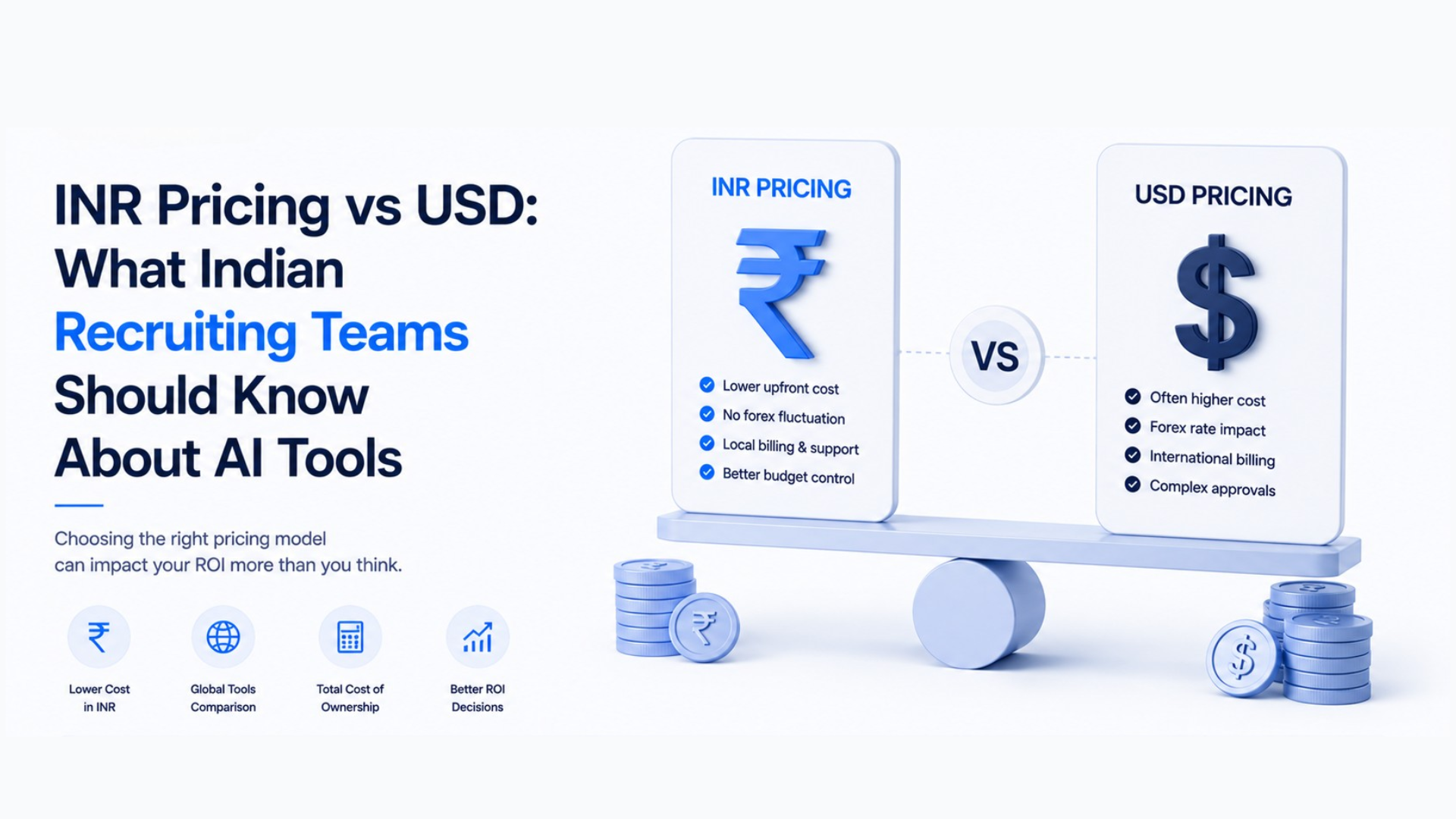
The Indian staffing and recruitment industry employs over 3 million people and generates an estimated ₹70,000 crore in annual revenue, according to the Indian Staffing Federation (ISF). It is the backbone of workforce supply for India's booming IT services sector, its expanding GCC (Global Capability Center) ecosystem, and its rapidly growing startup economy. Yet this massive industry faces a persistent technology gap: the AI recruiting tools designed to make recruiters more productive are priced in a currency that makes them disproportionately expensive for Indian teams.
A tool that costs a US staffing agency $300 per recruiter per month — expensive but manageable when the average American agency recruiter earns $65,000-$85,000 per year — costs an Indian agency ₹25,000 per recruiter per month. In a market where many junior recruiters earn ₹25,000-₹35,000 per month in total compensation, spending an equivalent amount on a single software subscription per person is, for many firms, simply not viable. This currency disconnect is the single biggest barrier to AI recruiting tool adoption in India, and it's the problem this guide is designed to solve.
The Currency Reality: What USD Pricing Actually Costs in INR
Before evaluating any AI recruiting tool, Indian teams need a clear picture of what USD-denominated pricing translates to in rupees. The exchange rate fluctuates, but as of mid-2025, the Reserve Bank of India (RBI) reference rate hovers around 83-84 INR per USD. This means every dollar of software cost costs you roughly 84 rupees.
Let's apply this to the major AI recruiting platforms:
A platform charging $150/seat/month in USD costs approximately ₹12,600/seat/month. For a 5-recruiter agency, that's ₹63,000 per month or ₹7,56,000 per year. A platform charging $300/seat/month — which is the entry point for several well-known enterprise tools — costs approximately ₹25,200/seat/month. For the same 5-recruiter agency, that's ₹1,26,000 per month or ₹15,12,000 per year.
To put these numbers in context, NASSCOM's workforce reports indicate that the average annual revenue per recruiter at Indian staffing firms ranges from ₹8,00,000 to ₹15,00,000, depending on specialization and client mix. Spending ₹15,12,000 per year on a single sourcing tool for a 5-person team represents 20-38% of total revenue per recruiter — an allocation that is extremely difficult to justify, especially when the tool is just one component of the technology stack.
The currency effect is even more pronounced for the per-credit and usage-based charges that many platforms layer on top of per-seat pricing. A $0.50 per-contact overage charge sounds trivial in USD, but at 84 rupees to the dollar, it's ₹42 per contact. A recruiter sourcing for a job vacancy with 200 potential candidates could easily incur ₹8,400 in overage charges for a single search — charges that weren't visible in the base pricing.
Why Most AI Recruiting Tools Don't Offer INR Pricing
Understanding why INR pricing is rare helps Indian teams navigate the market more strategically. The majority of AI recruiting tool vendors are headquartered in the United States or Europe, and their pricing infrastructure is built around USD or EUR. According to SaaS pricing research from Price Intelligently, most B2B SaaS companies serve 70-80% of their customers in their home currency and lack the billing infrastructure, tax compliance, and local support capabilities to offer meaningful pricing in other currencies.
Even vendors with significant Indian customer bases — like hireEZ and SeekOut, both of which have customers among Indian IT services companies and staffing agencies — typically bill in USD. The reason is straightforward: their costs are in USD. Engineering teams, sales operations, customer support, and infrastructure are all priced in dollars, and offering INR pricing would expose them to currency risk without a clear revenue upside in what is, for most of these companies, a secondary market.
Some vendors offer quasi-INR pricing by allowing Indian customers to pay via Indian payment methods (UPI, net banking, or Indian credit cards) while still billing in USD at the prevailing exchange rate. This helps with payment convenience but doesn't address the fundamental cost problem — the amount in rupees still fluctuates with the exchange rate, and the rupee amount is still determined by a USD price point designed for US-market economics.
The Indian Recruiting Economics Context
To evaluate whether an AI tool is worth its INR cost, you need to understand the economic context of Indian recruiting. The cost structure of an Indian staffing agency is fundamentally different from a US or European agency, and this difference profoundly affects how tool costs should be evaluated.
Recruiter Compensation in India
According to AmbitionBox salary data and Indeed India's recruiter salary reports, recruiter compensation in India varies significantly by experience and geography:
Junior recruiters (0-2 years): ₹2,50,000-₹4,00,000 per year, or approximately ₹20,000-₹33,000 per month
Mid-level recruiters (3-5 years): ₹4,50,000-₹7,50,000 per year, or approximately ₹37,500-₹62,500 per month
Senior recruiters (6+ years): ₹8,00,000-₹15,00,000 per year, or approximately ₹66,000-₹1,25,000 per month
These figures vary by city — PayScale's India compensation data shows that recruiter salaries in Bengaluru, Mumbai, and Gurgaon are typically 20-40% higher than in Tier 2 cities like Pune, Hyderabad, or Chennai. For agencies operating in Tier 2 and Tier 3 cities, where much of India's IT and BPO staffing happens, recruiter compensation is even lower.
Placement Fees and Revenue Per Recruiter
Indian staffing agencies typically charge placement fees of 8-15% of the candidate's annual CTC (Cost to Company), depending on the role level and specialization. For a mid-level IT role with a CTC of ₹12,00,000, the placement fee ranges from ₹96,000 to ₹1,80,000. A productive Indian recruiter making 3-5 placements per month at an average fee of ₹1,00,000 generates ₹3,00,000-₹5,00,000 in monthly revenue.
These economics mean that an AI tool costing ₹25,000/seat/month needs to generate at least ₹25,000 in additional monthly revenue per recruiter — roughly one additional placement every 4-5 months — to break even. In practice, well-adopted AI tools generate far more than that, but the breakeven threshold is important context when evaluating whether a tool's INR cost is justified.
The Overhead Reality
Indian staffing firms typically operate on thinner margins than their US counterparts. The ISF's industry reports suggest average operating margins of 8-15% for Indian staffing firms, compared to 15-25% for US-based agencies. This means every rupee of software cost has a bigger impact on the bottom line for an Indian firm. A ₹15,000/month per-seat tool that represents 5% of a US recruiter's fully loaded cost might represent 15-25% of an Indian recruiter's fully loaded cost — making the same tool three to five times more expensive in relative terms.
Huntlo's Pricing in the Indian Context
Huntlo's $99/seat/month flat-rate pricing takes on a particularly compelling dimension when viewed through the lens of Indian recruiting economics. At approximately ₹8,300/seat/month (at an exchange rate of 84), Huntlo costs less than what many Indian agencies pay for a single recruiter's LinkedIn subscription, mobile phone reimbursement, or job board access.
For a 5-recruiter Indian staffing agency, the total monthly cost is approximately ₹41,500 — a figure that fits comfortably within most agency technology budgets. Compare this to the ₹1,26,000/month that a comparable enterprise tool at $300/seat would cost the same team. Over a year, the difference is approximately ₹10,14,000 — enough to fund a significant portion of a junior recruiter's annual compensation or invest in other growth initiatives.
Huntlo's flat-rate model is especially valuable in the Indian context because it eliminates the currency risk associated with usage-based pricing. With per-credit tools, your INR costs fluctuate not only with the exchange rate but also with your team's activity level. A month of heavy sourcing — which is when you most need the tool — can produce a surprisingly large bill when both contact volume and the USD/INR rate work against you. Huntlo's ₹8,300/seat/month is the same whether you source 10 candidates or 1,000.
The multi-channel outreach capability is particularly relevant for the Indian market. WhatsApp Business data from Meta shows that India has over 500 million WhatsApp users, and for many candidate segments — particularly for roles like work from home jobs, data entry jobs, and customer service positions — WhatsApp is the primary communication channel. Huntlo's inclusion of WhatsApp outreach in its standard pricing means Indian recruiters can reach candidates on their preferred platform without paying extra for third-party WhatsApp tools or upgrading to premium tiers on other platforms.
Evaluating AI Tools in INR: A Practical Framework
When you evaluate AI recruiting tools, don't convert the USD price to INR and compare the raw number. Instead, evaluate the tool's cost relative to your specific recruiting economics. Here's a framework designed for Indian teams:
Step 1: Calculate Your Cost-Per-Placement
Divide your total monthly recruiting cost (recruiter compensation + all tool subscriptions + job board spend + overhead allocation) by your monthly placement volume. If a 5-recruiter agency spends ₹5,00,000 per month on total recruiting costs and makes 15 placements, the cost per placement is ₹33,333. This is the number that matters — not the software's monthly price in isolation.
Step 2: Estimate the Tool's Impact on Cost-Per-Placement
If the AI tool helps your team make 2 additional placements per month (a conservative estimate based on industry benchmarks from the Recruiting Brainfood community), your new monthly placement volume is 17 instead of 15. Your new cost per placement is ₹5,00,000 ÷ 17 = ₹29,411 — a saving of ₹3,922 per placement, or ₹66,670 per month across all placements.
Step 3: Subtract the Tool's INR Cost
If the tool costs ₹8,300/seat/month × 5 seats = ₹41,500/month, and the monthly savings from improved efficiency is ₹66,670, the net monthly benefit is ₹25,170. Over 12 months, that's ₹3,02,040 in net value — a 6:1 return on the ₹3,01,920 annual investment (after accounting for the fact that savings and costs are nearly equal in month 1, with savings growing as the team optimizes its use of the tool).
Step 4: Factor in Currency Risk
For USD-priced tools, add a 10-15% buffer to your projected annual cost to account for potential rupee depreciation. The INR has historically depreciated 3-5% per year against the USD, according to RBI historical exchange rate data, and periods of sharper depreciation are common. If a tool costs ₹12,600/seat/month today, budget for ₹13,800-₹14,500/seat/month over the next 12 months to avoid budget surprises.
Step 5: Consider Opportunity Cost
Every rupee spent on an overpriced tool is a rupee not spent on recruiter development, candidate experience improvements, or business growth. When a ₹25,000/seat/month tool could be replaced by a ₹8,300/seat/month alternative that delivers comparable or superior capabilities, the ₹16,700/seat/month difference represents ₹1,00,200 per month for a 5-person team that could be invested elsewhere.
Indian Market-Specific Considerations
Beyond currency, Indian recruiting teams evaluating AI tools should consider several market-specific factors that affect tool value.
Sourcing for the Indian Candidate Market
The Indian professional talent pool is distributed differently than Western markets. While LinkedIn has significant penetration in India's IT and professional services sectors — LinkedIn India reports over 100 million members — large segments of the Indian workforce are more active on platforms like Naukri.com, Indeed India, and regional job boards that many US-centric AI sourcing tools don't index well.
For roles like freshers jobs, where the primary candidate pool consists of recent graduates active on Naukri, Indeed, and college placement portals, an AI tool that primarily sources from LinkedIn and Western professional networks will miss the majority of relevant candidates. Huntlo's 50+ source integrations include Indian job boards and professional networks, providing better coverage of the Indian candidate market than tools built primarily for US sourcing.
Compliance and Data Privacy
India's Digital Personal Data Protection Act (DPDPA) 2023 introduces data protection requirements that affect how AI sourcing tools handle candidate data. Indian recruiting teams need to ensure that any AI tool they use complies with these requirements, particularly around data storage location, consent management, and data retention policies.
Tools that store candidate data outside India may create compliance complications, especially for staffing firms that serve clients with strict data sovereignty requirements — such as GCCs of European or American companies operating in India. As the Internet Society's analysis of India's data protection framework notes, the DPDPA's requirements around data processing and consent have significant implications for recruitment technology vendors operating in India.
Multi-Language Considerations
India's linguistic diversity means that recruiting for many roles — particularly for jobs for women in Tier 2 and Tier 3 cities, part time jobs in regional markets, and internship jobs at colleges in non-metro areas — requires communication in languages other than English. AI tools that only operate in English have limited utility for these recruiting scenarios. While most AI recruiting tools currently operate primarily in English, the ability to handle transliterated names, regional job titles, and multilingual candidate profiles is increasingly important for Indian recruiting teams.
GST Implications
Software subscriptions purchased from foreign vendors attract Goods and Services Tax (GST) at 18% under the reverse charge mechanism for Indian businesses. This means a $150/seat/month tool doesn't cost ₹12,600 — it costs ₹12,600 plus ₹2,268 in GST, for a total of ₹14,868/seat/month. Many Indian teams forget to factor GST into their cost calculations, leading to budget underestimation. For a 10-person team, the GST on a $300/seat tool adds ₹45,360 per year to the total cost.
What Indian Recruiting Teams Should Demand from Vendors
Given the unique challenges Indian teams face, there are specific things you should ask for when evaluating any AI recruiting tool:
First, ask for INR-denominated billing or at minimum, INR-predictable pricing. Even if the vendor bills in USD, ask for a price-lock clause that fixes the INR equivalent for the contract duration. Some vendors will agree to this, particularly for multi-year commitments.
Second, demand transparent pricing with no per-credit overages. Usage-based pricing in a foreign currency is a budgeting nightmare. As the SaaS pricing experts at OpenView Partners have documented, usage-based pricing models benefit vendors disproportionately in markets with currency volatility because the customer bears both the usage risk and the currency risk.
Third, verify Indian data source coverage. Ask the vendor specifically which Indian job boards, professional networks, and regional platforms they index. If the vendor can't name at least 5-8 India-specific sources, their sourcing reach in the Indian market is likely limited.
Fourth, confirm data residency and DPDPA compliance. Ask where candidate data is stored, whether it ever leaves India, and whether the vendor has a documented compliance framework for the Digital Personal Data Protection Act. The Ministry of Electronics and IT (MeitY) has been increasing enforcement of data protection requirements, and non-compliance carries significant penalties.
Fifth, request references from other Indian staffing agencies or TA teams. Talk to organizations similar to yours about their real-world experience with the tool, including actual INR costs (including GST and any hidden charges), the vendor's responsiveness to India-specific issues, and the tool's effectiveness for Indian candidate sourcing.
Building Your INR Budget for AI Recruiting Tools
A practical budget framework for Indian recruiting teams should include the following line items, all calculated in INR:
Base subscription cost: Per-seat monthly cost × number of seats × 12 × current exchange rate (add 10% buffer for currency fluctuation)
GST: 18% of the base subscription cost
Implementation and onboarding: One-time cost converted at current rate
Training: Vendor training fees + internal team time (valued at recruiter hourly rate)
Integration costs: Any ATS or HRIS integration development
Annual escalator: If the contract includes annual price increases, model these at the projected exchange rate
Opportunity cost buffer: 10-15% of total to account for underutilization during the adoption period
For a 5-person Indian agency evaluating Huntlo, this budget would look approximately like:
Base subscription: ₹8,300 × 5 × 12 = ₹4,98,000
GST (18%): ₹89,640
Implementation: Minimal (self-service webhooks)
Training: Included in subscription
Integrations: Minimal (webhook-based)
Currency buffer: ₹49,800 (10%)
Total first-year budget: approximately ₹6,37,440
For the same team on a $300/seat/month enterprise tool:
Base subscription: ₹25,200 × 5 × 12 = ₹15,12,000
GST (18%): ₹2,72,160
Implementation: ₹60,000-₹1,20,000 (estimated)
Training: ₹25,000-₹50,000 (estimated)
Estimated overages: ₹60,000-₹1,20,000/year
Currency buffer: ₹1,51,200 (10%)
Total first-year budget: approximately ₹20,80,360-₹23,25,360
The difference — ₹14,42,920 to ₹16,87,920 over three years — is equivalent to hiring an additional junior recruiter. For Indian staffing firms where every rupee of margin counts, this cost differential is not academic; it's a strategic decision about resource allocation.
The Competitive Advantage of Smart Tool Selection
Indian recruiting teams that choose AI tools based on INR value rather than USD feature lists gain a structural competitive advantage. By selecting a platform like Huntlo that delivers comprehensive AI sourcing, multi-channel outreach, and conversational screening at approximately ₹8,300/seat/month, Indian agencies can access capabilities that their competitors — who may be overpaying 2-3 times as much for USD-priced enterprise tools — can't profitably deploy.
This advantage compounds over time. The agency that saves ₹15,000/seat/month on its sourcing tool can invest that savings in recruiter development, better candidate experience, or expanded business development. Over three years, the cumulative savings for a 10-person team could fund an entire additional recruiter's compensation, new office space, or entry into a new market segment.
The message for Indian recruiting teams is clear: don't evaluate AI tools through a USD lens. Convert every cost to INR, factor in GST and currency risk, measure against your actual recruiting economics, and demand the value-for-money that your market conditions require. The tools that deliver the most value in the Indian context aren't necessarily the most expensive or the most feature-rich — they're the ones that provide the best ratio of recruiting capability to rupee invested. Huntlo's flat-rate ₹8,300/seat/month pricing, when evaluated against this framework, represents one of the strongest value propositions available to Indian recruiting teams in 2025.
Related Topics
Best AI Recruiting Tools for Hiring in India vs Global Markets (2026 Guide)
Compliance and Data Privacy: AI Sourcing Tools for Indian Recruiters
AI Sourcing for Tier 2 and Tier 3 City Hiring in India: A Recruiter's Guide