In 2025, a record 234 CEOs departed their roles globally — a 16% increase from 2024 and 21% above the eight-year average. According to the Russell Reynolds Associates Global CEO Turnover Index, the average tenure of outgoing CEOs fell to 7.1 years, down from 8.3 in 2021. Behind each of those departures is a board that made a hiring decision — and in many cases, a board that is now making another one. The cost of getting an executive hire wrong is not measured in recruiting fees. It is measured in strategic misalignment, cultural disruption, team attrition, missed market opportunities, and the compounding effects of leadership instability across the organization.
Yet the methods most organizations use to make these high-stakes decisions remain remarkably resistant to evidence. Harvard Business School research on recruiting practices, conducted with scores of CEOs, HR executives, and recruiters, found current hiring practices to be "haphazard at best and inept at worst." HBR's landmark analysis argued that the fundamental approach to hiring — across all levels, but especially at the executive tier — is structurally flawed, relying on credentials and chemistry rather than on rigorous assessment of the capabilities that actually predict success.
Meanwhile, artificial intelligence has entered the executive hiring arena with tools that can analyze candidate communication patterns, assess leadership competencies through structured video interviews, and provide data-driven insights that human interviewers simply cannot generate at scale. But AI brings its own set of limitations: it cannot read the subtext of a strategic conversation, assess the interpersonal dynamics between a candidate and a board, or evaluate whether a leader's vision is genuinely original or merely well-articulated conventional wisdom.
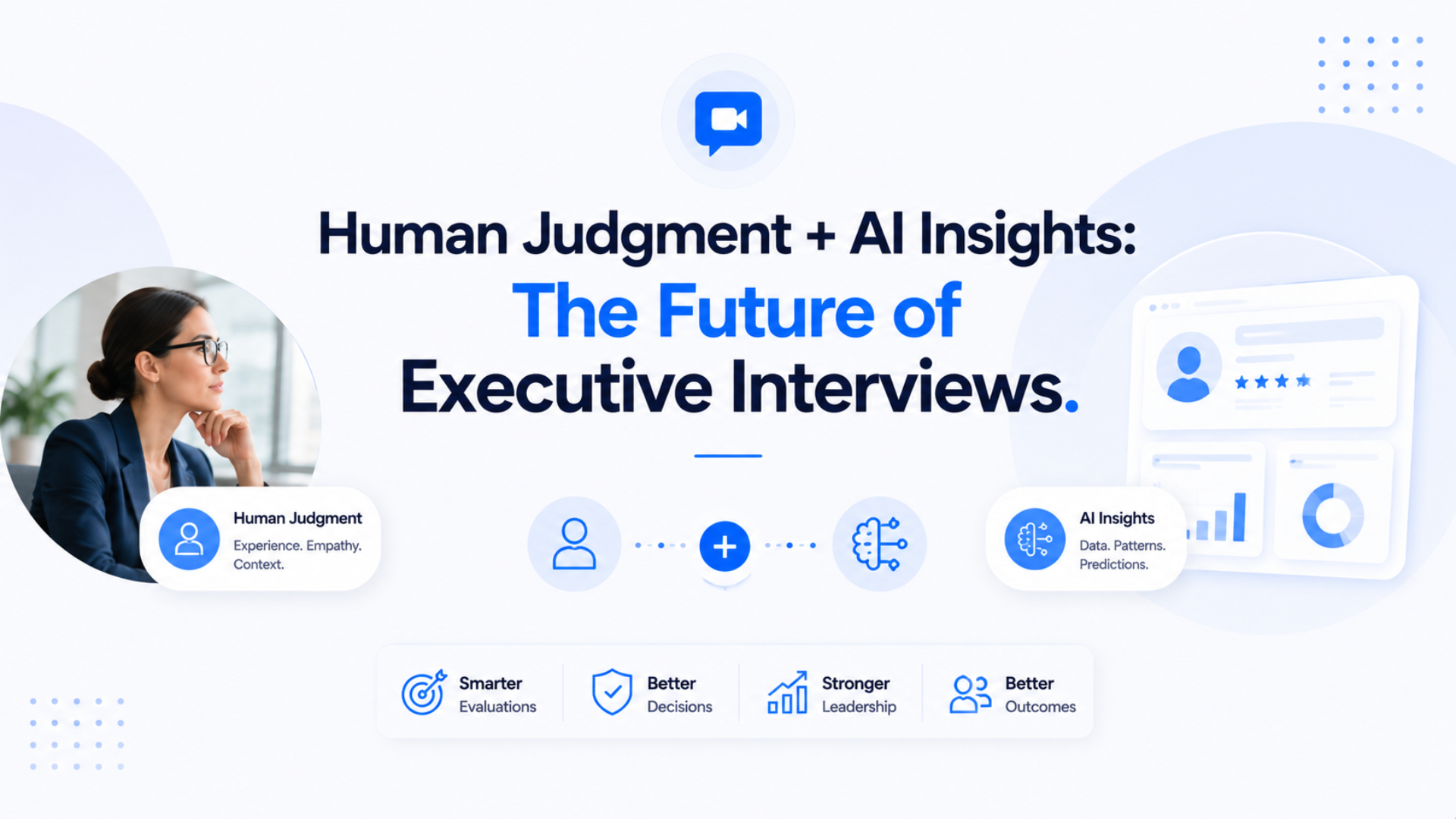
The organizations that will win the war for executive talent are not the ones that cling to intuition alone, nor the ones that outsource judgment to algorithms. They are the ones that figure out how to combine human insight with AI-powered intelligence in ways that produce better decisions than either could deliver independently. This is the future of executive interviews — and it is already unfolding.
The Problem with Pure Human Judgment in Executive Hiring
Human judgment in hiring is not merely imperfect — it is systematically and predictably flawed. Decades of research in cognitive psychology, behavioral economics, and industrial-organizational psychology have documented the specific biases and heuristics that distort hiring decisions, and these distortions are amplified rather than diminished at the executive level.
The NIH's comprehensive review of cognitive biases in professional decision-making examines how cognitive biases affect professionals across management, finance, medicine, and law, finding that even highly experienced decision-makers are susceptible to systematic errors in information processing and evaluation. In the context of executive hiring, these biases manifest in several particularly damaging ways.
The halo effect — the tendency to let one positive attribute (an Ivy League degree, a charismatic presentation style, experience at a well-known company) color the evaluation of all other attributes — is pervasive in executive interviews. A candidate who delivers a polished thirty-minute conversation may be assessed as strategically brilliant, culturally aligned, and operationally competent on the basis of limited evidence, simply because the initial impression was positive. Conversely, the horn effect can cause a single awkward moment — a missed reference, a fumbled answer about a difficult period in the candidate's career — to overshadow substantial evidence of capability.
The similarity bias, sometimes called the "mirror effect," leads interviewers to prefer candidates who remind them of themselves — in background, communication style, educational pedigree, or professional experience. Criteria Corp's research on unconscious bias in hiring documents how this bias operates at scale, systematically reducing diversity in hiring outcomes and causing interviewers to overestimate the cultural fit of candidates who share their demographic or professional profile. At the executive level, where interview panels are often composed of people from similar backgrounds, this bias can be particularly entrenched.
The availability heuristic — our tendency to overweight information that comes to mind quickly and easily — distorts executive evaluation by causing interviewers to over-index on recent, vivid, or emotionally resonant information rather than considering the full body of evidence. A candidate who shares a compelling story about a turnaround they led may be rated more highly than a candidate with a more consistent but less dramatic track record, even if the latter's overall performance record is stronger.
The NIH's research on heuristics in decision-making further explains that cognitive biases arise when decision-makers do not process the full range of information available to them, often due to cognitive limitations, time pressure, or emotional states — all of which are common conditions in executive interview processes that are compressed into a few meetings over a short timeline.
The consequences of these biases are not abstract. Gallup's research on managerial hiring reveals that companies miss the mark on high managerial talent in 82% of their hiring decisions — an alarming failure rate that has direct consequences for employee engagement, team performance, and organizational outcomes. Gallup's broader finding — that employees who are supervised by highly engaged managers are 59% more likely to be engaged themselves — underscores the cascading impact of executive and managerial hiring quality.
SHRM's 2025 Recruiting Executives Priorities and Perspectives Report, based on insights from 292 heads of recruiting, found that recruiting was the top priority in 2024, with 43% of HR professionals identifying it as their primary focus. Yet the same report reveals that organizations continue to struggle with executive hiring quality, particularly as the demands on leaders evolve rapidly and the attributes that predict success in one context may not transfer to another.
The problem is compounded by the fact that executive interviews often involve very small sample sizes of human evaluation. A CEO or CFO candidate may be evaluated by five to eight board members across two or three meetings — a fraction of the observational data that would be collected in a rigorous assessment center or multi-day evaluation process. Each individual interviewer forms an impression based on limited interaction, and the final decision is typically made through a group discussion where social dynamics — deference to the board chair, the influence of the most vocal committee member, anchoring on the first opinion expressed — introduce additional layers of bias. Research on group decision-making consistently shows that groups do not reliably outperform their most accurate individual member when the task involves subjective judgment under conditions of uncertainty — precisely the conditions that characterize executive hiring.
The financial and strategic consequences of executive mis-hires are staggering. Research consistently estimates that a bad executive hire costs between 100% and 400% of the executive's annual compensation when accounting for direct costs (severance, recruitment fees, onboarding investment), indirect costs (team disruption, strategic delays, opportunity costs), and systemic costs (cultural damage, employer brand erosion, board credibility). For a CEO earning $2 million annually, a mis-hire can easily represent a $10 million to $20 million total cost to the organization — and that figure does not include the harder-to-quantify costs of strategic missteps made during the failed executive's tenure.
The evidence is clear: unaided human judgment, no matter how experienced the decision-maker, is a fundamentally unreliable foundation for executive hiring decisions. But the solution is not to remove human judgment — it is to augment it.
The Promise and Limitations of AI in Executive Assessment
Artificial intelligence brings a different set of capabilities and a different set of limitations to the executive interview process. Understanding both is essential for designing a human-AI hybrid approach that leverages the strengths of each.
What AI does well in executive assessment is structured, consistent, and data-rich evaluation. AI-powered interview platforms can administer standardized questions to every candidate, evaluate responses against predefined competency rubrics with perfect consistency, process large volumes of candidate data in hours rather than weeks, and generate comparative analytics that show how candidates stack up against each other and against historical performance benchmarks. These capabilities directly address the most significant weaknesses of human-only evaluation: inconsistency, incomplete information processing, and susceptibility to cognitive biases.
SHRM's research on eliminating biases in hiring through structured interviewing and AI solutions demonstrates how AI-powered structured interview platforms reduce unconscious bias by standardizing evaluation criteria, removing the visual and auditory distractions that influence human judgment, and producing auditable scorecards that enable organizations to review their hiring patterns for evidence of disparate impact. The structured approach enforced by AI platforms ensures that every candidate is evaluated against the same dimensions with the same weighting — a consistency that no panel of human interviewers, no matter how well-trained, can reliably achieve.
AI also excels at processing signals that humans may miss or underweight. Natural language processing can analyze the specificity, structure, and depth of a candidate's responses in ways that go beyond whether the answer "sounded good." For example, AI can detect whether a candidate consistently attributes outcomes to team effort versus individual action, whether their descriptions of strategic decisions include explicit consideration of trade-offs and risks, or whether their communication patterns shift meaningfully when discussing successes versus failures. These subtle but information-rich signals can provide valuable data points for executive evaluation.
In the executive context specifically, AI can assess dimensions that are difficult to evaluate consistently through unstructured human conversation. Leadership communication style — whether a candidate tends to be directive, collaborative, interrogative, or narrative in their approach to answering questions — can be measured and compared across candidates. Strategic thinking depth — the extent to which a candidate moves beyond surface-level analysis to consider second-order effects, stakeholder interdependencies, and long-term implications — can be evaluated against calibrated benchmarks. Adaptability signals — how a candidate's communication shifts in response to different question types and difficulty levels — can reveal cognitive flexibility that a single conversational interview might not surface.
The Leadership IQ research on executive failure rates documents how frequently executives fail not because of technical incompetence but because of misalignment between their leadership approach and the organizational context. AI assessments, by providing more granular and consistent data about leadership style and decision-making patterns, can help organizations identify these potential misalignments before a hire is made rather than discovering them months into a new executive's tenure.
McKinsey's research on increasing return on talent emphasizes that setting up data-driven dashboards and analytics capabilities helps talent decision-makers make more informed choices across all elements of the hiring process. For executive hiring specifically, this means moving beyond the traditional reliance on board member impressions and search consultant recommendations to incorporate structured assessment data that provides a more complete and objective picture of each candidate.
However, AI's limitations in the executive context are significant and must be honestly acknowledged. Harvard Business School's research on AI and human judgment found that human experience and judgment remain critical to making decisions because AI cannot reliably distinguish good ideas from mediocre ones, evaluate the quality of strategic thinking in context, or assess the interpersonal and political dynamics that determine whether a leader will be effective in a specific organizational environment. AI can evaluate what a candidate says; it cannot fully evaluate who a candidate is, how they will lead under conditions of genuine ambiguity, or whether their leadership style will complement or clash with the existing executive team.
AI also cannot replicate the relational dimension of executive hiring. The decision to bring a new leader into an organization is not purely an analytical exercise — it involves trust, chemistry, shared values, and a belief that this person will represent the organization's identity and aspirations. These are fundamentally human judgments that require human interaction to assess. No algorithm can evaluate whether a CEO candidate will earn the trust of a skeptical board, inspire confidence in a weary workforce, or navigate the unspoken power dynamics that shape every organization.
Furthermore, AI assessments are only as good as the frameworks they are built on. If the competency model is wrong — if it emphasizes attributes that look impressive but do not predict actual leadership success — then the AI will efficiently and consistently evaluate candidates against the wrong criteria, producing precise but inaccurate results. The quality of the human judgment that goes into designing the assessment framework, selecting the competencies, and calibrating the scoring rubrics is therefore a prerequisite for AI to generate valuable insights.
The Hybrid Model: Where Human and AI Strengths Converge
The most effective approach to executive interviews is neither purely human nor purely AI-driven. It is a deliberately designed hybrid that allocates specific evaluation tasks to the method — human or artificial — best suited to perform them. This is not about having AI provide a score that humans rubber-stamp, nor about having humans conduct interviews while AI passively records data. It is about creating an integrated evaluation process where each element builds on the others to produce a decision-quality understanding of each candidate.
The framework for this hybrid approach rests on four principles.
Principle 1: AI for breadth and consistency; humans for depth and context. AI should be deployed in the early and middle stages of the executive interview process to evaluate all candidates against a standardized set of competencies, ensuring that the evaluation is consistent, comprehensive, and free from the variability that plagues human-only screening. Human interviewers should then focus their limited time on the candidates who have demonstrated strong baseline capabilities, using their time to explore nuances, probe ambiguities, and assess the interpersonal and contextual fit factors that AI cannot evaluate. This staged approach ensures that no candidate receives a superficial evaluation while also ensuring that human interviewer time — the most expensive and scarce resource in executive hiring — is deployed where it adds the most value. It also creates a natural filter: candidates who demonstrate strong capabilities in the AI assessment earn the right to more extensive human evaluation, while those who do not are screened out with full transparency about the criteria that led to their exclusion.
Consider a concrete example. A board is hiring a new Chief Operating Officer for a global manufacturing company. The search firm presents a long list of 25 candidates. In a traditional process, the search consultant narrows this to a short list of four or five based on their own judgment — reviewing resumes, conducting reference calls, and using their experience to assess fit. The board then meets each shortlisted candidate for two or three conversations, forms impressions, and makes a decision. The entire evaluation of 25 candidates has been filtered through the lens of one or two search consultants before the board even sees a single candidate.
In the hybrid model, all 25 candidates complete an AI-powered structured assessment tailored to the specific COO role requirements — evaluating operational excellence, supply chain thinking, cross-functional leadership, transformation experience, and stakeholder communication. The AI evaluates all 25 candidates within days, producing comparative data that the search consultant and board can review together. The short list is formed not on the basis of one consultant's impression but on structured, comparative data across the full candidate pool. The board then conducts deeply informed conversations with the top candidates, having already reviewed detailed assessment profiles. The result is a more rigorous, more inclusive, and more transparent process.
Principle 2: Structured data informs human judgment rather than replacing it. AI-generated candidate profiles, competency scores, and comparative analytics should be treated as input to human decision-making, not as decision outcomes. Board members and search committees should receive AI assessment data before their live interviews with candidates, using it to prepare more targeted and probing questions. After the interview, they should reconcile their human observations with the AI data — noting areas of alignment and areas of divergence, and investigating the divergences rather than defaulting to either the human impression or the AI score. SHRM's research on data's growing role in hiring decisions highlights that the most effective organizations use analytics to inform and enrich human decision-making rather than to automate it.
Principle 3: Divergence between AI and human assessments is a signal, not a noise. When AI scores and human evaluations disagree, the disagreement itself is valuable information. If AI rates a candidate highly on strategic thinking but human interviewers found the candidate vague or evasive, the organization should investigate why. Perhaps the AI captured structured thinking that the human interviewers missed because they were distracted by a less polished communication style. Perhaps the human interviewers detected a lack of genuine strategic substance that the AI could not distinguish from articulate wordplay. In either case, the divergence points to an aspect of the candidate's profile that deserves deeper investigation before a hiring decision is made.
Principle 4: The framework evolves with feedback. The competency model, assessment questions, scoring rubrics, and decision-making process should be continuously refined based on actual hiring outcomes. As organizations accumulate data linking pre-hire assessments to post-hire performance, they can identify which AI-generated signals and which human judgments were most predictive of success and which were misleading. Deloitte's 2026 Global Human Capital Trends research shows that competitive advantage increasingly depends on organizations' ability to learn quickly from their talent decisions and adapt their processes accordingly.
Designing the Hybrid Executive Interview Process
Translating these principles into practice requires a structured but flexible interview process that integrates AI and human evaluation at every stage. The following framework is designed for organizations hiring at the VP level and above, including C-suite roles, and can be adapted for both internal executive development assessments and external executive search engagements.
Stage 1: AI-Enhanced Candidate Intelligence (Pre-Interview)
Before any human conversation takes place, candidates should complete an AI-powered structured assessment. This is not a generic personality test or a one-size-fits-all video interview. It is a carefully designed assessment built around the specific leadership competencies that the organization has identified as critical for the role — typically through a combination of board input, incumbent analysis, and strategic context.
For a CEO role, the assessment might evaluate strategic vision articulation, stakeholder communication under pressure, decision-making under ambiguity, organizational change leadership, and personal resilience. For a CFO, it might assess financial communication clarity, risk-reward framing, cross-functional collaboration, investor relations acumen, and ethical judgment in financial decision-making. For a CHRO, it might evaluate talent philosophy, culture-building orientation, conflict navigation, business acumen, and change management approach.
The AI assessment should consist of four to six carefully crafted questions — a mix of behavioral prompts ("Describe a time when you had to make a consequential strategic decision with incomplete information and significant organizational resistance — what was the outcome and what would you do differently?") and situational scenarios ("You inherit an organization where the previous leader's approach has left the executive team demoralized and the board frustrated. What are your first 90 days, and how do you balance quick wins with deeper structural change?").
The AI platform evaluates responses across the predefined competency dimensions and produces a structured profile that includes individual competency scores, specific evidence excerpts from the candidate's responses, comparative benchmarks against the candidate pool, and flags for areas requiring deeper exploration. This profile is shared with all human interviewers before they conduct their live conversations, enabling them to prepare targeted questions rather than generic conversation starters.
Stage 2: Human-Led Strategic Conversations (Live Interviews)
Armed with AI-generated candidate intelligence, human interviewers can conduct far more productive conversations. Instead of spending the first twenty minutes of an interview asking the candidate to walk through their resume — information that the AI has already analyzed and summarized — interviewers can immediately probe the areas that matter most.
This stage should involve multiple interviewers with different perspectives and evaluation focuses. The board chair might focus on strategic alignment and governance orientation. The lead independent director might assess stakeholder management and communication authenticity. The search committee member with operational expertise might probe execution capability and organizational judgment. The CHRO might evaluate leadership philosophy and cultural intelligence. Each interviewer brings a different lens, and the diversity of perspectives is a strength that AI cannot replicate.
During these conversations, interviewers should explicitly reference the AI assessment data. Phrases like "The assessment highlighted your approach to risk management — can you walk me through a specific example where that approach was tested?" signal to the candidate that the organization has done its homework while also creating opportunities to explore the substance behind the AI's ratings. Interviewers should also pay attention to what the AI cannot capture: the quality of the interpersonal interaction, the candidate's emotional intelligence in real-time conversation, their curiosity about the organization and its challenges, and the implicit messages conveyed through questions they ask and those they do not ask.
Stage 3: AI-Assisted Calibration and Decision Support
After all interviews are complete, the organization convenes a calibration session where human interviewers share their observations and reconcile them with the AI assessment data. This is where the hybrid model delivers its greatest value.
The calibration discussion should be structured around three questions for each candidate. First, where do the AI scores and human evaluations align? Strong alignment across multiple competency dimensions and multiple interviewers provides a high-confidence signal — whether positive or negative. Second, where do they diverge, and what explains the divergence? Each area of disagreement should be investigated and resolved through discussion, additional reference checks, or follow-up conversations. Third, what important dimensions has neither the AI nor the human process adequately assessed? This question identifies blind spots — aspects of the candidate's profile or the role's requirements that the evaluation process may have underweighted.
This structured calibration approach directly addresses one of the most well-documented problems in executive hiring: the tendency for group discussions to converge prematurely on a preferred candidate, often the one who made the strongest first impression or who is championed by the most senior or most vocal board member. By requiring the group to systematically review AI data alongside human observations, and by explicitly surfacing areas of disagreement, the calibration process prevents premature convergence and ensures that the group considers the full range of evidence before reaching a conclusion.
The Macquarie University analysis of AI in hiring decisions emphasizes that the transition from bias to balance in AI-driven hiring requires organizations to maintain active human oversight, treat AI outputs as decision inputs rather than decision outputs, and build feedback loops that continuously improve the quality of both the AI assessments and the human evaluation processes.
Stage 4: Human Decision with AI-Informed Confidence
The final hiring decision is and must remain a human decision. The board or search committee has the authority, accountability, and contextual understanding to make the call. But they make it with significantly better information than they would have had in a traditional process.
The decision conversation should explicitly reference the AI assessment data. Board members should be able to articulate not just "I liked this candidate" or "She has great presence" but "The AI assessment rated this candidate in the top decile for strategic thinking and change leadership, which aligned with my own observations in the interview. There was a divergence in the risk-tolerance dimension — the AI rated the candidate as moderate-risk, but I observed a more aggressive risk orientation in our conversation about the expansion strategy. After discussion, we concluded that the AI may have been calibrated to the candidate's cautious self-presentation, while the live conversation revealed a more contextually appropriate risk appetite." This level of specificity and self-awareness in the decision process is what the hybrid model enables.
The Role of Search Firms and Talent Intelligence Platforms
Executive search firms and talent intelligence platforms play a critical role in facilitating the hybrid interview model. Traditional search firms have built their value proposition on relationships, market intelligence, and the ability to present a curated shortlist of candidates who match the client's requirements. The hybrid model does not diminish the importance of these capabilities — it enhances them.
The N2Growth analysis of executive search and AI argues that in traditional executive search, soft skills such as intuition and personal judgment play a crucial and irreplaceable role — a position that remains valid but incomplete. The firms that will lead the market are those that layer AI-powered assessment capabilities onto their relational expertise, providing clients with both the human insight that comes from decades of executive relationship-building and the structured data that comes from rigorous AI analysis.
This is precisely the kind of integrated workflow that platforms like Huntlo are designed to support. With 50+ platform sourcing, AI conversational screening, and Webhook ATS integration at $99 per seat per month with no usage limits, Huntlo enables search firms and enterprise talent acquisition teams to connect the entire hiring workflow — from initial candidate identification through AI-powered screening and assessment to human-led interviews and final selection — within a unified platform. The AI does not replace the search consultant's judgment; it enriches the data that informs it.
Korn Ferry's 2026 talent acquisition research reports that 84% of talent leaders worldwide say they will increase their use of AI in hiring over the coming year, with the most significant adoption happening at the intersection of sourcing and assessment — exactly the workflow stage where the hybrid model creates the most value.
Overcoming Organizational Resistance to the Hybrid Model
Introducing AI into the executive interview process inevitably encounters resistance, and that resistance is not irrational. Boards and search committees have legitimate concerns about relying on technology for decisions that have profound organizational consequences. Addressing these concerns requires directness, transparency, and a willingness to acknowledge AI's limitations alongside its capabilities.
The most common objection is that executive hiring is an "art" that cannot be reduced to data points and scores. There is truth in this — executive leadership is complex, context-dependent, and involves dimensions that resist quantification. But the hybrid model does not reduce executive hiring to data points. It uses data to inform and enrich human judgment. The human decision-maker retains full authority; the AI simply provides better information for that decision-maker to work with. Harvard Business School's research supports this framing, demonstrating that AI augments rather than replaces human judgment in high-stakes decisions when it is deployed as an information tool rather than a decision agent.
A second objection is that AI assessment data will be used to justify decisions that are actually driven by politics, preferences, or preconceptions — that the data will become a post-hoc rationalization rather than a genuine input. This risk is real, but it is an argument for better governance, not for avoiding AI altogether. Organizations should require that AI assessment data be shared with all decision-makers before final discussions, that areas of AI-human divergence be explicitly discussed and documented, and that the rationale for hiring decisions reference specific assessment data rather than vague impressions.
A third objection is that AI assessments will make the executive hiring process feel impersonal or transactional to candidates — particularly senior leaders who expect a high-touch, relationship-driven experience. This concern can be addressed by positioning the AI assessment as one element of a comprehensive, human-centered process. Candidates should be informed about the AI component, given the opportunity to ask questions about how it works, and assured that their AI assessment is one input among many — not a gatekeeping mechanism that will determine their fate without human review.
In practice, many executive candidates actually appreciate the rigor of a structured assessment process. Senior leaders who have been through traditional executive searches often express frustration with opaque processes where the criteria for evaluation are unclear, feedback is nonexistent, and the outcome seems driven by factors beyond their control. A well-designed hybrid process that includes a structured AI assessment, transparent evaluation criteria, and substantive human conversations signals that the organization takes the hiring decision seriously and values the candidate's time. This professionalism can enhance the employer brand and strengthen the relationship with the candidate — whether or not they receive the offer.
SHRM's C-Suite research reveals that 61% of CHRO appointments in the first three quarters of 2025 were first-timers, compared to 53% in the same period of 2024, and that 77% of these first-timers were internal promotions. This trend underscores the importance of having rigorous internal assessment processes — not just for external executive search but for identifying and preparing internal leaders for executive roles. The hybrid AI-human model is equally applicable to internal executive development, providing organizations with structured data about their high-potential leaders that can inform succession planning and development investments.
The Frazer Jones analysis of AI in executive search reports that AI-powered executive search can reduce C-suite time-to-fill by 30% to 50% while improving 24-month retention by up to 92% — outcomes that address two of the most persistent complaints about traditional executive hiring: excessive timelines and disappointing retention. These results suggest that candidates, too, may benefit from a more rigorous and efficient process, even if the initial introduction of AI requires careful change management.
Measuring the Impact of the Hybrid Model
Organizations that adopt the human-AI hybrid approach to executive interviews should track several key metrics to evaluate whether the model is delivering on its promise.
Decision Quality Metrics: The ultimate measure is whether the hybrid model produces better hiring outcomes than the previous approach. Track new executive performance assessments at 6, 12, and 24 months post-hire. Track executive retention rates — the Russell Reynolds data showing declining CEO tenure makes this particularly relevant. Track the correlation between pre-hire AI scores and post-hire performance ratings to calibrate the assessment over time. Track whether areas of AI-human divergence in the interview process predicted specific post-hire outcomes.
Process Efficiency Metrics: Track the total time from search launch to offer acceptance. Track the number of human interview hours required per successful hire. Track board and search committee satisfaction with the quality of candidate information available during the decision process. Organizations that implement the hybrid model effectively should see significant reductions in the time required to evaluate shortlisted candidates while simultaneously increasing the depth and quality of the evaluation.
Bias and Diversity Metrics: Track the demographic composition of candidates at each stage of the process — from long list to short list to interview to offer — to identify any points where AI or human evaluation may be introducing disparate impact. The SHRM research on AI in talent acquisition demonstrates that well-designed AI assessments can reduce bias in the screening stages, but ongoing monitoring is essential to ensure that the overall process remains equitable.
Decision Process Metrics: Track the quality of the decision conversation itself. Are board members referencing specific assessment data in their deliberations? Are they identifying and discussing areas of AI-human divergence? Is the decision rationale specific, evidence-based, and documented? The quality of the process is a leading indicator of the quality of the outcome, and organizations should invest in making their executive hiring deliberations more rigorous and more transparent.
The measurement framework should also include retrospective analysis — looking back at executive hiring decisions after 12 to 24 months and comparing pre-hire assessment data with actual performance outcomes. This retrospective analysis serves two purposes. First, it provides the data needed to calibrate and improve the AI assessment over time, refining competency models and scoring rubrics based on real-world outcomes. Second, it builds organizational learning about what executive attributes actually predict success in the organization's specific context — knowledge that is far more valuable than any external benchmark or industry best practice.
SHRM's 2026 Recruiting Executives Priorities and Perspectives Report shows that executives are now significantly more likely to have identified recruiting function strategy as their top focus area — 42% in 2026 versus 30% in 2025 — signaling that talent acquisition is ascending as a board-level strategic priority. As this trend accelerates, the organizations that can demonstrate data-driven rigor in their executive hiring processes will have a meaningful advantage in attracting both top candidates and top board talent.
The Road Ahead: What This Means for Executive Hiring
The hybrid model of human judgment plus AI insights is not a futuristic aspiration — it is a present-day imperative. The organizations that continue to rely on gut instinct and unstructured conversations for their most consequential hiring decisions are making a bet that their interviewers are immune to the cognitive biases that decades of research have shown to be universal. That is a bet they will lose, repeatedly and expensively.
Deloitte's 2026 Global Human Capital Trends research emphasizes that competitive advantage increasingly depends on the speed and quality of an organization's talent decisions — and that the organizations getting this right are those that combine data-driven intelligence with human judgment, not those that rely on either one alone.
For boards, the implication is clear: demand better information for your hiring decisions. Require that candidates for executive roles undergo structured AI assessments as part of the evaluation process. Use the resulting data to prepare more incisive interview questions. Reconcile AI insights with human observations through structured calibration sessions. And hold your search partners accountable for providing data-rich candidate profiles, not just narrative recommendations.
For search firms, the implication is equally clear: the value proposition of "we know the market and we have great relationships" is necessary but no longer sufficient. Clients increasingly expect search firms to bring analytical rigor, structured assessment capabilities, and data-driven candidate intelligence to the engagement. Firms that invest in AI-powered assessment tools and learn to integrate them with their human expertise will differentiate themselves in a market where the traditional relationship-only model is becoming commoditized.
For candidates, the hybrid model is ultimately beneficial. It creates a more level playing field where evaluation is based on demonstrated capabilities rather than pedigree, chemistry, or the whims of individual interviewers. It provides clearer feedback and a more transparent process. And it increases the likelihood that the leaders selected are those best equipped to succeed in the role — which is in everyone's interest, including the candidate's.
The practical steps to begin this transition are manageable even for organizations with no current AI assessment capabilities. Start with a single executive hire — perhaps a VP-level role rather than the CEO — and add an AI-powered structured video assessment as a complement to the existing interview process. Use the results not to make the decision but to enrich the conversation. Observe whether the AI data changes the quality of the interview questions, surfaces information that would otherwise have been missed, or creates productive disagreements among interviewers that lead to better-informed deliberations. Even a single pilot will provide enough data to evaluate whether the hybrid approach adds value in the organization's specific context.
For organizations already using AI tools in non-executive hiring, the executive application requires a deliberate step-up in sophistication. Executive assessments need executive-caliber competency models, executive-appropriate question design, and executive-level confidentiality and data governance. The AI platform must be configured to evaluate leadership dimensions rather than functional skills, and the scoring rubrics must be calibrated to the complexity and ambiguity of executive roles. This is not a plug-and-play deployment — it requires investment in assessment design, stakeholder alignment, and change management. But the investment is modest compared to the cost of a single executive mis-hire.
The future of executive interviews is not human versus machine. It is human with machine — judgment augmented by intelligence, experience enriched by data, and decisions made with the full benefit of both. The organizations that embrace this future will not just make better hires. They will build stronger leadership teams, create more resilient organizations, and gain a durable competitive advantage in the most consequential arena of business: the quality of the people who lead it.
Related Topics:
Is It Ethical to Use AI for Candidate Screening? - https://www.huntlo.ai/blog/is-it-ethical-to-use-ai-for-candidate-screening
Best AI Recruiting Tools for Executive Search Firms in 2026 - https://www.huntlo.ai/blog/best-ai-recruiting-tools-for-executive-search-firms-in-2026
How Does an AI Hiring OS Connect Sourcing, Screening, and Interviews? - https://www.huntlo.ai/blog/how-does-an-ai-hiring-os-connect-sourcing-screening-and-interviews