Executive search doesn't run on the same clock as agency or in-house recruiting. A retained search for a CEO or CFO can take months, involve a handful of confidential conversations, and depend entirely on a consultant's ability to track a relationship that started three years before the actual mandate. The tools that work well for high-volume staffing desks — built around speed, submittal counts, and job-board integrations — miss almost everything that actually matters to a search firm.
What executive search firms need instead is software built around long-term relationship tracking, confidential search assignment workflows, off-limits management that protects client trust, and candidate data that represents a firm's most valuable asset: decades of institutional knowledge about who's good, who's moved, and who's ready for their next role. This guide walks through the AI recruiting tools that actually fit that world in 2026 — what each does well, where the trade-offs are, and how firms of different sizes should think about building a stack.
Why Executive Search Needs Different Software Than Staffing or In-House Recruiting
Most recruiting software comparisons default to volume metrics — time-to-fill, submittals per recruiter, cost per hire. Those metrics matter far less in executive search, where a single search might run for four to six months and involve deep, ongoing relationship management rather than rapid submittal cycles.
The core functionality that actually distinguishes serious executive search software includes several things a typical ATS never has to think about. A relationship CRM needs to track candidate interactions across years, not weeks — logging every call, meeting, and note against both a person and a company record, since the executive a firm speaks to today might be the perfect candidate for a completely different mandate two years from now. Search assignment workflows need structured stages — research, long list, short list, candidate presentation, placement — with milestone tracking clients can see. And off-limits management, which flags automatically when a candidate belongs to a client organization protected by a formal agreement, is close to a non-negotiable requirement, since violating an off-limits agreement can end a client relationship overnight.
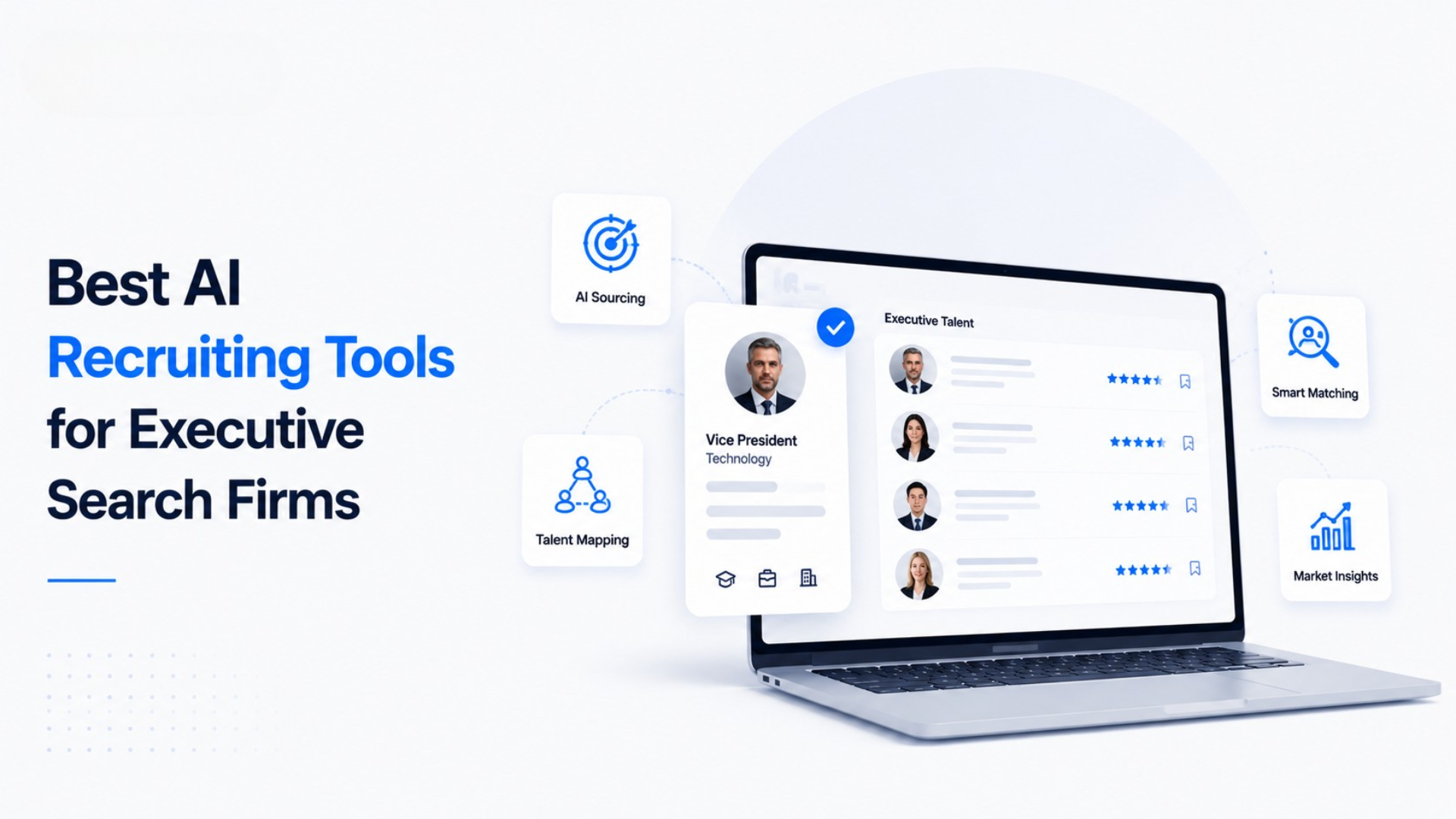
Beyond core functionality, the standout differentiators in 2026 are increasingly AI-driven: talent mapping and automated market research that surface promising passive candidates and target companies faster than manual research ever could, deep LinkedIn Recruiter integrations that enrich candidate histories with minimal manual effort, and diversity reporting sophisticated enough to satisfy boards and hiring committees who now expect DEI data on every slate as standard practice.
What to Evaluate Before Choosing Executive Search Software
Beyond the core functionality every serious tool needs, a few practical factors tend to separate a good fit from a frustrating one:
Data migration support. A search firm's proprietary candidate and client database, often built over a decade or more, is its single most valuable asset. How a vendor handles importing that history from legacy systems matters as much as any feature.
GDPR and global compliance. Most executive search firms source internationally and handle sensitive compensation and diversity data, making compliance tooling a baseline requirement rather than a nice-to-have.
Firm size fit. A boutique five-person practice and a hundred-consultant global firm need very different pricing, onboarding, and support models — and the same platform rarely serves both well.
Client-facing reporting. Boards and hiring committees expect polished, customizable progress reports and candidate comparison documents delivered on a predictable cadence.
Integration depth with LinkedIn Recruiter and Salesforce. Since so much of executive search sourcing still runs through LinkedIn and client relationship data often lives in a broader CRM, sync quality between systems is a recurring pain point worth testing directly.
The Best AI Recruiting Tools for Executive Search Firms in 2026
1. Huntlo — Best for Outbound Sourcing and Multi-Channel Engagement Alongside a Search CRM
Executive search sourcing is fundamentally an outbound problem — the strongest candidates for a retained mandate are almost never actively looking, and reaching them requires more than a single LinkedIn InMail. Huntlo is built around that exact challenge: agentic AI that sources candidates across 50+ public platforms using natural-language search, then runs outreach autonomously across email, WhatsApp, and AI voice with automated follow-up sequences for candidates who don't respond on the first touch.
For a search consultant, this matters most at the very beginning of a mandate — the research and long-list stage, where the goal is building the widest possible qualified talent map before narrowing down. Rather than a consultant or researcher manually working through target companies and LinkedIn profiles one at a time, Huntlo's AI agents can surface and begin engaging a broader long list in a fraction of the time, freeing the consultant's time for the part of executive search that AI genuinely can't replace: the confidential, relationship-driven conversations that actually move a senior candidate toward a yes.
Huntlo isn't a replacement for a dedicated executive search CRM with off-limits management and long-term relationship tracking — firms should still pair it with one. But as the sourcing and first-outreach layer that feeds a search CRM, it removes a genuine bottleneck at the top of the funnel, which is where executive searches most often stall in their early weeks.
Best for: Search firms and independent consultants who need to build a wide, well-engaged long list quickly at the start of a mandate, without manually working through target lists one profile at a time. Standout feature: Natural-language sourcing across 50+ platforms paired with autonomous multi-channel outreach that keeps a long list warm without manual follow-up. Pricing: 7-day free trial (3 active roles, 30 candidate searches); paid plans start at $99 per seat/month.
2. Loxo — Best for AI-Powered Sourcing at Talent-Intelligence Scale
Loxo positions itself as a full talent intelligence platform supporting the entire recruiting lifecycle, and it's a frequent pick specifically for its sourcing depth. According to PeopleManagingPeople's 2026 executive search software review, Loxo's standout features include automated AI-powered sourcing, an end-to-end recruiting CRM, and a talent directory spanning more than 1.2 billion profiles, alongside programmatic job posting and automated outreach sequences.
Best for: Search firms that want AI-driven sourcing and CRM functionality bundled into a single platform with a very large underlying candidate directory. Trade-off: Limited customization options and pricing that isn't published up front, which is common across this category but worth clarifying early in a sales conversation. Pricing: From $169 per user/month, billed annually, with a free plan and a 7-day trial available.
3. Vincere — Best for LinkedIn Sourcing and Client-Facing Presentation
Vincere is built specifically around making the executive search process feel polished from the client's side, not just the recruiter's. Its LiveList client portal presents long lists and short lists to clients in a format designed for collaboration rather than a static spreadsheet or PDF, and its retainer management tools handle the milestone-based billing common to retained search engagements. Per the same PeopleManagingPeople review, Vincere's integration with LinkedIn is a particular strength, allowing recruiters to source candidates efficiently directly from the platform recruiters already spend the most time in.
Best for: Retained search firms that want strong client-facing presentation tools alongside solid LinkedIn-based sourcing. Trade-off: Pricing isn't transparent upfront and requires a direct conversation with sales.
4. Recruit CRM — Best for Customizable Search Workflows
Recruit CRM's appeal for executive search firms is flexibility — pipelines, stages, and automation rules can be configured to match a firm's actual process rather than forcing every search into a fixed template. Its Chrome extension pulls candidate data directly from LinkedIn during sourcing, and built-in email and resume parsing reduce the manual data entry that otherwise eats into a researcher's day. According to PeopleManagingPeople's testing, Recruit CRM recently added AI candidate matching and enhanced resume parsing specifically aimed at helping recruiters identify strong-fit candidates faster.
Best for: Retained or relationship-driven search firms that want a highly configurable ATS/CRM combination rather than a rigid, pre-built workflow. Pricing: From $49 per user/month, billed annually, with an unlimited free trial available to test configuration before committing.
5. Manatal — Best Budget Option for Lean Search Teams
Manatal earns a spot for executive search specifically because of how its AI candidate scoring and enrichment work together for senior-level searches. The platform analyzes resumes, job descriptions, and historical hiring data to surface candidates matching senior-level requirements, and its enrichment feature automatically pulls in public data from LinkedIn and other sources to build fuller candidate profiles without additional manual research — useful context for a search that depends on understanding a candidate's full career trajectory, not just their current title.
Best for: Lean search teams or boutique firms that want AI-assisted sourcing and CRM functionality without the cost or complexity of a full talent-intelligence platform. Pricing: From $15 per user/month, with a 14-day free trial.
6. iSmartRecruit — Best for Advanced Candidate Matching Methods
iSmartRecruit differentiates itself through search sophistication — supporting fuzzy, proximity, Boolean, and semantic search methods in addition to standard AI candidate and job matching. For niche executive mandates where the right candidate might use unconventional terminology to describe their own background, that range of search methods can surface profiles a simple keyword match would miss.
Best for: Search firms working niche or highly technical executive mandates where flexible search logic matters as much as AI ranking. Pricing: From $30 per user/month, with a 14-day free trial and free demo available.
7. Crelate — Best for Long-Term Network Management
Crelate's core strength for executive search is relationship tracking over time — candidate, contract, and engagement tracking with customizable activity types designed to keep a consultant's professional network organized across years, not just the duration of a single search. Its integrations with hireEZ, SeekOut, and ZoomInfo also give it real sourcing depth beyond its own native database.
Best for: Search consultants and boutique firms whose competitive edge is a long-cultivated professional network that needs careful, ongoing organization. Pricing: From $99 per user/month, billed annually.
8. Invenias by Bullhorn — Best for Microsoft Office-Centric Search Teams
For search firms whose day-to-day work happens primarily inside Outlook and the broader Microsoft ecosystem, Invenias (now part of Bullhorn) is built around that integration specifically, syncing correspondence and calendar activity directly against candidate and client records without requiring a separate parallel workflow.
Best for: Firms standardized on Microsoft Office who want executive search functionality embedded into tools consultants already use daily.
9. Clockwork — Best for Client Collaboration on Active Searches
Clockwork focuses specifically on the client side of the search relationship, built to support the kind of ongoing collaboration retained search clients expect — visibility into where a search stands, structured feedback loops, and shared context across a search committee rather than a single hiring manager.
Best for: Retained search firms managing searches with multiple internal stakeholders on the client side who need visibility without constant status-update emails.
Compliance and Data Considerations Specific to Executive Search
Executive search firms handle an unusually sensitive mix of data — compensation history, board affiliations, diversity information, and details about candidates who often aren't actively job-seeking and haven't consented to broad visibility the way an active job-board applicant has. That makes a few compliance questions worth asking directly of any vendor:
Does the platform support GDPR-compliant data handling for international searches? Most retained search work crosses borders, and inconsistent data handling across regions creates real legal exposure.
How is off-limits data structured and enforced? A tool that only flags off-limits candidates manually, rather than automatically checking against a client list at the point of sourcing, creates a real risk of an accidental — and reputationally costly — breach.
What encryption and access control standards are in place? Given the sensitivity of executive compensation and career data, role-based access controls and encryption at rest and in transit should be treated as a baseline requirement, not a premium feature.
How does the vendor handle legacy data migration? A firm's historical candidate and client database, often spanning a decade or more, is frequently its most valuable asset — losing fidelity in a migration is a real cost, not just an inconvenience.
How Firm Size Should Shape the Stack
The right executive search tech stack looks meaningfully different depending on firm size, and it's worth being explicit about that rather than assuming one platform serves every buyer well:
Independent consultants and boutique firms (1-10 consultants) typically get the most value from a lean combination: one relationship CRM built for long-term network tracking, paired with a sourcing and outreach layer for building long lists on active mandates. Cost predictability and fast setup matter more here than deep configurability.
Mid-size search firms (10-50 consultants) usually need more structure — customizable workflows that standardize how different consultants run searches, off-limits management that scales across a larger shared client base, and client-facing reporting polished enough for board-level presentations across multiple simultaneous mandates.
Large or global search firms (50+ consultants) face the heaviest requirements around data migration, multi-region compliance, and integration with a broader enterprise tech stack, often including Salesforce for client relationship management alongside a dedicated search CRM. At this scale, vendor evaluation should weigh implementation timeline and data migration fidelity as heavily as day-to-day feature set.
Regardless of size, the sourcing and outreach layer tends to be the highest-leverage addition for firms still relying on manual LinkedIn research, since it's the stage where AI-driven tools can compress weeks of long-list building into days without touching the relationship-driven work that actually closes a search.
Frequently Asked Questions
Can a general-purpose ATS work for executive search, or does it need to be search-specific? A general ATS can technically manage candidates, but it typically lacks off-limits management, long-term relationship tracking across years, and the client-facing presentation tools boards expect — all of which are close to essential once a firm is doing retained search work seriously.
How important is off-limits management, really? Very. An off-limits violation — approaching a candidate who works at a protected client organization — can end a client relationship immediately and damage a firm's broader reputation in a way that's difficult to repair. Automatic flagging at the point of sourcing, rather than manual checking, is worth prioritizing in any evaluation.
Do AI sourcing tools actually help with senior, hard-to-reach executive candidates? Yes, particularly at the long-list stage. AI-driven tools can build a broader initial talent map and handle first-touch outreach faster than manual research, though the relationship-building and closing work that defines executive search still depends on human judgment and trust.
What should a boutique firm expect to pay for a reasonable executive search tech stack? Entry-level combinations — a CRM in the $15 to $50 per seat/month range plus a sourcing and outreach tool starting around $99 per seat/month — can cover most of what a lean team needs, well below the cost of enterprise-tier platforms with six-figure implementations.
The Bottom Line
Executive search technology succeeds or fails on a different measure than most recruiting software — not how many candidates it processes, but how well it protects and extends relationships that took years to build. The right stack pairs a relationship-focused CRM with off-limits management and client-facing reporting alongside a sourcing and outreach layer that removes the manual grind of long-list building at the start of every new mandate.
If that sourcing layer is the current bottleneck, Huntlo's agentic AI platform is built to compress the research and outreach stage of a search without touching the relationship work that actually closes it — worth testing directly against your next mandate with the free trial.
Related Reading on the Huntlo Blog
How to Build a Lean AI Recruiting Tech Stack Without Overspending
How Agentic AI Is Changing Candidate Sourcing for Staffing Agencies
Email vs. WhatsApp vs. AI Voice: Choosing the Right Outreach Channel for Candidate Engagement