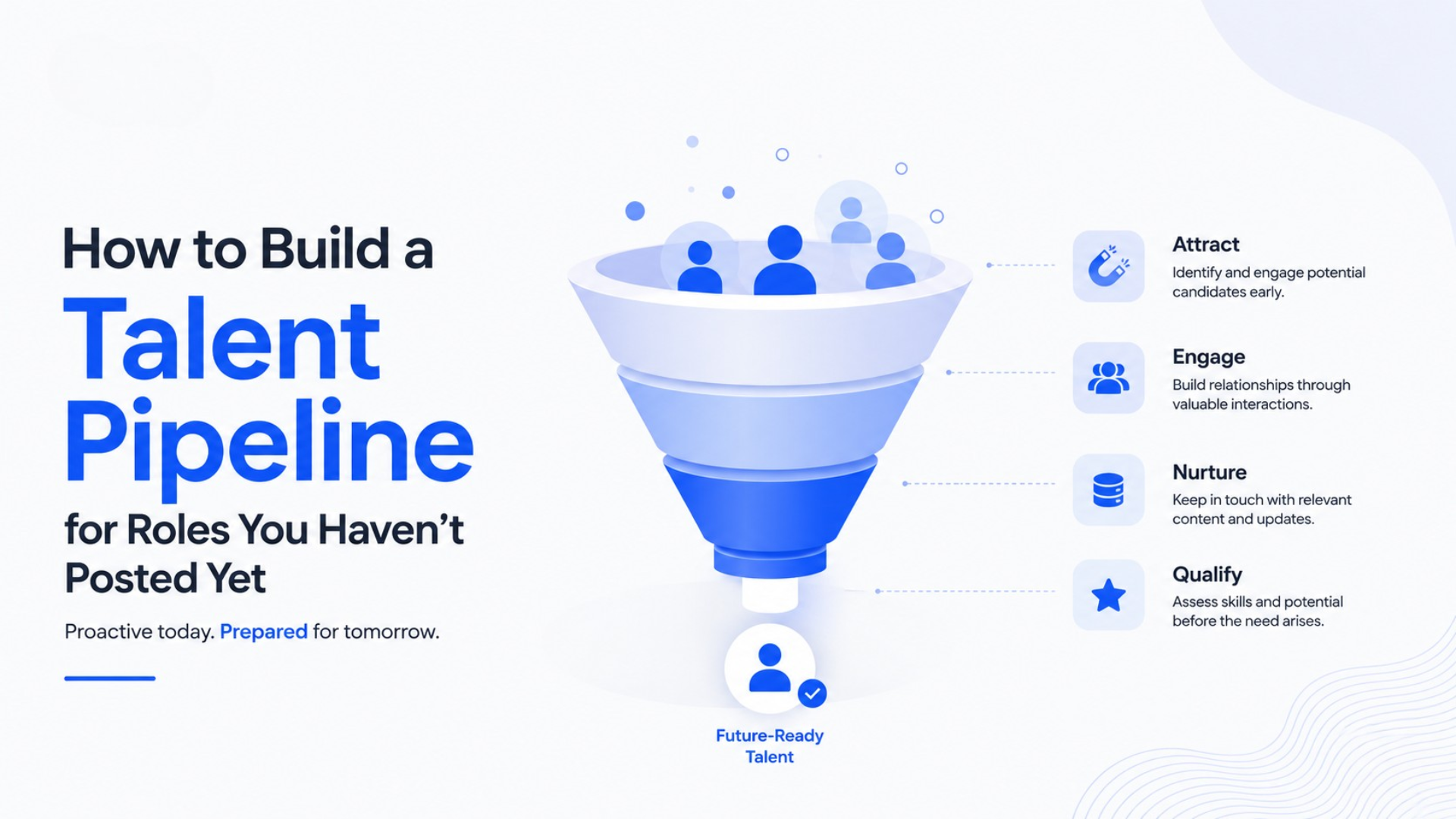
Most recruiting teams begin searching for talent only after a role becomes official. A hiring manager receives approval, the job description is finalized, the vacancy is posted, and the recruiter begins trying to understand where suitable candidates might be found.
By that point, the business is already waiting.
The manager may need someone immediately. The team may be carrying additional work. A product launch may depend on the hire. A new market may be opening. A customer contract may require additional capacity. The recruiter is expected to move quickly even though the candidate market has not yet been mapped.
This is one of the main reasons recruiting becomes reactive.
The company waits for certainty before beginning any talent work, but hiring rarely becomes urgent at the exact moment a requisition is approved. In many cases, the signals existed months earlier. The business was discussing expansion. A team was repeatedly requesting the same skills. Turnover was predictable. A new capability was becoming strategically important.
A future role does not need to be fully approved before a recruiting team can begin understanding the talent market around it.
Building a talent pipeline for roles that have not been posted means identifying likely future hiring needs, discovering potentially relevant people, preserving candidate context, and developing appropriate relationships before an immediate vacancy forces the company to start from zero.
This does not mean promising candidates jobs that do not exist. It does not mean sending continuous outreach about imaginary opportunities. It does not mean collecting thousands of profiles in a spreadsheet and calling the result a pipeline.
A useful future-role pipeline is more disciplined.
The recruiting team understands why a role may become necessary, how confident the business is about the demand, which candidate profiles are likely to matter, and what level of engagement is appropriate before formal hiring begins.
When the role eventually opens, the company already understands the market. It may already know people worth speaking with. The recruiter can move from a cold start to a warmer, more informed search.
That is the real advantage of building a talent pipeline before the job is posted.
Why Start Building a Talent Pipeline Before the Role Exists?
The traditional hiring process assumes that recruitment should begin when a vacancy becomes official. This makes administrative sense, but it does not always make recruiting sense.
Candidate markets do not appear when a requisition is approved.
The software engineers, sales leaders, healthcare professionals, operations specialists, finance experts, and other people a company may need already exist somewhere in the market. Some are actively looking for work. Many are not. Their availability, career priorities, compensation expectations, and interest can change long before the company creates a job post.
If recruiting begins only after approval, the company has to understand all of this under time pressure.
A future-role pipeline moves part of that learning earlier.
Recruiters can understand which companies employ relevant talent, which job titles are common, how experience varies across the market, what compensation expectations may look like, and how difficult the search is likely to become.
This creates value even if the final role changes.
A company may initially believe it needs a senior data scientist and later discover that the real requirement is a machine learning engineer. A business may expect to hire one regional sales leader but eventually build a larger team. A planned expansion may move from one city to another.
Early talent mapping gives the business evidence before the hiring process becomes urgent.
The purpose of the pipeline is therefore not only to store candidates. It is to improve the company’s understanding of future talent supply.
A proactive talent pipeline connects workforce planning with recruiting reality.
Start With Business Signals, Not Imaginary Job Descriptions
The first step is not sourcing.
It is understanding where future hiring demand may come from.
Recruiting teams often make one of two mistakes. They either wait until every role is formally approved, or they attempt to pipeline candidates for every possible job the company might someday create.
Neither approach works well.
The better starting point is business signals.
A company entering a new market will probably need certain capabilities. A team that has hired the same role four times in the past year may need it again. A function with predictable turnover creates recurring demand. A product roadmap may reveal future technical skills. A new customer segment may require a different type of sales or customer-success experience.
Recruiters should work with business leaders, finance teams, workforce-planning teams, and hiring managers to understand where demand is becoming more likely.
The question is not simply, “Which jobs will we post next quarter?”
A better question is, “Which capabilities is the business becoming more dependent on?”
This changes the quality of the pipeline.
A job title can change.
A business capability usually provides a more stable direction.
If the company knows it will expand its cybersecurity capability, the recruiting team can begin understanding the relevant talent market even before the exact mix of security engineers, analysts, architects, and leaders is finalized.
This is where proactive recruiting becomes strategic rather than speculative.
Recent guidance on talent pipeline development from Cornerstone similarly emphasizes connecting talent strategy with future business needs rather than waiting for vacancies to appear. The practical value of this approach is that recruiting can begin learning before the business begins waiting.
Separate High-Confidence Future Roles From Possible Roles
Not every future hiring idea deserves the same recruiting investment.
Some roles are highly predictable.
The company hires them repeatedly. The business has approved expansion. Historical turnover creates regular vacancies. The skill is consistently difficult to find. The team knows it will need more capacity even if the exact start date is uncertain.
Other roles are possibilities.
A business leader may be exploring a new market. A project may or may not receive funding. The organization may be considering a capability that is still being defined.
These situations require different pipeline strategies.
For a high-confidence future role, the recruiting team may actively map the market, identify candidates, begin conversations, and maintain relationships.
For a lower-confidence role, the team may limit activity to market research and candidate identification. It may be inappropriate to begin active engagement when the business cannot explain whether or when a real opportunity could exist.
This distinction protects candidate trust.
Recruiters should not create false urgency around jobs that have not been approved. A candidate should never be led to believe that a hiring process exists when the company is only exploring a possibility.
The pipeline should reflect the confidence level of the hiring demand.
As certainty increases, engagement can increase.
Define the Candidate Profile Without Pretending the Role Is Final
Future-role pipelining requires enough clarity to search, but not so much rigidity that the team builds a pipeline around assumptions that later become outdated.
This is a difficult balance.
If the profile is too broad, the pipeline becomes a database of loosely related people. If it is too narrow, recruiters may spend months finding candidates for a specification the business later changes.
The best approach is to define the profile around durable evidence.
What problems will this person probably need to solve? Which capabilities are likely to remain important even if the title changes? What environments produce relevant experience? Which skills are genuinely essential, and which are based on the current version of the plan?
For example, a company planning enterprise expansion may not know whether the future role will be called Enterprise Account Executive, Strategic Account Executive, or Regional Sales Manager.
The title is less important than the underlying evidence.
The company may need someone who has sold a complex product, managed long sales cycles, worked with senior buyers, and succeeded in a particular market.
Those characteristics can guide the pipeline even while the final job description remains unfinished.
This is one advantage of beginning before the role is posted.
The recruiter has time to learn.
If the first 50 potentially relevant candidates reveal that the expected profile is unrealistic, the company can adjust before the hiring process becomes urgent.
Choose Which Roles Are Worth Pipelining
A talent pipeline requires maintenance, so it should not be created for every position.
The strongest candidates for future-role pipelining usually share one or more characteristics.
The company hires the role repeatedly. The talent market is small. The search usually takes a long time. The position has significant business impact. Demand can be predicted with reasonable confidence. Candidate relationships often require time to develop.
Recurring roles are particularly suitable.
If a company hires ten enterprise salespeople each year, it already knows that future demand will exist. Waiting for each requisition before beginning candidate discovery creates repeated work.
Hard-to-fill roles also benefit.
If a specialized engineering search normally takes three months, beginning the talent-market work only after the vacancy opens almost guarantees a slow hiring process.
Leadership and strategic roles can justify a pipeline even when hiring is less frequent. The business may not know exactly when a senior leader will be needed, but understanding the market before the transition becomes urgent can be valuable.
The weakest pipeline candidates are one-off roles with uncertain demand and broad candidate availability.
Recruiting teams should focus their energy where earlier knowledge creates a meaningful advantage.
Map the Talent Market Before You Start Collecting Profiles
One of the biggest mistakes in proactive recruiting is moving directly from a future hiring idea to a list of candidate names.
A better pipeline begins with market understanding.
Recruiters should learn where relevant talent works, which companies develop the required experience, how job titles vary, which adjacent backgrounds may transfer well, and where the candidate market is geographically concentrated.
This is talent mapping.
Imagine a company expects to build an artificial intelligence engineering team next year.
A weak approach is to search for “AI engineers” and save hundreds of profiles.
A stronger approach is to understand the different talent segments.
Some candidates may come from research environments. Others may have production machine-learning experience. Some may specialize in infrastructure. Others may work closer to product applications. The company may discover that the original role definition combines skills rarely found in one person.
This learning improves future hiring decisions.
The pipeline becomes more than a list of people. It becomes a view of the market.
AI sourcing can accelerate this process by helping recruiters explore related titles, adjacent skills, companies, locations, and experience patterns. However, the recruiter still needs to interpret what the market is showing.
The objective is not to collect the largest number of profiles.
It is to understand where future talent is likely to come from.
Search Your Existing Candidate History Before Looking Externally
Many companies begin future pipelining by searching for completely new candidates.
This often ignores the most valuable source of talent they already have.
Previous finalists may be relevant to future roles. Strong applicants may have been rejected because another candidate was slightly better. Sourced candidates may have shown interest at the wrong time. Employee referrals may have entered the system before a suitable role existed.
These relationships should be reviewed before the company pays to rediscover the same people externally.
The problem is that candidate history is often fragmented.
One recruiter remembers a conversation. Another recruiter has left the company. Notes exist inside an ATS. Outreach happened through email. A candidate was saved in a sourcing project but never moved anywhere else.
Future-role pipelining should begin by asking what the company already knows.
Which candidates reached final interviews for similar positions?
Who previously expressed interest in the company?
Who asked to reconnect later?
Which people were strong but did not match the exact role available at the time?
Which previous employees or contractors may become relevant again?
This can produce a warmer starting point than a completely new search.
It also changes the economics of recruiting.
The company has already spent time and money discovering these people. A functioning pipeline should make that previous investment useful.
Build the Pipeline Around Candidate Context
A candidate profile alone is not enough.
The recruiting team needs to understand why the person belongs in the pipeline.
What future need might they match? Which part of their experience is relevant? Has the company contacted them before? What happened? Did they express interest? Did they decline? Was the timing wrong? Did they ask to reconnect later?
This context determines whether the pipeline can actually be used.
Imagine two candidates with similar experience.
The first completed final interviews six months ago and told the recruiter they would be interested in future leadership roles.
The second received three unanswered outreach messages and has never interacted with the company.
These candidates should not be treated the same way simply because they match the same search.
A useful pipeline preserves relationship history.
This is what separates talent pipelining from candidate storage.
A spreadsheet can contain names.
A functioning pipeline should help the next recruiter understand what happened and what should happen next.
The more recruiters, teams, and locations involved, the more important this becomes.
Candidate memory should belong to the recruiting organization, not only to the individual recruiter who had the original conversation.
Create Pipeline Stages That Reflect Future Readiness
Candidates in a future-role pipeline should not all sit in one large list.
The team needs a simple way to understand how close each relationship is to a possible future hiring process.
Some candidates are only identified.
The company knows who they are but has not contacted them.
Others have been engaged.
They know the company and may be open to future conversations.
Some have been previously evaluated.
The company has meaningful evidence from an earlier hiring process.
Others may be warm future prospects who have clearly stated when they would reconsider a move.
The exact stages will vary, but the purpose should remain practical.
The pipeline should answer questions such as: Who have we only discovered? Who knows us? Who has shown interest? Who has already been evaluated? Who should be contacted when a relevant role becomes real?
Avoid creating too many stages.
A complicated pipeline often becomes difficult to maintain.
The goal is visibility, not administrative perfection.
Decide When to Engage Candidates Before a Role Exists
This is one of the most sensitive parts of future-role pipelining.
Should recruiters contact people when there is no open job?
Sometimes yes.
Sometimes no.
The answer depends on the confidence of the hiring need and the purpose of the conversation.
If the company knows it is expanding a team within the next quarter but has not published the roles, an early conversation may be reasonable.
If the business is only considering a possibility for next year, active recruiting outreach may create expectations the company cannot meet.
The recruiter should be transparent.
A candidate can be told that the company is planning future growth, exploring a talent market, or building relationships before formal roles open.
There is nothing inherently wrong with that conversation.
The problem appears when exploratory outreach is presented as an immediate job opportunity.
Trust matters more than pipeline size.
A candidate who has an honest early conversation may remain interested for months.
A candidate who feels misled may never respond again.
The strongest pipeline strategies therefore match candidate engagement to hiring certainty.
Give Candidates a Reason to Stay Connected
A future talent pipeline cannot survive on generic “just checking in” messages.
Candidates need a reason for the relationship to continue.
That reason may be a genuinely relevant company update. A planned expansion may become official. A product launch may make the future opportunity more interesting. A new leadership hire may change the direction of the team. A role may move closer to approval.
The communication should reflect the candidate.
A previous finalist deserves a different message from a person who has never spoken with the company.
A senior candidate who asked to reconnect after a major project should not be placed into the same automated sequence as hundreds of cold prospects.
A passive candidate may not need regular communication at all.
The goal is not constant contact.
It is continuity.
When the next conversation happens, it should feel like a continuation of the relationship rather than another cold outreach attempt.
This is why candidate engagement should be based on context rather than a universal calendar.
Use Different Pipeline Strategies for Different Time Horizons
A role likely to open in 30 days should not be managed like a role that may exist in 18 months.
Near-term pipelines can be more active.
Recruiters can validate candidate interest, update availability, confirm major requirements, and prepare for a formal process.
Medium-term pipelines may focus more on relationship development and market learning.
Long-term pipelines should usually remain broader.
The company may understand important capabilities and candidate segments without trying to maintain active conversations with every person.
This prevents over-engagement.
A common mistake is treating every future candidate as if a vacancy is about to open.
The recruiter sends repeated messages.
The candidate keeps hearing that opportunities may appear.
Nothing happens.
Eventually, the relationship loses credibility.
The amount of recruiting activity should match the probability and timing of the future demand.
A pipeline becomes stronger when it respects uncertainty.
Connect Talent Pipelining With Workforce Planning
Recruiting teams should not build future pipelines in isolation.
The business needs to provide signals.
Workforce planning helps identify where hiring demand may emerge, which capabilities may become critical, and which teams face likely talent gaps.
Recruiting adds market evidence.
The talent acquisition team can explain whether the expected candidates are easy to find, whether the required experience exists in the target location, how competitive the market appears, and how long relationship development may take.
This creates a useful feedback loop.
The business tells recruiting what it may need.
Recruiting tells the business what the market can realistically provide.
That conversation can change hiring plans before they become urgent.
A company may decide to develop internal talent instead of hiring externally.
It may expand the location strategy.
It may separate one unrealistic role into two positions.
It may begin earlier because the candidate market is smaller than expected.
This is one of the deeper benefits of building pipelines before roles are posted.
Recruiting becomes a source of workforce intelligence rather than only a response to approved requisitions.
Use AI Sourcing to Explore Future Talent Markets Faster
Traditional talent mapping can be slow.
Recruiters need to think of titles, companies, skills, locations, and related experience. Searches are built and refined. Profiles are reviewed manually. New patterns lead to new searches.
AI sourcing can accelerate this exploration.
A recruiter can begin with the future capability the company expects to need.
The system can help identify related titles, adjacent experience, relevant employers, and candidates whose profiles may not contain the exact keywords used in the future job description.
This is particularly valuable when the role is still evolving.
The recruiter is not limited to one perfect search string.
The market can be explored from several directions.
However, AI does not remove the need for recruiter judgment.
A future-role pipeline is especially vulnerable to weak assumptions because the final job does not yet exist.
If the AI search begins with a poor definition, it may simply create a large, polished list of the wrong people.
The recruiter should use AI to learn faster, not to avoid learning.
Use AI to Rediscover Candidates as Future Needs Change
A candidate may be irrelevant today and valuable next year.
This is one of the main reasons future-role pipelines need better rediscovery.
Imagine a candidate applied three years ago as a junior engineer.
At the time, the company did not hire them.
Since then, the person has changed companies, gained leadership experience, and developed a new specialization.
A static candidate record may not reveal this change.
Similarly, a previous finalist for one role may become highly relevant when a different position opens.
AI can help compare future requirements with existing candidate information and surface relationships that recruiters may otherwise forget.
This is more useful than simply maintaining larger talent databases.
The real question is whether the system can make old candidate relationships relevant again.
A pipeline should become more valuable as the company learns more people.
If recruiters repeatedly search externally for candidates who already exist somewhere inside the organization’s history, the pipeline is not creating leverage.
Do Not Confuse Pipeline Size With Pipeline Quality
Recruiting teams often measure what is easiest to count.
How many candidates are in the pipeline?
How many profiles were sourced?
How many people were added this month?
These numbers can create the appearance of progress.
A pipeline with 10,000 outdated profiles may be less useful than a pipeline with 100 relevant, well-understood candidate relationships.
The more important questions are different.
How many future roles can begin with known candidates?
How many pipeline candidates respond when relevant opportunities appear?
How many have useful context?
How many can be rediscovered?
How many eventually move into active hiring processes?
How much external sourcing work does the pipeline prevent?
These measures connect the pipeline with recruiting outcomes.
The purpose of future pipelining is not to build the largest possible database.
It is to reduce uncertainty when hiring begins.
Build a Candidate Re-Engagement System
Future-role pipelines fail when recruiters depend on memory.
A recruiter has a good conversation.
The candidate says, “Contact me after my bonus in March.”
The recruiter writes a note somewhere.
March arrives.
Nothing happens.
A re-engagement system should preserve these signals.
Candidates may ask to reconnect after completing a project, moving location, receiving a promotion, finishing a notice period, or reaching another career milestone.
These are valuable pieces of recruiting context.
The system should make them actionable.
This does not require constant messaging.
In many cases, one well-timed follow-up is more valuable than a six-message automated sequence.
AI and workflow automation can help organize reminders, summarize previous conversations, and surface candidates when the right future requirement appears.
The objective is to make candidate timing part of the recruiting workflow.
Create a Clear Handoff When the Role Becomes Real
A future talent pipeline should not remain separate from active recruiting.
When a role is approved, the team needs a clear process for moving relevant candidates into the live hiring workflow.
The recruiter should review the existing pipeline first.
Which candidates still match the requirement?
Which profiles need updated information?
Who has already shown interest?
Who was previously evaluated?
Who should not be contacted again?
This review should happen before the team begins another broad external search.
The most relevant candidates can then move into active engagement or the formal hiring process.
The candidate’s history should move with them.
A previous finalist should not be asked the same basic questions as a completely new applicant if the company already knows the answers.
A candidate who has spoken with three recruiters should not receive a generic message introducing the company.
The transition from future pipeline to active hiring should preserve context.
This is where the earlier investment begins producing real value.
Build a 90-Day Future-Role Pipeline
A practical pipeline does not need to begin with a massive transformation.
Choose one future hiring area.
The best starting point is usually a recurring or difficult role with a reasonable probability of demand.
During the first month, focus on business understanding and market mapping.
Speak with the relevant leaders. Understand the likely capability need. Review previous hiring data. Search existing candidate history. Identify the companies, titles, skills, and adjacent backgrounds that appear relevant.
During the second month, begin candidate discovery.
Use existing data and external sourcing. Review the market. Refine the profile. Organize candidates according to relevance and relationship history.
During the third month, begin appropriate engagement.
High-confidence future needs may justify direct conversations. Lower-confidence needs may remain in a research and mapping stage. Create clear re-engagement signals and decide how the pipeline will be reviewed.
At the end of 90 days, the team should not ask only how many profiles were added.
It should ask whether it understands the future talent market better than it did before.
That is the first sign that the pipeline is working.
Common Mistakes When Building Pipelines for Unposted Roles
The first mistake is building pipelines for everything.
Recruiting capacity becomes spread across dozens of hypothetical roles, and none of the pipelines remain useful.
The second mistake is pretending the job is more certain than it is.
Candidates should understand whether the company is discussing a real near-term plan or simply exploring future talent.
The third mistake is collecting profiles without context.
A large database of names does not create hiring readiness.
The fourth mistake is over-engaging candidates.
Future talent relationships should not become endless automated campaigns.
The fifth mistake is failing to update the pipeline when the business plan changes.
A pipeline built around last year’s assumptions may become irrelevant.
The sixth mistake is ignoring existing candidate history.
The company keeps paying to rediscover people it already knows.
The seventh mistake is failing to connect the pipeline with active hiring.
When the role finally opens, the recruiter starts a new search without reviewing the work already completed.
Every one of these mistakes creates the same outcome.
The company appears proactive but still begins hiring from zero.
How Huntlo Fits Into Future Talent Pipelining
Huntlo approaches future talent pipelines as part of a connected recruiting workflow rather than a static candidate-storage exercise.
The first challenge is discovery.
Recruiting teams need to identify relevant people before a vacancy becomes urgent. AI sourcing can help explore talent markets, find passive candidates, and surface profiles that may match future capabilities.
The second challenge is engagement.
Some candidates may be appropriate for immediate conversations. Others may need to remain in the pipeline until the hiring need becomes clearer.
The third challenge is context.
Candidate responses should affect what happens next. A person who is interested later should not be treated like a cold prospect every time a new role appears.
The fourth challenge is execution.
When the role becomes real, recruiters should be able to move from candidate rediscovery to engagement, qualification, and interview coordination without rebuilding the workflow across several disconnected tools.
Huntlo’s agentic AI recruiting infrastructure is designed around this larger process. The platform supports proactive candidate sourcing, engagement across channels including email and WhatsApp, AI voice screening, and recruiting workflow execution.
For future-role pipelines, the value is not simply finding more people.
It is reducing the amount of work required to turn earlier candidate discovery into future hiring activity.
Why Agentic AI Changes Talent Pipeline Management
Traditional talent pipelines depend heavily on recruiters remembering what to do next.
Someone needs to run the search.
Someone needs to review the database.
Someone needs to notice that a future role resembles a previous candidate.
Someone needs to send the follow-up.
Someone needs to move the interested candidate toward qualification.
The pipeline may contain valuable people, but it remains passive until a recruiter activates it.
Agentic AI creates a different possibility.
The system can support multi-step workflows around candidate discovery, engagement, response handling, qualification, and scheduling rather than treating each action as an isolated task.
This does not mean the system should independently promise jobs or make important hiring decisions.
Human judgment remains essential.
The opportunity is to reduce the manual coordination between those decisions.
Huntlo’s broader view of this shift is explored in its article on what comes after sourcing automation, where the focus moves from simply finding candidates toward executing more of the recruiting workflow around them.
How to Measure a Future-Role Talent Pipeline
The first useful metric is coverage.
For the future roles that matter most, does the company understand the relevant talent market?
The second is candidate readiness.
How many people are only identified, how many have been engaged, and how many have meaningful prior context?
The third is reuse.
When a role opens, how many relevant candidates come from existing relationships rather than a completely new search?
The fourth is conversion.
How many pipeline candidates eventually enter active hiring processes, reach interviews, or become hires?
The fifth is speed.
Do future roles reach qualified candidate conversations faster because the pipeline existed?
The sixth is recruiter productivity.
Does the team spend less time repeating candidate discovery?
These measures reveal whether the pipeline is creating recruiting leverage.
A large pipeline that never affects hiring is not a strategic asset.
It is a storage problem.
When You Should Not Build a Talent Pipeline
Future-role pipelining is not always the right answer.
If the business has almost no confidence that the role will exist, extensive candidate engagement may waste recruiter time and create false expectations.
If the role is easy to fill and demand is rare, maintaining a long-term pipeline may cost more than beginning a search when needed.
If the company cannot preserve candidate context, it may be better to improve the recruiting system before adding more people to it.
If recruiters are already overwhelmed with active vacancies, asking them to manually maintain large future pipelines may create another neglected process.
The strategy should be selective.
Build pipelines where future demand is likely and earlier relationships create a meaningful advantage.
Proactive recruiting works best when it is focused.
The Future of Recruiting Starts Before the Requisition
The traditional requisition is an administrative starting point.
It should not always be the first moment the company thinks about talent.
Modern recruiting teams can use business signals, workforce planning, historical hiring data, candidate rediscovery, AI sourcing, and relationship management to understand future talent markets earlier.
This changes the recruiter’s role.
The recruiter is not only filling approved vacancies.
They are helping the business understand whether future talent will be available, where it may come from, and how long it may take to build the right relationships.
AI can make this work more scalable.
It can help explore markets faster.
It can rediscover previous candidates.
It can organize context.
It can support appropriate engagement.
It can reduce the manual work required to move future candidates into active hiring workflows.
But the principle remains human.
A talent pipeline is built on relevance and trust.
The technology should make those relationships easier to manage, not turn people into rows inside a larger database.
Conclusion: The Best Time to Start Recruiting May Be Before the Job Exists
Building a talent pipeline for roles you have not posted yet is not about recruiting people for imaginary jobs.
It is about recognizing that future hiring needs often become visible before formal vacancies exist.
The business may be expanding.
A skill may be becoming strategically important.
A team may hire the same role repeatedly.
A difficult talent market may require longer relationship development.
Recruiting teams can use these signals to begin earlier.
They can understand the future capability, map the talent market, review existing candidate history, identify relevant people, preserve context, and engage candidates when the timing is appropriate.
When the role finally opens, the company does not need to begin with an empty search.
It already understands the market.
It may already know strong candidates.
It may already have relationships worth continuing.
AI can make this process faster and more scalable through candidate discovery, rediscovery, engagement, qualification, and workflow automation.
The goal, however, is not a larger database.
The goal is hiring readiness.
A strong future-role pipeline means that when the business finally says, “We need this person,” recruiting is not hearing about the talent problem for the first time.
Frequently Asked Questions
Can you build a talent pipeline before a job is approved?
Yes. Recruiting teams can map future talent markets, review existing candidates, and identify potentially relevant people before formal approval. The level of candidate engagement should match how certain and near-term the hiring need is.
How do you build a talent pipeline for future roles?
Begin with likely business demand, define the future capability, map the talent market, review existing candidate history, identify relevant people, preserve relationship context, and create a process for appropriate re-engagement.
Should recruiters contact candidates when there is no open role?
They can, but transparency is essential. Recruiters should explain whether the company is planning future growth, exploring a talent market, or expecting roles to open later rather than implying that an immediate vacancy exists.
Which roles should companies build pipelines for?
The best roles for pipelining are usually recurring, difficult to fill, strategically important, predictable, or located in talent markets where candidate relationships take time to develop.
How early should a company start building a talent pipeline?
The timing depends on the role. Difficult and strategic searches may benefit from months of market mapping and relationship development, while recurring roles can support continuous pipelines.
What is the difference between talent mapping and talent pipelining?
Talent mapping focuses on understanding the market, including relevant companies, titles, skills, locations, and candidate segments. Talent pipelining goes further by preserving and developing potentially useful candidate relationships.
How does AI help build future talent pipelines?
AI can support market exploration, passive candidate sourcing, candidate rediscovery, matching, conversation summaries, re-engagement workflows, qualification, and other recruiting activities.
How many candidates should be in a future talent pipeline?
There is no universal number. Pipeline quality, relevance, candidate context, and future usability matter more than the total number of profiles stored.
How often should recruiters contact pipeline candidates?
There is no fixed schedule that works for every candidate. Communication should be based on the relationship, hiring certainty, candidate preferences, and whether something meaningful has changed.
How do you know whether a future talent pipeline is working?
A useful pipeline should help future roles reach relevant candidate conversations faster, increase the reuse of existing candidate relationships, reduce repeated sourcing work, and produce candidates who eventually enter active hiring processes.
Related Topics
Learn why AI sourcing creates the most value when recruiters measure outcomes rather than feature activity in How to Avoid Wasting Your AI Sourcing Tool’s Free Trial.
Explore what recruiting leaders should prioritize when evaluating sourcing technology in AI Sourcing Tools for Recruitment Team Leads: What to Prioritize.
See how small recruiting teams can evaluate whether sourcing automation creates enough value to justify the investment in Is AI Sourcing Worth It for Small Recruitment Teams?.