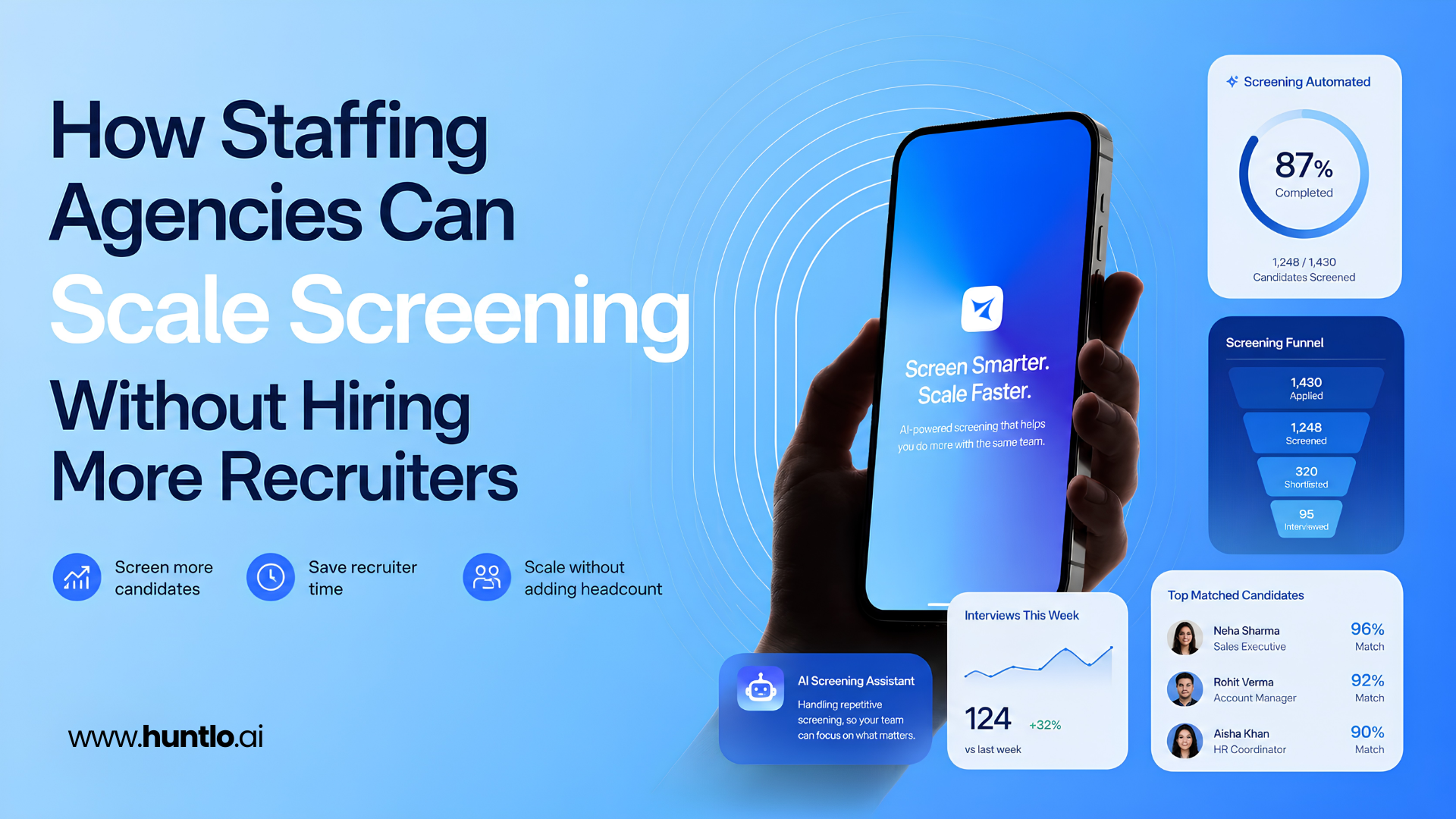
Every staffing agency reaches the same inflection point. Business is growing. New client contracts are coming in. The pipeline of candidates who need to be screened is expanding faster than the team can process it. The obvious solution — hire more recruiters — is also the most expensive and slowest one. Each new recruiter requires sourcing, onboarding, training, and several months of ramp-up time before they reach full productivity. And once they do, the agency now carries higher fixed overhead that must be covered regardless of whether the next quarter’s client volume holds steady. AI voice interviews offer a fundamentally different path to scale: multiply the screening capacity of your existing recruiters instead of adding headcount. This article explains how agencies are using AI voice screening to take on more clients, fill more roles, and grow revenue without proportionally growing their recruiting team.
The Staffing Agency Economics Problem
Staffing agencies operate on margins that are tighter than most people outside the industry realize. Between recruiter compensation, job board subscriptions, ATS licensing, office costs, and client acquisition expenses, the average agency net margin sits between 5% and 12% of revenue. The single largest controllable cost is recruiter headcount, which typically represents 50–65% of total operating expenses. This creates a structural tension: growth requires more screening capacity, more screening capacity requires more recruiters, and more recruiters compress margins unless revenue grows faster than headcount.
Most agencies try to solve this problem by pushing recruiters harder — higher activity targets, more screens per day, shorter calls. The result is predictable and documented across industry research. SHRM’s talent acquisition workforce data shows that recruiter effectiveness degrades sharply beyond 20–25 phone screens per week. Quality drops, documentation gets skimpier, and candidate experience suffers. The agency fills more roles in the short term but starts losing clients in the medium term because submission quality declines. It is a classic growth trap: scaling by adding or overworking recruiters works until it does
not, and the breaking point arrives faster than agency owners expect.
This disconnect between what agency owners need and what recruiters experience is one of the most underappreciated dynamics in the staffing industry. As explored in Agency Owners Are Solving Different Problems Than Recruiters Think, owners are focused on margin, scalability, and client retention — while recruiters are focused on finding candidates, managing their desk, and making placements. These are not the same problem, and a scaling strategy that only addresses one side of this equation will fail. AI voice interviews address both: they give owners the screening throughput they need to grow profitably, and they give recruiters the capacity to focus on the high-value candidate interactions that actually produce placements.
What AI Voice Screening Actually Changes for Agencies
AI voice interviews replace the manual phone screen — the single most time-consuming activity in a staffing agency’s workflow. In a typical agency, phone screening accounts for 50–60% of a recruiter’s working hours. Each screen takes 30 to 45 minutes of call time plus 10 to 15 minutes of documentation. When a recruiter is managing 15 to 25 active requisitions and screening 8 to 12 candidates per requisition, the math becomes overwhelming. AI voice interviews compress the recruiter’s per-candidate time investment from 45–60 minutes to 5–8 minutes of scorecard review — a 7 to 10x reduction that translates directly into capacity.
But the more important change is not speed — it is consistency. In a staffing agency, different recruiters screen candidates for the same client using different questions, different evaluation criteria, and different quality thresholds. The client receives submissions that were screened to inconsistent standards, which makes the agency look unprofessional and forces the client to re-screen candidates themselves. AI voice interviews apply the same competency framework and scoring methodology to every candidate for a given role, regardless of which recruiter is managing the requisition. Every submission the client receives has been evaluated against the same standard. This consistency is a competitive advantage that directly impacts client retention — and client retention is the most valuable asset a staffing agency has.
The third change is data. Manual phone screens produce recruiter notes — unstructured, inconsistent, and impossible to aggregate. AI voice interviews produce structured scorecards with competency-level ratings, response highlights, and disposition recommendations. Over time, this data creates a performance database that tells the agency which screening criteria actually predict successful placements for specific clients and role types. This kind of evidence-based screening optimization is impossible with manual processes but becomes natural with AI-generated evaluation data. SIOP’s research on structured interview validation has demonstrated that organizations using structured, data-driven screening methodologies improve quality-of-hire metrics by 20–35% within the first year of implementation, because they can systematically identify which evaluation criteria predict success and which do not.
How Agencies Actually Implement AI Voice Screening
The implementation path for most agencies follows a predictable pattern. The first step is selecting one or two high-volume client contracts where screening throughput is the primary bottleneck. These are typically roles with large applicant pools, clear competency requirements, and standardized evaluation criteria — customer service, data entry, logistics coordination, administrative support, and similar operational roles. The agency defines the competency framework for each role, configures the AI voice interview questions and evaluation criteria, and begins routing all initial screening through the AI platform.
The second step is training recruiters to work with AI-generated scorecards rather than conducting manual screens. This is a bigger behavioral change than most agencies anticipate. Recruiters who have built their careers on the phone screen are often resistant to the idea that an AI can do part of their job. The key to successful adoption is framing the AI correctly: it is not replacing the recruiter’s judgment, it is handling the repetitive first layer of evaluation so the recruiter can spend their time on the candidates and client relationships that actually generate revenue. Once recruiters experience the workflow — reviewing a detailed scorecard in 6 minutes instead of spending 45 minutes on a call that covers the same ground — resistance typically collapses within the first two weeks.
The third step is expanding AI voice screening to additional client contracts and role types. As the agency builds confidence in the AI’s evaluation quality and develops internal expertise in configuring competency frameworks, the range of roles suitable for AI screening expands. Some agencies eventually apply AI voice screening to 70–80% of their total screening volume, reserving manual phone screens for senior roles, client-specific relationship hires, and candidates whose AI scorecards indicate edge cases that warrant deeper human exploration. The critical implementation requirement, as emphasized by research on evaluating AI recruiting tools before buying, is that the agency should test the AI platform against real requisitions with real recruiters before committing to a broader rollout — not against demo scenarios or vendor-provided case studies, but against the actual candidates and client standards that define the agency’s business.
The Financial Impact: What Scaling Without Headcount Actually Means
The financial impact of AI voice screening for staffing agencies is significant and measurable. Consider a mid-size agency with 12 recruiters, each conducting 20 phone screens per week at an average loaded cost of $75 per screen (recruiter compensation, benefits, and overhead allocated per screening hour). That agency spends roughly $93,600 per month on screening labor alone. If AI voice interviews reduce the recruiter’s per-candidate time investment by 80%, the effective screening cost drops to roughly $18,720 per month — a saving of $74,880 per month or $898,560 per year. Even after accounting for the AI platform’s subscription cost, the net financial impact is a reduction in per-screening cost of 60–75%.
But the more important financial impact is not cost reduction — it is revenue
expansion. With AI voice screening handling the initial volume, the same 12-recruiter team can take on 3 to 5 additional client contracts without adding headcount. Each new client contract might generate $150,000 to $400,000 in annual placement revenue, depending on volume and margin. Adding three new contracts at $250,000 each represents $750,000 in new revenue with minimal additional cost. That is not incremental growth. That is a step change in the agency’s revenue capacity, achieved by redeploying existing recruiter time from low-value screening to high-value client management and candidate relationship building.
This revenue expansion is what makes AI voice screening a genuinely transformative investment for agencies, not just a cost optimization tool. The agencies that treat it purely as a cost-cutting measure — using the time savings to run leaner rather than to grow — capture only a fraction of the value. The agencies that use it as a growth enabler — taking on more clients, entering new verticals, and building a reputation for faster, more consistent submissions — build a competitive advantage that compounds over time. PwC’s staffing industry analysis has found that agencies adopting AI-powered screening and sourcing tools grow revenue 25–40% faster than non-adopting peers over a three-year period, primarily because AI enables them to serve more clients without proportional cost increases.
The Tool Proliferation Trap
One of the risks agencies face when pursuing AI-powered scaling is the tool proliferation trap. The agency adopts an AI sourcing tool, then a separate AI screening tool, then an outreach automation platform, then a candidate relationship management system, then an interview scheduling tool. Each tool solves a specific problem, but the integration between them is manual and fragmented. Recruiters spend their time moving candidate data between systems instead of actually evaluating candidates. The agency has more technology than ever and the same operational problems it started with.
This pattern — more tools, same problems — is one of the most common failure modes in staffing technology adoption. As explored in More Tools. Same Hiring Problems., the issue is not a lack of technology but a lack of integration. Each tool creates its own data silo, its own workflow, and its own administrative overhead. The recruiter who should be spending their time on high-value candidate interactions instead spends it on copy-pasting data, reconciling conflicting candidate records, and managing five different login credentials. The AI screening tool that was supposed to save time ends up costing time because the surrounding workflow is fragmented.
The Integrated Platform Advantage for Agencies
For staffing agencies, the platform choice matters more than for most organizations because agencies operate at the intersection of multiple clients, multiple role types, and multiple hiring timelines simultaneously. A standalone AI voice screening tool that is not connected to the agency’s sourcing pipeline, candidate database, and client management
system creates as much administrative overhead as it saves. The agencies getting the most from AI voice screening are using it within platforms where sourcing, outreach, screening, and coordination operate as a single workflow.
Huntlo is designed as this kind of integrated hiring operating system. Its AI sourcing engine searches across 50+ platforms simultaneously, its multi-channel outreach engages candidates through email, LinkedIn, and WhatsApp, its AI voice screening produces structured evaluation scorecards, and its scheduling system coordinates next-round interviews — all within a single platform with shared candidate data. For a staffing agency managing requisitions across multiple clients, this integration means a candidate sourced through Huntlo can be screened, evaluated, and submitted to the client without a single manual data handoff. The recruiter reviews the AI scorecard, adds their own assessment, and submits — in a fraction of the time a manual screening workflow requires.
The practical impact for agencies is straightforward. Existing recruiters handle more requisitions per person. Screening consistency improves across the team, which means better client submissions and stronger client retention. The agency can take on new client contracts without proportionally adding headcount, which means revenue grows faster than costs. And the structured evaluation data generated by AI screening gives the agency an evidence base for continuously improving its screening frameworks and demonstrating ROI to clients. The question for agency owners is not whether AI voice screening can help their team scale — the math on that is clear. The question is whether the platform delivering that screening is integrated enough to actually deliver the scalability it promises, or whether it will become one more disconnected tool in a fragmented stack. The difference between those two outcomes determines whether AI is a growth multiplier or just another expense.
Related Topics:
Agency Owners Are Solving Different Problems Than Recruiters Think
More Tools. Same Hiring Problems.
What’s the Best Way to Evaluate an AI Sourcing Tool Before Buying?