The average recruiter conducts between 15 and 25 phone screens per week. Each screen takes 30 to 45 minutes, plus another 15 minutes of prep and follow-up notes. That means a typical recruiter spends roughly 60% of their working hours on initial candidate conversations that are, by their very nature, repetitive and structurally identical. The questions are largely the same. The evaluation criteria are largely the same. The only thing that changes is the candidate on the other end of the line. AI voice interviews are designed to absorb this volume — not by replacing the recruiter, but by handling the repetitive first layer of screening so that recruiters can focus their limited time on the candidates who actually deserve a human conversation.
The Phone Screen Bottleneck Is Real
Most talent acquisition leaders underestimate how much of their recruiting capacity is consumed by phone screens. According to SHRM’s talent acquisition benchmarks, initial screening calls account for the single largest time investment in the recruiting funnel — larger than sourcing, larger than interview coordination, and larger than offer negotiation. The reason is simple arithmetic: for every open requisition, a recruiter may need to screen 40 to 80 candidates to produce a shortlist of 5 to 8 for hiring manager review. At 45 minutes per screen, that is 30 to 60 hours of phone calls per requisition — spread across a recruiting team that is typically managing 15 to 25 open roles simultaneously.
The bottleneck creates a cascade of downstream problems. Slow screening means slower time-to-present, which means hiring managers wait longer, which means top candidates accept other offers. LinkedIn’s global hiring trends data consistently shows that the probability of a candidate accepting an offer drops by roughly 10% for every week the hiring process extends beyond the expected timeline. The screening bottleneck also forces recruiters into triage mode — they stop evaluating every candidate thoroughly and start making faster, less rigorous decisions just to keep the pipeline moving. This is exactly the kind of problem that compounds: rushed screens produce weaker shortlists, weaker shortlists produce more interview rounds, more interview rounds consume even more recruiter time,
and the cycle feeds itself.
What AI Voice Interviews Actually Do
An AI voice interview is a structured screening conversation conducted by an AI agent over a phone call or voice channel. The candidate answers a series of role-specific questions — behavioral, technical, or situational — and the AI evaluates their responses in real time using natural language understanding. The output is not a pass/fail verdict. It is a structured scorecard: competency-by-competency ratings, key response highlights, red-flag indicators, and a recommended disposition that the recruiter can accept, override, or adjust.
The critical distinction is that this is fundamentally different from the kind of basic automation that legacy recruiting tools offer. Traditional ATS screening relies on keyword matching, resume parsing, and knockout questions — all of which evaluate whether a candidate looks good on paper. AI voice interviews evaluate how a candidate thinks, communicates, and responds under the pressure of a real-time conversation. That is a qualitatively different data point, and it is far more predictive of on-the-job performance than any resume signal. SIOP’s research on video and voice-based interviewing has shown that structured interview methodologies — the kind AI voice platforms enforce by design — deliver predictive validity that is 2 to 3 times higher than unstructured phone screens conducted by individual recruiters.
What makes this genuinely scalable is the asynchronous nature of the format. Unlike a phone screen that requires the recruiter and candidate to be available at the same time, AI voice interviews can be initiated by the recruiter and completed by the candidate at any hour, in any time zone. The recruiter sends the interview link, the candidate completes it on their own schedule, and the recruiter receives a complete evaluation scorecard within minutes of completion. There is no scheduling friction, no no-show risk, and no time-zone math. For teams hiring across geographies — which, according to McKinsey’s research on organizational hiring, now includes over 70% of mid-size and large employers — this alone can compress screening timelines by days per candidate.
Where the 10× Math Comes From
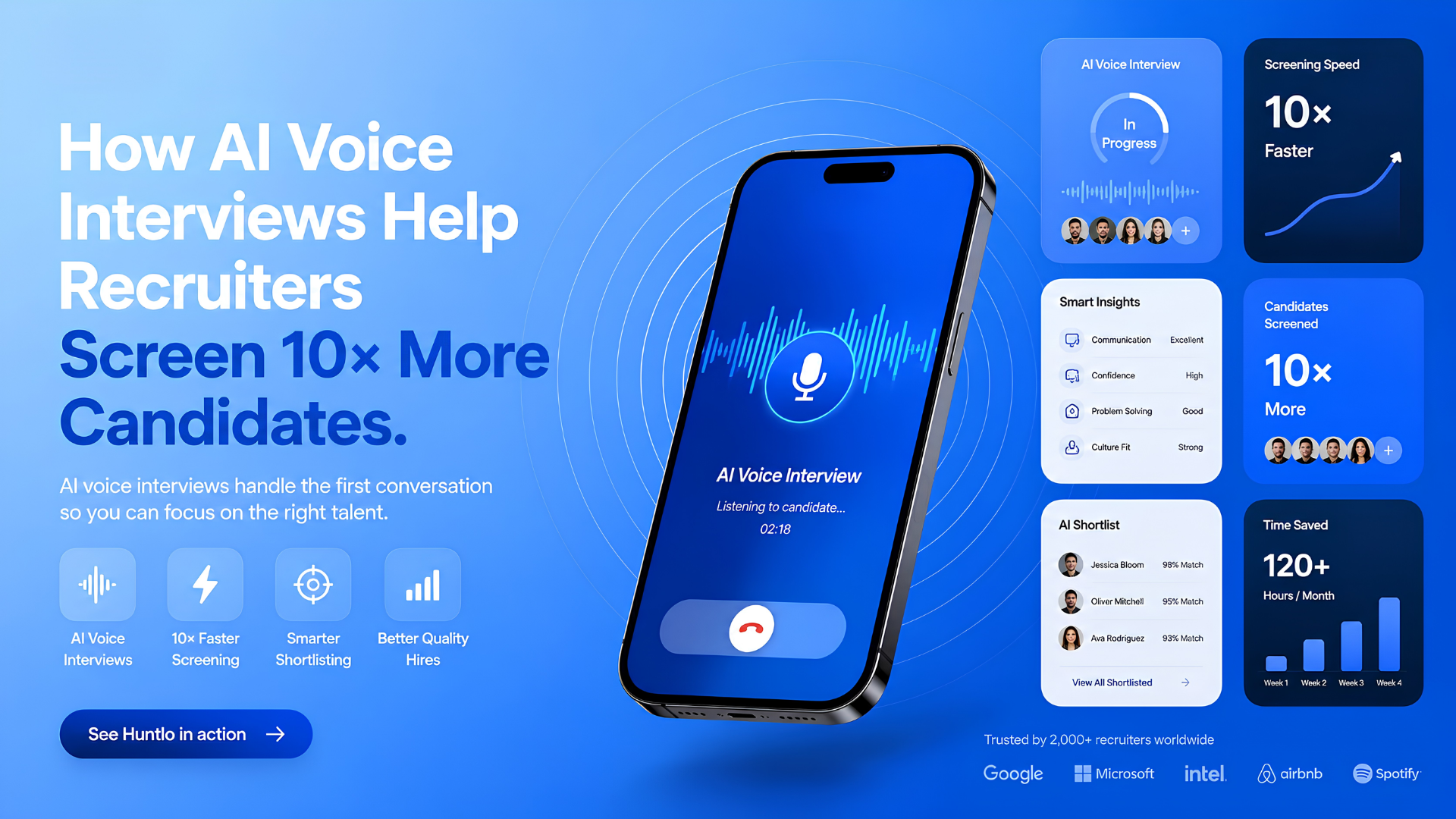
The 10× claim is not marketing hyperbole — it is straightforward capacity math. A recruiter who can manually conduct 20 phone screens per week can, with AI voice interviews, deploy 200 or more screenings in the same period. Here is how the calculation works in practice. The recruiter sets up the AI voice interview once — defining the role, selecting the competency framework, choosing the questions (or letting the AI generate role-relevant questions), and configuring the evaluation criteria. This setup takes 20 to 30 minutes and applies to every candidate for that requisition.
Each candidate then completes the interview autonomously. The AI handles the conversation, evaluates the responses, and generates the scorecard. The recruiter’s only time investment per candidate is the 5 to 8 minutes needed to review the AI-generated evaluation and decide on disposition. Compared to the 45 to 60 minutes required for a manual
phone screen (including scheduling, the call itself, and documentation), that is a 7 to 10x reduction in recruiter time per screen. Across 200 candidates, the time savings are enormous: what would have taken a recruiter roughly 150 hours of phone screens is reduced to roughly 25 hours of scorecard review — freeing over 120 hours per requisition cycle for higher-value activities like candidate engagement, hiring manager consultation, and strategic sourcing.
The math becomes even more compelling when you factor in candidate throughput. Because AI voice interviews remove scheduling as a bottleneck, candidates who would have waited 3 to 5 days for a phone screen slot can complete their screening within hours of expressing interest. Gartner’s HR research has found that reducing screening wait time by even one day improves candidate engagement rates by 15–20%, which means more candidates complete the process, which means larger and higher-quality shortlists, which means better hires.
What AI Voice Interviews Evaluate — and What They Don’t
AI voice interviews are not a universal replacement for every recruiting conversation. They are exceptionally good at evaluating structured, observable dimensions: clarity of communication, structured thinking, role-specific knowledge, problem-solving approach, behavioral evidence for competencies like collaboration and adaptability, and basic cultural alignment indicators. These dimensions happen to be the ones that matter most at the screening stage — the stage where the goal is not to make a hiring decision but to determine whether a candidate is worth a deeper investment of human time.
What AI voice interviews do not evaluate well are the dimensions that require human intuition, contextual judgment, and two-way dialogue: team chemistry, leadership presence in an interactive setting, candidate motivation and career narrative nuance, and the kind of creative or strategic thinking that emerges through a real back-and-forth conversation. These are precisely the evaluations that should happen during the human-led interview stages — and they happen more effectively when the recruiter has already reviewed an AI-generated screening scorecard that tells them exactly what to probe deeper on. The AI does not replace the human conversation; it makes the human conversation dramatically more productive by providing structured intelligence about what to focus on.
Candidate Experience and Compliance
One of the most common concerns about AI screening is candidate experience. Will candidates be put off by talking to an AI? The evidence so far suggests the opposite. Candidates consistently report that AI voice interviews feel less adversarial and lower-pressure than traditional phone screens with recruiters, because there is no judgment in the moment, no performance anxiety about impressing a specific person, and the ability to complete the interview at a time when they are at their best. The Talent Board’s CandE Award benchmarking data shows that candidates who complete AI-screened processes report satisfaction scores that are comparable to — and in some cases higher than — those who go
through traditional phone screen processes, primarily because of the convenience and speed of the AI format.
On the compliance side, AI voice interviews actually create a stronger audit trail than manual screening. Every question asked, every response given, and every evaluation criterion applied is recorded, structured, and timestamped. This is particularly valuable for organizations operating under evolving AI-in-hiring regulations across jurisdictions — including the EU AI Act, New York City’s Local Law 144, and Illinois’ AI Video Interview Act. Because the AI applies the same evaluation framework to every candidate, it reduces the kind of inconsistent, undocumented screening decisions that create legal exposure. The structured output also makes bias auditing straightforward: organizations can analyze scorecard data across demographic groups to identify and correct potential disparities in a way that is impossible with unstructured recruiter notes.
Why the Platform You Choose Determines Whether 10× Actually Works
The theoretical capacity of AI voice interviews is one thing. Realizing that capacity in practice requires a platform that integrates voice screening into a complete recruiting workflow — not as an isolated tool, but as one component of an end-to-end system that handles sourcing, outreach, screening, and scheduling as a unified process. This is the difference between an AI voice interview tool that produces scorecards you have to manually reconcile with your ATS and a platform like Huntlo where AI voice screening is part of the same pipeline that sourced the candidate in the first place.
Huntlo’s approach combines agentic AI sourcing across 50+ platforms, multi-channel outreach (email, LinkedIn, WhatsApp), AI voice screening, and automated interview scheduling into a single platform. The practical implication is that a candidate who is sourced through Huntlo’s AI engine, engaged through automated outreach, and screened through an AI voice interview flows through the entire pipeline without manual handoffs, data re-entry, or tool switching. As explored in What Makes an AI Recruiting Platform “Agentic” vs Just Automated?, this kind of end-to-end integration is what separates platforms that genuinely multiply recruiter output from those that simply add another tool to an already fragmented stack.
For recruiters, the question is not whether AI voice interviews can help you screen more candidates — the math on that is straightforward and well-documented. The question is whether the platform delivering those AI voice interviews also handles the upstream work of finding and engaging those candidates and the downstream work of moving them through your hiring process. Fragmented tools create fragmented data. Fragmented data creates more work for recruiters, not less. The whole point of AI in recruiting is to reduce recruiter workload while improving hiring quality — and that only happens when sourcing, screening, and coordination operate as one system, not three separate ones.
The recruiters who will gain the most from AI voice screening are not those who adopt it as a standalone tool but those who embed it within a broader AI-powered hiring operating system. Whether you are a solo recruiter trying to manage 30 open roles, a
staffing agency processing hundreds of candidates per week, or a global TA team standardizing screening across regions, the multiplier effect comes from integration — from having every tool in your recruiting stack operate on the same candidate data, the same evaluation framework, and the same workflow. As discussed in Should Recruiters Worry About AI Replacing Their Jobs?, the recruiters who thrive are not the ones who resist AI or the ones who over-rely on it — they are the ones who use it to handle volume while investing their freed-up time in the human parts of recruiting that actually close hires.
Related Topics:
What Makes an AI Recruiting Platform "Agentic" vs Just Automated?
The ATS Mistake Companies Keep Repeating
Should Recruiters Worry About AI Replacing Their Jobs?