The Hidden Cost of Global Hiring Inconsistency
Most global organizations have a hiring consistency problem, and most do not know the full extent of it. On the surface, everything appears functional. Each regional office posts job descriptions, screens candidates, conducts interviews, and makes offers. The process completes. Roles get filled. But beneath the surface, the evaluation standards applied to ostensibly identical roles vary significantly across geographies, and this variation carries costs that compound across the organization over time.
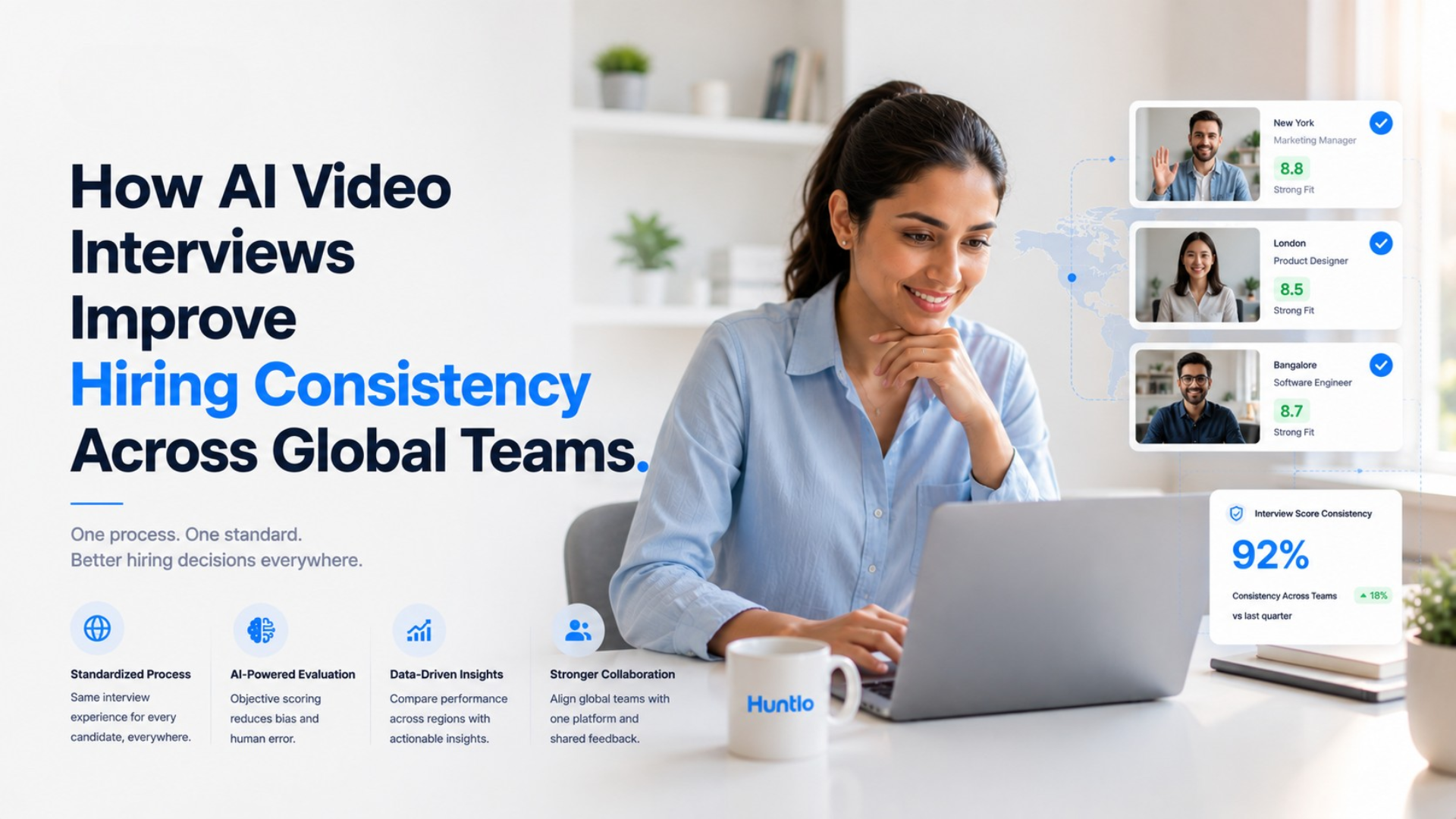
SHRM's global talent acquisition survey found that 72% of multinational organizations do not have a standardized interview framework that is consistently applied across all regions. What they have instead is a collection of regional hiring practices that share a job title and a logo but operate with different evaluation criteria, different interview formats, different scoring standards, and different definitions of what constitutes a "strong" candidate. The New York office evaluates software engineers for system design depth and communication clarity. The Bangalore office evaluates the same title for coding speed and algorithmic proficiency. The London office prioritizes academic credentials and previous employer prestige. Each office believes it is hiring to the same standard. It is not.
The consequences of this inconsistency are not immediately visible, which is why they persist. The first consequence is workforce quality variation. When different offices apply different standards to the same role family, the resulting hires have different capability profiles. This creates friction when these hires are expected to collaborate across regions, because team members who were selected for different strengths now need to work together on shared projects. A product team spanning New York, London, and Bangalore may include engineers selected for very different capabilities, creating misalignment that shows up as communication breakdowns, quality inconsistencies, and delivery delays that no one traces back to the hiring process.
The second consequence is fairness and legal exposure. When candidates from different geographies are evaluated against different standards, the organization cannot demonstrate that its hiring process is equitable — because it is not. In an era of increasing regulatory scrutiny of hiring practices, including the EU AI Act's high-risk classification of employment AI and evolving anti-discrimination enforcement globally, this inconsistency represents a compliance risk that the International Association of Privacy Professionals (IAPP) has identified as one of the top three AI governance challenges for multinational employers.
The third consequence is data fragmentation. Global talent analytics — understanding workforce capabilities, identifying skill gaps, and planning succession — requires consistent data across regions. When each office uses different interview methods and evaluation frameworks, the resulting data cannot be meaningfully aggregated. The head of global engineering cannot answer a simple question: "How do our engineering hires in different regions compare on communication skills?" — because the data was collected using different methods, against different criteria, by different evaluators with different standards. McKinsey's organizational analytics research has described this data fragmentation as "the single biggest barrier to evidence-based workforce planning in multinational organizations."
Why Global Teams Naturally Drift Apart on Hiring Standards
Hiring consistency across global teams is difficult to achieve not because organizations are negligent but because the forces pulling teams apart are powerful and persistent. Understanding these forces is essential for designing interventions that actually work.
Cultural differences in evaluation norms. Research in cross-cultural psychology has consistently demonstrated that different cultures evaluate professional competence differently. In some cultures, directness and assertiveness in an interview are viewed as indicators of leadership potential. In others, the same behaviors are interpreted as arrogance or poor interpersonal judgment. A candidate who would be rated highly for "confidence" in a New York interview might be rated poorly for the same behavior in a Tokyo interview. Harvard Business Review's coverage of cross-cultural management has documented that these cultural evaluation biases operate largely unconsciously, making them resistant to training and awareness programs alone. The interviewer in Tokyo is not intentionally applying a different standard — they are applying the standard that their cultural context has taught them is correct.
Hiring manager autonomy. In most global organizations, regional hiring managers have significant autonomy over their hiring processes. This autonomy exists for legitimate reasons: local labor markets differ, local regulatory requirements vary, and local business needs may require role-specific adaptations. But the autonomy also means that hiring managers develop idiosyncratic evaluation preferences that diverge from the organizational standard over time. A hiring manager in Berlin who values academic research experience will gradually calibrate their interview process to screen for that attribute, even if the global role framework does not prioritize it. Over years, these individual calibrations accumulate into significant regional divergence.
Recruiter turnover and knowledge loss. Global recruiting teams experience high turnover — the Bureau of Labor Statistics reports that recruiter turnover in enterprise organizations averages 30% to 40% annually. Every time a recruiter leaves, their implicit evaluation standards — the unwritten criteria they used to assess candidates — leave with them. The replacement recruiter brings their own standards, which may differ significantly. In regions with high recruiter turnover, the evaluation standard can shift substantially every 12 to 18 months, making consistency impossible to maintain through human effort alone.
Time zone and coordination challenges. Even when global organizations invest in standardization efforts — developing common interview guides, training interviewers on shared criteria, and establishing calibration sessions — the practical coordination challenges of operating across multiple time zones make enforcement difficult. A calibration session that requires participation from hiring managers in New York, London, Mumbai, and Sydney is extraordinarily difficult to schedule. The resulting infrequent calibration allows standards to drift between sessions, often without anyone noticing until a cross-regional project reveals the quality gap.
Local market competitive pressures. Regional talent markets differ in competitiveness, and hiring teams under pressure to fill roles quickly sometimes lower their standards to meet headcount targets. A recruiting team in a tight talent market may advance candidates who would not meet the bar in a less competitive market, rationalizing the decision as a necessary adaptation to local conditions. While this flexibility can be appropriate in specific circumstances, it creates inconsistency when applied informally and tracked inconsistently.
How AI Video Interviews Enforce Consistent Evaluation
AI video interview platforms address the consistency challenge not by eliminating human judgment but by ensuring that every candidate is evaluated against the same framework, using the same methodology, regardless of where they are interviewed, who conducts the interview, or what time zone they are in. The technology achieves this through several mechanisms.
Standardized competency frameworks applied uniformly. The foundation of AI-driven consistency is a structured competency framework that defines, in specific and measurable terms, what each role requires. For a senior software engineer, the framework might specify technical depth (demonstrated through specific project descriptions and technical decision-making examples), communication clarity (evaluated through response structure and the use of evidence versus assertion), problem-solving approach (assessed through scenario-based questions), and collaboration indicators (inferred from how candidates describe team interactions). This framework is encoded into the AI's evaluation parameters, and every candidate is evaluated against it. The AI does not apply a stricter standard in Berlin and a more lenient standard in Bangalore. It applies the same standard everywhere.
SIOP's research on structured interviews has demonstrated that structured interview frameworks — the kind AI platforms enforce — achieve inter-rater reliability coefficients 2 to 3 times higher than unstructured interviews. In the global context, this means that the variance in candidate scores reflects actual differences in candidate capability rather than differences in regional evaluation standards. A candidate who scores an 8.2 on technical depth in New York and a candidate who scores an 8.4 in Bangalore can be meaningfully compared, because both scores were derived from the same evaluation framework applied by the same AI system.
Elimination of interviewer-dependent variability. In a traditional global hiring process, the interviewer is the primary source of evaluation inconsistency. Different interviewers ask different questions, weight different competencies differently, and apply different implicit standards. AI video interviews remove the interviewer as a variable in the initial evaluation stages. Every candidate is "interviewed" by the same AI system, using the same questions, with the same evaluative framework. The human interviewers who participate in later stages still bring their individual perspectives, but they do so with the benefit of a structured, AI-generated evaluation baseline that anchors their assessment.
This does not mean human interviewers become irrelevant. It means their role changes from primary evaluator to informed advisor. A hiring manager in Singapore reviewing an AI-generated candidate profile can see exactly how the candidate performed on each competency dimension, compare that performance against other candidates in the pipeline, and bring their local market knowledge to bear on the final decision. The AI provides the consistent foundation; the human provides the contextual nuance. Gartner's HR technology analysis has found that this "AI baseline, human overlay" model produces better hiring outcomes than either pure AI evaluation or pure human evaluation, because it combines the consistency advantages of AI with the contextual intelligence of experienced local hiring managers.
Real-time cross-regional benchmarking. One of the most powerful consistency features of AI video interview platforms is the ability to benchmark candidates across regions in real time. When a global organization is hiring for the same role in multiple locations, the AI can generate comparative analytics showing how candidates in different geographies score on each competency dimension. This benchmarking reveals whether a regional talent pool is genuinely weaker on a specific competency — which may require sourcing strategy adjustments — or whether the regional evaluation standards have drifted — which requires calibration intervention.
This capability is impossible with traditional interview processes because the data is not structured, not standardized, and not centralized. An AI platform that evaluates every candidate against the same framework naturally produces comparable data across regions, enabling global talent acquisition leaders to identify and address consistency issues proactively rather than discovering them after they have already produced hiring quality problems.
Cross-Cultural Evaluation: The Accuracy Question
The most legitimate concern about AI-driven consistency in global hiring is whether a single evaluation framework can accurately assess candidates from different cultural backgrounds. The concern is that an AI system calibrated on Western communication norms might penalize candidates from cultures where different communication styles are the norm — for example, candidates who demonstrate competence through modest, indirect language rather than assertive self-advocacy.
This concern is valid and must be addressed directly. The evidence, however, suggests that well-designed AI video interview platforms handle cross-cultural evaluation more equitably than human interviewers, not less.
The mechanism is counterintuitive but well-documented: human interviewers are more susceptible to cultural bias than AI systems because humans interpret communication through the lens of their own cultural conditioning, while AI systems — when properly designed — evaluate communication against role-relevant behavioral indicators that are culturally agnostic. An AI evaluating a candidate's problem-solving approach does not care whether the candidate describes their experience with American-style directness or Japanese-style indirectness. It cares whether the candidate describes a specific problem, explains the analysis that led to their decision, acknowledges trade-offs, and articulates the outcome. These are behavioral indicators of effective problem-solving that are relevant across cultures, and they can be detected in candidate responses regardless of communication style.
Research from the MIT Sloan Management Review on cross-cultural AI evaluation found that AI systems evaluating candidates from 12 different countries using a behaviorally anchored competency framework produced evaluation scores with 40% less cross-cultural variance than human interviewers evaluating the same candidates. The AI was not "culture-blind" — it detected meaningful cultural differences in candidate responses — but it evaluated those differences against a role-relevant standard rather than a culturally conditioned preference.
The critical implementation requirement is that the AI's evaluation framework must be designed by industrial-organizational psychologists with cross-cultural expertise, and the AI's training data must include diverse cultural representation. Platforms that fail on either dimension will produce culturally biased evaluations. Platforms that invest in both — like Huntlo.ai, which conducts AI evaluations across candidates from multiple countries and cultural contexts — can deliver the consistency advantages of AI evaluation while respecting cultural diversity in communication styles.
Gallup's cross-cultural workforce research has added an important nuance: candidates from non-Western cultures actually report higher satisfaction with AI interview processes than with human-led interviews, because the AI does not exhibit the micro-expressions of cultural bias — subtle shifts in tone, facial expression, or follow-up question framing — that candidates from minority cultural backgrounds are often acutely sensitive to. The AI, by contrast, is consistently professional and consistently focused on role-relevant content, creating an experience that many candidates perceive as fairer than a human interview.
Time Zone Elimination: The Practical Consistency Multiplier
Time zones are one of the most practical — and most underappreciated — barriers to global hiring consistency. When a hiring manager in San Francisco needs to interview a candidate in Bangalore and a hiring manager in London needs to interview a candidate in the same role, the time zone gap makes it nearly impossible to conduct both interviews within the same week using the same process. The San Francisco interview happens on Tuesday at 9 AM Pacific. The London interview happens on Thursday at 2 PM GMT. The Bangalore interview happens the following Monday at 10 AM IST. By the time all three interviews are complete, the evaluation standards have already drifted because the interviewers had different days, different energy levels, and different candidate comparison sets in mind.
AI video interviews eliminate this time zone barrier entirely. Asynchronous AI interviews allow candidates to complete their evaluations at any time, in any time zone, and the AI processes them immediately upon completion. A candidate in Bangalore and a candidate in San Francisco can complete the same AI interview on the same day, and their evaluations are available for comparison within hours. The time zone that once introduced days of delay and inconsistency now introduces no delay and no inconsistency at all.
For synchronous AI interviews — the live format where candidates interact with an AI agent in real time — the time zone challenge is managed through AI availability. Unlike human interviewers, AI agents are available 24/7, so a candidate in Singapore can complete a live AI interview at 10 PM local time without requiring any human interviewer to be awake. LinkedIn's global hiring data shows that 35% of candidates prefer to complete interviews outside standard business hours, a preference that traditional interview processes cannot accommodate but AI interviews serve naturally.
The practical impact on hiring speed is substantial. Deloitte's global workforce survey found that time zone coordination adds an average of 7 to 12 days to global hiring processes — time spent scheduling across regions, accommodating calendar conflicts, and managing rescheduling due to last-minute conflicts. AI video interviews eliminate this overhead entirely, producing a measurable speed advantage that is particularly pronounced for global roles where candidates and interviewers span three or more time zones.
Language and Communication: How AI Handles Multilingual Hiring
Global organizations hiring across multiple countries inevitably encounter language diversity. Some roles require English proficiency and are interviewed in English regardless of location. Other roles — particularly customer-facing roles in non-English-speaking markets — are best evaluated in the local language. The question for AI video interview platforms is whether they can maintain evaluation consistency across languages.
The answer depends on the platform. Basic AI interview tools that rely heavily on keyword matching and NLP trained primarily on English text will produce lower-quality evaluations in other languages. Advanced platforms that use multilingual natural language processing models can maintain evaluation quality across multiple languages, though with some variation in analytical depth depending on the language's representation in the AI's training data.
The more important point is that AI video interview platforms can evaluate dimensions of candidate communication that are language-independent. Response structure — whether the candidate organizes their thoughts logically, provides context before detail, and differentiates between opinions and facts — is detectable in any language. Problem-solving approach — whether the candidate considers multiple options, weighs trade-offs, and articulates a decision framework — is equally assessable across languages. These are the evaluation dimensions that most strongly predict on-the-job performance, and they are the dimensions where AI analysis is most consistent regardless of the interview language.
Korn Ferry's global leadership assessment research has found that the most predictive competency indicators for cross-border leadership roles — strategic thinking, stakeholder awareness, adaptability, and communication clarity — are assessable across languages with high inter-language reliability when evaluated by AI systems designed for multilingual operation. The key implementation requirement is ensuring that the AI's evaluation framework defines each competency in behavioral terms that can be demonstrated in any language, rather than in linguistic terms that may privilege specific language patterns.
For organizations operating in markets where multiple languages are common — India, Southeast Asia, the Middle East, and parts of Europe — platforms like Huntlo.ai that support multilingual candidate engagement across email, WhatsApp, and AI voice calls provide an additional consistency advantage. The candidate can be engaged in their preferred language throughout the entire process, from initial outreach through final evaluation, without the quality loss that occurs when language switching introduces different recruiters with different capabilities at different stages.
Data Unification: The Strategic Value of Consistent Global Hiring Data
The most strategically significant benefit of AI-driven hiring consistency is not any individual hiring decision — it is the data asset that consistent evaluation produces. When every candidate, in every region, is evaluated against the same framework using the same methodology, the resulting data can be aggregated, analyzed, and acted upon at the global level. This data unification enables capabilities that are impossible with fragmented regional hiring data.
Global talent mapping. With consistent evaluation data, the organization can map its actual talent capabilities across regions — not based on resume keywords or self-reported skills, but on demonstrated competency assessments. This mapping reveals where the organization has deep capability concentrations and where capability gaps exist, enabling strategic workforce planning that is grounded in evidence rather than assumptions.
Regional talent market intelligence. Consistent evaluation data across regions provides insight into the relative strength of different talent markets for specific competencies. If candidates in Berlin consistently score higher on design thinking but lower on stakeholder management than candidates in New York, that intelligence informs both hiring strategy (source design thinking skills from Berlin) and development strategy (invest in stakeholder management training for the Berlin team).
Cross-regional calibration. Global talent acquisition leaders can identify regional evaluation drift before it becomes a quality problem. If the average competency scores for a given role in one region begin to diverge significantly from other regions, that divergence is visible in the data and can be investigated and corrected proactively.
Predictive workforce modeling. With structured, consistent evaluation data across thousands of hires, organizations can build predictive models that forecast future workforce capabilities based on current hiring patterns. If the data shows that candidates scoring above a certain threshold on adaptability and communication clarity have 40% higher 18-month retention rates, the organization can adjust its evaluation framework to weight those competencies more heavily — and the adjustment applies globally, improving outcomes across every region simultaneously.
Mercer's talent strategy practice has documented that organizations with unified global hiring data — the kind that AI video interview platforms produce — make 32% more accurate workforce planning decisions and achieve 25% higher internal mobility rates, because the organization has a clear, data-driven understanding of its workforce capabilities across every geography.
Compliance Across Jurisdictions: A Consistency Advantage
Global organizations hiring across multiple jurisdictions face a patchwork of employment regulations that vary by country, state, and sometimes municipality. Hiring consistency, when implemented through AI video interviews, can actually simplify compliance rather than complicate it — provided the platform is designed for multi-jurisdictional operation.
The compliance advantage works through three mechanisms. First, AI video interview platforms generate structured evaluation data that can be audited for compliance purposes. When a regulator or a candidate challenges a hiring decision, the organization can produce a detailed, time-stamped evaluation record showing exactly what the candidate was asked, how they responded, and how they were scored. This audit trail is far more defensible than the fragmentary notes and subjective impressions that characterize traditional interview processes.
Second, AI platforms can be configured to apply jurisdiction-specific compliance requirements automatically. In the EU, the platform can ensure that candidates receive the required AI disclosure and consent notifications. In New York City, the platform can generate the bias audit data that Local Law 144 requires. In jurisdictions with specific interview question restrictions, the platform can prevent prohibited questions from being asked. This automated compliance reduces the risk of human error — a recruiter in one region inadvertently asking a prohibited question, for example — that can create legal exposure.
Third, consistent evaluation data enables the organization to conduct its own internal bias monitoring across regions. By analyzing AI evaluation scores across candidate demographics and geographies, the organization can identify potential disparate impact patterns before they become regulatory issues. The National Bureau of Economic Research (NBER) has published research demonstrating that organizations using AI hiring tools with built-in bias monitoring detect and correct potential discrimination 60% faster than organizations relying on post-hoc manual analysis of traditional interview data.
EY's HR compliance consulting practice has noted that global organizations with AI-powered hiring compliance capabilities spend 35% less on external legal counsel for employment matters and resolve compliance inquiries 40% faster, because the structured data that AI platforms generate enables efficient, evidence-based responses to regulatory inquiries.
Implementation: Achieving Global Consistency Without Sacrificing Local Relevance
The biggest risk in pursuing global hiring consistency is overstandardization — imposing a rigid, one-size-fits-all evaluation framework that does not account for legitimate regional variations in role requirements, market conditions, and candidate expectations. Effective implementation requires balancing global consistency with local flexibility.
The recommended approach is a "core-plus-flex" model. The global competency framework defines a core set of evaluation dimensions that apply to every instance of a given role family across all regions. This core ensures consistency on the competencies that matter most. Each region can then add supplementary evaluation dimensions that address local requirements — specific technical skills that are more important in one market, language proficiency requirements, or local regulatory knowledge. The AI platform evaluates the core dimensions consistently across all regions and the supplementary dimensions only in the regions where they are relevant.
Prosci's change management research emphasizes that global implementations require regional champions — respected local recruiting leaders who can advocate for the technology, address cultural concerns, and ensure that the implementation is adapted appropriately for their context. These champions serve a critical bridging function: they translate the global standard into local practice and they feed local learning back into the global framework.
The technology platform must support this core-plus-flex model through configurable evaluation frameworks, region-specific interview content, and reporting that provides both global consistency metrics and regional performance views. Huntlo.ai's platform architecture supports this approach, allowing global talent acquisition leaders to define standard competency frameworks while enabling regional teams to add localized evaluation dimensions and adjust interview content for their specific market context — all on a single platform with unified data and consistent analytics.
Training should be delivered regionally, in local languages, with region-specific examples that demonstrate how the AI evaluation framework applies to the local talent market. Global training webinars are insufficient for driving adoption across diverse cultural contexts. Heidrick & Struggles' global leadership research has found that global implementations with regionally delivered, culturally adapted training achieve 45% higher adoption rates than implementations relying on centralized, one-language training programs.
Measuring Consistency: KPIs for Global Hiring Operations
Global hiring consistency must be measured to be maintained. The following KPIs provide a framework for tracking consistency across regions and identifying problems before they impact hiring quality.
Inter-regional score variance. Track the average AI evaluation scores for each competency dimension by region. Significant variance in a specific competency — for example, if communication clarity scores in one region are consistently 20% lower than the global average — may indicate either a genuine talent market difference (which informs sourcing strategy) or a calibration issue (which requires intervention). Establish acceptable variance thresholds and trigger investigation when scores exceed those thresholds.
Hiring manager override rate. Track how frequently hiring managers in different regions override AI recommendations. A high override rate in one region may indicate that the AI's evaluation framework is not well-calibrated for that region's specific requirements, or it may indicate that a hiring manager is not using the AI data effectively. Either way, the override rate is a diagnostic indicator that warrants attention.
Quality-of-hire consistency. Track new-hire performance ratings and retention rates by region, using the same evaluation methodology. If one region's new hires consistently underperform or have lower retention rates, the root cause may be in the hiring process rather than the talent market. Consistent evaluation data makes this diagnostic possible.
Candidate experience parity. Track candidate satisfaction and completion rates across regions. If candidates in one geography have significantly different experiences — lower completion rates, lower satisfaction scores — the issue may be with the interview design, the technology infrastructure, or the communication supporting the process. Talent Board's CandE research provides benchmarking data for candidate experience by geography.
Compliance audit consistency. Track the results of internal bias audits across regions. Consistent compliance outcomes — similar disparate impact ratios, similar candidate notification compliance rates — indicate that the AI evaluation process is operating equitably across geographies. Inconsistent outcomes trigger investigation and correction.
The Multi-Channel Advantage for Global Hiring
Global hiring consistency is further strengthened when AI video interviews are integrated with multi-channel AI sourcing. When candidates from different regions are engaged through different channels — email in one market, WhatsApp in another, LinkedIn in a third — and those engagement interactions feed into the same AI evaluation framework, the consistency advantage extends beyond the interview itself to encompass the entire candidate journey.
Platforms like Huntlo.ai that combine sourcing across 50+ platforms with multi-channel outreach (email, LinkedIn, WhatsApp, AI voice) and AI-powered interview evaluation create a unified global hiring workflow. A candidate in Nigeria who is first engaged through WhatsApp, continues the conversation through an AI voice call, and completes a structured video interview generates evaluation data that is directly comparable to a candidate in Germany who was engaged through LinkedIn, screened by email, and completed the same video interview. The sourcing channels differ — appropriately, based on regional preferences and platform availability — but the evaluation framework is identical.
PwC's global HR technology analysis has found that organizations with integrated multi-channel sourcing and AI interview platforms achieve 30% higher consistency scores in their global hiring processes compared to organizations where sourcing and interviewing operate on disconnected systems. The integration eliminates the data loss and contextual fragmentation that occur when candidates transition between separate tools at each stage of the process.
For global organizations, this integration also simplifies technology governance. Managing a single AI recruiting platform across all regions is dramatically simpler than managing a patchwork of regional tools, each with its own data practices, security configurations, and compliance requirements. The reduction in vendor management complexity, integration overhead, and security surface area is itself a significant operational advantage.
The Competitors Who Figure This Out First Will Win
Global hiring consistency is not a nice-to-have optimization. It is a strategic capability that directly affects workforce quality, compliance risk, talent intelligence, and competitive positioning in every market where the organization operates. The enterprises that achieve consistent, data-driven hiring across all their regions will have better workforces, lower legal risk, stronger talent analytics, and a more compelling employer brand than the enterprises that allow regional hiring practices to drift apart.
AI video interviews provide the technological foundation for this consistency. They do not replace the local knowledge, cultural sensitivity, and market expertise that regional recruiting teams bring. They provide a consistent evaluation infrastructure that allows that local expertise to operate within a shared global framework — producing hiring outcomes that are both locally relevant and globally comparable.
The investment required is modest relative to the strategic returns. A flat $99 per seat per month — the pricing model that Huntlo.ai offers — makes AI-powered hiring consistency accessible to organizations of every size. The barrier is not cost. It is the organizational willingness to standardize, the change management investment to drive adoption, and the leadership commitment to data-driven hiring as a global operating principle. The organizations that make this commitment will build a durable competitive advantage in the global talent market. The ones that do not will continue to operate with a fragmented hiring process that produces inconsistent outcomes, fragmented data, and growing compliance risk — a position that becomes less tenable with every quarter that passes.
Related Topics:
The ATS Mistake Companies Keep Repeating
What’s the Difference Between AI Sourcing and AI Recruiting?
How Many Follow-Ups Does One Hire Need?