The Recruiter Confidence Crisis No One Talks About
Enterprise recruiting invests heavily in measurement and optimization — cost-per-hire dashboards, time-to-fill benchmarks, sourcing channel analytics, and offer acceptance rate tracking. These metrics are visible, actionable, and continuously refined. But there is a dimension of recruiting effectiveness that is almost never measured and almost never discussed: the confidence with which recruiters make and communicate their hiring recommendations.
A 2024 SHRM study of 2,400 corporate recruiters across North America and Europe found that 67% of recruiters "frequently" or "sometimes" second-guessed their hiring recommendations to hiring managers. Among recruiters with fewer than three years of experience, the figure rose to 81%. Among recruiters working in organizations without structured interview processes, it reached 74%. The study also found that recruiter confidence — or the lack of it — had measurable downstream effects on hiring outcomes that were independent of the recruiter's actual evaluation accuracy.
This confidence deficit is not a minor psychological phenomenon. It is a systemic problem that distorts the entire hiring process in ways that are measurable, consequential, and addressable. Recruiters who lack confidence over-screen candidates — requesting additional interview rounds and additional evaluators to share the decision burden. They avoid presenting borderline but high-potential candidates to hiring managers for fear of being wrong. They defer to hiring managers' subjective impressions rather than advocating for candidates who score well on competency evidence. And they experience higher levels of stress, anxiety, and burnout — accelerating the 35% annual recruiter turnover rate that Gallup reports for enterprise TA organizations.
AI video interviews address this confidence crisis at its structural root. By providing recruiters with structured evaluation data — dimensional competency scores, response transcripts, cross-candidate comparison frameworks, and auditable assessment records — AI video interviews transform hiring recommendations from subjective impressions that are difficult to defend into evidence-based positions that recruiters can present with confidence. This article examines the specific mechanisms, the supporting evidence, and the practical implementation considerations.
Why Recruiter Confidence Matters More Than We Think
Recruiter confidence is not merely a matter of professional comfort — it is a causal driver of hiring quality, speed, and recruiter retention. Three mechanisms explain the link between confidence and outcomes.
Confidence enables advocacy. The most valuable thing a recruiter does in the hiring process is not screening candidates or scheduling interviews — it is advocating for candidates. The recruiter who can look a hiring manager in the eye and say "I am confident this candidate has the strategic thinking competency this role requires, and here is the specific evidence" is fundamentally more effective than the recruiter who says "I have a good feeling about this candidate." A Harvard Business Review analysis of recruiter-hiring manager interactions found that recruiters who presented recommendations with specific evidence — rather than general impressions — were 2.4 times more likely to have their recommendation accepted and 1.7 times more likely to have the resulting hire rated as "exceeding expectations" at the 12-month performance review.
Confidence reduces over-processing. Lack of confidence drives process inflation — additional interview rounds, additional evaluators, additional assessment steps — that slow hiring and do not improve quality. A Gartner study found that organizations where recruiters reported low decision confidence averaged 5.8 interview rounds per hire, compared to 3.4 rounds in organizations where recruiters reported high confidence. The additional rounds added an average of 12 days to time-to-hire without measurably improving new-hire performance ratings. The extra rounds were a confidence coping mechanism, not a quality improvement intervention.
Confidence reduces turnover. Recruiters who feel confident in their evaluation process and their recommendations are significantly less likely to burn out and leave. The same SHRM study found that recruiters who reported "high" or "very high" confidence in their hiring recommendations were 41% less likely to be actively searching for a new job, 34% less likely to report burnout symptoms, and 28% more likely to rate their job satisfaction as "high" or "very high." In a talent market where recruiter turnover costs $25,000-40,000 per departure and the average TA team loses 35% of its members annually, the retention impact of recruiter confidence is financially material.
The What Recruiters Actually Use AI Sourcing Tools For (Survey Insights) article on the Huntlo blog provides additional data on recruiter confidence levels, decision-making patterns, and the tools and data sources that recruiters report needing most.
Where Recruiter Confidence Comes From — And Why It Is Lacking
Recruiter confidence derives from four sources. When all four are strong, recruiters make recommendations with assurance. When any are weak, second-guessing creeps in.
Data confidence is the belief that the evaluation data accurately represents the candidate's capabilities. When a recruiter's evaluation is based on unstructured notes from a free-flowing conversation — with no scoring rubric, no behavioral anchors, and no standardized framework — data confidence is inherently low. The recruiter knows, consciously or not, that their evaluation is subjective, incomplete, and vulnerable to the cognitive biases that SIOP research has extensively documented. A Deloitte survey found that only 23% of recruiters using unstructured interview processes described themselves as "confident" or "very confident" in the accuracy of their candidate evaluations, compared to 71% of recruiters using structured processes with scoring rubrics.
Comparison confidence is the belief that candidates are being evaluated against the same standard. When different candidates are assessed through different questions by different evaluators using different implicit criteria — the default in unstructured hiring — the recruiter cannot make meaningful comparisons. Is Candidate A stronger than Candidate B? The recruiter cannot answer this question with confidence because the two candidates were not evaluated against the same framework. This comparison uncertainty is especially acute when the candidate pool is large and the recruiter must identify the top candidates to advance — precisely the decision where confidence matters most.
Defensibility confidence is the belief that the evaluation process would withstand scrutiny — from hiring managers, from rejected candidates, from legal challenges, or from regulatory audits. When the evaluation exists only in the recruiter's memory and a few handwritten notes, defensibility confidence is near zero. A hiring manager who challenges a recommendation, a rejected candidate who requests feedback, or a compliance officer who asks for documentation of the selection rationale can all expose the fragility of an unstructured evaluation. This exposure creates chronic anxiety for recruiters — particularly those working in regulated industries or jurisdictions with active employment litigation.
Outcome confidence is the belief that the hiring recommendation will produce a good result — that the candidate who is recommended and hired will perform well. This is the most forward-looking dimension of confidence and the one most directly affected by the recruiter's track record. Recruiters who have made recommendations that resulted in bad hires lose outcome confidence, which makes them more cautious and more likely to over-process future recommendations — a negative feedback loop that compounds over time. A Gallup analysis found that recruiter confidence in their hiring recommendations was 47% lower after experiencing a bad hire outcome in the previous quarter, and that this confidence reduction persisted for an average of four months.
AI video interviews strengthen all four dimensions of confidence simultaneously — which is why their impact on recruiter decision-making is disproportionately large relative to their role in the overall hiring process.
How AI Video Interviews Build Data Confidence
AI video interviews build data confidence by replacing subjective impressions with structured, consistent, and documented evaluation data. The specific mechanisms are straightforward but their impact is transformative.
Standardized competency scoring. Every candidate response is evaluated against the same competency framework, with the same scoring criteria, producing dimensional scores that are directly comparable across candidates. The recruiter no longer relies on their subjective impression of the candidate — they have specific, calibrated scores for each competency dimension. A Mercer study found that AI scoring systems achieved inter-rater reliability coefficients of 0.82-0.89 for structured competency evaluation, compared to 0.45-0.61 for individual human evaluators. The AI's evaluation is not only more consistent — it is more reliable.
Response transcripts. AI video interviews generate written transcripts of every candidate response, giving the recruiter a complete, reviewable record of what the candidate actually said. This eliminates the memory degradation and selective recall that plague unstructured evaluation — where the recruiter's post-interview impression is filtered through cognitive biases and cannot be verified against the actual conversation. When a hiring manager asks "what specifically did this candidate say about their approach to stakeholder management?", the recruiter can reference the transcript rather than relying on memory.
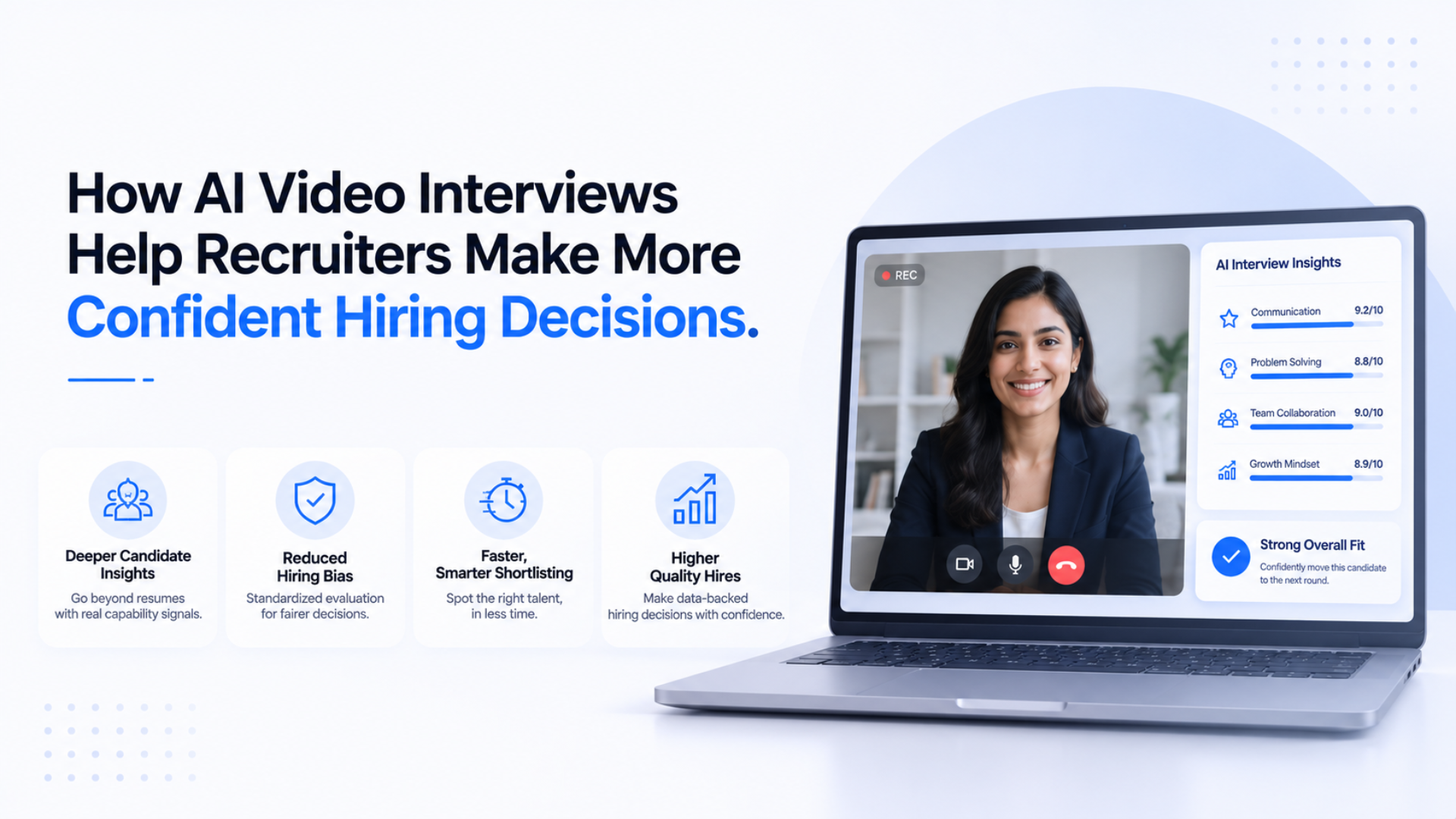
Evaluation summaries. AI video interviews produce structured evaluation summaries that synthesize the candidate's performance across all competency dimensions — highlighting strengths, identifying areas of concern, and providing an overall assessment that is grounded in specific response evidence. These summaries give the recruiter a clear, concise, and evidence-based narrative to present to hiring managers — replacing the vague, impression-based summaries that characterize unstructured evaluation.
The combined effect is a recruiter who can approach a hiring manager conversation with specific data rather than general impressions. "This candidate scored 4.2 out of 5 on strategic thinking, with particularly strong evidence in their response to the market expansion scenario — here is the transcript excerpt" is a fundamentally different — and fundamentally more confident — recommendation than "this candidate seems like a strong strategic thinker."
How AI Video Interviews Build Comparison Confidence
The ability to compare candidates objectively is one of the most valuable capabilities that AI video interviews provide, and one that is most frequently absent from unstructured evaluation.
When every candidate for a given role family completes the same structured AI interview, the recruiter has directly comparable evaluation data for every candidate in the pipeline. Candidate A scored 4.3 on problem-solving and 3.1 on communication. Candidate B scored 3.5 on problem-solving and 4.4 on communication. These comparisons are meaningful because they are based on the same assessment, the same scoring criteria, and the same standard — something that is impossible when different candidates are evaluated through different unstructured conversations.
This comparison capability is especially valuable for three common recruiting scenarios. First, high-volume screening, where recruiters must identify the top candidates from a large pool. Without comparable data, this identification relies on the recruiter's subjective impression — which degrades rapidly as the number of candidates increases due to interviewer fatigue and contrast effects. Second, cross-geographic hiring, where candidates from different locations are evaluated by different people. Without standardized assessment, geographic comparison is meaningless. Third, calibration discussions, where hiring committees must make final selections among multiple strong candidates. Without comparable data, these discussions devolve into opinion-sharing rather than evidence-based deliberation.
Huntlo.ai's talent pool management capabilities provide real-time candidate comparison through structured evaluation data. Recruiters and hiring managers can sort, filter, and rank candidates by competency scores, identify the strongest candidates on specific dimensions, and make data-driven advancement decisions. The Best Recruiting Tools for Solo Recruiters in 2026 article on the Huntlo blog examines how AI-powered comparison capabilities are especially transformative for solo recruiters and small TA teams that lack the institutional evaluation infrastructure of larger organizations.
How AI Video Interviews Build Defensibility Confidence
Every recruiter has experienced the anxiety of an indefensible hiring decision: the hiring manager who challenges a recommendation, the rejected candidate who demands to know why they were not selected, the compliance officer who requests documentation of the selection rationale, or the legal team that needs to defend a discrimination claim.
When the evaluation is unstructured — based on an unrecorded conversation, documented in a few bullet points, and justified by the recruiter's "professional judgment" — these situations are genuinely stressful because there is no evidence to present. The recruiter must defend an impression, which is inherently vulnerable to challenge.
AI video interviews create a comprehensive, structured, and auditable evaluation record for every candidate. The record includes: the specific questions asked, the candidate's responses (in transcript form), the dimensional competency scores with the scoring criteria applied, the evaluation summary, and the timestamped record of when the assessment was completed. This record provides the evidentiary foundation for defending any hiring decision.
For hiring manager challenges: When a hiring manager questions why a particular candidate was advanced over another, the recruiter can present the competency score comparison, the specific response evidence, and the documented evaluation rationale. The conversation shifts from opinion ("I think this candidate is stronger") to evidence ("this candidate scored 0.8 points higher on the two competencies most critical to the role, and here is the specific response evidence").
For candidate feedback requests: When a rejected candidate asks for feedback, the recruiter can provide specific, constructive, and evidence-based information: "Your strongest competency was communication clarity, where your response to the stakeholder scenario demonstrated particularly effective framing. The area where the evaluation identified the most room for development was financial acumen, where the response to the budget allocation scenario could have been more specific about the quantitative trade-offs." This kind of feedback is impossible with unstructured evaluation but becomes straightforward with structured AI assessment data.
For legal and compliance requirements: The structured evaluation record provides the documentation that EEOC guidelines, New York City's Local Law 144, the EU AI Act, and emerging state-level regulations require. The record demonstrates that every candidate was evaluated against the same job-related criteria using the same methodology — the evidentiary foundation for demonstrating that the selection process is job-related and consistent with business necessity.
How AI Video Interviews Build Outcome Confidence
Outcome confidence — the belief that a hiring recommendation will produce a good result — is the most forward-looking and most emotionally significant dimension of recruiter confidence. It is also the most damaged by the experience of bad hires.
AI video interviews build outcome confidence through two mechanisms. First, they improve the actual quality of hiring decisions — which, over time, gives recruiters a track record of successful recommendations that reinforces their confidence. A Gartner study found that organizations using AI screening reported 22% fewer "regret hires" (hires that the hiring manager wished they had not made within 12 months) compared to organizations using unstructured screening. Fewer bad hires means fewer confidence-damaging experiences and a progressively stronger track record.
Second, AI video interviews provide the data infrastructure for learning from hiring outcomes. When evaluation data is structured and documented, the organization can connect interview scores to subsequent performance data — identifying which competencies most strongly predict success, which questions produce the most discriminating evaluations, and which candidates were correctly or incorrectly assessed. This feedback loop — from hiring decision to performance outcome back to evaluation improvement — is impossible with unstructured data but becomes a continuous capability with structured AI assessment.
Over time, this feedback loop creates a virtuous cycle: better data leads to better assessment design, which leads to better hiring decisions, which leads to better performance outcomes, which strengthens the recruiter's confidence that the process works. A McKinsey analysis found that organizations with structured hiring data and regular calibration reviews improved their new-hire performance ratings by an average of 12% over three years — a compounding improvement that reinforces recruiter confidence at every stage.
The Hiring Manager Relationship: Confidence as the Foundation
The recruiter-hiring manager relationship is the most consequential interpersonal dynamic in the hiring process, and recruiter confidence is the foundation on which that relationship is built.
When a recruiter lacks confidence, the relationship degrades in predictable ways. The recruiter becomes a process administrator rather than a talent advisor — submitting candidate packets, receiving cursory feedback, and executing decisions rather than influencing them. The hiring manager's subjective impressions dominate the selection process because the recruiter has no evidence-based alternative to offer. And the quality of the hiring decision suffers because the conversation lacks the productive tension between data-driven recruiter insight and context-rich hiring manager judgment that characterizes the most effective hiring partnerships.
When a recruiter has confidence — grounded in structured evaluation data — the relationship transforms. The recruiter can present candidates with specific competency evidence, challenge hiring managers' subjective impressions with data, and advocate for candidates who score well on evidence but might not make the strongest first impression in a conversational setting. This advocacy role is where recruiters add the most value, and it requires precisely the kind of evidence-based confidence that AI video interviews provide.
A Korn Ferry study of recruiter-hiring manager relationships found that hiring managers who described their recruiter as a "strategic talent advisor" (rather than "administrative support") were 2.1 times more likely to rate their new hires as "exceptional" or "above expectations" at the 12-month mark. The key differentiator: advisors presented evidence-based recommendations, while administrators presented impressions.
The Solo Recruiter and Small Team Advantage
The confidence-building impact of AI video interviews is especially significant for solo recruiters and small TA teams — professionals who must make high-stakes hiring decisions without the institutional support systems that larger organizations provide.
A solo recruiter at a 200-person startup has no calibration partners, no evaluation committee, and no senior recruiter to provide a second opinion. Every hiring recommendation is made in isolation, with no one to validate the assessment or share the decision burden. This isolation amplifies the confidence challenge: the solo recruiter must bear the full weight of every hiring decision, knowing that a bad hire will be entirely their responsibility.
AI video interviews function as a structured evaluation partner for the solo recruiter — providing the dimensional scoring, cross-candidate comparison, and documented evaluation record that would otherwise require a team of evaluators to produce. The solo recruiter no longer relies solely on their own subjective impression; they have AI-generated competency scores, response transcripts, and evaluation summaries to inform and support their recommendation. This does not replace the recruiter's judgment — it provides the evidence base that makes the recruiter's judgment more confident and more defensible.
The Best AI Recruiting Tools for Staffing Agencies in 2026 article on the Huntlo blog examines how staffing agencies and small TA teams are using AI evaluation tools to make placement recommendations with the same confidence and evidence base that larger organizations have historically monopolized.
How Huntlo.ai's Platform Builds Decision Confidence
Huntlo.ai's platform is designed to strengthen every dimension of recruiter decision confidence through structured evaluation data, intelligent comparison capabilities, and seamless integration with existing hiring workflows.
The conversational AI screening engine produces three categories of confidence-building output for every candidate. Dimensional competency scores provide specific, calibrated assessments of each candidate's performance on every evaluation dimension — replacing vague impressions with precise, comparable metrics. Response transcripts give the recruiter a complete, searchable record of what each candidate actually said — eliminating the memory degradation and selective recall that undermine confidence in unstructured evaluation. Evaluation summaries synthesize the full assessment into a clear, evidence-based narrative that the recruiter can present directly to hiring managers.
The talent pool management capabilities enable real-time candidate comparison — sorting, filtering, and ranking candidates by competency scores, identifying the strongest candidates on specific dimensions, and making data-driven advancement decisions across the entire pipeline. This comparison capability is especially valuable when the candidate pool is large or when the recruiter must make rapid advancement decisions under time pressure.
The platform's integration with 50+ sourcing platforms ensures that every candidate — regardless of sourcing channel — enters the same standardized evaluation pipeline, creating consistent assessment data across the entire candidate pool. Webhook-based ATS integration means that this data flows directly into the organization's existing hiring workflows, where recruiters and hiring managers can access it without switching tools or re-entering information.
The flat pricing model of $99 per seat per month with no usage caps supports confidence-building by removing financial incentives to limit evaluation scope. When AI interview tools are priced per-candidate, organizations face pressure to restrict structured assessment to a narrow candidate pool — forcing the recruiter to make hiring recommendations about unevaluated candidates, which directly undermines confidence. Huntlo.ai's uncapped model ensures that every candidate can receive the same structured assessment, giving the recruiter complete evaluation data for the entire pipeline.
The Confidence-to-Quality Flywheel
The most powerful insight about recruiter confidence is that it creates a self-reinforcing cycle — a flywheel — that compounds over time to produce continuously improving hiring outcomes.
When AI video interviews provide structured evaluation data, recruiter confidence increases. When recruiter confidence increases, recruiters make more assertive, evidence-based recommendations to hiring managers. When hiring managers receive evidence-based recommendations, they make better hiring decisions. When hiring decisions improve, new-hire performance ratings improve. When new-hire performance improves, the recruiter's track record strengthens, which further increases confidence. And when the structured evaluation data is connected to performance outcomes, the assessment process itself improves — which produces even better data in the next hiring cycle.
This flywheel is impossible with unstructured evaluation because unstructured processes generate no data to connect evaluation to outcomes, no evidence to support confident recommendations, and no mechanism for continuous improvement. The process operates at the same level of quality (or degrades) in every cycle because there is no feedback loop to drive improvement.
AI video interviews create the data infrastructure that enables the flywheel. The structured evaluation data connects to performance outcomes, the performance outcomes drive assessment improvement, the assessment improvement strengthens recruiter confidence, and the strengthened confidence produces better hiring decisions. Each cycle of the flywheel produces a marginal improvement that compounds over time — creating an ever-widening gap between organizations with structured, data-driven hiring processes and those still relying on unstructured evaluation.
Implementation: Building Confidence Without Undermining Judgment
Implementing AI video interviews to build recruiter confidence requires careful attention to the relationship between AI-generated data and human judgment. The goal is to augment human decision-making with evidence, not to replace it.
Position the AI as a confidence tool, not a decision tool. Frame AI video interviews as a resource that gives recruiters better information, not a system that makes decisions for them. Recruiters who feel the AI is replacing their judgment will resist; recruiters who feel the AI is empowering their judgment will adopt enthusiastically. The messaging should emphasize: "The AI gives you structured data so you can make more confident recommendations" rather than "The AI evaluates candidates so you don't have to."
Preserve recruiter override authority. Recruiters must retain the authority to override AI scores when their human judgment suggests a different assessment. This override authority is essential for maintaining recruiter agency and for capturing the genuine value of human evaluation — the contextual understanding, relationship insight, and professional judgment that AI cannot replicate. When recruiters know they can override the AI, they are more willing to trust it.
Train recruiters on interpreting AI data. Confidence comes from understanding, not from blind trust. Recruiters should be trained on what AI competency scores mean, how to interpret dimensional score profiles, what the limitations of NLP evaluation are, and how to combine AI data with their own professional judgment. Confident recruiters are those who understand the tool, not those who defer to it uncritically.
Track and celebrate confidence outcomes. Measure recruiter confidence before and after AI implementation, and track the downstream outcomes — hiring manager satisfaction, new-hire performance, offer acceptance rates — that improve as confidence increases. Publicize these results to reinforce the connection between AI-powered evidence and better hiring decisions.
The Competence of Confidence
In a profession where the stakes are high, the data is complex, and the decisions are consequential, confidence is not arrogance — it is competence. A recruiter who can present a hiring recommendation backed by structured competency scores, specific response evidence, and cross-candidate comparison data is not overconfident. They are appropriately confident — calibrated to the quality of the evidence they have.
AI video interviews provide that evidence. They give recruiters the data foundation to make recommendations that are not only better but that recruiters can stand behind with genuine professional confidence. For a profession that has historically operated on impressions, instincts, and unrecorded conversations, this represents a fundamental shift in what it means to be a good recruiter — from someone who has good judgment to someone who has good judgment backed by good data.
The enterprises that invest in building this evidence-based recruiter confidence will make better hiring decisions, retain their best recruiters longer, and build the kind of talent acquisition capability that compounds over time. The data is available. The technology is proven. The confidence advantage is real.
Related Topics
What Recruiters Actually Use AI Sourcing Tools For (Survey Insights) — Survey data on recruiter confidence levels, decision-making patterns, and the specific data sources and tools recruiters report needing most to make confident recommendations.
Best Recruiting Tools for Solo Recruiters in 2026 — How AI evaluation tools are especially transformative for solo recruiters and small TA teams who lack the institutional support systems that larger organizations use to build decision confidence.
Best AI Recruiting Tools for Staffing Agencies in 2026 — How staffing agencies use AI-powered evaluation data to make placement recommendations with the same confidence, evidence base, and defensibility that enterprise TA teams have historically monopolized.