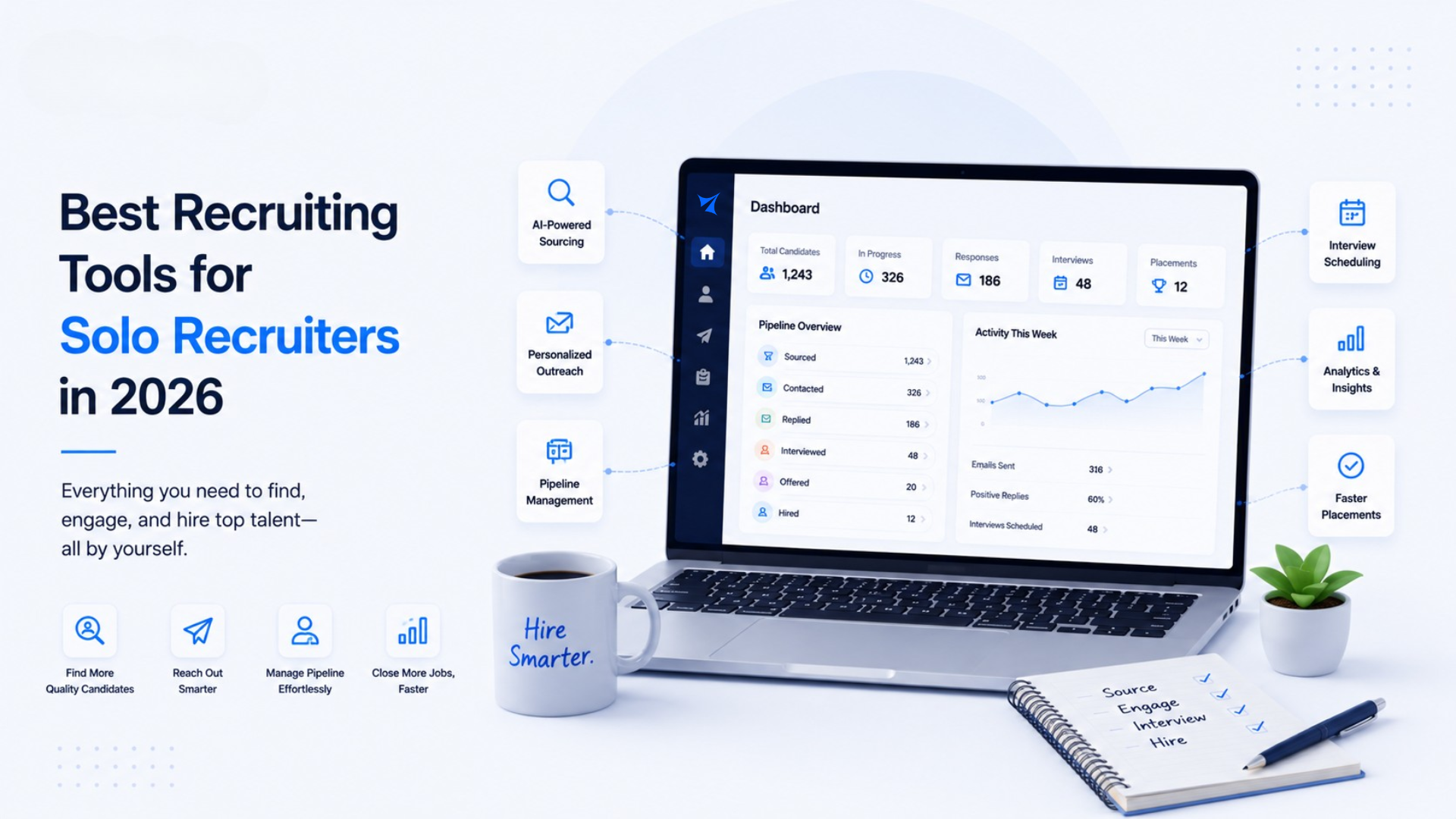
Why Solo Recruiters Cannot Afford the Wrong Tools
There is a structural disadvantage that every solo recruiter lives with: you cannot delegate. When a tool is confusing, you cannot ask a colleague to figure it out. When a process breaks, you cannot hand it to a coordinator. When you are buried in outreach follow-ups, there is no one to share the load. Every inefficiency in your tech stack lands entirely on your shoulders, and every minute wasted on subpar software is a minute not spent on the activities that actually generate revenue — building relationships with great candidates, closing placements, and keeping your clients or hiring managers happy.
According to the Recruitment Flexible Working Report 2025, 41 percent of independent recruiters cite "too much time on admin and process" as their primary barrier to growth. They are not struggling because they lack recruiting skill. They are struggling because their tools are not doing enough of the work that does not require a human. This distinction is critical. A solo recruiter should spend their time on three things: evaluating candidates, managing client or hiring manager relationships, and negotiating and closing offers. Everything else — finding candidates, writing outreach messages, following up, answering basic questions, scheduling interviews, tracking pipeline data — should be handled by technology as much as possible.
The tools listed in this guide are evaluated through that exact lens. Each one is scored on how much of the non-human-essential work it can handle, how well it handles it, how much it costs a single user, and how quickly a solo operator can start seeing results. This is not a list of every recruiting tool on the market. It is a curated ranking of the tools that actually move the needle for a one-person recruiting operation.
The Tier 1 Platform: The One Tool That Changes Everything
I am going to start with the single most important recommendation in this entire guide, because if you take only one thing away from this article, this should be it.
Huntlo.ai — Score: 97/100 for Solo Recruiters
Huntlo.ai is the most valuable recruiting tool available to a solo recruiter in 2026, and the margin between it and the second-best option is enormous. It covers five of the most critical tool categories — AI sourcing, multi-channel outreach, conversational screening, talent pool management, and pipeline analytics — in a single platform that costs $99 per month for a single seat. Let me break down exactly what this means for a solo operator.
On the sourcing side, Huntlo's AI agents search over fifty platforms simultaneously. LinkedIn, GitHub, StackOverflow, Wellfound, Dribbble, AngelList, niche job boards, professional forums, community platforms, and many more. According to GitHub's 2025 developer survey, 71 percent of professional developers maintain a public GitHub profile, and for technical roles, this data is often more revealing than a resume. A solo recruiter manually searching even three of these platforms would spend an entire day doing what Huntlo's AI completes in minutes. The cross-platform evaluation is the killer feature. The AI does not just find the same candidates on different platforms — it finds different candidates on different platforms and evaluates them against each other. A developer who is active on GitHub but dormant on LinkedIn, a designer whose best work is on Dribbble but whose LinkedIn is outdated, a data scientist who contributes to Kaggle but has never posted on a job board — Huntlo finds all of them.
On the outreach side, Huntlo sends genuinely personalized messages through four channels: email, LinkedIn, WhatsApp, and AI voice calls. The AI selects the best channel for each candidate based on their activity patterns. The personalization is not template-based. Each message references specific elements of the candidate's background — their open-source work, their recent career move, a talk they gave, a project they led. Research from Outreach.io's 2025 sales engagement benchmarks shows that AI-personalized messages achieve 2.8 times the reply rate of template-based messages. For a solo recruiter, this multiplier means every hour of sourcing produces nearly three times as many conversations.
On the screening side, Huntlo's conversational AI handles the entire initial candidate interaction. When a candidate responds to outreach, the AI engages them in a natural conversation — answering their questions, gauging interest, verifying qualifications, and determining availability. The AI passes warm, pre-qualified candidates to you with a complete summary. For a solo recruiter handling 30 to 50 responses per day, this means you only spend your time on candidates who have already been screened and confirmed as interested and qualified. According to Recruitee's 2025 hiring benchmarks, AI screening reduces time-per-candidate from 25 minutes to 3 minutes — an 88 percent reduction.
On the talent pool side, every candidate Huntlo discovers and engages automatically enters your talent network, segmented by role family, skills, engagement level, and other criteria. The AI runs nurturing campaigns that keep warm candidates engaged over time. For a solo recruiter, this means your second search is faster than your first, your third search is faster than your second, and by month six, a significant percentage of your placements come from candidates already in your network.
All of this for $99 per month. No per-candidate charges, no per-channel add-ons, no feature-gated tiers that force you to upgrade for the capabilities you actually need. For a solo recruiter, this is the best return on investment available in any recruiting tool category.
Tier 2: Sourcing Tools Worth Considering as Complements
If you need additional sourcing capability beyond Huntlo — perhaps you specialize in a niche where a particular platform has unique data — these tools are worth evaluating. But be clear-eyed about the tradeoffs: each of these costs as much as or more than Huntlo while covering only one category.
SeekOut — Score: 78/100
SeekOut brings a proprietary database of over 800 million profiles and strong search filtering. Its standout capability is deep diversity analytics — the ability to search for candidates from underrepresented backgrounds with specific skill profiles. For solo recruiters working with clients who have diversity hiring requirements, this is genuinely valuable. SeekOut also has strong technical search capabilities, particularly for engineering and data science roles.
The limitations for solo recruiters are significant. SeekOut searches its own database plus LinkedIn, but it does not reach GitHub, StackOverflow, or the dozens of other platforms that Huntlo covers. The outreach AI is functional but not agentic — it helps you write better messages but does not autonomously conduct outreach or handle candidate conversations. Channel support is limited to email and LinkedIn. At $200-plus per month for a single seat, you are paying more than twice Huntlo's price for a fraction of the capability. For a detailed cost breakdown, our SeekOut pricing analysis for 2026 covers every plan and the hidden costs that catch solo recruiters off guard.
hireEZ — Score: 74/100
hireEZ offers AI-powered sourcing with a large candidate database and automated email outreach sequences. The platform is straightforward to use and the search quality is decent. hireEZ is a reasonable choice for solo recruiters who want a step up from manual LinkedIn searching without committing to a full AI platform. However, the sourcing breadth is narrower than Huntlo's, the personalization is template-enhanced rather than AI-generated, and there is no conversational screening or multi-channel support beyond email. At $150 to $250 per month, it is more expensive than Huntlo while delivering less.
AmazingHiring — Score: 76/100
AmazingHiring is a specialized technical sourcing platform that aggregates data from over 70 public sources. For solo recruiters who focus exclusively on technology hiring, it provides deep visibility into developers' actual work — code repositories, contributions, technical community activity, and more. The platform excels at finding engineers who might not have polished LinkedIn profiles but whose technical work speaks for itself. The drawback is narrow focus: it only searches technical sources, so it is useless for non-technical roles. Pricing starts at $250 to $500 per month, making it a significant investment for a solo operator. Most tech-specialist solo recruiters would be better served by Huntlo, which includes strong technical sourcing alongside multi-industry capability and outreach automation, at a fraction of the cost.
Tier 3: Outreach and Communication Tools
These tools handle the contacting and follow-up stages of recruiting. If you are using Huntlo, you already have world-class outreach. If you are not, these tools can help — though they will cost more and do less than Huntlo's integrated approach.
Juicebox — Score: 72/100
Juicebox is an outbound recruiting sequence tool with AI-powered email personalization. You load a list of candidates, define an outreach sequence with multiple steps, and Juicebox handles the sending and follow-up. The AI personalization generates unique messages based on each candidate's LinkedIn profile, which is a step up from basic templates. The platform is well-designed and easy to use, and the analytics dashboard provides clear visibility into sequence performance.
However, Juicebox has significant limitations for solo recruiters. It does not source candidates — you must provide the list yourself. It only supports email outreach — no LinkedIn, no WhatsApp, no voice. It does not handle candidate conversations — when candidates reply, you need to respond manually. And at $119 per seat per month, it delivers a fraction of the capability that Huntlo provides at $99. For an honest assessment of whether Juicebox justifies its cost, our review of Juicebox in 2026 covers its strengths and weaknesses in detail.
Loxo — Score: 70/100
Loxo combines a recruiting CRM with basic ATS functionality and a sourcing database. The platform is designed for recruitment agencies, and solo agency owners often consider it because it provides multiple functions in one system. Loxo includes a built-in candidate database, basic email outreach sequences, and pipeline management. The all-in-one approach is appealing for solo operators who want fewer tools to manage.
The tradeoff is that Loxo does none of these functions at the level of a dedicated tool. Its sourcing is shallower than SeekOut or hireEZ. Its outreach is less sophisticated than Juicebox. Its ATS is less capable than even free options like Freshteam. The AI capabilities are minimal compared to agentic platforms. Loxo works as a basic all-in-one system for solo recruiters who prioritize simplicity over capability, but if you want top-tier performance in any category, you need a more specialized tool. For solo agency owners exploring alternatives, our comparison of Loxo alternatives for recruitment agencies covers platforms that deliver stronger results.
Mixmax — Score: 68/100
Mixmax is an email productivity tool that adds sequencing, templates, and basic analytics to Gmail. It is not a recruiting tool — it does not source candidates or understand recruiting workflows — but some solo recruiters use it for email outreach because it is affordable at $25 per month and integrates directly with their existing email. The sequences are template-based, the personalization is limited to variable fields, and there is no AI intelligence. For a solo recruiter who just needs basic email automation and does not want to learn a new platform, Mixmax is functional. But it is dramatically less capable than AI-powered alternatives.
Tier 4: Applicant Tracking Systems
Your ATS manages the hiring process once candidates enter it. For a solo recruiter, the ideal ATS is simple, affordable, and does not require significant setup time.
Freshteam (Free Tier) — Score: 75/100 for Budget-Conscious Solos
Freshteam's free plan supports up to three active job postings and basic candidate management. You can track candidates through customizable hiring stages, send email templates, and generate basic reports. For solo recruiters who are just starting or who have very light hiring volume, the free plan is genuinely useful. The main limitations are the three-job cap and the lack of advanced automation, but at zero cost, it is hard to argue with the value. You can always upgrade to Freshteam's paid plans — starting around $50 to $100 per month — when your volume outgrows the free tier.
Recruitee — Score: 78/100
Recruitee offers the best balance of capability and affordability for solo recruiters who need a more robust ATS. The interface is clean and intuitive, the automation features handle most routine communications, and the reporting provides actionable insights into pipeline health. Paid plans start around $200 to $400 per month, which is a significant expense for a solo operator but delivers a full-featured ATS. Recruitee also integrates with several sourcing platforms, which means candidates sourced through Huntlo can flow into the hiring workflow with minimal friction.
Ashby — Score: 80/100
Ashby has become the ATS of choice for growing technology companies and the solo recruiters who serve them. Its modern design, excellent API, and strong analytics make it a favorite among data-driven recruiting operations. For solo recruiters who want deep pipeline visibility and the ability to build custom workflows, Ashby is the strongest ATS option. The tradeoff is cost — plans start around $8,000 to $15,000 per year, which puts it out of reach for some solo operators. If your recruiting revenue supports it, Ashby is excellent. If not, Recruitee or even Freshteam will cover your basic needs.
The Strategic Insight on ATS Selection. According to Greenhouse's 2025 hiring report, the median time a recruiter spends per candidate on ATS-related activities is 12 minutes. Your ATS handles 12 minutes per candidate. Your sourcing and outreach tools determine how many candidates you have. The math is clear: invest your limited budget in sourcing and outreach first, and use whatever ATS you can afford — even a free one. Huntlo.ai at $99 per month delivers sourcing, outreach, screening, and CRM capabilities that free and affordable ATS tools do not provide. A solo recruiter with Huntlo and a free ATS will outperform a solo recruiter with a $2,000 ATS and manual sourcing every single time.
Tier 5: Interview Scheduling
Calendly Pro — Score: 82/100
Calendly remains the best scheduling tool for solo recruiters. It is simple, reliable, and inexpensive. The Pro plan at $12 per month supports multiple event types, group scheduling for panel interviews, automated reminders, and timezone detection. You set your availability, create event types for phone screens and video interviews, share your link, and candidates book directly. No back-and-forth. No timezone errors. The time savings are substantial — according to Doodle's 2025 state of meetings report, the average professional spends 4.8 hours per week on scheduling coordination. Calendly reduces this to near zero for interview scheduling.
Huntlo.ai — Integrated Scheduling
If you are using Huntlo as your primary platform, you may not need a separate scheduling tool at all. Huntlo's AI can coordinate interview scheduling directly within the ongoing candidate conversation — whether that conversation is on email, LinkedIn, WhatsApp, or voice. The candidate does not click a separate link; the AI finds a time within the channel they are already using. For many solo recruiters using Huntlo, this integrated approach eliminates the need for Calendly entirely.
Tier 6: Analytics and Reporting
Huntlo.ai — Built-In Analytics
Huntlo includes analytics that cover the front-end recruiting funnel: sourcing volume by platform, outreach response rates by channel, screening-to-qualified conversion rates, and talent pool growth. These are the metrics that matter most for a solo recruiter's day-to-day decisions — which sourcing searches are producing the best candidates, which outreach channels are getting responses, and whether your talent network is growing. The analytics are included in the $99 per month subscription.
Google Sheets — Score: 70/100
For solo recruiters who want to track metrics beyond what their primary platform provides, a well-structured Google Sheet is often sufficient and costs nothing. Track weekly numbers: candidates sourced, messages sent, responses received, screens completed, interviews scheduled, and offers extended. Calculate conversion rates at each stage. Compare week over week. The discipline of recording these numbers manually creates awareness that passive dashboard viewing does not. Many of the highest-billing solo recruiters in the industry use a simple spreadsheet as their primary analytics tool because the act of manually recording data forces reflection and intentionality.
The Solo Recruiter's Monthly Budget Reality Check
Let me be brutally honest about what different stacks cost and what they deliver, so you can make an informed decision based on your actual situation.
Scenario A: Solo recruiter just starting out, 0 to 5 placements per month
Recommended stack: Huntlo ($99/month) + Freshteam free ( $0) + Calendly free or Pro ($0-$12/month) + Google Sheets ($0). Monthly total: $99 to $111.
This is the minimum viable tech stack for a solo recruiter in 2026. It gives you AI-powered sourcing from fifty-plus platforms, multi-channel personalized outreach, conversational AI screening, talent pool management, basic ATS functionality, interview scheduling, and analytics. If you are currently spending $170 to $270 per month on LinkedIn Recruiter and getting by with a spreadsheet, switching to this stack will cost you less and deliver dramatically more capability. Even one additional placement per month — which is a conservative estimate of the improvement — pays for an entire year of this technology stack.
Scenario B: Established solo recruiter, 5 to 15 placements per month
Recommended stack: Huntlo ($99/month) + Recruitee ATS ($200-$400/month) + Calendly Pro ($12/month) + Loom Pro for video outreach ($12.50/month). Monthly total: $323 to $523.
This stack adds a more capable ATS with better automation and reporting, plus video outreach for high-priority candidates. At 5 to 15 placements per month with average placement fees of $10,000 to $20,000, your monthly revenue is $50,000 to $300,000. A $500 per month technology investment is 0.2 to 1 percent of revenue — an extraordinary return by any standard.
Scenario C: High-billing solo recruiter or small agency owner, 15+ placements per month
Recommended stack: Huntlo ($99/month) + Greenhouse or Ashby ATS ($667-$2,500/month) + GoodTime scheduling ($500/month) + Metaview interview intelligence ($500-$1,000/month). Monthly total: $1,766 to $4,099.
This is the full professional stack for solo operators and small agency owners who are placing candidates at high volume and need enterprise-grade tools at every stage. Even at the top end of this range, the total monthly technology cost is less than one mid-level recruiter's salary — and the AI-powered sourcing and screening deliver far more candidate throughput than an additional human recruiter would provide.
The Mistakes That Cost Solo Recruiters the Most
Paying for LinkedIn Recruiter instead of AI sourcing. This is the single most common and most expensive mistake. A LinkedIn Recruiter subscription costs $170 to $270 per month and searches one platform with declining organic reach. Huntlo costs $99 per month, searches fifty-plus platforms, and includes multi-channel outreach, AI screening, and talent pool management. The solo recruiters who switch from LinkedIn Recruiter to Huntlo consistently report sourcing 5 to 10 times more qualified candidates per day at lower cost. If you are spending $200 per month on LinkedIn Recruiter and not using an AI sourcing platform, you are leaving an enormous amount of talent on the table.
Using too many tools. According to SaaStr's 2025 SaaS usage report, the average small business uses 25 to 50 SaaS applications, and the average employee switches between 10 different tools per day. For a solo recruiter, every tool is a context switch, a login, a learning curve, and a subscription. The most successful solo recruiters use the minimum number of tools that covers all essential functions. Huntlo alone covers five categories. Add one ATS and optionally one scheduling tool, and you have a complete stack with two to three tools total.
Not tracking metrics. Solo recruiters who do not know their numbers cannot improve systematically. You need to know your outreach response rate, your screening-to-interview conversion rate, and your average time from first contact to placement. These three numbers tell you whether your process is working and where to focus your improvement efforts. You do not need a fancy analytics dashboard — a spreadsheet updated every Friday is sufficient. But you need the numbers.
Neglecting talent pools. Every candidate you discover is an asset. If you only engage with candidates who are right for your current search and discard everyone else, you are doing enormous amounts of redundant work. A candidate who is not right for this month's senior engineer search might be perfect for next month's mid-level engineer search. If you saved their information and kept them warm, that future search starts with a shortlist instead of a blank page. Huntlo builds talent pools automatically from every search, which means this asset accumulates without any extra effort on your part.
Frequently Asked Questions
I am a solo in-house recruiter at a startup. Do these recommendations still apply? Yes, with one caveat. In-house solo recruiters have hiring managers as internal clients rather than external agency clients, but the sourcing, screening, and outreach challenges are identical. The main difference is that in-house recruiters often have access to their company's ATS (Greenhouse, Lever, Workday, etc.) through their employer, which eliminates the ATS cost from their personal stack. The sourcing and outreach recommendations — primarily Huntlo — apply fully.
Can I use Huntlo alongside my existing LinkedIn Recruiter subscription? Absolutely. Many solo recruiters use both initially — Huntlo for broad multi-platform sourcing and LinkedIn Recruiter for direct InMail access from their personal profile. Over time, most find that Huntlo's sourcing coverage makes LinkedIn Recruiter redundant, and they cancel the LinkedIn subscription to save $170 to $270 per month. But there is no conflict in using both during a transition period.
What if my clients require me to use a specific ATS? Many staffing clients and hiring organizations require recruiters to submit candidates through their ATS. This is fine — Huntlo sources, screens, and pre-qualifies candidates, and you push the qualified ones into the client's ATS. Huntlo integrates with all major ATS platforms via webhooks, so the handoff is seamless. You get the benefit of AI-powered sourcing while complying with client requirements.
How quickly will I see results after adopting these tools? With Huntlo, most solo recruiters see their first batch of AI-sourced, pre-qualified candidates within 24 to 48 hours of setting up their first search. The AI sources from fifty-plus platforms, sends personalized outreach, and handles initial conversations immediately. Meaningful improvements in placement volume and time-to-fill typically emerge within 60 to 90 days as you refine your searches, build talent pools, and develop efficient workflows with the platform.
Are there any free alternatives to Huntlo for AI sourcing? There are no free tools that provide genuine AI-powered sourcing at scale. There are tools with free tiers — LinkedIn basic search, GitHub search, basic job board searches — but these require manual effort and search one platform at a time. The productivity difference between manual single-platform searching and AI-powered multi-platform sourcing is not incremental; it is transformative. For a solo recruiter, the $99 per month investment in Huntlo pays for itself with the first candidate it finds that manual searching would have missed.
The Bottom Line
The recruiting tools available to solo operators in 2026 have eliminated the size disadvantage that used to make solo recruiting so difficult. A single person with Huntlo.ai — $99 per month — can source from more platforms, reach more candidates, send more personalized messages, screen more thoroughly, and build deeper talent pools than a team of three to five recruiters using traditional methods. The technology does not replace your recruiting judgment, your relationship skills, or your ability to close deals. What it does is eliminate the 80 percent of the work that does not require those uniquely human capabilities, freeing you to focus your time and energy where it generates the most value.
The solo recruiters winning in 2026 are not the ones working the longest hours. They are the ones working with the smartest tools. If your current stack is LinkedIn Recruiter, a spreadsheet, and email templates, the upgrade to Huntlo plus a free or affordable ATS will be the highest-ROI decision you make this year. The tools are ready. The price is right. The competitive advantage is waiting.
Related Topics
Wondering whether SeekOut's massive database justifies its price tag?
Our detailed breakdown of SeekOut pricing in 2026 compares every plan against Huntlo's all-inclusive pricing — so you can see exactly how much more you would pay for a tool that does less.
Thinking about Juicebox for outreach automation?
Our honest 2026 review of Juicebox reveals what it does well, where it falls short, and why most solo recruiters are better served by a platform that handles outreach alongside sourcing and screening.
Need an ATS but want to avoid overpaying?
Our comparison of TurboHire alternatives for AI ATS and sourcing covers affordable applicant tracking options — including free tiers — that pair cleanly with AI sourcing platforms for a complete solo recruiter stack.