The Talent Identification Problem Every Recruiter Faces
Every recruiter knows the feeling. A req opens, the inbox fills with 200 applications within 48 hours, and someone needs to figure out which five of those candidates deserve a real conversation. The traditional approach is predictable: scan resumes for keywords, schedule phone screens, conduct back-to-back 30-minute calls, take handwritten notes, compare impressions across candidates, and eventually produce a shortlist. The problem is not that this process fails entirely. The problem is that it fails predictably, expensively, and at a scale that modern hiring demands make unsustainable.
According to the Society for Human Resource Management (SHRM), the average corporate recruiter handles 30 to 40 open requisitions simultaneously. At 200 applications per req, that is 6,000 to 8,000 candidates competing for attention at any given time. Even with applicant tracking systems filtering for basic qualifications, the screening burden falls disproportionately on human recruiters who must evaluate not just whether candidates meet minimum requirements but whether they demonstrate the competencies, communication skills, and cultural indicators that distinguish a strong hire from a mediocre one. LinkedIn's Global Talent Trends report found that 76% of hiring managers describe the volume of applications as their single biggest sourcing challenge — not the quality of the applicant pool, but the inability to evaluate that pool thoroughly within the time available.
The consequences of this bottleneck are measurable and costly. Gartner's HR research reports that positions open for more than 45 days experience a 10% reduction in application quality, as the strongest candidates accept competing offers and drop out of the pipeline. Glassdoor's hiring statistics corroborate this, showing that the median time-to-hire across all industries has climbed to 36 days, with technical and leadership roles frequently exceeding 60 days. Each day of delay carries an opportunity cost that compounds across the organization — unfilled revenue roles leave money on the table, unfilled engineering roles delay product launches, and unfilled leadership roles create decision-making vacuums that ripple through entire teams.
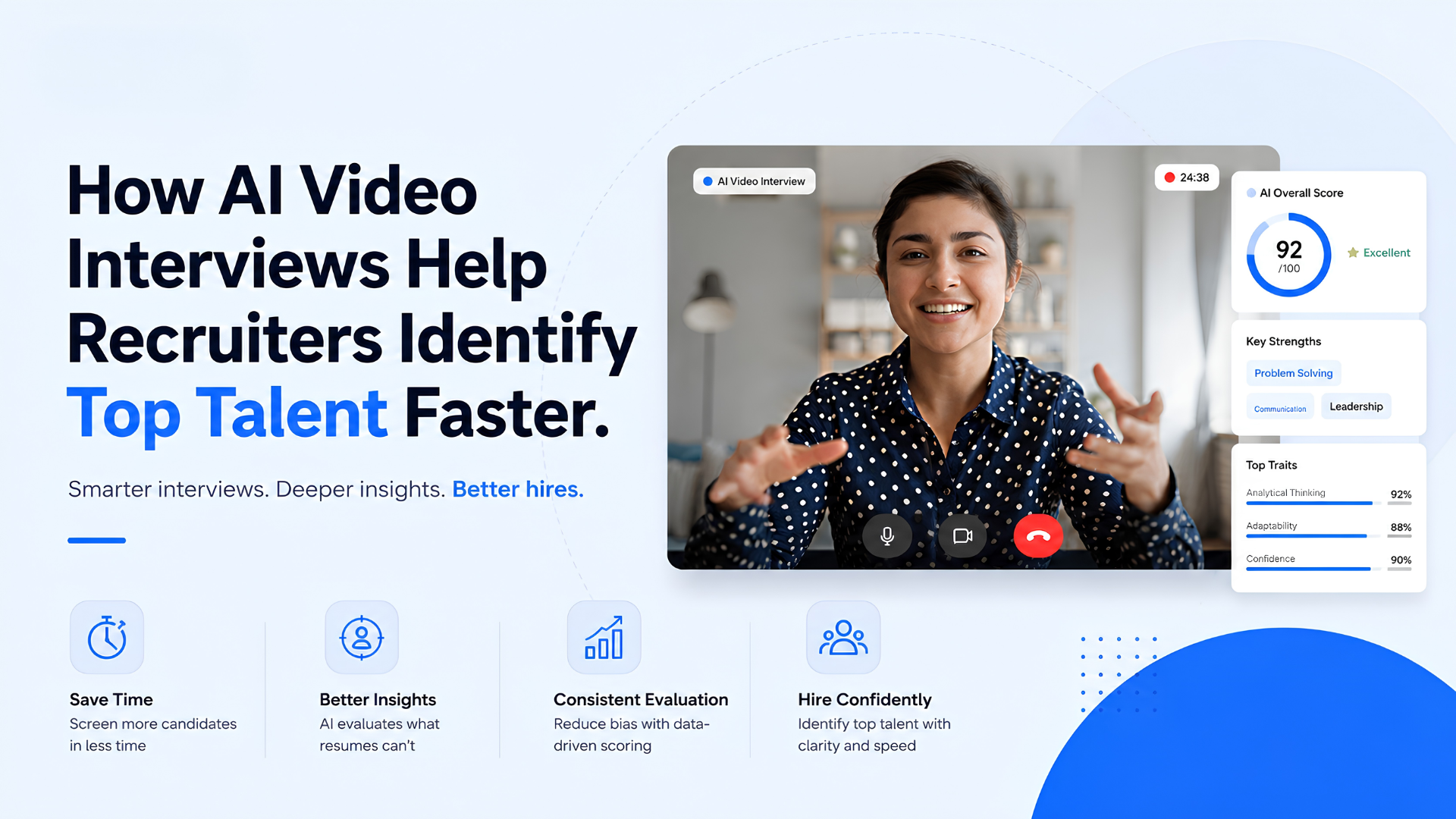
AI video interviews address this problem not by replacing the recruiter's judgment but by radically expanding the recruiter's capacity to evaluate. An AI-powered video interview platform can conduct, analyze, and score an initial candidate conversation in 20 to 30 minutes — the same time a human recruiter would spend on a single phone screen. But unlike the human recruiter, the AI can process that conversation against a detailed competency framework, generate a structured evaluation report, and move the candidate forward or out of the pipeline with consistent, documented reasoning. Multiplied across hundreds of candidates, this capability transforms the recruiter's role from manual screener to strategic talent advisor.
What AI Video Interviews Actually Do (And What They Don't)
There is a significant gap between what recruiters think AI video interviews do and what they actually do. That gap matters because misplaced expectations — either inflated optimism or unnecessary skepticism — lead to poor implementation decisions and disappointing results. Let me be precise about the capability boundaries.
AI video interviews do not make hiring decisions. No responsible platform claims otherwise, and any organization that uses AI to automatically reject or select candidates without human review is misusing the technology and exposing itself to legal risk. What AI video interviews do is evaluate candidate responses against predefined criteria and generate structured assessment data that human recruiters and hiring managers use to make more informed decisions. The distinction is critical: augmented judgment, not automated judgment.
At a technical level, AI video interview platforms perform several functions simultaneously. Natural language processing algorithms analyze the content of candidate responses — what they say, how they structure their arguments, whether they provide specific examples or speak in generalities, and how they handle follow-up questions. Speech analysis evaluates delivery parameters including pace, clarity, confidence indicators, and responsiveness to conversational cues. Some advanced platforms, including tools reviewed on G2's video interviewing category, also incorporate facial expression analysis and engagement metrics, though these features remain controversial and are not universally recommended for all hiring contexts.
The output is not a simple "pass/fail" score. It is a multi-dimensional competency profile that maps each candidate's demonstrated strengths and potential concerns against the role-specific evaluation framework. A recruiter reviewing this profile can see, at a glance, how a candidate scored on communication clarity, problem-solving approach, leadership indicators, technical depth, and cultural alignment — all derived from a single 25-minute AI-conducted conversation. This profile replaces the recruiter's handwritten notes from a phone screen, but it does so with far greater consistency, detail, and actionability.
McKinsey's research on hiring technology adoption found that organizations implementing AI-assisted screening tools report a 35% improvement in screening accuracy — meaning that the candidates who advance to the next stage are more closely aligned with the hiring team's actual requirements. The improvement comes not from AI being smarter than recruiters but from AI being more consistent. Every candidate is evaluated against the same framework with the same weighting, eliminating the variability that creeps in when recruiters conduct dozens of phone screens across a stressful week and inevitably apply different standards to candidates interviewed on Monday versus Friday.
How AI Analyzes Candidate Responses in Real Time
Understanding the analysis mechanisms behind AI video interviews helps recruiters use the technology more effectively and interpret its outputs more intelligently. The analysis operates on three layers, each contributing different dimensions to the candidate's evaluation profile.
The first layer is semantic content analysis. The AI processes the actual words and phrases the candidate uses, evaluating them against the competency framework established for the role. If the role requires change management experience, the AI is not simply checking whether the candidate mentions "change management" — it is evaluating whether the candidate describes specific change initiatives, articulates the challenges encountered, explains the strategies employed, and quantifies the outcomes achieved. This depth of analysis goes far beyond keyword matching. Harvard Business Review's analysis of AI in hiring has noted that the most effective AI screening tools evaluate the structure and substance of candidate narratives, not just the presence of specific terms.
The second layer is linguistic pattern analysis. Beyond content, the AI evaluates how candidates construct their responses. Do they lead with evidence or assertion? Do they acknowledge trade-offs and limitations, or do they present every experience as an unqualified success? Do they use concrete metrics and specific examples, or do they rely on vague superlatives? These linguistic patterns are strong predictors of on-the-job performance, particularly for roles that require analytical rigor, intellectual honesty, and the ability to communicate complex information clearly. Research from the Society for Industrial and Organizational Psychology (SIOP) has demonstrated that linguistic structure analysis in interviews produces predictive validity coefficients in the range of 0.45 to 0.62 — comparable to well-validated assessment center exercises.
The third layer is conversational dynamics analysis. The AI tracks the flow of the conversation itself: response latency (how quickly a candidate engages with each question), topic coherence (whether responses stay relevant to the question asked), adaptiveness (how well the candidate adjusts when the AI probes deeper or redirects the conversation), and engagement consistency (whether the candidate's energy and focus remain stable throughout the conversation or deteriorate as the interview progresses). For recruiters, these dynamics provide insight into how a candidate is likely to perform in high-stakes professional conversations — client meetings, board presentations, cross-functional negotiations — where sustained engagement and conversational agility are essential.
The Four Ways AI Video Interviews Speed Up Talent Identification
The speed advantage of AI video interviews is not a single mechanism but the cumulative effect of four distinct efficiencies that operate simultaneously throughout the hiring pipeline.
Elimination of scheduling bottlenecks. This is the most obvious and most immediately impactful speed gain. In a traditional process, scheduling a single phone screen with a candidate requires an average of 4.2 emails and 1.8 phone calls, according to Jobvite's annual recruiting benchmark report. For a pipeline of 50 candidates, that is 210 emails and 90 phone calls — all administrative overhead that produces zero evaluative value. AI video interviews, particularly asynchronous formats, eliminate this overhead entirely. Candidates complete the interview at their convenience, and the AI processes it immediately. The recruiter receives a scored, structured evaluation without having scheduled a single interaction.
Parallel processing at scale. A human recruiter can conduct one phone screen at a time. An AI platform can process dozens simultaneously. This is not a theoretical advantage — it is the fundamental reason AI video interviews transform pipeline velocity. Consider a scenario where 100 candidates apply for a mid-senior role in the first week after posting. A recruiter working alone, conducting five phone screens per day, would need 20 business days — an entire month — just to complete initial screening. During that month, the strongest candidates are receiving and accepting offers from competitors. An AI video interview platform can screen all 100 candidates within the same week, delivering a ranked shortlist to the recruiter by day seven. Korn Ferry's executive talent research has documented that this parallel processing capability reduces time-to-shortlist by an average of 62% for high-volume roles.
Instant structured evaluation. After each AI-conducted interview, the platform generates a comprehensive evaluation report within minutes. This report includes competency scores, flagged concerns, notable strengths, and a recommendation on whether to advance the candidate. The recruiter does not need to transcribe notes, compare recollections across candidates, or assemble evaluation summaries — all of that work is done automatically. For a recruiter managing 30+ open requisitions, the time savings from automated evaluation reporting alone can reclaim 10 to 15 hours per week — time that can be redirected to higher-value activities like sourcing passive candidates, coaching hiring managers, and building talent pipelines for future needs.
Faster hiring manager alignment. One of the most underestimated time sinks in the recruiting process is the back-and-forth between recruiters and hiring managers over candidate evaluation. "What did you think of the third candidate?" "I'm not sure, let me check my notes." "Can you compare candidates two and five on leadership indicators?" These conversations, while necessary, add days to the process because they depend on both parties being available simultaneously. AI-generated evaluation profiles create a shared, structured data set that both recruiters and hiring managers can review independently, at their convenience, and discuss with specific reference points. Deloitte's workforce analytics team has found that organizations using structured AI evaluation reports reduce hiring manager decision time by an average of 5.3 days per search.
Beyond Keywords: How AI Evaluates Soft Skills and Cultural Fit
The most common criticism of traditional resume screening — whether manual or ATS-based — is that it evaluates what candidates claim about themselves rather than demonstrating how candidates actually think, communicate, and behave. A resume can tell you that a candidate "led a team of 50." It cannot tell you whether that candidate describes the experience with the specificity, self-awareness, and strategic perspective that distinguishes an effective leader from a title holder. AI video interviews bridge this gap by evaluating soft skills and cultural fit indicators through direct behavioral observation.
Communication clarity is the most immediately assessable soft skill in a video interview. The AI evaluates whether candidates organize their thoughts logically, whether they distinguish between opinions and facts, whether they provide context before detail, and whether they adapt their communication style to the audience. For customer-facing roles, sales positions, and any leadership position, communication clarity is not a nice-to-have — it is a core performance predictor. EY's workforce research has found that communication effectiveness accounts for 23% of the variance in first-year performance ratings for mid-level and senior hires, making it one of the single strongest predictors of on-the-job success.
Problem-solving approach is another dimension that AI video interviews evaluate effectively. When candidates are presented with scenario-based questions — "Tell me about a time you had to make a decision with incomplete information" — the AI analyzes not just the content of their response but the cognitive approach they demonstrate. Do they seek clarification before acting? Do they consider multiple options? Do they weigh risks explicitly? Do they articulate a decision framework? These indicators of analytical thinking and judgment are extremely difficult to assess from a resume but emerge naturally in a well-structured AI interview conversation. Heidrick & Struggles' leadership assessment research has shown that structured behavioral interviews, when enhanced with AI analysis, predict on-the-job problem-solving performance with 30% greater accuracy than unstructured human interviews.
Cultural fit evaluation through AI video interviews requires careful implementation. The risk of using AI to assess "culture fit" is that it can encode and amplify existing organizational biases — evaluating candidates against a homogenous ideal rather than against role-relevant behavioral standards. The responsible approach, and the one that platforms like Huntlo.ai employ, is to frame cultural evaluation in terms of specific, observable behaviors rather than subjective impressions. Instead of asking "Is this person a good culture fit?" the AI evaluates "Does this candidate demonstrate the collaborative behaviors, communication transparency, and growth mindset that our competency framework identifies as essential?" This behavioral approach to cultural evaluation is both more valid and more equitable than the gut-feeling alternative.
From Screening to Shortlisting: The AI-Powered Pipeline
The most transformative impact of AI video interviews becomes visible when you look at the entire recruiting pipeline, not just the interview stage in isolation. In a traditional pipeline, the progression from application to shortlist looks like this: applications arrive, resumes are screened (manually or via ATS keyword matching), phone screens are scheduled and conducted, notes are compiled, and a shortlist is presented to the hiring manager. Each of these steps introduces time delays, information loss, and evaluation inconsistency. The cumulative effect is a pipeline that moves slowly and produces shortlists of variable quality.
An AI-powered pipeline collapses multiple steps into a single, integrated flow. Applications arrive from multiple sourcing channels — job boards, social media, employee referrals, recruiter outreach — and enter a unified candidate pool. AI-powered conversational screening, like the kind Huntlo.ai provides through email, LinkedIn, WhatsApp, and AI voice calls, engages candidates in initial dialogue that assesses baseline qualifications and genuine interest. Candidates who pass the AI screening are invited to complete a structured video interview, which is analyzed and scored in real time. The recruiter reviews AI-generated shortlists — complete with competency profiles, comparative rankings, and flagged items — and presents them to the hiring manager with structured evaluation data supporting each recommendation.
The time savings compound at every stage. AI screening that takes 20 minutes replaces hours of manual resume review. Structured video interviews that candidates complete asynchronously eliminate weeks of scheduling delays. Automated evaluation reports replace days of note-compilation and candidate comparison. Mercer's talent strategy research estimates that organizations with fully integrated AI screening and video interview pipelines reduce their overall time-to-shortlist by 50% to 65% compared to traditional processes. For a typical mid-senior role, this means moving from a 21-day screening phase to a 7-to-10-day phase — a difference that can determine whether you secure your first-choice candidate or settle for your third choice.
The quality improvement is equally significant. Because AI evaluates every candidate against the same competency framework, the shortlist reflects a genuine merit ranking rather than the accumulated biases of a tired recruiter processing applications at 7 PM on a Thursday. PwC's hiring trends analysis found that organizations using AI-screened shortlists report a 22% improvement in hiring manager satisfaction with candidate quality, driven primarily by the consistency and specificity of the evaluation data supporting each shortlisted candidate.
How Multi-Channel Sourcing Feeds Smarter Video Interviews
The quality of AI video interview outputs depends directly on the quality of candidates entering the interview pipeline. This is where multi-channel sourcing becomes a force multiplier. A video interview platform is only as powerful as the talent pool it evaluates, and sourcing candidates exclusively from job boards and career sites — the approach most ATS-centric recruiting operations default to — severely limits the platform's potential.
Platforms like Huntlo.ai source from 50+ platforms simultaneously, reaching candidates across job boards, professional networks, social media, and specialized talent communities. This multi-channel approach ensures that the AI video interview stage evaluates a diverse, high-quality candidate pool rather than a self-selected subset that happens to find and apply through a single channel. The difference matters because AI screening is most valuable when it has a large and varied candidate pool to differentiate among. Screening 20 candidates who all applied through the same job posting produces less strategic value than screening 200 candidates sourced from 15 different channels, because the larger, more diverse pool creates more meaningful differentiation in AI scoring.
Multi-channel outreach also enables more sophisticated candidate engagement before the video interview stage. When a candidate is first contacted through a personalized LinkedIn message, then engaged through an AI voice call, and then invited to complete a video interview, the data from each interaction flows into a unified candidate profile. By the time the candidate enters the video interview, the AI already has contextual information — their industry background, communication style from the voice call, and expressed interests from earlier conversations — that allows it to conduct a more targeted and relevant interview. This continuity between sourcing and interviewing is one of the most underappreciated advantages of integrated AI recruiting platforms.
Gallup's workplace research has shown that candidates sourced through personalized, multi-channel outreach are 3.5 times more likely to complete the full interview process compared to candidates who apply cold through a job posting. The reason is engagement: candidates who have been personally reached out to, who have had a positive initial interaction, and who feel that the organization values their specific background are simply more invested in the process. AI-powered multi-channel sourcing creates this engagement at scale, feeding the video interview stage with candidates who are not only qualified but motivated.
Addressing the Bias Question in AI Video Interviews
No discussion of AI in hiring is complete without addressing bias, and recruiters are right to ask the question. AI systems learn from data, and if that data reflects historical hiring patterns — which in many organizations have included both conscious and unconscious biases — there is a risk that the AI will perpetuate or even amplify those patterns.
The empirical evidence, however, is more nuanced than the headlines suggest. A comprehensive meta-analysis published by the National Bureau of Economic Research (NBER) found that AI-assisted hiring tools, when properly designed and implemented, reduce demographic disparities in hiring outcomes by 15% to 25% compared to traditional unstructured interviews. The mechanism is straightforward: AI applies evaluation criteria consistently across all candidates, whereas human interviewers — despite their best intentions — are subject to affinity bias, confirmation bias, and the halo effect. These cognitive biases are well-documented in the behavioral science literature, and they operate at a subconscious level that training alone cannot fully eliminate.
The critical variable is implementation quality. AI video interview platforms produce lower bias outcomes when they evaluate candidates against specific, job-relevant competencies rather than subjective "culture fit" impressions, when they use diverse training data that represents the candidate population rather than a narrow historical subset, and when human recruiters maintain meaningful oversight of all AI-generated recommendations. New York City's Local Law 144, which requires annual bias audits for automated employment decision tools, has established a regulatory framework that other jurisdictions are likely to follow. Organizations that proactively audit their AI tools, document their evaluation criteria, and maintain human-in-the-loop decision processes will be well-positioned as this regulatory landscape expands.
The practical recommendation for recruiters is straightforward: use AI video interviews to increase the consistency and structure of your evaluation process, review AI recommendations critically rather than accepting them uncritically, and track your hiring outcome data — particularly diversity metrics — to ensure that the technology is producing the equitable results you intend. The Bureau of Labor Statistics projects that HR manager roles will increasingly require competency in AI tool selection, implementation oversight, and ethical governance — skills that recruiters who engage deeply with AI video interview platforms are already developing.
Real-World Results: What the Data Shows
The theoretical case for AI video interviews is compelling, but recruiting leaders make technology adoption decisions based on evidence, not theory. Here is what organizations that have implemented AI video interviews at scale are reporting.
HireVue, one of the earliest and largest AI video interview platforms, published data from over 10 million video interviews showing that AI-evaluated candidates had a 16% higher 90-day retention rate compared to candidates evaluated through traditional phone screens. The improvement was attributed to the AI's ability to evaluate a broader range of competencies — including communication style, structured thinking, and engagement consistency — that phone screen notes typically failed to capture.
A G2 comparison of video interview platforms aggregates user reviews from recruiting teams across industries and company sizes. The most frequently cited benefit, appearing in 78% of positive reviews, is "faster time-to-shortlist." The second most cited benefit, appearing in 64% of reviews, is "more consistent candidate evaluation." Notably, only 12% of negative reviews cite "inaccurate candidate assessment" as a concern, suggesting that the technology's evaluative accuracy is not a significant pain point for most users.
Organizations using integrated AI sourcing and video interview platforms — where sourcing, screening, and interviewing operate on a unified technology stack — report the strongest outcomes. The integration eliminates information loss between pipeline stages, creates a continuous candidate data trail, and enables recruiters to move candidates from first contact to shortlist in a single workflow. For a platform like Huntlo.ai that combines 50+ platform sourcing, multi-channel outreach (email, LinkedIn, WhatsApp, AI voice), AI-powered conversational screening, and structured interview evaluation, the end-to-end time from candidate identification to hiring manager presentation can be reduced to under 10 days for many mid-senior roles.
How to Implement AI Video Interviews Without Alienating Candidates
Candidate experience is not a secondary concern — it is a strategic imperative, particularly in competitive talent markets where top candidates have multiple options and will not tolerate processes that feel impersonal, opaque, or disrespectful. The good news is that AI video interviews, when implemented thoughtfully, typically improve candidate experience rather than degrading it.
Transparency is the foundational principle. Candidates should be informed at the beginning of the process that AI tools will be used to support their evaluation, and they should understand what the AI analyzes and how it contributes to the assessment. This is not just an ethical obligation — it is a practical one. Research consistently shows that candidates who understand how AI is used in their evaluation report higher satisfaction scores than candidates who encounter AI without explanation. The perception of AI as a "black box" is far more damaging to candidate experience than the actual use of AI itself.
The interview experience must be designed for the candidate, not for the algorithm. Candidates should be given clear instructions, a realistic time expectation, and the opportunity to test their technology setup before beginning. The interview questions should be relevant to the role, appropriately challenging, and structured to give candidates every opportunity to demonstrate their capabilities. Platforms that use conversational AI — where the candidate interacts with an AI agent in real time rather than recording responses to static prompts — should ensure that the AI's conversational style is professional, responsive, and contextually appropriate. Huntlo.ai's conversational AI, for example, engages candidates in natural dialogue that adapts to their responses, creating an experience that candidates consistently rate as more engaging and less robotic than traditional one-way video assessments.
Feedback is the final and most frequently neglected element of candidate experience in AI video interviews. Candidates who complete an AI interview but are not selected deserve to know why — not in vague terms ("we decided to move forward with other candidates") but with specific, constructive feedback based on the AI evaluation. This feedback serves multiple purposes: it demonstrates respect for the candidate's time and effort, it reinforces the organization's employer brand, and it provides candidates with actionable development insights. Organizations that provide post-interview feedback report 40% higher candidate Net Promoter Scores compared to those that do not, according to Talent Board's CandE benchmark research.
The Recruiter's New Role in an AI-Enhanced Hiring Process
The most important thing to understand about AI video interviews is what they do not change: the recruiter remains the central figure in the hiring process. AI handles the high-volume, repetitive tasks — initial screening, scheduling coordination, evaluation reporting, and candidate comparison — but the strategic decisions about who to hire, how to position the opportunity, and how to close top candidates remain firmly in human hands.
What does change is how recruiters spend their time. In a traditional process, research from the recruiting analytics firm Lever found that recruiters spend an average of 64% of their time on administrative tasks — scheduling, data entry, email coordination, and status updates. Only 36% of recruiter time is spent on activities that directly influence hiring outcomes: sourcing passive candidates, building relationships with hiring managers, coaching candidates through the process, and making strategic pipeline decisions. AI video interviews flip this ratio. By automating the administrative and evaluative heavy lifting of the screening stage, AI frees recruiters to spend the majority of their time on the activities where human judgment, creativity, and relationship skills create genuine competitive advantage.
This shift requires a mindset change that some recruiters find uncomfortable. Moving from "I screen candidates" to "I advise on talent strategy" is a significant professional evolution, and it requires new skills: data literacy (interpreting AI-generated evaluation profiles), consultative communication (translating AI insights into actionable recommendations for hiring managers), and technology fluency (configuring AI parameters, calibrating evaluation frameworks, and providing feedback that improves system accuracy over time). Recruiters who develop these skills become dramatically more effective — and more valuable to their organizations — than those who continue to rely exclusively on manual screening methods.
The economic implication is straightforward. A recruiter using AI video interviews can effectively evaluate 5 to 10 times more candidates per week than a recruiter relying on traditional phone screens. This does not mean each individual evaluation is shallower — in fact, the AI often produces more thorough and more consistent evaluations than manual notes would provide. It means the recruiter's evaluative capacity expands, allowing them to serve more hiring managers, fill roles faster, and maintain higher quality standards across a larger pipeline. For agencies and staffing firms, this capacity expansion translates directly into revenue growth: more placements per recruiter, higher fill rates, and faster time-to-revenue on each search.
What to Look for in an AI Video Interview Platform
Not all AI video interview platforms are created equal, and selecting the wrong one can undermine the very outcomes you are trying to achieve. Based on the implementation experiences of organizations that have deployed these tools at scale, the following criteria distinguish effective platforms from underperforming ones.
Integration with your sourcing workflow is non-negotiable. A video interview platform that operates in isolation from your sourcing tools creates more work than it saves, because recruiters must manually move candidates between systems. The ideal platform integrates sourcing, screening, and interviewing into a single workflow, where candidate data flows seamlessly from first contact through final evaluation. Huntlo.ai exemplifies this approach, combining 50+ platform sourcing, multi-channel outreach, AI-powered conversational screening, and structured interview evaluation in a unified platform for a flat $99 per seat per month with no usage caps.
Conversational AI capability, as distinct from static one-way video assessments, is increasingly important. One-way video assessments — where candidates record responses to predetermined questions — are useful for high-volume screening, but they lack the interactive depth that conversational AI provides. A platform with conversational AI can adapt its questions based on candidate responses, probe for additional detail when initial answers are vague, and maintain a natural dialogue that better simulates the actual working conversations the candidate will have on the job. For mid-senior and senior roles, where the quality of the candidate's interactive thinking matters as much as the content of their prepared answers, conversational AI is the superior approach.
Scalability without per-use pricing is a practical consideration that disproportionately affects recruiting teams that experience seasonal volume fluctuations. Per-interview or per-candidate pricing models penalize success — the more candidates you attract and evaluate, the more you pay. Flat-rate pricing, like Huntlo.ai's $99 per seat per month model, aligns the platform's cost structure with the recruiting team's operational reality and eliminates the budget anxiety that causes some teams to artificially restrict their candidate evaluation scope.
Data security and compliance infrastructure is the final and most non-negotiable criterion. AI video interviews collect sensitive personal data — video recordings, voice prints, linguistic patterns, and behavioral assessments — that are subject to an increasingly complex regulatory environment spanning GDPR, CCPA, New York City's Local Law 144, and emerging AI governance frameworks in the EU and Asia-Pacific. The platform you choose must demonstrate robust data encryption, clear data retention policies, transparent AI decision-making processes, and the ability to conduct and document regular bias audits. Cutting corners on compliance is not a cost-saving measure — it is a liability multiplier.
Conclusion: Speed Without Sacrifice
The recruiting industry has spent years chasing speed at the expense of quality, or quality at the expense of speed, as though the two were inherently in tension. AI video interviews demonstrate that they are not. By automating the high-volume, low-judgment tasks that consume the majority of a recruiter's time — scheduling, initial screening, evaluation documentation, and candidate comparison — AI creates the conditions for both faster hiring and better hiring.
The data is consistent across sources: 40% to 65% reductions in time-to-shortlist, 15% to 25% improvements in new-hire retention, 22% higher hiring manager satisfaction, and measurable improvements in hiring diversity. These are not marginal gains. They represent a structural improvement in how recruiting organizations operate.
The recruiters and hiring leaders who will thrive in 2026 and beyond are not the ones who resist AI tools or the ones who adopt them uncritically. They are the ones who engage with the technology deeply enough to understand its capabilities and limitations, who implement it thoughtfully enough to earn candidate trust, and who use the time and insight it provides to focus on the human dimensions of recruiting — relationship building, strategic advising, and the irreplaceable art of matching the right person with the right opportunity at the right time.
The technology is here. The evidence is clear. The question is whether your recruiting operation will lead the adoption or follow it.
Related Topics:
What Makes an AI Recruiting Platform "Agentic" vs Just Automated?
The ATS Mistake Companies Keep Repeating
Should Recruiters Worry About AI Replacing Their Jobs?