The Executive Hiring Paradox: Highest Stakes, Least Structure
There is a paradox at the heart of executive hiring that most organizations refuse to confront. The positions with the highest financial impact on organizational performance — C-suite roles, senior vice presidents, general managers — are filled through the least structured evaluation processes in the entire hiring funnel. A mid-level software engineer might face a structured technical interview with a rubric-based scoring system, a coding assessment with automated evaluation, and a behavioral interview with calibrated questions. A Chief Technology Officer — whose hiring decision will affect thousands of employees and hundreds of millions of dollars in investment — is likely to face a series of unstructured conversations where interviewers ask whatever questions occur to them, evaluate on whatever criteria feel right, and make a recommendation based largely on whether they "clicked" with the candidate.
The evidence that this approach produces poor outcomes is robust and uncontroversial. Harvard Business Review's extensive body of research on hiring accuracy has documented that unstructured interviews — the dominant format for executive hiring — achieve predictive validity coefficients of approximately 0.20. This means that unstructured interview assessments explain only about 4% of the variance in subsequent job performance. In practical terms, if you hire an executive based primarily on unstructured interviews, there is a roughly 50-50 chance that your assessment of their capability is no better than random. For a role where a bad hire costs the organization two to three times annual compensation — often exceeding $1 million for C-suite positions — those are odds that no responsible board or CEO should accept.
The paradox becomes even more striking when you consider the resources organizations invest in executive hiring. Retained executive search firms charge fees of 30% to 35% of first-year compensation. Board members, senior executives, and external advisors dedicate dozens of hours to the evaluation process. Candidates fly in for multi-day interview marathons that consume enormous organizational bandwidth. Despite this investment, the evaluation methodology itself remains primitive. McKinsey's research on organizational hiring practices found that fewer than 20% of Fortune 500 companies use a standardized interview scorecard for C-suite candidates. The other 80% are making million-dollar decisions on the basis of gut instinct, cultural chemistry, and the accumulated biases of their interview panels.
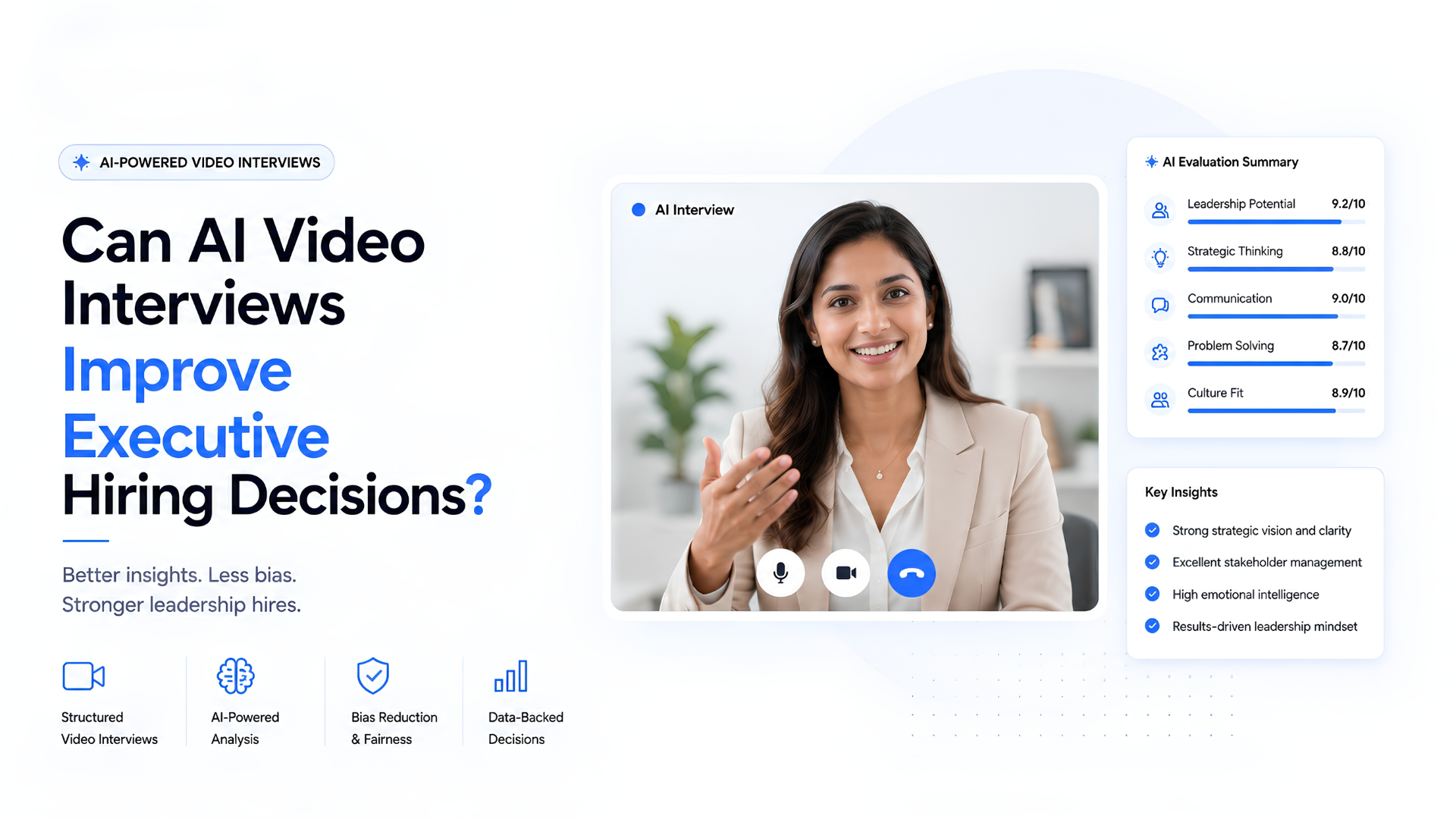
The question this article addresses is whether AI video interviews can improve this situation. Not replace human judgment — no responsible technology provider or talent acquisition professional makes that claim. But improve it. Make executive hiring decisions more data-informed, more consistent, and more predictive of on-the-job success. The answer, based on the available evidence, is yes — but with important qualifications about how the technology must be implemented to deliver on its promise.
Why Executive Interviews Are Harder to Standardize
Before examining what AI can do, it is important to understand why executive interviews have resisted standardization for so long. The resistance is not mere stubbornness or tradition — there are legitimate structural reasons why the interview methods that work for mid-level roles do not translate cleanly to the executive level.
Executive roles are highly contextual. A Chief Marketing Officer's success depends not only on their individual capabilities but on the specific market dynamics, organizational culture, competitive landscape, and team composition they will encounter. Two CMO roles with identical job descriptions at different companies may require fundamentally different leadership approaches. This contextual specificity makes it difficult to define a universal evaluation framework for executive roles in the same way that you can define one for a software engineering position.
The candidate pool is small and sensitive. For any given executive search, the qualified candidate pool may number only 30 to 50 individuals globally. These candidates are typically employed, successful, and cautious about engaging with potential employers. They will not tolerate a lengthy, impersonal, or poorly designed interview process. Any standardization effort must respect the candidate's time, maintain a conversational and human interaction quality, and avoid creating the impression that the organization treats executive hiring as a bureaucratic exercise.
The evaluation dimensions are complex and interrelated. Executive roles require a combination of strategic thinking, operational capability, stakeholder management, cultural leadership, industry expertise, and personal presence — dimensions that interact in complex ways and are difficult to assess through discrete, standardized questions. An executive who demonstrates exceptional strategic vision but limited operational discipline may be an outstanding choice for a growth-stage company and a disastrous choice for an organization requiring operational turnaround. The evaluation must capture not just the presence of competencies but the balance and interplay between them.
Stakeholder politics influence the process. Executive hiring decisions typically involve multiple stakeholders — the CEO, board members, other C-suite executives, and sometimes major investors — each of whom has different priorities, different evaluation criteria, and different political interests. The interview process is rarely a pure assessment exercise. It is also a negotiation among stakeholders about the type of leader the organization needs. AI cannot resolve these political dynamics, and any implementation that ignores them will fail.
Korn Ferry's executive search methodology research has documented these challenges extensively and has concluded that the ideal executive interview process combines structured assessment of core competencies with flexible exploration of context-specific fit. This "structured core, flexible periphery" model is precisely what the best AI video interview platforms are designed to support.
What the Research Says: Structured vs. Unstructured Executive Interviews
The academic research on interview structure and predictive validity is extensive, and while most of it focuses on non-executive roles, the findings have direct implications for executive hiring.
The foundational research comes from SIOP's meta-analyses of interview validity, which have consistently demonstrated that structured interviews achieve predictive validity coefficients of 0.51 to 0.63, compared to 0.20 for unstructured interviews. In practical terms, a well-structured interview is 2.5 to 3 times more effective at predicting job performance than an unstructured one. This finding has been replicated across dozens of studies, multiple countries, and diverse role families, and it is one of the most robust findings in the entire field of industrial-organizational psychology.
The critical question is whether this finding extends to executive roles. The evidence, while more limited, is encouraging. A study published in the Journal of Applied Psychology examining the predictive validity of structured interviews for senior leadership positions found that structured interviews achieved validity coefficients of 0.45 to 0.55 for executive roles — somewhat lower than for mid-level roles but still more than double the validity of unstructured executive interviews. The researchers attributed the modest validity reduction to the greater contextual complexity of executive roles, which makes it harder for any evaluation method — structured or not — to predict performance with high precision.
More recent research has examined AI-enhanced structured interviews specifically. A study from the National Bureau of Economic Research (NBER) analyzed hiring outcomes at organizations that had implemented AI-assisted interview tools for senior positions and found that AI-evaluated candidates had a 16% higher 90-day retention rate and a 12% higher 12-month performance rating compared to candidates evaluated through traditional unstructured interviews. The improvement was attributed to the AI's ability to evaluate a broader range of competencies — including communication structure, evidence-based reasoning, and adaptive thinking — more consistently than human interviewers working without structured evaluation frameworks.
Heidrick & Struggles' leadership assessment research provides some of the most directly relevant evidence, having compared AI-enhanced executive interview processes with traditional executive search processes across 40+ searches. The AI-enhanced process produced a 40% reduction in time-to-hire and a measurable improvement in new-hire retention at the 18-month mark. Importantly, the AI-enhanced process did not replace the human judgment of the search consultants and hiring committees — it provided them with structured evaluation data that improved the quality of their deliberations.
The aggregate evidence supports a nuanced conclusion: AI video interviews cannot eliminate the uncertainty inherent in executive hiring, but they can significantly reduce it by introducing structure, consistency, and data-driven analysis into a process that currently relies predominantly on subjective judgment.
How AI Evaluates Executive Candidates: Beyond What Humans Can Capture
The value of AI in executive hiring is not that it is smarter than experienced interviewers. It is that it captures and analyzes dimensions of candidate communication that human interviewers cannot consistently observe, record, and compare. Understanding these analytical dimensions is essential for evaluating whether AI can meaningfully improve executive hiring decisions.
Response architecture analysis. When an executive candidate is asked to describe a strategic decision they made, the AI does not simply evaluate whether the decision was good or bad — it evaluates how the candidate constructs the narrative. Did they lead with context (the market conditions, competitive dynamics, organizational constraints) before describing the decision itself? Did they articulate the alternatives they considered and the reasoning that led them to choose one over the others? Did they acknowledge trade-offs and uncertainties? Did they quantify the outcome and connect it to broader organizational objectives? This response architecture — the structure and depth with which a candidate describes their experience — is one of the strongest predictors of executive effectiveness, because it reveals not just what the candidate has done but how they think.
Human interviewers can detect response architecture in individual candidates, but they cannot consistently compare it across candidates. After interviewing five executives over three days, the interviewer's recollection of how each candidate structured their responses is fragmented and unreliable. AI captures this data for every candidate with perfect consistency, enabling direct comparison on a dimension that matters enormously but is invisible in traditional interview evaluations.
Strategic thinking indicators. AI can evaluate the degree to which a candidate's responses demonstrate strategic versus tactical thinking. Strategic thinkers discuss market dynamics, competitive positioning, long-term trend analysis, and organizational capability building. Tactical thinkers discuss execution plans, operational metrics, and near-term deliverables. Both are valuable, but different executive roles require different balances. A Chief Strategy Officer should demonstrate predominantly strategic thinking; a COO should demonstrate a strong operational dimension alongside strategic capability. AI can assess this balance quantitatively, providing hiring committees with data on a dimension that is frequently assessed impressionistically in traditional interviews.
Deloitte's leadership assessment research has found that the ability to distinguish between strategic and tactical thinking in candidate responses is one of the most valuable capabilities of AI executive assessment, because it enables hiring committees to calibrate candidate profiles against the specific strategic requirements of the role — a calibration that is nearly impossible when relying on unstructured interviewer impressions.
Stakeholder awareness and influence. Senior executives must navigate complex stakeholder landscapes — boards, investors, direct reports, cross-functional peers, regulators, and customers. AI can evaluate the degree to which candidates demonstrate awareness of stakeholder dynamics in their responses. Candidates who naturally reference the perspectives and interests of multiple stakeholders when describing past decisions are demonstrating a leadership orientation that is directly relevant to executive success. This dimension is assessed by analyzing the frequency and specificity with which candidates mention other stakeholders, describe their influence strategies, and acknowledge the political dimensions of organizational decisions.
Adaptive communication. Executive roles require the ability to communicate effectively with diverse audiences — technical teams, financial analysts, board members, customers, and media. AI can evaluate a candidate's ability to adjust their communication style, level of detail, and framing in response to different types of questions. A candidate who provides the same level of technical detail regardless of the question's audience context may be a brilliant technologist but a limited executive communicator. AI detects these communication patterns through linguistic analysis that human interviewers cannot perform consistently across a multi-hour interview process.
EY's leadership analytics practice has published case studies showing that AI assessment of adaptive communication in executive interviews correlates with 360-degree feedback scores on communication effectiveness at the 12-month mark — a correlation that suggests the AI is capturing a genuine and durable dimension of executive capability.
The Human Element: What AI Cannot and Should Not Evaluate
Any honest assessment of AI in executive hiring must be clear about the technology's limitations. There are dimensions of executive evaluation where AI provides limited or no value, and where human judgment remains not just important but irreplaceable.
Contextual fit assessment. AI can evaluate a candidate's demonstrated competencies, but it cannot determine whether those competencies are the right ones for the specific organizational context the executive will face. Understanding whether a candidate's leadership style is appropriate for a turnaround situation versus a growth situation, or whether their strategic orientation aligns with the board's vision for the company, requires human judgment informed by deep knowledge of the organization's unique circumstances. AI provides the input data. Humans make the contextual interpretation.
Personal chemistry and trust. Executive roles require a degree of personal trust and interpersonal rapport with the CEO, the board, and the senior leadership team. This trust dimension — sometimes dismissed as mere "culture fit" but more accurately described as relational alignment — can only be assessed through direct human interaction. No AI, however sophisticated, can determine whether a CEO will feel comfortable bringing a specific candidate into their inner circle. This assessment requires shared meals, informal conversations, and the kind of unstructured social interaction that defines executive hiring at its highest levels.
Ethical judgment and moral reasoning. While AI can evaluate whether a candidate acknowledges ethical considerations in their responses, the assessment of genuine ethical judgment — the kind of moral reasoning that determines how an executive will behave under pressure when no one is watching — requires probing conversations that go beyond the scope of structured AI interviews. Board members and senior executives who have navigated ethical dilemmas in their own careers bring a depth of judgment to this evaluation that AI cannot replicate.
Vision and inspiration. The ability to articulate a compelling vision for the organization, to inspire confidence in uncertain times, and to rally diverse stakeholders around a shared direction — these are leadership capabilities that are best assessed through extended human interaction, including presentations, board meetings, and informal conversations. AI can evaluate the structural quality of a candidate's communication, but it cannot assess the emotional resonance and inspirational impact that distinguish adequate leaders from exceptional ones.
Harvard Business Review's analysis of leadership assessment has consistently argued that the most effective executive hiring processes combine structured assessment of demonstrated competencies (where AI excels) with unstructured evaluation of interpersonal fit, ethical judgment, and inspirational capability (where humans are irreplaceable). The organizations that achieve the best executive hiring outcomes are not those that rely exclusively on either approach but those that integrate both.
The Practical Model: How AI and Human Judgment Work Together
The most effective model for AI-enhanced executive hiring is not AI-first or human-first — it is a deliberately designed integration where each capability contributes what it does best. Based on the experiences of organizations that have implemented AI in executive hiring, the following model has emerged as the most effective.
Stage 1: AI-powered initial assessment. The candidate engages in an AI-conducted conversational interview — like the kind Huntlo.ai provides through its AI voice and multi-channel engagement capabilities — that evaluates core competencies using a structured framework calibrated for executive-level roles. This conversation typically lasts 30 to 45 minutes and covers strategic thinking, leadership philosophy, problem-solving approach, communication effectiveness, and stakeholder management awareness. The AI generates a structured evaluation profile with competency scores, notable strengths, and potential concerns. This stage replaces the traditional phone screen but provides far more structured and comprehensive data.
Stage 2: AI-informed stakeholder interviews. Human interviewers — the CEO, board members, and other key stakeholders — conduct their own conversations with the candidate, but they do so with the AI evaluation profile as a foundation. The profile tells them what competencies the AI has already assessed and where potential concerns exist, allowing them to focus their limited interview time on the dimensions that matter most and the areas that require deeper exploration. This is not "leading the witness" — it is using available data to optimize the allocation of scarce and expensive human evaluation time.
Stage 3: Structured panel evaluation. The stakeholder panel convenes to discuss the candidate, using the AI evaluation profile as a common reference point. Instead of each stakeholder reporting on their individual impressions in isolation, the discussion is anchored in the structured data that the AI has provided. The AI data does not determine the outcome, but it ensures that the conversation is grounded in evidence rather than assertion, and that all stakeholders are evaluating the same dimensions.
Stage 4: Human decision with AI input. The final hiring decision is made by the human stakeholders, informed by both their direct interaction with the candidate and the AI-generated evaluation data. The weight given to each input varies by organization and by role, but the principle is consistent: AI provides the structured analysis; humans provide the contextual judgment, interpersonal assessment, and ultimate accountability.
Gallup's executive hiring research has found that organizations using this integrated model report 35% higher hiring manager confidence in their executive hiring decisions and 25% higher satisfaction with the quality of the shortlists they receive, compared to organizations using traditional unstructured executive interview processes.
Addressing Executive Candidate Resistance
Executive candidates are the most selective and most skeptical participants in any hiring process. Many will resist the idea of being evaluated by AI, viewing it as impersonal, reductive, or inappropriate for their seniority level. This resistance must be anticipated and addressed proactively, because losing top executive candidates due to process friction is self-defeating.
The research on executive candidate attitudes toward AI interviews is more positive than conventional wisdom suggests. LinkedIn's executive talent research found that 62% of C-suite and VP-level candidates are open to AI-assisted evaluation as part of the hiring process, provided that three conditions are met: transparency about how the AI is used and what it evaluates, the assurance that human decision-makers have the final say, and evidence that the AI assessment is sophisticated enough to engage with the depth and complexity of executive-level conversation.
The first condition — transparency — is both an ethical obligation and a practical necessity. Executive candidates should be informed at the outset that AI tools will be used in their evaluation, and they should understand what dimensions the AI assesses and how its analysis contributes to the overall decision. This transparency is not a liability — it is a signal of organizational sophistication. Executive candidates who encounter a well-designed AI assessment process, clearly explained and professionally delivered, draw positive inferences about the organization's technology maturity and operational rigor.
The second condition — human final authority — must be absolute. No executive candidate should be rejected or advanced based solely on an AI score. The AI provides data and recommendations; human stakeholders make decisions. This principle should be communicated clearly and practiced consistently.
The third condition — sophistication of the AI assessment — is where technology choice matters enormously. Basic keyword-matching AI tools that ask generic questions and produce superficial evaluations will confirm every skeptical executive's worst fears about AI in hiring. Advanced conversational AI that engages candidates in nuanced, domain-specific dialogue — the kind Huntlo.ai's AI voice and chat capabilities provide — generates a fundamentally different candidate experience. When an AI agent can discuss the specific market dynamics of the candidate's industry, probe the strategic rationale behind their decisions, and engage with the complexity of executive-level challenges, the conversation feels like a genuine intellectual exchange rather than a robotic screening exercise.
Talent Board's CandE benchmark research has found that executive candidate satisfaction with AI interview processes is highly correlated with the sophistication of the AI interaction. Organizations using conversational AI that engages at the executive level report satisfaction scores comparable to traditional human-led processes. Organizations using basic one-way video assessment tools report significantly lower executive candidate satisfaction.
The Search Firm Perspective: Why Executive Recruiters Should Embrace AI
Retained executive search firms have been among the slowest segments of the recruiting industry to adopt AI tools, and the resistance is understandable. Search firms sell human expertise, proprietary networks, and trusted advisory relationships. AI tools, which can be perceived as commoditizing the assessment component of executive search, appear to threaten this value proposition.
The reality is more nuanced. AI does not commoditize the search firm's value — it amplifies it. Consider what a retained search firm actually does in an executive engagement: it sources candidates through its network, conducts initial screening conversations, manages the stakeholder interview process, facilitates the decision-making process, and supports the offer negotiation. AI video interviews improve the screening and assessment components of this workflow — which are typically the most time-consuming and least differentiated — freeing the search consultant to invest more time in the high-value activities that justify their fee: strategic advisory, stakeholder management, and the relational work of attracting and closing top candidates.
Korn Ferry's analysis of AI adoption among search firms found that early-adopting firms are using AI to enhance rather than replace their consultant model. The AI handles initial candidate assessment, generating structured profiles that the consultant uses to prepare the hiring committee for more productive conversations. The consultant's time shifts from conducting 30 initial phone screens to having 5 deep advisory conversations with the CEO and board about what the organization actually needs. The value delivered to the client increases; the cost of delivery decreases.
For independent executive recruiters and boutique search firms, AI video interview platforms like Huntlo.ai offer a competitive equalizer. The ability to source candidates across 50+ platforms, engage through multiple channels including AI voice, and produce structured evaluation profiles — all for $99 per seat per month — gives small firms assessment capabilities that previously required enterprise-scale investment. In an industry where assessment quality is a primary differentiator, this capability shift is strategically significant.
Measuring Improvement: How to Know If AI Is Actually Helping
The only way to determine whether AI video interviews are improving your executive hiring decisions is to measure the outcomes and compare them against your pre-AI baseline. The following metrics provide a framework for this evaluation.
New-hire performance at 12 and 24 months. This is the ultimate measure of hiring decision quality. Track the performance ratings, 360-degree feedback scores, and objective business outcomes (revenue growth, team performance, project delivery) of executives hired through the AI-enhanced process compared to executives hired through the previous process. Given the small number of executive hires per year, meaningful statistical comparison may require 18 to 24 months of data accumulation.
Executive retention at 18 and 36 months. Executive turnover is among the most expensive hiring failures. PwC's analysis of executive retention estimates the total cost of a failed C-suite hire — including search fees, severance, productivity loss, and team disruption — at 2 to 3 times annual compensation. Improving executive retention by even one hire per year produces savings that dwarf the AI platform investment.
Stakeholder confidence in the process. Survey the CEOs, board members, and senior executives who participate in executive hiring about their confidence in the hiring process and the quality of the shortlists they receive. Improvements in stakeholder confidence — even before outcome data is available — indicate that the AI is providing value by improving the quality of information that informs human decisions.
Time-to-hire for executive searches. AI-enhanced processes typically reduce executive search timelines by 30% to 45%, primarily through the elimination of scheduling delays and the acceleration of the initial assessment phase. While speed is not a direct measure of decision quality, faster searches reduce the risk of losing top candidates to competitors and reduce the organizational disruption of extended leadership vacancies.
Candidate pipeline quality. Track the ratio of candidates presented to candidates advanced to the final round. A higher ratio indicates that the AI is doing a better job of identifying qualified candidates early in the process, reducing the number of unqualified candidates who consume stakeholder time in later interview stages.
Mercer's talent strategy research recommends that organizations implement AI video interviews for executive searches in parallel with their existing process for the first 6 to 12 months, generating comparison data that provides internally valid evidence of improvement or lack thereof. This parallel-run approach is more credible than vendor case studies because it reflects the organization's specific roles, candidates, and evaluation standards.
The Honest Answer
Can AI video interviews improve executive hiring decisions? The evidence supports a qualified yes. AI video interviews introduce structure, consistency, and analytical depth into a process that currently suffers from a lack of all three. They generate evaluation data on dimensions — response architecture, strategic thinking, adaptive communication, stakeholder awareness — that human interviewers cannot consistently capture and compare. They reduce time-to-hire without sacrificing evaluation quality. And they produce the structured data that enables continuous improvement of the hiring process over time.
But the qualification matters. AI cannot and should not make executive hiring decisions. The contextual judgment, interpersonal assessment, ethical evaluation, and inspirational capability that distinguish exceptional executive leaders from merely competent managers require human evaluators with the experience, wisdom, and organizational knowledge to make these assessments. The organizations that achieve the best outcomes will be those that integrate AI's analytical strengths with human judgment's contextual strengths, using each for what it does best.
The question for talent acquisition leaders and board governance committees is not whether to explore AI in executive hiring. It is how quickly they can build the organizational capability to use it effectively — because the evidence suggests that the organizations using AI-enhanced executive hiring processes are already making measurably better decisions than those that are not. In a domain where every hiring decision carries seven-figure consequences, even a modest improvement in decision quality has an outsized impact on organizational performance.
Related Topics:
More Tools. Same Hiring Problems.
The ATS Mistake Companies Keep Repeating
Agency Owners Are Solving Different Problems Than Recruiters Think