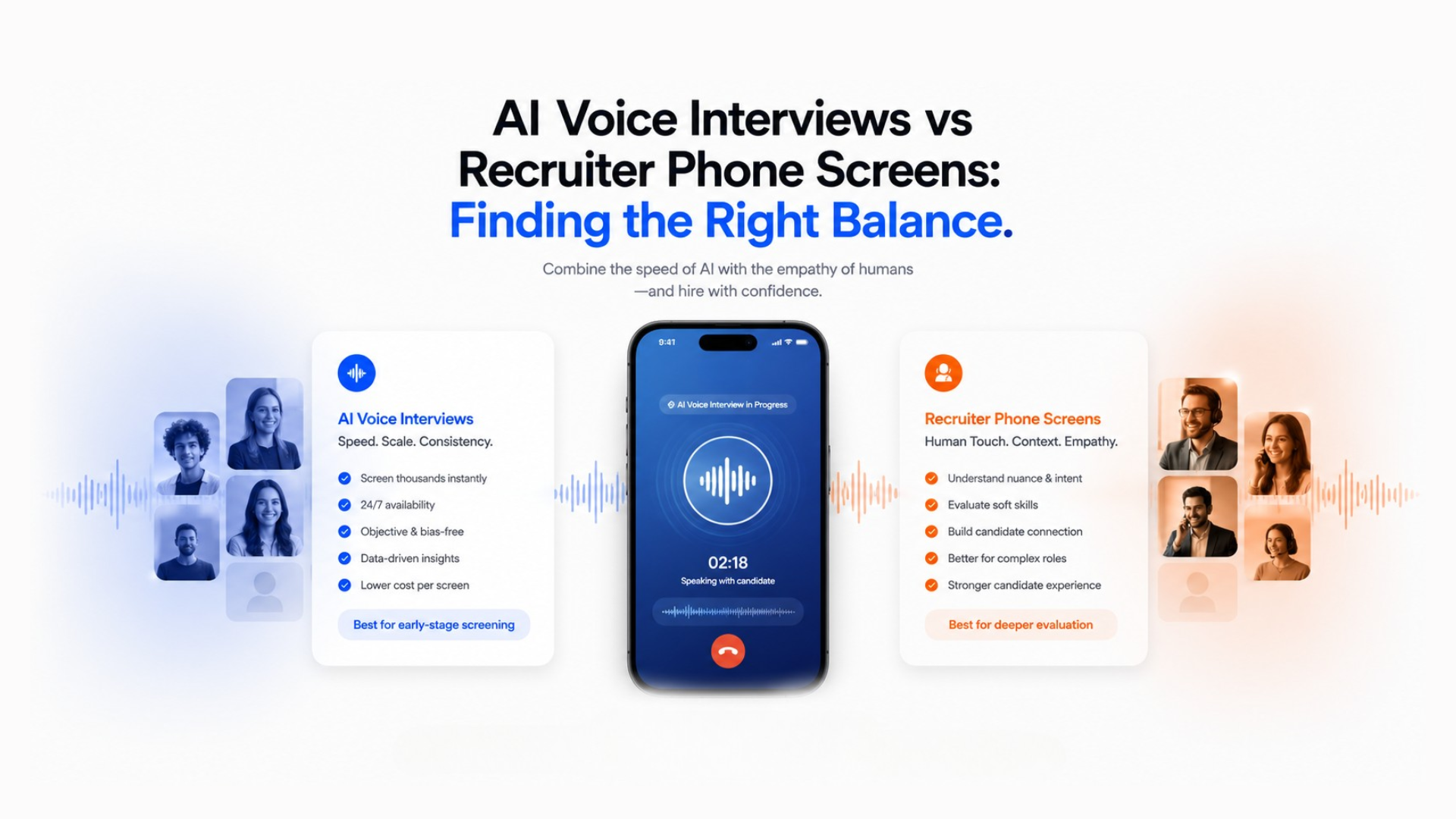
The conversation about AI in recruiting tends to frame the technology as a replacement for human recruiters. AI voice interviews are positioned as the alternative to phone screens. Recruiter phone screens are described as outdated. The implication is that organizations need to choose one approach or the other. This framing is wrong — not because it overstates AI’s capabilities, but because it misunderstands what each method is actually good at. AI voice interviews and recruiter phone screens serve fundamentally different functions in the hiring funnel, and the organizations that get the best results use both, at the right moments, for the right reasons. The challenge is not choosing between them. It is knowing when each one adds the most value.
What Each Method Actually Does Best
A recruiter phone screen is a human-to-human conversation designed to accomplish two things simultaneously: evaluate the candidate and build a relationship with them. An experienced recruiter uses a phone screen to assess communication style, cultural alignment, career motivation, salary expectations, and basic role fit — but they are also selling the opportunity, answering the candidate’s questions, addressing concerns, and creating the kind of personal connection that makes a candidate want to continue the process. This dual function is what makes phone screens valuable, and it is also what makes them time-consuming. A good phone screen is not just an evaluation — it is a micro-negotiation and a branding exercise rolled into one 30-minute call.
An AI voice interview, by contrast, is a structured evaluation conversation designed to accomplish one thing: assess the candidate’s responses against a predefined competency framework with maximum consistency and minimum human time investment. The AI asks the same questions, in the same order, with the same evaluation criteria, for every candidate. It does not sell the role. It does not build rapport. It does not adapt its questions based on an interesting answer or pivot to explore a promising thread. What it does is produce a detailed, objective, comparable scorecard for every candidate in a fraction of the time a
human screen requires. SIOP’s research on structured interview methodologies has consistently shown that this kind of structured, criterion-referenced evaluation produces higher predictive validity than unstructured human conversations — not because the AI is smarter than the recruiter, but because it applies the same standard every single time.
Where AI Voice Interviews Have a Clear Advantage
There are specific scenarios in the hiring process where AI voice interviews are objectively better than recruiter phone screens. The first is high-volume initial screening. When a requisition generates 80 to 150 applicants, conducting phone screens with every one of them is impractical for most recruiting teams. AI voice interviews can process that entire pool in days, producing structured evaluations that let recruiters focus their human phone screen time on the 15 to 25 candidates who scored highest. This is not a theoretical benefit. Gartner’s HR technology research has found that organizations using AI screening at the top of the funnel reduce recruiter screening workload by 60–75% while maintaining or improving shortlist quality — because the AI ensures every candidate is evaluated thoroughly, not just the ones the recruiter had time to call.
The second scenario is cross-time-zone hiring. When a recruiting team in New York needs to screen candidates in London, Dubai, and Singapore, phone screen scheduling becomes a coordination nightmare that adds days to the process. AI voice interviews eliminate this bottleneck entirely. Candidates complete the interview at any hour, and recruiters receive scored evaluations without a single scheduling email. The third scenario is compliance-sensitive hiring. In jurisdictions with strict documentation and bias-auditing requirements — including the EU under GDPR-related employment rules, New York City under Local Law 144, and several emerging regulatory frameworks documented by the International Association of Privacy Professionals — the structured, recorded, and auditable nature of AI voice interviews provides a compliance advantage that manual phone screens cannot match. Every question, response, and score is documented in a way that manual recruiter notes are not.
Where Recruiter Phone Screens Still Win
Despite AI’s advantages in consistency and scalability, there are situations where a recruiter phone screen remains the better choice. Senior and executive roles are the clearest example. When hiring for a VP of Engineering, a Director of Sales, or a C-suite position, the screening conversation is less about checking competency boxes and more about assessing leadership presence, strategic thinking depth, and the kind of nuanced interpersonal chemistry that determines whether someone can lead a team. These are inherently subjective, contextual evaluations that require human judgment. Heidrick & Struggles’ leadership advisory research has consistently found that the most predictive assessment for senior roles is a real-time conversation with an experienced interviewer who can probe, challenge, and read between the lines in ways that current AI cannot replicate.
Recruiter phone screens also have an advantage in candidate selling scenarios. When
you are competing for a passive candidate who has multiple opportunities, the phone screen is often the first real human touchpoint in the process — and its quality can determine whether the candidate continues or withdraws. A skilled recruiter uses the phone screen to understand the candidate’s motivations, address specific concerns about the role or company, and create a personal connection that differentiates your opportunity from the three others the candidate is considering. AI voice interviews cannot do this. This distinction matters because, as explored in depth in Should Recruiters Worry About AI Replacing Their Jobs?, the value of a recruiter is not in conducting evaluations — AI can do that — but in the relationship-building, advisory, and strategic capabilities that are uniquely human. The phone screen is where many of those capabilities are exercised most visibly.
The Hybrid Model: When to Use Each
The most effective approach for most organizations is not to choose between AI voice interviews and recruiter phone screens but to use them as complementary stages in a structured hiring funnel. The model works in three tiers. Tier one is AI voice interviewing for all applicants who meet basic qualifications. This is the volume screening layer — every candidate gets a thorough, consistent evaluation without consuming recruiter time. Tier two is recruiter phone screening for candidates who score above a defined threshold on the AI evaluation. The recruiter reviews the AI scorecard before the call, knows exactly which competencies to probe deeper on, and uses the phone screen to assess the dimensions that AI cannot evaluate — motivation, cultural nuance, career narrative, and role-specific chemistry. Tier three is hiring manager and panel interviews for the final shortlist, informed by both the AI evaluation data and the recruiter’s phone screen notes.
This hybrid approach delivers the best of both worlds. The AI provides consistency, scalability, and structured data at the top of the funnel. The recruiter provides relationship building, contextual judgment, and candidate selling at the middle. And the hiring team receives better-qualified, better-documented candidates at the bottom. McKinsey’s research on hiring process design has found that organizations using structured, multi-stage evaluation processes — where each stage has a clearly defined purpose and evaluation criteria — make significantly better hiring decisions than those relying on a single evaluation method, regardless of whether that method is human or AI-led.
The key implementation detail is that the AI voice interview must produce scorecards that are actually useful to the recruiter in the phone screen stage. This means the AI evaluation needs to be competency-specific, with enough detail to tell the recruiter not just whether a candidate passed or failed, but where their strengths and gaps are. A scorecard that says “candidate scored 7.2/10” is almost useless. A scorecard that says “candidate demonstrated strong problem-solving and communication but showed limited evidence of leadership experience and had difficulty articulating career motivation” gives the recruiter a clear agenda for the phone screen. This is the difference between genuinely agentic AI recruiting platforms that enhance recruiter decision-making and basic automation tools that simply add another step to the process without making the recruiter’s subsequent work
more productive.
When the Balance Tips Toward AI — and When It Does Not
The right balance between AI voice interviews and recruiter phone screens is not static. It shifts depending on the role level, the volume of applicants, the urgency of the hire, and the competitive dynamics of the talent market. For high-volume operational roles — customer service, logistics, retail, data entry — the balance tips heavily toward AI. These roles have clear, observable competency requirements, large applicant pools, and tight hiring timelines. A recruiter phone screen for every applicant in a 500-candidate customer service pipeline is not just inefficient — it is impossible. AI voice interviews handle the volume, and recruiter phone screens are reserved for the top-scoring 10–15% who reach the second stage.
For niche and highly technical roles, the balance is more nuanced. AI recruiting tools can work well for specialized hiring — but the screening conversation needs to be tailored to the specific technical domain in ways that generic AI frameworks may not support. A senior machine learning engineer needs to be assessed on depth of technical knowledge, research methodology, and the ability to communicate complex concepts to non-technical stakeholders. These are dimensions where the AI interview needs to be complemented by a recruiter or hiring manager who understands the domain deeply enough to evaluate the candidate’s responses in context. The AI handles the initial screening and identifies candidates worth a deeper look; the human conversation verifies that the technical depth is genuine.
For senior leadership and executive roles, the balance tips toward human conversations at every stage. The screening of a C-level candidate is less about volume management and more about strategic assessment — and that assessment benefits from human judgment, relationship context, and the kind of adaptive conversation that explores a candidate’s leadership philosophy, strategic thinking, and organizational vision. AI can still play a supporting role by providing structured preliminary data, but the primary evaluation should remain human-led.
Why the Platform Determines Whether Balance Is Possible
The hybrid model — AI voice interviews for initial screening, recruiter phone screens for high-potential candidates, and panel interviews for finalists — sounds straightforward in theory. In practice, it requires a platform that supports all three stages within a single workflow, with shared candidate data, seamless handoffs, and no manual re-entry between stages. When AI screening, recruiter outreach, and interview scheduling operate on separate systems, the hybrid model creates more work than it saves: recruiters export scorecards from the AI tool, import them into the ATS, coordinate phone screens through email and calendar tools, and then manually update candidate records after each stage. The administrative overhead of managing three disconnected systems often exceeds the time saved by AI screening in the first place.
This is where integrated platforms like Huntlo change the equation. Huntlo combines AI sourcing across 50+ platforms, multi-channel outreach, AI voice screening, and interview scheduling into a single hiring operating system. A candidate sourced through Huntlo’s AI engine, engaged through automated outreach, and screened through an AI voice interview flows through the entire pipeline without manual handoffs. The recruiter reviews the AI scorecard, decides which candidates deserve a phone screen, conducts that conversation with full context from the AI evaluation, and schedules the next round — all within the same platform. The balance between AI and human evaluation is not a theoretical framework. It is a workflow that the platform either supports or does not.
The recruiters who will lead the next phase of hiring innovation are not those who cling exclusively to phone screens or those who delegate everything to AI. They are the ones who understand that AI voice interviews and recruiter phone screens are complementary tools, and who use a platform that makes using both — at the right time, for the right candidates, for the right reasons — as seamless as possible. That is not a compromise. It is the most effective way to hire.
Related Topics:
Should Recruiters Worry About AI Replacing Their Jobs?
What Makes an AI Recruiting Platform “Agentic” vs Just Automated?