Why This Comparison Matters Now
Enterprise recruiting is at a decision point that has been building for several years. The volume of AI hiring tools on the market has exploded — G2 now lists over 60 platforms in the video interviewing category alone, up from 18 in 2020. Hiring managers are beginning to ask why the interview process still takes weeks when they have seen what AI can do in other business functions. Candidates increasingly expect the kind of fast, responsive, data-informed experience that AI-enabled processes can provide. And regulators are creating a compliance framework that effectively rewards structured, auditable evaluation processes — the kind that AI video interview platforms provide naturally.
At the same time, many experienced enterprise recruiters have legitimate reservations about AI in hiring. They have seen technology initiatives fail before. They have worked with AI tools that produced shallow, inaccurate, or biased evaluations. They know that hiring is a human process, and they are skeptical of claims that algorithms can capture the nuance required to make good hiring decisions. These reservations are not anti-technology — they are the healthy skepticism of professionals who understand that hiring decisions affect people's livelihoods and organizations' futures.
This article is written for that audience: enterprise recruiters who need to make an informed evaluation of AI video interviews, not as converts or skeptics, but as professionals with a responsibility to adopt the right tools for the right reasons. The comparison that follows is organized around the dimensions that enterprise recruiters consistently cite as their primary evaluation criteria when assessing new hiring technology.
Predictive Accuracy: The Most Important Dimension
Predictive accuracy — the degree to which interview performance predicts subsequent on-the-job performance — is the single most important dimension of any interview method. An interview process that is fast, cheap, and popular but does not predict job performance is worthless. An interview process that is slower and more expensive but significantly more predictive is worth the investment, because the cost of a bad hire far exceeds the cost of a thorough evaluation.
The research on this dimension is unambiguous. SIOP's comprehensive meta-analyses of interview validity, spanning hundreds of studies and tens of thousands of hires, have established the following hierarchy of predictive validity:
Structured interviews (AI-enforced or human-administered) achieve predictive validity coefficients of 0.51 to 0.63. This means that structured interview scores explain approximately 26% to 40% of the variance in subsequent job performance. Work sample tests achieve similar validity (0.54), and cognitive ability tests achieve slightly higher validity (0.65). These three methods — structured interviews, work samples, and cognitive tests — represent the gold standard of hiring assessment.
Unstructured interviews — the format used in the vast majority of traditional enterprise hiring — achieve predictive validity coefficients of approximately 0.20. This means that unstructured interview impressions explain only about 4% of the variance in job performance. In practical terms, an unstructured interview is only marginally better than flipping a coin at predicting whether a candidate will succeed in the role.
The critical variable is structure, not the technology used to deliver the interview. A human interviewer using a structured interview guide with a scoring rubric can achieve predictive validity comparable to an AI system. The advantage of AI is not that it evaluates more accurately than a well-trained human interviewer using a structured format — it is that AI enforces structure consistently, at scale, without the degradation that inevitably occurs when human interviewers conduct dozens of interviews across a stressful week. McKinsey's analysis of hiring process consistency found that human interviewer adherence to structured interview protocols degrades by approximately 30% after the 10th interview in a week, as fatigue, time pressure, and cognitive load erode discipline.
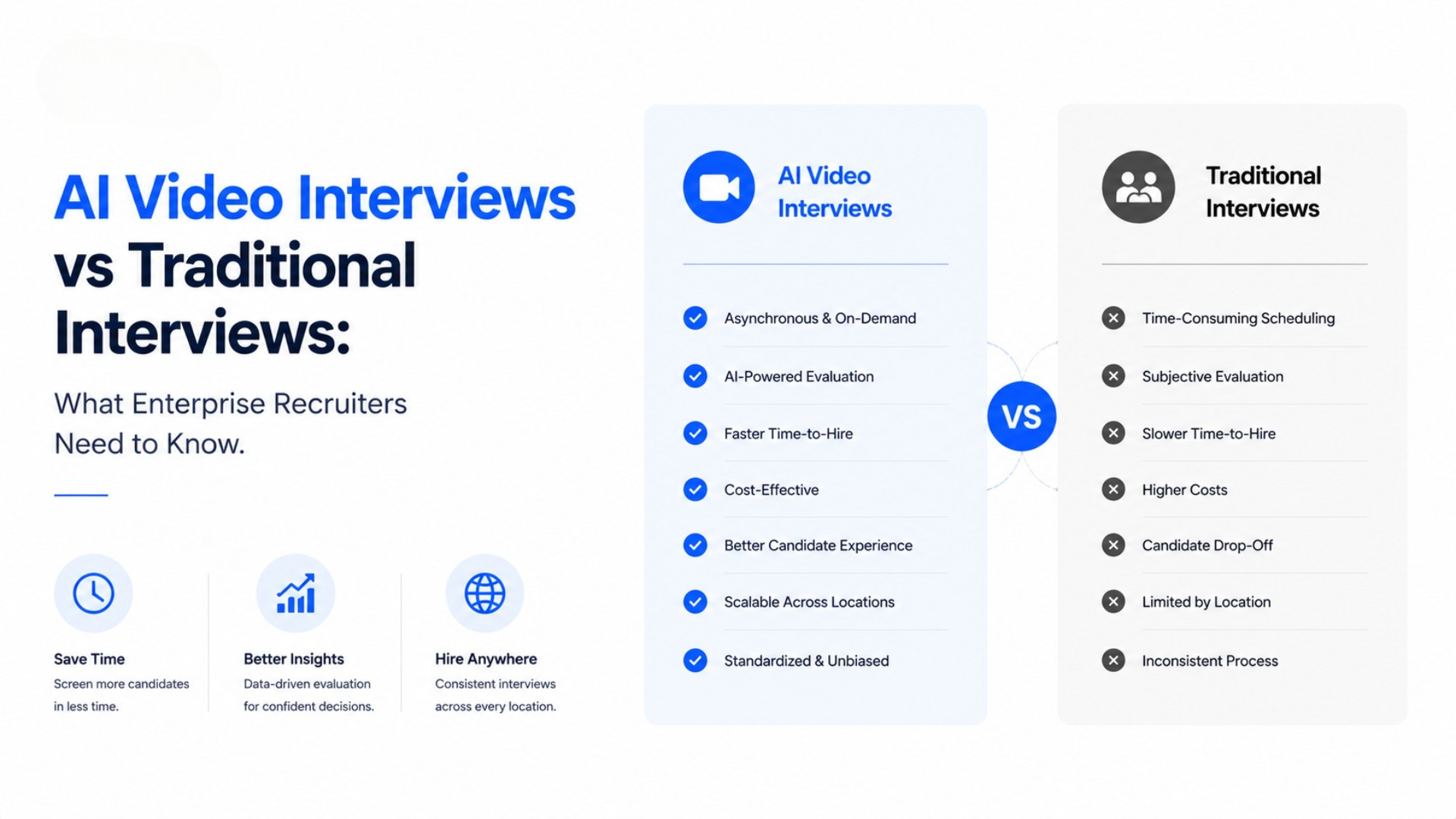
AI video interview platforms do not experience this degradation. The 100th candidate evaluated by the AI receives the same structured assessment as the first, with the same questions, the same evaluation criteria, and the same scoring methodology. This consistency is the primary accuracy advantage of AI video interviews over traditional interviews. It is not that AI is a better evaluator than humans in any single interview. It is that AI maintains its evaluative quality across hundreds of interviews, while human evaluators cannot.
Practical implication for enterprise recruiters: If your organization currently uses unstructured traditional interviews — and SHRM's data suggests that approximately 80% of enterprise organizations do for at least some of their roles — the accuracy improvement from adopting structured AI video interviews for initial screening is likely to be substantial. If your organization already uses well-implemented structured interviews, the accuracy improvement from adding AI will be more modest but still meaningful, primarily through the consistency advantage described above.
Time Efficiency: Where the Gap Is Widest
Time is the dimension where AI video interviews most dramatically outperform traditional interviews, and the difference is not marginal. It is structural, and it scales with hiring volume.
Consider the traditional interview process for a mid-senior role at an enterprise organization. A typical pipeline of 100 applicants produces approximately 30 candidates who pass the initial resume screen. Each of these 30 candidates requires a phone screen — scheduled, conducted, and evaluated by a human recruiter. Scheduling each phone screen requires an average of 4.2 emails and 1.8 phone calls, according to Jobvite's recruiting benchmarks. Each screen takes 30 to 45 minutes of interviewer time. After the screen, the recruiter spends an additional 10 to 15 minutes documenting their notes and deciding whether to advance the candidate.
The total time investment per candidate in a traditional phone screen is approximately 60 to 90 minutes, including scheduling, conducting, and documenting. For 30 candidates, that is 30 to 45 hours of recruiter time — nearly a full week of work for a single open requisition. An enterprise recruiter handling 20 to 30 open requisitions simultaneously faces a screening workload of 600 to 1,350 hours per cycle, which is physically impossible to complete without sacrificing evaluation quality or extending time-to-fill.
AI video interviews collapse this timeline. The same 30 candidates can be invited to complete an AI interview asynchronously. Candidates complete the interview at their convenience — no scheduling required. The AI evaluates each candidate and generates a structured report within minutes of completion. The recruiter's total time investment is not 30 to 45 hours of screening — it is 3 to 5 hours of reviewing AI-generated evaluation reports and making advancement decisions. The time savings range from 80% to 90% for the screening stage.
LinkedIn's talent acquisition benchmarks provide additional context: the average enterprise recruiter spends 64% of their time on administrative tasks, primarily scheduling and screening coordination. AI video interviews can reduce this administrative burden by 50% to 70%, freeing recruiter capacity for higher-value activities: sourcing passive candidates, building relationships with hiring managers, and managing the strategic aspects of talent acquisition that genuinely require human expertise.
For synchronous AI interviews — where the candidate interacts with a live AI agent rather than recording responses — the scheduling advantage is smaller but still significant. AI agents are available 24/7, so candidates can complete live interviews at any time without requiring human interviewer availability. A candidate in Tokyo can conduct a live AI interview at 11 PM local time without requiring any human in New York to be awake. This time zone elimination is particularly valuable for enterprise organizations hiring across multiple geographies.
Practical implication for enterprise recruiters: If time-to-fill and recruiter capacity are primary concerns — and for most enterprise recruiting teams they are — AI video interviews offer the most impactful improvement available. The time savings are not theoretical. They are immediate, measurable, and scale linearly with hiring volume.
Cost Per Hire: The Full Picture
Enterprise recruiting leaders evaluating AI video interviews often focus on the platform's subscription cost without considering the full cost picture of traditional interviews. A complete cost comparison must account for all cost components on both sides.
Traditional interview costs per screen:
Recruiter time: 60 to 90 minutes per screen at a fully loaded cost of $75 to $150 per hour = $75 to $225 per screen
Scheduling overhead: 15 to 20 minutes per screen in administrative coordination = $19 to $50 per screen
Hiring manager time (for second-round screens): 45 to 60 minutes at $200 to $500 per hour = $150 to $500 per screen
Technology costs: videoconferencing license, ATS usage, recruiting CRM = $5 to $15 per screen
Total traditional cost per screen: approximately $250 to $790, depending on role level and interviewer seniority
AI video interview costs per screen:
Platform cost: allocated across volume, typically $3 to $15 per screen on flat-rate pricing
Recruiter review time: 10 to 15 minutes per AI evaluation report at $75 to $150 per hour = $12.50 to $37.50 per screen
Hiring manager review time: 15 to 20 minutes per report at $200 to $500 per hour = $50 to $167 per screen
Total AI cost per screen: approximately $65 to $220, depending on role level and platform pricing
The per-screen cost advantage for AI video interviews ranges from 60% to 75% for initial screening. For enterprise organizations conducting tens of thousands of screens annually, this translates to six- or seven-figure annual savings. An enterprise hiring 5,000 employees with an average of 4 screens per hire — 20,000 screens — saves approximately $3.7 million to $11.4 million annually by shifting from traditional to AI screening, depending on the specific cost structure.
The most cost-efficient pricing model for enterprise organizations is flat-rate per seat, which eliminates per-candidate cost variability and aligns platform costs with recruiting team headcount rather than hiring volume. Huntlo.ai's $99 per seat per month pricing — with no per-candidate or per-interview charges — exemplifies this model. For an enterprise recruiting team of 30 recruiters, the total platform cost is $35,640 per year, a figure that is dwarfed by the screening cost savings the platform enables.
Practical implication for enterprise recruiters: The cost case for AI video interviews is strong at enterprise scale, primarily driven by recruiter and hiring manager time savings rather than platform cost reduction. The ROI calculation should focus on the value of reclaimed recruiter capacity and faster time-to-fill, not on the platform subscription fee.
Candidate Experience: The Nuanced Reality
Candidate experience is frequently cited as a concern with AI video interviews, but the evidence is more nuanced than the concerns suggest. The reality depends entirely on implementation quality.
Talent Board's CandE Awards benchmark research provides the most comprehensive data on candidate experience across interview methods. Their findings can be summarized as follows:
Candidates who complete well-designed AI interview processes report satisfaction scores that are equal to or higher than satisfaction with traditional phone screens. The key variables that determine AI interview satisfaction are transparency (candidates know AI is involved and understand what it evaluates), experience design (the interview is professional, relevant, and respects the candidate's time), and feedback (candidates receive some form of response or outcome communication after completing the interview).
Candidates who complete poorly designed AI interview processes — generic questions, robotic interaction, unclear instructions, no feedback — report significantly lower satisfaction than with any other interview method. The damage from a poor AI interview experience is greater than the damage from a poor human interview experience, because candidates interpret a bad AI experience as a signal of organizational technology immaturity and general disrespect for candidates.
For asynchronous AI interviews, candidate satisfaction is driven primarily by convenience and flexibility. Gallup's candidate experience research found that 68% of candidates prefer asynchronous interview formats for initial screening rounds, citing the ability to complete the interview at their convenience and in a comfortable environment. This preference is particularly strong among employed candidates — the high-performers who are not actively job searching but would consider the right opportunity. Passive candidates, who are the most desirable segment of any talent pool, have the least tolerance for scheduling coordination and the most appreciation for flexible formats.
For synchronous AI interviews using conversational AI — where the candidate interacts with an AI agent in real time — satisfaction depends heavily on the quality of the AI's conversation. Platforms that use sophisticated conversational AI, like Huntlo.ai's AI voice and chat capabilities, can engage candidates in natural, context-aware dialogue that candidates rate as professional and substantive. Platforms that use basic chatbot-style interactions produce the low satisfaction scores that critics of AI interviews cite.
Practical implication for enterprise recruiters: AI video interviews do not inherently damage candidate experience. Poorly implemented AI video interviews do. The implementation quality variables — transparency, design, feedback, and AI sophistication — are within the recruiting team's control. Organizations that invest in these variables report candidate experience outcomes that match or exceed traditional interview processes.
Compliance and Audit Readiness: The Emerging Differentiator
The regulatory landscape for hiring technology is evolving rapidly, and this evolution favors structured, auditable interview processes over traditional unstructured methods. This is a significant and often underappreciated advantage of AI video interviews for enterprise organizations.
New York City's Local Law 144 requires employers using automated employment decision tools to conduct annual bias audits, publish summary results, and notify candidates of AI usage. The EU AI Act classifies employment AI as "high-risk" and imposes requirements for conformity assessments, risk management, human oversight, and data governance. Similar legislation is advancing in California, Illinois, Maryland, Washington, and other U.S. states, as well as in Canada, the UK, Australia, and Singapore.
The practical implication of this regulatory trajectory is that organizations will increasingly need to demonstrate that their hiring processes are structured, auditable, and capable of being evaluated for bias. Traditional unstructured interviews — where evaluation criteria are implicit, scoring is subjective, and documentation is fragmentary — cannot meet these requirements. AI video interview platforms, by contrast, generate structured evaluation data for every candidate, maintain complete audit trails, and can produce the statistical analyses that bias audits require.
The IAPP's regulatory analysis estimates that enterprises with AI-powered structured interview processes will spend 40% less on AI hiring compliance over the next five years compared to enterprises that attempt to comply using traditional interview processes retrofitted with manual documentation. The cost advantage comes from the difference between compliance that is embedded in the technology and compliance that must be constructed manually after the fact.
EY's HR compliance practice has noted a growing trend of enterprise legal departments actively advocating for AI hiring tools, not because they are technology enthusiasts but because the structured evaluation data these tools generate significantly reduces the organization's legal and regulatory exposure. When a hiring decision is challenged, the ability to produce a detailed, time-stamped, criterion-referenced evaluation record is far more defensible than the alternative of relying on interviewer recollections and handwritten notes.
Practical implication for enterprise recruiters: Compliance is no longer a future consideration — it is a present requirement in multiple jurisdictions and an emerging requirement in many more. AI video interview platforms provide compliance-ready infrastructure that traditional interview processes cannot match. For enterprise organizations operating across multiple regulatory environments, this compliance advantage is a significant practical benefit.
Bias and Fairness: What the Evidence Actually Shows
Bias in hiring is one of the most discussed and least understood aspects of the AI versus traditional interview debate. The popular narrative — that AI is inherently biased and traditional human interviews are fairer — is not supported by the evidence.
Human interviewers are subject to a well-documented set of cognitive biases that affect hiring decisions. Affinity bias (preferring candidates who share background characteristics with the interviewer), confirmation bias (seeking information that confirms initial impressions), the halo effect (allowing one positive attribute to influence the overall assessment), and similarity bias (preferring candidates with similar career trajectories) all operate at subconscious levels that training can reduce but not eliminate. Harvard Business Review's extensive coverage of interview bias has documented that these biases are particularly pronounced in unstructured interviews, where the absence of standardized criteria allows implicit preferences to influence evaluations without constraint.
AI systems are also susceptible to bias, but the mechanisms and the remedies are different. AI bias typically originates in training data — if the historical hiring data used to train the AI reflects biased patterns, the AI may replicate or amplify those patterns. However, AI bias is detectable (through statistical analysis of evaluation outcomes across demographic groups), measurable (through disparity metrics), and correctable (through model adjustment and framework refinement). Human bias, by contrast, is largely invisible, unmeasurable in real-time, and resistant to correction because it operates through subjective judgment that cannot be directly audited.
The National Bureau of Economic Research (NBER) published a comprehensive study examining AI-assisted hiring tools across multiple organizations and found that properly implemented AI tools reduced demographic disparities in hiring outcomes by 15% to 25% compared to traditional unstructured interviews. The improvement was attributed to the AI's consistent application of role-relevant evaluation criteria, which eliminates the evaluator-dependent variability that disproportionately affects underrepresented candidates.
The critical caveat is "properly implemented." AI video interview platforms that evaluate candidates against specific, job-relevant competencies produce more equitable outcomes than unstructured human interviews. Platforms that use poorly designed evaluation frameworks or that incorporate biased training data can produce worse outcomes. The quality of the implementation — the competency framework design, the AI model training, and the ongoing bias monitoring — determines whether the technology reduces or amplifies bias.
Practical implication for enterprise recruiters: AI video interviews, when properly implemented with well-designed competency frameworks and ongoing bias monitoring, produce more equitable hiring outcomes than traditional unstructured interviews. Enterprise recruiters should evaluate AI platforms based on the transparency of their evaluation methodology, the quality of their bias monitoring capabilities, and their willingness to support regular independent audits.
Scalability: The Hidden Advantage
Scalability is rarely discussed in AI versus traditional interview comparisons, but it is one of the most operationally significant differences for enterprise organizations. The question is simple: what happens to your hiring process when volume doubles, triples, or increases tenfold due to a growth spurt, a restructuring, or a seasonal surge?
Traditional interview processes scale linearly with human capacity. If your screening volume doubles, you need to either double your recruiter headcount or accept longer time-to-fill and lower evaluation quality. Recruiter headcount is expensive and slow to scale — hiring and training a new recruiter takes 3 to 6 months, and the fully loaded cost of an enterprise recruiter ranges from $120,000 to $200,000 per year. During a high-volume hiring surge, the traditional approach creates a brutal trade-off between speed and quality that often results in both: slow hiring and degraded evaluation standards.
AI video interviews scale differently. Because the AI evaluates candidates automatically, increasing screening volume from 1,000 to 5,000 candidates per month does not require proportional increases in human evaluator capacity. The same recruiter team can manage a dramatically larger pipeline because the AI handles the evaluative heavy lifting. The recruiter's role shifts from conducting individual screens to reviewing AI-generated reports and managing the strategic aspects of the pipeline. This scalability advantage is particularly valuable during organizational growth phases, seasonal hiring surges, and multi-location hiring campaigns.
Deloitte's workforce analytics team has documented that enterprise organizations using AI screening tools manage 3 to 5 times the candidate volume per recruiter compared to organizations relying on traditional screening methods. The quality of evaluation does not degrade with volume because the AI applies the same standards regardless of how many candidates it processes.
Practical implication for enterprise recruiters: For organizations with variable or growing hiring volume, AI video interviews provide a scalability advantage that traditional interviews structurally cannot match. The difference is not incremental — it is an order of magnitude in candidate processing capacity.
Data and Talent Intelligence: The Compounding Asset
Every interview generates data. The question is whether that data is structured, aggregated, and actionable — or whether it exists in fragmentary, inconsistent, and inaccessible form.
Traditional interviews generate data in the form of recruiter notes, hiring manager impressions, and possibly interview recordings. This data is typically stored in the ATS as free-text notes, if it is stored at all. It cannot be systematically analyzed, aggregated across candidates, or used to improve future hiring decisions. When a recruiter who conducted 200 interviews leaves the organization, their evaluative knowledge leaves with them. The organization loses accumulated interview intelligence with every recruiter departure.
AI video interviews generate structured evaluation data for every candidate: competency scores, behavioral indicators, communication assessments, and comparative rankings. This data is machine-readable, aggregatable, and analyzable. Over hundreds and thousands of interviews, it accumulates into a talent intelligence asset that provides strategic insight no other interview method can produce.
Mercer's talent strategy research has found that organizations with structured hiring data — the kind AI video interviews produce — make 28% faster hiring decisions and achieve 25% higher accuracy in workforce planning forecasts. The advantage compounds because each search generates data that improves the next search. An organization that has conducted 10,000 AI-evaluated interviews has a talent intelligence capability that no amount of recruiter experience can replicate through manual methods.
This data advantage is amplified when AI video interviews are integrated with AI-powered sourcing, as platforms like Huntlo.ai enable. The combination of sourcing data (which channels produce the strongest candidates, what engagement patterns predict interview success) and interview data (which competencies most strongly predict on-the-job performance) creates a feedback loop that continuously improves both sourcing efficiency and evaluation accuracy.
Korn Ferry's talent analytics research describes this capability as "the next frontier of competitive advantage in talent acquisition," noting that the organizations building talent intelligence assets today will have a significant and durable advantage over organizations that continue to rely on fragmented, unstructured hiring data.
Practical implication for enterprise recruiters: The data and talent intelligence advantage of AI video interviews is a long-term strategic asset that compounds over time. Traditional interviews generate no comparable data asset. For enterprise organizations with 1,000+ annual hires, this intelligence advantage alone may justify the AI investment, independent of the shorter-term speed and cost benefits.
When Traditional Interviews Still Make Sense
A balanced comparison must acknowledge the situations where traditional interviews remain the better choice. AI video interviews are not universally superior. There are specific contexts where human-led, unstructured or semi-structured interviews are more appropriate.
Final-round executive and senior leadership interviews. The final stages of executive hiring require the kind of interpersonal assessment, ethical judgment evaluation, and trust-building that only human interaction can provide. AI can inform these final-stage conversations with structured evaluation data from earlier stages, but the final-round interview itself should be conducted by human stakeholders.
Roles requiring exceptional creative or artistic capability. For positions where the primary value proposition is creative originality — certain design roles, content strategy positions, artistic director roles — the evaluation benefits from the interpretive flexibility that human interviewers provide. AI can assess communication structure and evidence-based reasoning, but it is less effective at evaluating the kind of creative intuition that these roles require.
Highly confidential or sensitive searches. In situations where the search itself must be kept strictly confidential — internal succession planning, board-level evaluations, or searches where organizational politics make formal evaluation processes risky — the informal, discreet nature of traditional conversations may be more appropriate than a technology-mediated process that generates structured evaluation records.
Small-volume, high-touch hiring. For organizations hiring only a handful of senior roles per year, the infrastructure investment in AI video interviews may not be justified by the volume. The per-hire value of structured evaluation data diminishes when the total number of hires is very small.
Prosci's change management research emphasizes that the most effective technology adoption strategies identify the use cases where the technology provides the clearest advantage and deploy there first, expanding to additional use cases as organizational capability and confidence grow. For AI video interviews, the initial deployment should target high-volume screening and evaluation, where the speed, consistency, and scalability advantages are most pronounced. Traditional interviews can continue to serve the low-volume, high-touch use cases where their flexibility and interpersonal quality provide genuine value.
The Practical Recommendation: A Hybrid Approach
The comparison evidence does not point to a wholesale replacement of traditional interviews with AI video interviews. It points to a hybrid model that deploys each method where it is most effective.
AI video interviews for:
Initial candidate screening across all role levels
First-round evaluations for mid-level and senior roles
High-volume hiring programs (campus recruiting, seasonal surges, geographic expansion)
Multi-geography hiring where time zone coordination is a bottleneck
Any context where interview consistency, data capture, or scalability are primary requirements
Traditional human interviews for:
Final-round evaluations for senior and executive roles
Roles requiring exceptional creative, artistic, or interpersonal assessment
Situations requiring confidentiality or political sensitivity
Any context where relationship-building and trust assessment are primary requirements
AI-informed human interviews for:
Second-round evaluations where human interviewers review AI-generated profiles before conducting their conversations
Panel interviews where AI evaluation data provides a shared analytical framework for stakeholder discussion
Any context where the combination of AI's analytical consistency with human's contextual judgment produces the best outcome
This hybrid model is not a compromise — it is the optimal approach that leverages the strengths of each method while mitigating their weaknesses. Organizations that attempt to use AI for everything will encounter the technology's genuine limitations in interpersonal assessment. Organizations that refuse to use AI for anything will continue to accept the well-documented accuracy, speed, and consistency limitations of traditional methods.
PwC's HR technology analysis has found that enterprises adopting this hybrid model achieve the best hiring outcomes across all measured dimensions: speed, quality, cost, candidate experience, and compliance readiness. The hybrid approach captures the efficiency and consistency advantages of AI where they matter most, while preserving the human judgment and interpersonal connection that remain essential at the decision stage.
The Recruiter's Evolving Role
Perhaps the most important dimension of the AI versus traditional interview comparison is what it means for the recruiter's role. In a traditional hiring process, the recruiter's primary value is their ability to conduct interviews, evaluate candidates, and manage the logistics of the hiring pipeline. These activities are time-intensive, largely administrative, and subject to the consistency limitations discussed throughout this article.
In an AI-enhanced hiring process, the recruiter's role shifts from evaluator to talent strategist. AI handles the screening volume, generates structured evaluation data, and provides the analytical foundation for hiring decisions. The recruiter interprets AI insights, advises hiring managers on pipeline strategy, manages candidate relationships at the critical moments that require human touch, and makes the strategic decisions about sourcing priorities and talent market positioning that AI cannot make.
This shift requires new skills — data literacy, consultative communication, and technology fluency — but it also elevates the recruiter's organizational value. A recruiter who can leverage AI to evaluate 500 candidates per week while focusing their own time on the 20 strategic talent decisions that most affect organizational capability is dramatically more valuable than a recruiter who spends 80% of their time on administrative screening.
The Bureau of Labor Statistics projects that the most in-demand HR competencies through 2032 will include data analysis, technology management, and strategic advisory — precisely the capabilities that AI-enhanced recruiting develops. The recruiters who build these capabilities now will be the most competitive talent acquisition professionals in the market.
The comparison is clear. AI video interviews outperform traditional interviews on predictive accuracy (through enforced structure), time efficiency (through automation and parallel processing), cost efficiency (through reduced human evaluator time), compliance readiness (through structured audit trails), scalability (through automated evaluation), and data utility (through structured evaluation data). Traditional interviews retain advantages in interpersonal assessment, creative evaluation, and confidential contexts. The organizations that will thrive are those that deploy each method where it delivers the most value — using AI to handle the volume and structure, and using human judgment for the nuance and context — in a hybrid model that captures the best of both approaches.
Related Topics:
Why Do Some AI Recruiting Tools Have Outdated Candidate Data?
What’s the Difference Between AI Sourcing and AI Recruiting?
How Many Follow-Ups Does One Hire Need?