AI Video Interviews for Campus, Professional, and Leadership Hiring
Every talent acquisition leader knows the feeling: you walk into a steering committee meeting and the head of campus recruiting wants faster screening for 5,000 internship applicants, the VP of Engineering needs to fill twelve mid-level positions by quarter end, and the CHRO is pressuring the team to reduce executive time-to-fill from 90 days to 45. Each of these demands is legitimate. Each requires a different assessment approach. And each is currently being managed through a different tool, a different process, and often a different vendor relationship that adds cost, complexity, and data fragmentation to an already overstretched talent acquisition function.
According to Gartner's 2026 talent acquisition trends analysis, the "AI revolution and cost pressures" are the two dominant forces reshaping hiring. Gartner identifies the need to "reshape talent assessment" as a top priority — not through incremental improvements to existing processes, but through fundamentally rethinking how organizations evaluate candidates across every level of experience and responsibility.
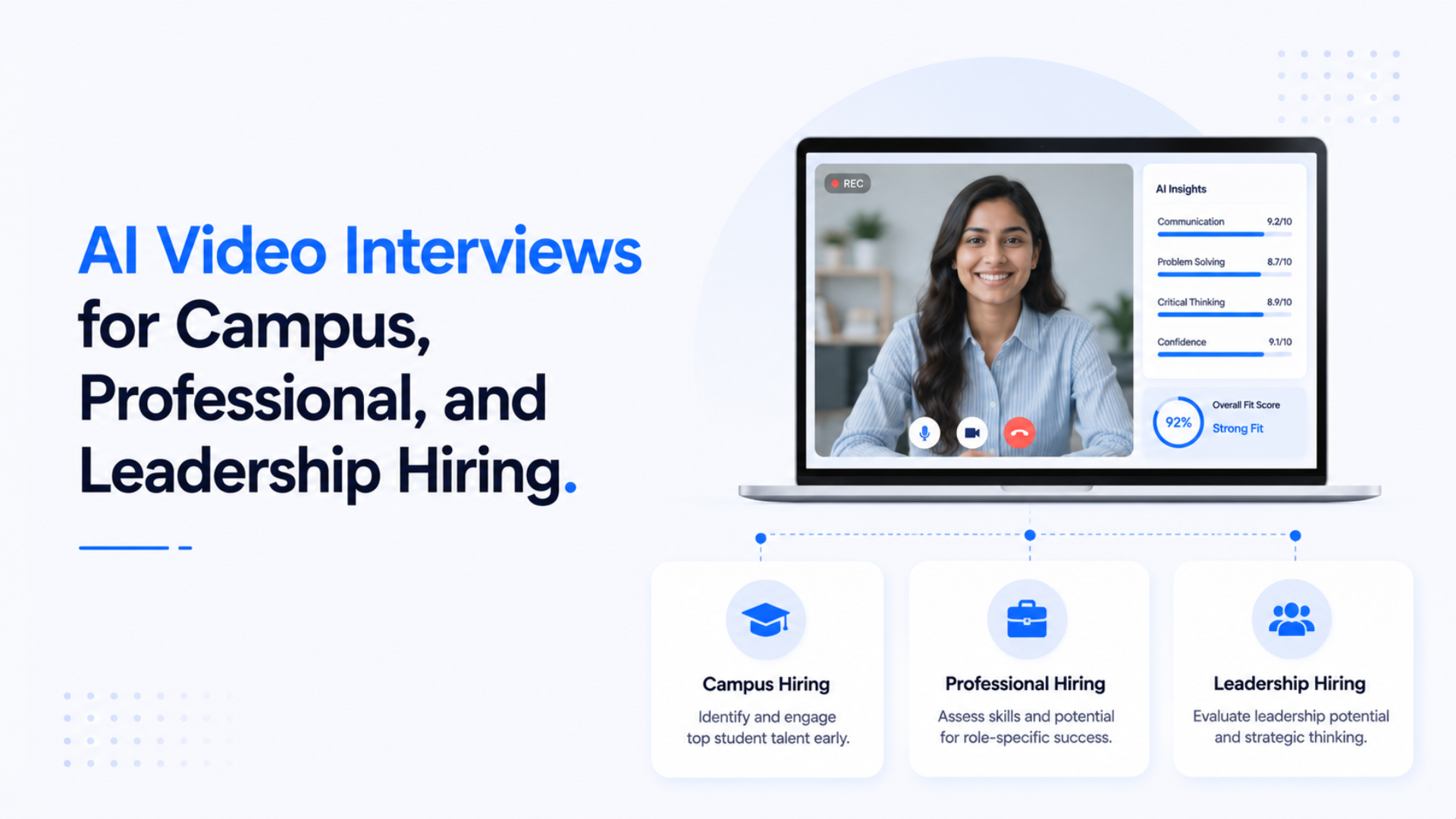
AI video interview technology offers exactly this kind of unified rethink. By providing a single platform that can be configured with different question frameworks, scoring rubrics, and candidate experience designs for campus, professional, and leadership hiring, AI video interviews eliminate the need for separate tools at each tier. The result is not just cost savings — it is a strategic advantage: a coherent, data-rich assessment ecosystem that gives talent acquisition leaders visibility across the entire hiring pipeline, from a graduating senior's first interview to a C-suite finalist's leadership assessment.
This article examines how AI video interviews perform at each of the three major hiring tiers, what the research says about their effectiveness at each level, and how a single platform — Huntlo, at $99 per seat per month with no usage limits — can replace the fragmented tool stack that most organizations currently endure.
The Three-Tier Hiring Problem: Why One Process Does Not Fit All
Before exploring the AI video interview solution, it is important to understand why the three tiers of hiring — campus, professional, and leadership — demand fundamentally different assessment approaches. The differences are not cosmetic. They reflect genuine differences in what organizations are trying to evaluate, what candidates can reasonably demonstrate, and what the consequences of a hiring error look like at each level.
Campus Hiring: Evaluating Potential, Not Track Record
Campus hiring is unique in that recruiters are evaluating potential rather than proven performance. A graduating senior has limited work experience, a resume built largely on academic projects and internships, and very little track record of professional decision-making. The assessment challenge is fundamentally different from professional or leadership hiring: you are not asking "what has this person achieved?" but rather "what is this person capable of achieving?"
NACE's Job Outlook 2025 survey found that employers planned to hire 7.3% more new graduates from the Class of 2025 than they did from the Class of 2024, following a full year of decreases. This rebound in campus hiring creates enormous volume pressure: NACE's trends data shows that nearly 87% of employers are actively recruiting for both full-time and internship positions. The organizations that can efficiently process and assess thousands of campus applicants gain a decisive advantage in securing top emerging talent.
SHRM reports that 74% of employers think incoming college graduates should already have AI user experience prior to entering the workforce, while another SHRM analysis notes that 95% of hiring managers said they are "much more likely or somewhat more likely to hire a graduate with an AI background." These expectations add new dimensions to the campus assessment challenge — organizations are no longer just evaluating academic aptitude and communication skills, but also a candidate's familiarity with the tools and technologies that will define their professional careers.
Professional Hiring: Evaluating Fit, Capability, and Adaptability
Professional hiring — the recruitment of individual contributors, managers, and specialists with three to fifteen years of experience — occupies the middle ground between campus potential and leadership track record. At this tier, candidates have demonstrable professional accomplishments, but they are also being evaluated for their fit within a specific team, function, and organizational culture. The assessment must probe both what candidates have done and how they approach new challenges.
The professional hiring tier is also where the volume-to-quality tension is most acute. Organizations may need to fill dozens or hundreds of professional roles per quarter — software engineers, marketing managers, financial analysts, operations supervisors — and each role requires a meaningful assessment of technical capability, problem-solving approach, and interpersonal effectiveness. Traditional unstructured phone screens, which typically last 15–30 minutes and vary wildly in quality from one interviewer to the next, are poorly suited to this challenge.
Deloitte's research on skills-based hiring highlights the growing shift away from credential-based evaluation toward skills-based assessment at the professional level. Deloitte's own hiring process for consulting and advisory roles now includes an "immersive online assessment — a 30-minute simulation testing situational judgment," a structured evaluation method that Career-On's analysis describes as part of a broader 2022 strategic decision that "sent shockwaves through the professional services industry."
NACE's 2026 data shows that 70% of employers now use skills-based hiring practices, up from 65% the previous year — a trend that is particularly pronounced at the professional hiring tier, where candidates' actual capabilities matter more than the prestige of their credentials.
Leadership Hiring: Evaluating Judgment, Vision, and Organizational Impact
Leadership hiring — whether for first-time managers, senior directors, or C-suite executives — demands the most nuanced and consequential assessment of all three tiers. At this level, the stakes of a hiring error are amplified exponentially: a poor leadership hire can trigger team attrition, strategic missteps, and cultural damage that reverberates across the organization for years.
The assessment challenge at the leadership tier is fundamentally about evaluating judgment under ambiguity. Leadership candidates must demonstrate not just technical competence or professional achievement, but the ability to navigate complex stakeholder dynamics, make decisions with incomplete information, inspire and retain talented teams, and articulate a vision that others will follow. These capabilities are difficult to assess through resume review or unstructured conversation — they require structured, scenario-based evaluation that probes how candidates think, not just what they have done.
Gallup's research on managerial talent found that only 18% of current managers demonstrate a high level of talent for managing others, and that organizations select the wrong candidate for management roles 82% of the time. These statistics underscore the enormous opportunity available to organizations that improve their leadership assessment processes — and the enormous cost of continuing with approaches that have consistently failed.
How AI Video Interviews Adapt to Each Hiring Tier
The core promise of AI video interview technology for three-tier hiring is not that a single interview format works for everyone — it is that a single platform can be configured to deliver fundamentally different interview experiences tailored to the specific evaluation needs of each tier.
Campus-Tier AI Video Interviews: Structured Assessment at Scale
For campus hiring, the primary value of AI video interviews lies in scale and consistency. When an organization receives 2,000–10,000 applications for a summer internship program or a campus full-time hiring initiative, the bottleneck is not sourcing — it is screening. Traditional campus recruiting relies heavily on resume screening (which increasingly fails to differentiate candidates as AI-assisted resumes become the norm) and brief career fair conversations (which provide minimal assessment value).
AI video interviews transform the campus screening process by giving every applicant a structured, substantive evaluation opportunity. The typical campus-tier AI video interview consists of five to eight questions designed to assess the competencies that predict early-career success: communication clarity, problem-solving approach, intellectual curiosity, collaboration orientation, and alignment with the organization's values and mission.
Designing Effective Campus-Tier Interview Questions
Effective campus-tier AI video interview questions differ from professional or leadership questions in important ways. They do not assume deep professional experience. Instead, they create scenarios that allow candidates to demonstrate their thinking processes, their ability to structure ambiguous problems, and their communication skills in a low-pressure format.
Common question types for campus-tier AI video interviews include:
Situational judgment questions that present a realistic workplace scenario and ask the candidate to explain how they would respond. For example: "You are working on a group project and one team member consistently misses deadlines. How would you handle this situation?" These questions evaluate interpersonal awareness, problem-solving approach, and communication style — all predictors of early-career success.
Behavioral reflection questions that ask candidates to draw on their academic, internship, or extracurricular experience. For example: "Tell us about a time when you had to learn a complex new topic quickly. What was your approach?" These questions evaluate learning agility, self-awareness, and the ability to articulate experiences clearly.
Aspirational and values-alignment questions that explore the candidate's motivations and fit with the organization's culture. For example: "What kind of impact do you want to have in your first three years after graduation?" These questions evaluate ambition, values alignment, and long-term thinking.
The AI system evaluates each response against predefined criteria — clarity of communication, logical structure, relevance to the question, evidence of critical thinking, and overall engagement. Because every candidate answers the same questions, the resulting scorecards are directly comparable, enabling recruiters to identify the most promising candidates from a large pool with confidence and consistency.
Addressing Candidate Concerns About AI Assessment
One challenge specific to campus-tier AI video interviews is candidate skepticism. Gartner's survey data reveals that only 26% of job applicants trust AI to evaluate them fairly — a figure that is likely even lower among college students who may have limited exposure to AI hiring tools. The survey also found that 32% of candidates were concerned about AI potentially failing their applications, and 25% said they would be less likely to apply to a company that uses AI in hiring.
These concerns are real, and they require deliberate attention. Best practices for campus-tier AI video interviews include transparent communication about how the assessment works, clear explanation that human reviewers have access to all responses and can override AI scores, and a candidate experience design that feels respectful rather than impersonal. Organizations that invest in this communication consistently see higher completion rates and more positive candidate feedback — advantages that are particularly important in campus recruiting, where employer brand perception among emerging talent has long-term strategic value.
NACE's insights data shows that 86% of career centers are now using AI as an assistive tool when working with individual students — up sharply from just 20% in 2023. This rapid adoption by career services professionals means that students are becoming more familiar with AI-assisted hiring processes, but it also means they have higher expectations for how these processes should work.
Professional-Tier AI Video Interviews: Competency-Based Evaluation for the Skills Economy
At the professional hiring tier, AI video interviews shift from assessing potential to assessing demonstrated capability and adaptability. The typical professional-tier candidate has three to fifteen years of experience, a track record of specific accomplishments, and a set of developed skills that can be probed through more sophisticated and technically specific questions than campus-tier interviews allow.
From Resume Claims to Demonstrated Competency
The professional hiring tier is where AI video interviews deliver perhaps their most impactful value. SHRM's analysis of the current recruitment landscape reports that "an estimated 40% to 80% of job applicants use AI to write resumes, craft cover letters, and prepare for interviews." At the professional tier, where candidates have more experience to draw on and more at stake, the prevalence of AI-enhanced application materials means that resume-based screening is increasingly unreliable as a differentiator.
AI video interviews cut through this noise by evaluating what candidates can actually articulate in real time — their ability to explain complex projects, describe their decision-making processes, respond to follow-up probes, and demonstrate the communication skills that are essential for professional success. A candidate whose resume has been polished by AI may still struggle to coherently explain the technical architecture of a system they claim to have built. The AI video interview reveals this gap in a way that resume screening cannot.
Designing Professional-Tier Interview Frameworks
Professional-tier AI video interviews typically consist of six to ten questions that are customized to the specific role and function. Unlike campus-tier questions, which focus on general potential, professional-tier questions are designed to validate specific competencies claimed on the candidate's resume and to assess the depth of their expertise.
Technical depth questions probe the candidate's actual knowledge and experience in their functional area. A senior software engineer might be asked to walk through a complex system design challenge. A financial analyst might be asked to explain how they would model a specific business scenario. These questions are not about right or wrong answers — they are about the depth, clarity, and practical relevance of the candidate's thinking.
Behavioral competency questions explore how the candidate has handled specific professional situations. For example: "Describe a situation where you had to influence a stakeholder who initially disagreed with your recommendation. What approach did you take, and what was the outcome?" These questions evaluate persuasion, emotional intelligence, and the ability to navigate organizational complexity.
Adaptability and growth questions assess the candidate's capacity to learn, evolve, and take on new challenges. For example: "Tell us about a time when you had to quickly master a new technology or methodology to deliver a project. How did you approach the learning curve?" These questions are particularly important in the current environment, where Deloitte's research on skills-based organizations emphasizes that "rapid shifts in technology are contributing to a shorter half-life of skills," making learning agility one of the most valuable professional competencies.
Skills-Based Hiring and AI Video Interviews
The convergence of AI video interviews with the skills-based hiring movement is particularly powerful at the professional tier. NACE's 2026 survey data shows that 70% of employers now use skills-based hiring — a trend driven by the recognition that credentials and job titles are imperfect proxies for actual capability. AI video interviews provide the assessment mechanism that makes skills-based hiring practical at scale: rather than inferring skills from resumes, the interview directly evaluates whether candidates can demonstrate the skills the role requires.
Huntlo's AI video interview capabilities support this skills-based approach by allowing organizations to configure interview frameworks around specific competency models. Each question can be mapped to one or more skills, and the AI-generated scorecard provides a skills-level assessment that goes beyond overall ratings to show where each candidate's demonstrated strengths and development areas lie.
Leadership-Tier AI Video Interviews: Evaluating Judgment, Vision, and Executive Presence
The leadership tier represents the most demanding application of AI video interview technology — and the one where the gap between traditional approaches and AI-augmented assessment is widest. Leadership candidates are typically senior professionals with extensive track records, strong networks, and high expectations for how they should be evaluated. The assessment must probe not just competence but judgment, not just achievement but vision, and not just knowledge but the ability to inspire and lead organizations through complexity and change.
The Unique Challenges of Leadership Assessment
Leadership hiring has historically been the domain of retained search firms, executive assessment consultancies, and board-driven evaluation processes. These approaches bring significant expertise, but they also introduce variability, cost, and scalability constraints that are increasingly difficult to justify.
A typical executive search involves multiple rounds of unstructured conversations, reference checks, and subjective assessments by different stakeholders — each applying different implicit criteria and reaching conclusions based on different standards. As SHRM Labs' research on structured interviewing demonstrates, this lack of structure leads to inconsistent evaluations that are poorly correlated with actual on-the-job performance. The problem is not that the evaluators lack expertise — it is that the process lacks the structure needed to make that expertise reliable.
AI video interviews bring structured assessment rigor to the leadership tier without sacrificing the depth or sophistication that executive evaluation demands. The key is designing interview frameworks that are specifically calibrated for leadership-level competencies.
Designing Leadership-Tier Interview Frameworks
Leadership-tier AI video interviews typically consist of eight to twelve questions that are carefully crafted in collaboration with the hiring committee, the board (for C-suite roles), and subject matter experts who understand the strategic context of the role. These questions are longer and more complex than campus or professional-tier questions, and they often require candidates to think out loud as they work through multi-layered scenarios.
Strategic thinking questions evaluate the candidate's ability to analyze complex business situations, identify key drivers and trade-offs, and articulate a coherent strategic position. For example: "Our company is facing increasing disruption from AI-native competitors. If you were in this role, how would you approach the tension between investing in AI capabilities and protecting our existing revenue streams?" These questions assess analytical depth, business acumen, and the ability to hold multiple competing priorities in mind simultaneously.
Leadership and influence questions probe how candidates have navigated complex stakeholder environments, built and led high-performing teams, and driven organizational change. For example: "Tell us about a time when you had to lead a significant organizational change that faced resistance from multiple stakeholder groups. How did you approach the challenge, and what was the outcome?" These questions evaluate political savvy, resilience, communication skill, and the ability to maintain momentum in the face of opposition.
Values and ethics questions explore the candidate's decision-making framework when faced with difficult trade-offs. For example: "Describe a situation where doing what was right for the long term required accepting short-term costs or criticism. How did you navigate that tension?" These questions are particularly valuable for assessing the character and integrity dimensions of leadership — qualities that are notoriously difficult to evaluate through resume review or unstructured conversation.
Vision and culture questions ask candidates to articulate their leadership philosophy and their approach to building organizational culture. For example: "When you look back at the teams you have built, what patterns do you see in the people you have hired and developed? What does that tell you about your leadership values?" These questions evaluate self-awareness, intentionality, and the ability to create environments where others can do their best work.
The Human-AI Partnership in Leadership Assessment
At the leadership tier, AI video interviews function best as a structured supplement to human evaluation rather than a replacement for it. The AI system provides consistent, evidence-based assessments that establish a reliable baseline — but the final evaluation should always involve experienced human judgment that considers the full context of the candidate's career, the organization's specific needs, and the intangible qualities that are difficult to capture in any standardized assessment.
This human-AI partnership model is consistent with McKinsey's research on AI in the workplace, which emphasizes that AI's greatest organizational value comes from "empowering people to unlock AI's full potential at work" — augmenting human judgment rather than replacing it. For leadership hiring, this means using AI video interviews to create a structured, evidence-rich foundation that makes human evaluators more effective, more consistent, and more confident in their decisions.
The Unified Platform Advantage: Why Three Tiers Demand One System
The strategic case for using a single AI video interview platform across all three hiring tiers goes beyond convenience. When campus, professional, and leadership assessments are managed through separate tools, organizations lose the ability to track talent trajectories, compare assessment data across levels, and build the integrated talent intelligence that drives long-term workforce planning.
Talent Pipeline Visibility
A unified AI video interview platform creates a single data repository that captures assessment data for every candidate — from the campus intern who completed their first structured interview to the senior executive who demonstrated strategic vision in a leadership assessment. Over time, this data repository becomes a powerful talent intelligence asset. Organizations can identify patterns in the competencies that predict success at each level, calibrate their assessment frameworks based on actual hiring outcomes, and build predictive models that connect early-career assessment profiles with long-term leadership potential.
This pipeline visibility is particularly valuable for organizations that run structured early-career development programs — management associate programs, leadership rotation schemes, and accelerated development tracks. When the same assessment platform captures data from a candidate's campus interview, their professional development assessments, and their leadership evaluation, the organization has a longitudinal view of that person's growth trajectory that is simply impossible to achieve with disconnected tools.
Cost and Operational Efficiency
The cost efficiency of a unified platform is straightforward but significant. When an organization uses separate tools for campus screening (often a high-volume, low-cost-per-interview platform), professional hiring (typically the existing ATS's built-in screening tools), and leadership assessment (often a premium executive assessment service), it is paying for three vendor relationships, three integration points, three training programs, and three sets of administrative overhead.
Huntlo's pricing model — $99 per seat per month with no usage limits — makes the unified platform approach economically compelling. A single Huntlo seat can handle campus screening for thousands of applicants, professional assessments for dozens of mid-career candidates, and leadership evaluations for senior executive searches, all within the same platform and at the same flat cost. This pricing eliminates the per-interview fees that make it expensive to conduct thorough assessments at the campus tier, the per-assessment charges that constrain professional-level evaluation, and the premium fees that make leadership-level AI assessment accessible only to the largest enterprises.
Consistency and Brand Experience
A unified platform also ensures a consistent candidate experience across all three hiring tiers. When candidates at different career stages interact with the same platform — even if the interview content and scoring criteria are different — they perceive a coherent, professional employer brand. The campus candidate who completes an AI video interview as a graduating senior and then returns three years later to complete a professional-tier interview for a lateral move encounters a familiar interface, a consistent process, and an employer that appears organized and intentional about how it evaluates talent.
This consistency matters more than many talent acquisition leaders realize. Gartner's research on talent acquisition technology emphasizes that "personalized candidate experiences" are among the critical capabilities that distinguish leading talent acquisition suites. A unified AI video interview platform is one of the most tangible ways to deliver that consistency — not through marketing language, but through the actual assessment experience that every candidate encounters.
Huntlo: One Platform, Three Tiers, Zero Usage Limits
Huntlo's approach to AI video interviews is built around the recognition that talent acquisition is not a single activity but a continuum — from the first campus outreach to the final executive offer. The platform's AI video interview capabilities are designed to serve all three tiers from a single seat, with the flexibility to configure question frameworks, scoring rubrics, and candidate experiences that are appropriate for each level.
Campus Recruiting with Huntlo
For campus recruiting teams, Huntlo provides an end-to-end solution that begins with AI-powered sourcing across 50+ professional platforms and databases and extends through multi-channel outreach, conversational AI screening, and structured AI video interviews. The platform's sourcing engine can identify students and recent graduates based on university, major, skills, extracurricular activities, and career interests — then engage them through personalized outreach campaigns that reflect the specific opportunity being offered.
The campus-tier AI video interview is configured with the question types described earlier — situational judgment, behavioral reflection, and values-alignment questions — and the AI scoring is calibrated to evaluate the competencies that predict early-career success. Because Huntlo charges a flat $99 per seat per month with no usage limits, campus teams can assess as many candidates as needed without worrying about per-interview fees that constrain assessment depth at volume.
Huntlo's existing resources for campus recruiters — including its guides on AI sourcing tools for university career centers and the best AI tools for campus and early-career recruiting — provide additional context for organizations building campus recruiting programs.
Professional Hiring with Huntlo
For professional hiring teams, Huntlo's AI video interviews provide the competency-based evaluation infrastructure that modern skills-based hiring demands. The platform's conversational AI screening conducts an initial assessment that evaluates the candidate's experience, availability, and core qualifications before inviting them to complete a more detailed structured video interview. This graduated approach ensures that recruiter time is focused on candidates who have already demonstrated baseline suitability.
The professional-tier interview framework is fully customizable to reflect the specific requirements of each role. Engineering managers can be assessed on technical leadership and team development. Marketing professionals can be evaluated on campaign strategy and data-driven decision-making. Financial analysts can be probed on modeling proficiency and business partnering skills. The AI scoring adapts to each framework, producing role-specific scorecards that allow hiring managers to compare candidates on the dimensions that matter most for their specific needs.
Huntlo's Webhook-based ATS integration ensures that assessment data flows seamlessly into the organization's existing hiring systems, regardless of whether the organization uses Greenhouse, Lever, Workday, iCIMS, or any other major ATS. This integration is essential for professional hiring, where the assessment must fit into a complex workflow that often involves multiple interviewers, hiring committee reviews, and cross-functional coordination.
Leadership Hiring with Huntlo
For leadership and executive hiring, Huntlo's AI video interviews provide the structured assessment layer that complements — rather than replaces — the human judgment of experienced hiring managers, board members, and search consultants. The platform supports the development of sophisticated, multi-scenario interview frameworks that probe strategic thinking, leadership judgment, stakeholder management, and organizational vision.
The leadership-tier assessment is designed to integrate with existing executive hiring processes. Whether the organization uses retained search firms, internal executive recruiters, or a combination of both, the AI video interview serves as an independent, standardized evaluation that provides the hiring committee with a structured evidence base for deliberation. The resulting scorecards and response excerpts are particularly valuable when the committee includes stakeholders who may not have deep expertise in the specific functional area of the role.
Huntlo's talent pool capabilities are especially powerful at the leadership tier. Every candidate who completes an AI video interview — whether they are hired for the current role or not — becomes part of an organizational talent pool that can be searched, scored, and re-engaged for future leadership opportunities. For organizations that hire five to fifteen leaders per year, this cumulative intelligence transforms the economics of executive recruitment within 12–18 months.
Comparative Analysis: AI Video Interview Performance Across Tiers
The effectiveness of AI video interviews varies across the three hiring tiers in predictable ways, reflecting the different evaluation challenges at each level.
Assessment Consistency
At the campus tier, AI video interviews deliver the largest consistency gains, because the baseline of traditional campus assessment is highly variable. Career fair conversations, resume screens, and unstructured phone interviews produce wildly inconsistent evaluations from one recruiter or campus ambassador to the next. AI video interviews standardize the assessment for every candidate, producing directly comparable scorecards across a large applicant pool.
At the professional tier, consistency improvements are significant but more nuanced. Professional candidates have more varied backgrounds and experiences, which means that even structured interviews require some interpretation. The AI system provides a consistent evaluation framework, but human reviewers play a more active role in contextualizing the results — for example, understanding that a candidate's unconventional career path may reflect valuable adaptability rather than instability.
At the leadership tier, AI video interviews provide the most value not in replacing human judgment but in structuring it. The AI assessment creates a reliable baseline that human evaluators can build upon with their contextual knowledge of the organization, the role, and the competitive landscape.
Candidate Experience Impact
At the campus tier, candidate experience is a double-edged sword. On one hand, AI video interviews offer flexibility that traditional campus interviews cannot — candidates can complete the assessment at their convenience, without traveling to a career fair or coordinating schedules with recruiters. On the other hand, Gartner's trust data shows that candidate skepticism about AI evaluation is highest among less experienced applicants who may feel they have less at stake and less ability to appeal an adverse decision.
At the professional tier, candidate experience expectations are more demanding. Professional candidates have been through hiring processes before and have clear expectations about how they should be treated. The AI video interview must feel like a thoughtful, professional assessment — not a screening hurdle or a technology test.
At the leadership tier, candidate experience is paramount. Senior executives are accustomed to being recruited through high-touch, personalized processes. The introduction of AI video interviews must be positioned as a structured opportunity to demonstrate their leadership thinking, with clear communication about how the assessment fits into the broader evaluation process.
ROI and Business Impact
The ROI profile of AI video interviews differs across tiers. At the campus tier, the primary value driver is efficiency — the ability to assess thousands of candidates at a consistent level of quality without proportional increases in recruiter time or cost. At the professional tier, the primary value driver is quality improvement — the ability to make better hiring decisions by evaluating demonstrated competency rather than resume claims. At the leadership tier, the primary value driver is risk reduction — the ability to reduce the astronomical cost of executive mis-hires by introducing structured, evidence-based assessment into what has traditionally been a highly subjective process.
Across all three tiers, Huntlo's flat pricing model — $99 per seat per month with no usage limits — ensures that the cost structure does not constrain the depth or breadth of assessment at any level.
Implementation Roadmap: Rolling Out AI Video Interviews Across Three Tiers
For organizations ready to adopt AI video interviews across campus, professional, and leadership hiring, a phased implementation approach is recommended.
Phase 1: Start with Campus (Months 1–3)
Begin with the campus tier, where the volume imperative is greatest and the organizational change management burden is lowest. Campus recruiting teams are typically more open to new technology, and the scale of campus hiring means that even modest efficiency gains produce immediately visible results. During this phase, develop and calibrate the campus-tier interview framework, train recruiters on interpreting AI-generated scorecards, and establish baseline metrics for completion rates, candidate feedback, and quality-of-hire outcomes.
Phase 2: Extend to Professional (Months 3–6)
Once the campus-tier deployment is stable, extend AI video interviews to professional hiring. This phase requires more customization, as the interview frameworks must be tailored to different functional roles and competency requirements. Work closely with hiring managers in two or three pilot functions — engineering, marketing, or finance, for example — to develop role-specific frameworks, validate the AI scoring against their experienced judgment, and refine the process based on real hiring outcomes.
Phase 3: Introduce for Leadership (Months 6–12)
The leadership-tier deployment should come last, after the organization has built confidence in the technology through campus and professional applications. This phase requires the most careful change management, as it involves the most senior stakeholders and the highest-stakes decisions. Begin with non-C-suite leadership roles — directors, vice presidents, senior individual contributors — before extending to C-suite positions. Run AI video interviews in parallel with traditional assessment methods during the initial leadership deployments, comparing results to build credibility and identify calibration adjustments.
Phase 4: Unify and Optimize (Months 12+)
Once AI video interviews are operational across all three tiers, the focus shifts to optimization and integration. This phase involves refining interview frameworks based on hiring outcome data, building predictive models that connect assessment profiles across tiers, and leveraging the unified data repository for strategic workforce planning. Organizations that reach this phase gain a sustainable competitive advantage in talent acquisition — a coherent, data-rich assessment ecosystem that improves continuously as it accumulates more data.
Measuring Cross-Tier Success
To evaluate the effectiveness of AI video interviews across all three hiring tiers, organizations should track both tier-specific metrics and cross-tier integration metrics.
Tier-Specific Metrics:
Campus: Application-to-assessment conversion rate, assessment completion rate, offer acceptance rate, 12-month retention rate for campus hires, campus hire performance ratings.
Professional: Time-to-shortlist, assessment consistency score (AI vs. human evaluator agreement), quality-of-hire retention at 12 and 24 months, hiring manager satisfaction with assessment quality.
Leadership: Time-to-finalist, assessment-to-hire conversion rate, executive hire retention at 12 and 24 months, board satisfaction with assessment quality, cost-per-executive-hire compared to pre-AI baseline.
Cross-Tier Integration Metrics:
Internal mobility rate for AI-assessed campus hires who advance to professional roles, promotion rate for AI-assessed professional hires who advance to leadership roles, candidate re-engagement rate from talent pool, overall platform adoption rate across all three tiers, total cost of assessment platform compared to previous multi-tool costs.
Regular review of these metrics — ideally quarterly — allows the talent acquisition function to demonstrate ROI, refine the platform configuration, and make the case for continued investment in AI video interview technology.
The Future: Toward a Seamless Assessment Continuum
The evolution of AI video interview technology is moving toward a future in which the distinction between campus, professional, and leadership assessment becomes less about different tools and more about different configurations of the same underlying platform. As AI capabilities advance — incorporating multimodal assessment, predictive analytics, and real-time interview assistance — the assessment experience will become more sophisticated and more seamless across all three tiers.
Gartner's 2026 TA trends analysis highlights "reshaping talent assessment for generative AI" as a top priority, noting that candidate quality is being threatened by "the rise of candidate fraud, candidates' increasing use" of AI tools, and the need for more sophisticated evaluation methods. A unified AI video interview platform that can adapt its assessment rigor across all three hiring tiers is the most practical response to this challenge — providing the depth needed for leadership evaluation, the consistency needed for campus screening, and the competency-based precision needed for professional hiring, all from a single system that the talent acquisition function can manage, measure, and improve over time.
The organizations that build this unified assessment capability now — starting with the tier where the need is most urgent and expanding systematically across all three — will be the ones that attract, identify, and develop the best talent at every level, from the campus intern who shows exceptional early promise to the seasoned executive who brings the strategic vision needed to lead through uncertainty.
Related Topics: