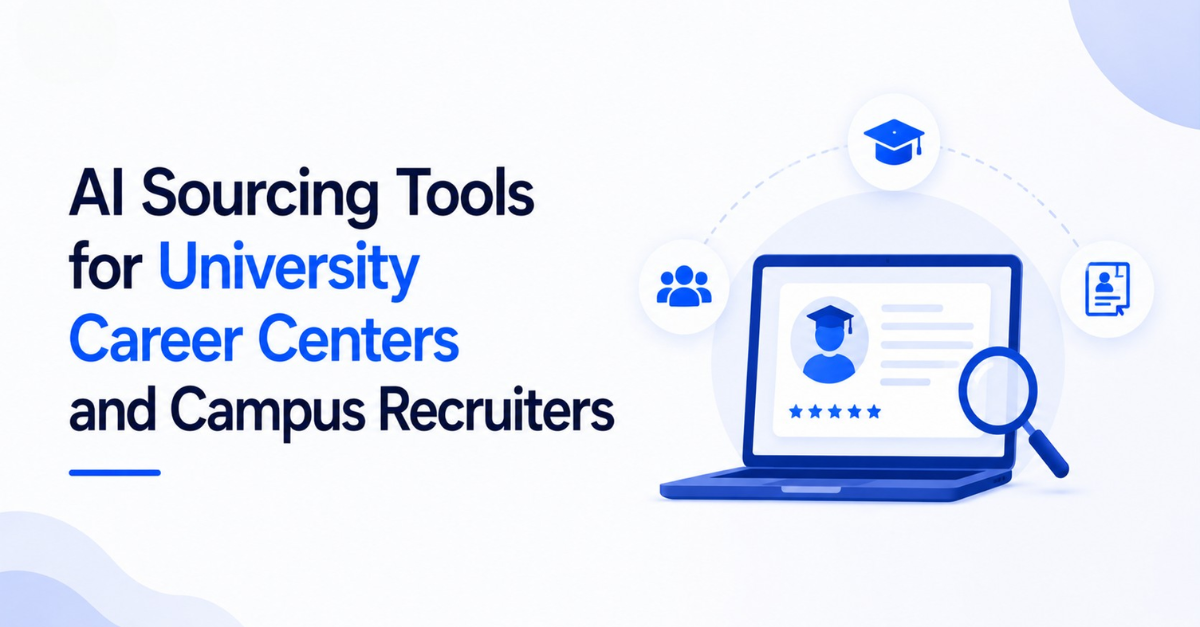
Campus recruiting has always been different from experienced hiring.
Unlike recruiters searching for senior engineers, sales leaders, or executives, campus recruiting teams often have access to thousands of candidates already. Students actively apply to graduate programs, internship opportunities, and fresher hiring drives.
The challenge is rarely candidate availability.
The challenge is managing large candidate volumes efficiently.
University career centers, placement cells, enterprise campus hiring teams, and graduate recruitment programs must coordinate communication, screening, scheduling, and engagement across hundreds—or even thousands—of students within short hiring windows.
This is why interest in AI sourcing tools for campus recruiters is growing rapidly.
While AI sourcing helps identify relevant student talent, many recruiting teams are discovering that the greatest value comes from automating what happens after sourcing.
In this guide, we'll explore how AI is transforming campus recruiting workflows and what campus recruiting teams should prioritize when evaluating technology.
Why Campus Recruiting Requires a Different Approach
Campus recruiting operates under unique constraints that traditional recruiting software wasn't designed to solve.
Student Hiring Challenges
Unlike experienced professionals, students often have:
Limited work history
Similar educational backgrounds
Fewer signals for qualification
High application volumes
As a result, traditional sourcing and matching approaches provide limited differentiation.
Recruiters often spend more time managing applicants than finding them.
High-Volume Recruiting Cycles
Campus hiring is highly seasonal.
Recruiting teams frequently manage:
Internship recruitment programs
Graduate hiring drives
Placement events
University partnerships
Campus assessments
Walk-in hiring events
During these periods, communication and coordination become significant operational challenges.
The larger the applicant pool becomes, the more difficult it is to maintain a consistent candidate experience.
How AI Sourcing Helps Campus Recruiters
AI sourcing tools still play an important role in campus recruitment.
Student Discovery
AI-powered sourcing can help recruiters identify students based on:
Academic background
Degree specialization
Technical skills
Internship experience
Certifications
Project portfolios
This allows recruiters to focus on candidates who best match hiring requirements.
Candidate Segmentation
Modern AI recruiting platforms can automatically categorize students into groups such as:
Engineering candidates
Business graduates
Internship applicants
High-potential candidates
Specialized skill categories
This improves targeting and helps recruiters personalize communication at scale.
However, identifying candidates is only the first step.
Most campus recruiting bottlenecks appear after candidate discovery.
The Biggest Campus Recruiting Bottlenecks
Many campus hiring teams discover that sourcing isn't their biggest problem.
Communication Overload
Students expect quick responses.
Recruiters often struggle to manage:
Application acknowledgements
Event reminders
Assessment invitations
Interview updates
Status notifications
Delays can negatively affect candidate engagement and employer brand perception.
Interview Scheduling
Campus recruitment frequently involves:
Recruiters
Hiring managers
University coordinators
Placement officers
Student candidates
Coordinating schedules across multiple stakeholders can consume significant recruiter time.
Candidate Drop-Offs
Student candidates often disengage due to:
Slow communication
Confusing processes
Lack of follow-up
Scheduling delays
Reducing drop-offs requires consistent engagement throughout the hiring process.
Features Campus Recruitors Should Prioritize
When evaluating AI sourcing tools for campus recruitment, candidate discovery should not be the only consideration.
Candidate Engagement
Effective campus recruiting platforms should support:
Automated outreach
Event communication
Interview reminders
Personalized updates
Multi-stage engagement workflows
Strong engagement capabilities often deliver greater impact than sourcing improvements alone.
Qualification Automation
Campus hiring frequently involves large applicant pools.
AI can help automate:
Initial screening
Eligibility verification
Assessment routing
Candidate categorization
This reduces manual review workload and improves recruiter efficiency.
Workflow Automation
Recruiting teams should also evaluate how well platforms automate:
Pipeline movement
Interview coordination
Candidate tracking
Status updates
Administrative tasks
The more workflow automation a platform provides, the more recruiter capacity it creates.
See how Huntlo helps campus recruiting teams automate student engagement and candidate communication.
How AI Improves Student Engagement
One of the most valuable applications of AI in campus recruiting is engagement automation.
Automated Outreach
AI can help recruiters communicate with hundreds of candidates simultaneously while maintaining personalization.
Common use cases include:
Campus event invitations
Application reminders
Assessment instructions
Interview scheduling requests
Personalized Communication
Students are more likely to respond when communication feels relevant.
AI can personalize messaging based on:
Program type
Skill set
University
Hiring stage
This improves response rates and engagement levels.
Follow-Up Workflows
Manual follow-ups often become impossible during large-scale hiring campaigns.
AI-driven follow-up workflows help ensure:
No candidate is forgotten
Engagement remains consistent
Response rates improve
Candidate experience remains positive
Campus Recruiting Beyond Sourcing
Many organizations initially invest in AI sourcing technology to improve candidate discovery.
Over time, they often realize the largest efficiency gains come elsewhere.
Screening
AI can automate early qualification workflows by:
Reviewing applications
Identifying eligibility criteria
Prioritizing applicants
Routing candidates appropriately
Scheduling
Interview coordination remains one of the most time-consuming recruiting activities.
Automation can reduce scheduling friction while accelerating hiring velocity.
Event Coordination
Campus recruitment frequently includes:
Career fairs
Placement drives
Assessment events
Hiring days
AI can streamline event communication, reminders, attendance tracking, and candidate coordination.
Discover how Huntlo streamlines qualification, scheduling, and campus recruiting operations.
AI Sourcing vs Agentic AI Recruiting Infrastructure
The recruiting technology market is evolving rapidly.
Finding Students
Traditional AI sourcing tools focus primarily on:
Candidate search
Talent discovery
Matching
Candidate identification
These capabilities help recruiters find talent faster.
Moving Candidates Through the Hiring Funnel
Agentic AI Recruiting Infrastructure focuses on recruiting execution.
This includes:
Candidate engagement
Qualification automation
Follow-ups
Interview coordination
Workflow management
Recruiting operations automation
The distinction is important.
Campus recruiting success depends less on finding students and more on efficiently managing thousands of interactions after students enter the funnel.
Best Practices for Campus Recruiting Teams
Organizations evaluating AI recruiting solutions should prioritize automation where bottlenecks occur most frequently.
Automation Priorities
Campus recruiters should typically automate:
Candidate communication
Screening workflows
Interview scheduling
Follow-up management
Event coordination
These areas often produce the fastest productivity gains.
Performance Measurement
Track metrics such as:
Applicant-to-interview ratio
Candidate response rates
Time-to-hire
Interview completion rates
Recruiter productivity
Candidate drop-off rates
These indicators provide a clearer picture of recruiting efficiency than sourcing volume alone.
Future Trends in Campus Recruitment
Campus hiring is moving toward increasingly automated recruiting operations.
AI-Driven Graduate Hiring
Future recruiting platforms will increasingly support:
Predictive candidate identification
Automated engagement journeys
Intelligent screening
Dynamic candidate qualification
Autonomous Recruiting Workflows
The next generation of recruiting technology will not simply assist recruiters.
It will execute recruiting workflows autonomously.
This shift enables recruiting teams to manage significantly larger hiring programs without increasing recruiter headcount.
Conclusion
Most discussions about campus recruiting technology focus on sourcing students.
But the reality is that campus recruiting challenges are rarely caused by a lack of candidates.
The real challenge is managing large candidate volumes efficiently.
Student communication, qualification, scheduling, follow-ups, and recruiting operations consume far more recruiter time than candidate discovery.
That is why the future of campus recruiting extends beyond sourcing automation.
The organizations that achieve the best hiring outcomes will be those that automate recruiting execution across the entire hiring workflow.
Platforms like Huntlo are helping universities, career centers, GCCs, and campus recruiting teams move beyond sourcing toward Agentic AI Recruiting Infrastructure that scales engagement, qualification, coordination, and recruiting operations—without increasing recruiter workload.
Learn how to scale campus hiring without increasing recruiter workload. Schedule a personalized Huntlo demo today.
Frequently Asked Questions
What are the best AI sourcing tools for campus recruiters?
The best solutions combine candidate sourcing with engagement automation, qualification workflows, scheduling, and recruiting operations support.
How can AI improve campus hiring?
AI improves campus hiring by automating communication, screening, scheduling, follow-ups, and candidate management across large applicant volumes.
What software do university recruiters use?
University recruiters commonly use campus recruiting platforms, applicant tracking systems, candidate engagement software, and AI-powered recruiting tools.
How do recruiters automate student hiring?
Recruiters automate student hiring using AI-powered workflows for candidate engagement, qualification, interview scheduling, and follow-up communication.
What is campus recruitment automation?
Campus recruitment automation uses technology to streamline candidate communication, screening, scheduling, event coordination, and recruiting workflows.
How can AI help university career centers?
AI can improve student engagement, automate communication, support employer partnerships, and help career centers manage placement activities more efficiently.
What recruiting tasks should be automated first?
Most campus recruiting teams should prioritize automating candidate communication, qualification, follow-ups, and scheduling.
What is Agentic AI recruiting?
Agentic AI recruiting uses autonomous AI systems to execute recruiting workflows such as engagement, qualification, scheduling, and coordination with minimal manual intervention.
How can recruiters improve student engagement?
Personalized communication, automated follow-ups, and timely updates significantly improve student engagement throughout the hiring process.
What comes after sourcing automation?
After sourcing automation, organizations increasingly focus on engagement automation, qualification workflows, scheduling, and recruiting operations automation.
Related Topic
AI Sourcing Tools for Solo Recruiters and Freelancers
Is AI Sourcing Worth It for Small Recruitment Teams?
AI Sourcing for EdTech and SaaS Hiring: What High-Growth Teams Need to Know