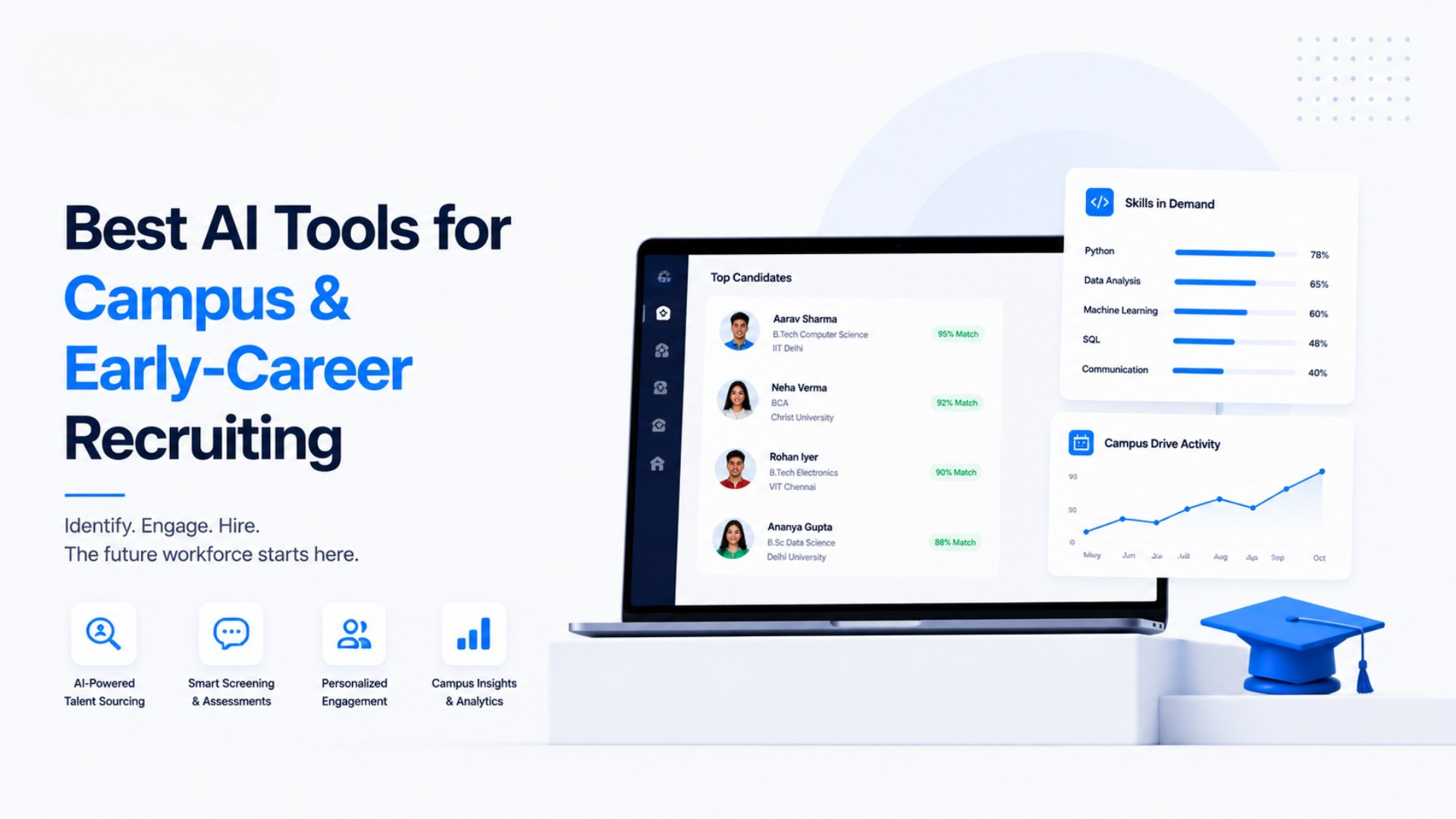
Why Campus Recruiting Breaks Most AI Hiring Tools
Most AI recruiting platforms were built to solve a specific problem: finding experienced professionals who match a set of skills and credentials. The AI evaluates years of experience, specific technology proficiency, career trajectory, industry background, and professional accomplishments. These are meaningful signals when you are hiring a senior engineer or a marketing director. They are almost entirely meaningless when you are hiring a graduating senior with a computer science degree and one summer internship.
Campus recruiting requires evaluating potential rather than track record. The signals that predict early-career success are fundamentally different from the signals that predict experienced-hire success. According to NACE's 2025 Job Outlook Survey, the top attributes employers look for in new college graduates are communication skills, teamwork, problem-solving ability, initiative, and analytical thinking — none of which are captured by traditional resume-based AI screening. Academic performance (GPA) matters, but it is a noisy signal — a 3.9 GPA from a rigorous program is different from a 3.9 GPA from a less demanding one, and many of the most successful early-career hires had good but not exceptional grades.
The candidate population is different too. College students and recent graduates are digital natives who consume information and communicate differently than experienced professionals. They are active on LinkedIn but also on Handshake, RippleMatch, and university career platforms. They follow employers on Instagram and TikTok, not just LinkedIn. They expect a mobile-first experience and rapid communication — waiting a week for a response to an application is unacceptable to a generation that grew up with instant messaging. According to Handshake's 2025 campus recruiting trends report, 78 percent of college students expect to hear back from an employer within one week of applying, and 45 percent expect a response within three days.
The timing is different as well. Campus recruiting runs on academic calendars, not business calendars. The primary hiring cycle for new graduates aligns with fall and spring recruiting seasons, with most offers extended between October and March for June start dates. Internship recruiting often happens even earlier, with many companies recruiting summer interns the preceding fall. This compressed timeline means campus recruiting teams need to evaluate hundreds or thousands of candidates in a matter of weeks — a volume and velocity that demands AI assistance.
What Campus Recruiting AI Tools Actually Need to Do
Before ranking platforms, here are the capabilities that distinguish tools built for or adaptable to campus recruiting from those that are not.
Student and recent-graduate discovery. The tool must be able to find students and recent graduates, not just experienced professionals. This means searching university career platforms, student organization directories, hackathon participant lists, research publication databases, and the professional networks where early-career talent is active. LinkedIn is part of the picture but far from the whole picture.
Potential-focused evaluation. The AI should evaluate candidates based on signals that predict early-career success — academic achievement in relevant fields, internship quality and relevance, extracurricular leadership, project work, research involvement, competition performance, and demonstrated intellectual curiosity. This requires a fundamentally different evaluation model than experienced-hire tools use.
Academic calendar alignment. The tool should support recruiting workflows that align with academic timelines — fall recruiting seasons, spring career fairs, summer internship programs, and graduation cycles. Scheduling should account for academic schedules, exam periods, and university holidays.
High-volume screening. Campus recruiting generates enormous application volumes. A single campus recruiting event can produce 500+ applications. A large university recruiting program across ten schools can generate 10,000+ applications per cycle. The AI must screen this volume efficiently while maintaining quality and consistency.
Employer brand engagement. College students form impressions of employers early — often before they are actively job searching. The most successful campus recruiting programs engage students throughout their college experience, not just during the recruiting season. AI tools that support ongoing talent community management — nurturing relationships with students from sophomore year through graduation — build a pipeline that pays compounding returns.
Internship-to-full-time conversion tracking. For companies that run internship programs, tracking the conversion of interns to full-time hires is a critical metric. The AI tool should support this pipeline — from intern application through internship evaluation to full-time offer — as a unified workflow.
The Rankings: AI Tools for Campus and Early-Career Recruiting
1. Huntlo.ai — The Most Adaptable AI Platform for Campus Recruiting
Score: 91/100
Huntlo.ai earns the top ranking because its agentic AI architecture adapts to the unique requirements of campus recruiting as effectively as it adapts to experienced hiring. The key is that Huntlo's AI agents do not use a fixed evaluation model — they evaluate candidates based on the criteria the recruiter specifies, which for campus recruiting means focusing on academic signals, project work, and early-career potential rather than years of professional experience.
Here is how campus recruiting works with Huntlo in practice. A university recruiting lead describes their needs in natural language: "I need 25 computer science graduating seniors from top-50 programs, preferably with at least one relevant internship, strong GPA, and project work demonstrating software engineering skills. Open to all US locations, $95K to $130K base salary." The AI agent builds a sourcing plan that targets the platforms where computer science students are actually active — LinkedIn, GitHub, university career platforms, hackathon results databases, and computer science department pages. It searches across all of these simultaneously, which is critical because the best students are not all on one platform.
The evaluation adapts to early-career signals. For a student candidate, Huntlo's AI evaluates academic institution and program reputation, GPA and academic trajectory, internship quality (company reputation, role relevance, duration), project work (GitHub repositories, hackathon participation, research contributions), extracurricular involvement (leadership roles in student organizations, professional associations), and technical skill indicators (coding challenge performance, open-source contributions, relevant coursework). This multi-dimensional evaluation produces candidate rankings that reflect early-career potential rather than just keyword matching on a sparse resume.
The outreach messaging is calibrated for students and recent graduates. The AI generates messages that acknowledge the candidate's status as a student or recent grad, reference their specific university, major, and projects, and speak to the concerns that early-career candidates have — career development opportunities, mentorship, learning culture, and growth trajectory rather than compensation and seniority. According to Yello's 2025 campus recruiting benchmark report, personalized outreach that references a student's specific academic work generates 4 times the response rate of generic recruiting messages. Huntlo's AI generates exactly this kind of message at scale.
Multi-channel outreach matters enormously for campus recruiting. Students are highly responsive to LinkedIn messages, but they are also responsive to email and, increasingly, to WhatsApp — particularly international students and students from demographics where WhatsApp is the primary communication tool. Huntlo's support for email, LinkedIn, WhatsApp, and AI voice calls means you reach early-career candidates through whatever channel they prefer. For international student recruiting — a growing priority for many companies — WhatsApp support is particularly valuable.
The talent pool management is where Huntlo delivers long-term value for campus recruiting. Every student the AI discovers and engages enters a talent pool segmented by university, major, graduation year, and interest level. The AI runs nurturing campaigns that keep students warm throughout their college experience — sharing relevant content about the company, inviting them to events, and maintaining the relationship until they are ready for the formal recruiting process. According to the National Association of Colleges and Employers, companies that engage students before their senior year fill 40 percent more campus positions than those that only recruit during the formal hiring season.
At $99 per seat per month, Huntlo delivers more campus recruiting capability per dollar than any other platform on this list. For university recruiting teams that need to source across dozens of schools, screen thousands of applications, and maintain year-round engagement with early-career talent, the value proposition is overwhelming.
2. RippleMatch — AI-Powered Campus Recruiting Platform
Score: 85/100
RippleMatch is one of the few platforms built specifically for campus recruiting, and its AI-powered matching is genuinely effective. The platform connects employers with early-career candidates based on mutual fit — analyzing student profiles, employer preferences, and historical hiring data to identify high-potential matches. Students create profiles on RippleMatch, and the AI matches them with relevant employers and opportunities.
RippleMatch's standout feature is its candidate pool. Over one million students and recent graduates have created profiles on the platform, which gives employers access to a pre-built audience of early-career talent. The AI matching considers academic background, skills, interests, location preferences, and diversity factors to identify candidates who are both qualified and likely to be interested in a specific opportunity.
The platform handles the initial outreach and screening, presenting matched candidates to employers who can then decide whether to pursue the match. This reversed approach — where candidates are matched to employers rather than employers searching for candidates — is well-suited to campus recruiting, where students are often unsure where to direct their applications.
The limitations are scope and flexibility. RippleMatch is a closed ecosystem — it only matches students who have created profiles on the platform, which means you miss the students who are active elsewhere (GitHub, university career platforms, professional communities). The outreach personalization is good but not at the level of agentic platforms that reference specific student work. The platform does not support multi-channel outreach beyond email. And at pricing that typically ranges from $5,000 to $25,000+ per year depending on scope, it is significantly more expensive than Huntlo while covering a narrower range of functionality.
3. Handshake — The Largest Student Professional Network
Score: 82/100
Handshake is the dominant platform in campus recruiting, with over 10 million student users across more than 1,400 colleges and universities. If you are recruiting college students in the United States, many of your target candidates are already on Handshake. The platform provides job posting distribution to university career centers, virtual and in-person career fair management, employer branding pages, and basic applicant tracking.
Handshake's strength is reach. No other platform provides access to as many college students at scale. The platform integrates directly with university career services, which means your job postings appear within the university's own career systems — a level of institutional access that no other tool can match. For companies with large campus recruiting programs, Handshake is effectively mandatory.
However, Handshake is primarily a job board and career fair platform, not an AI sourcing tool. It does not autonomously discover candidates across multiple platforms, does not generate personalized outreach, and does not conduct conversational screening. Students find your postings and apply — the platform does not proactively find them. The AI features that Handshake has added — candidate recommendations and basic matching — are useful but limited compared to the agentic capabilities of dedicated AI sourcing platforms.
For most campus recruiting teams, the practical approach is to use Handshake for its unparalleled reach and institutional access, supplemented by an AI sourcing platform like Huntlo for proactive candidate discovery, personalized outreach, and screening. For a pricing comparison across the full landscape, our analysis of Huntlo vs Juicebox vs SeekOut vs hireEZ shows how AI sourcing costs compare to campus-specific platform fees.
4. Yello — Campus-First Recruiting CRM
Score: 79/100
Yello was built specifically for campus recruiting and it shows. The platform manages the entire campus recruiting lifecycle — from event registration and career fair management to candidate communication, interview scheduling, and offer management. Yello's event management is particularly strong, allowing recruiters to register for career fairs, manage event logistics, track attendee engagement, and follow up with students met at events.
The platform also provides a talent CRM specifically designed for early-career candidates. You can build talent communities organized by university, major, graduation year, and engagement level. The nurturing campaigns keep students warm between recruiting seasons, which is critical for building a pipeline that produces results year over year.
The limitations are on the AI side. Yello does not have its own AI sourcing engine — it manages candidates you have already identified through events, postings, or other channels. The platform has added some AI features for candidate matching and communication optimization, but the AI capabilities are enhancements to a traditional CRM rather than the autonomous, multi-platform sourcing that agentic platforms provide. Yello also does not support multi-channel outreach beyond email. Pricing is enterprise-level, typically $15,000 to $40,000+ per year depending on the number of schools and features.
5. SeekOut — Deep Database With Campus-Friendly Features
Score: 76/100
SeekOut's massive database of over 800 million profiles includes a substantial population of students and recent graduates. The platform can filter by education level (bachelor's, master's, PhD), university, major, graduation year, and GPA range — which provides reasonable campus recruiting search capabilities. SeekOut's diversity analytics are also valuable for campus recruiting programs that have specific diversity hiring goals.
However, SeekOut is a general-purpose platform, and its evaluation model is designed for experienced professionals, not students. The AI does not evaluate project work, hackathon participation, research involvement, or the other early-career signals that matter most. The outreach is template-based and limited to email and LinkedIn. At $200-plus per month for a single seat, it delivers a large database but incomplete campus-specific evaluation. For teams evaluating costs, our SeekOut pricing guide provides a full breakdown.
6. hireEZ — AI Sourcing With Basic Campus Support
Score: 73/100
hireEZ provides AI-powered sourcing with filters that include education level, university, and graduation year. The platform can identify recent graduates and students with relevant academic backgrounds, and the automated outreach sequences can be adapted for early-career messaging. For campus recruiting teams that want AI-assisted sourcing within a general-purpose tool, hireEZ provides functional capability.
The limitations are significant. hireEZ does not evaluate early-career signals like project work, hackathon participation, or research involvement. The AI matching is based primarily on skills and keywords, which is less meaningful for students with limited professional experience. The multi-channel support is limited to email, missing the LinkedIn, WhatsApp, and voice channels that are important for reaching the full early-career candidate population. At $150 to $250 per month, it provides moderate campus recruiting value.
7. Symplicity — University Career Services Platform
Score: 71/100
Symplicity is the career services platform used by hundreds of universities. It is not a recruiting tool that employers use directly — it is the system that university career centers use to manage job postings, career fairs, and on-campus recruiting. However, many employers interact with Symplicity indirectly when they post jobs through university career centers, because those postings are distributed through the Symplicity platform.
Symplicity's relevance to campus recruiting AI is limited. It provides the institutional infrastructure that campus recruiting depends on, but it does not offer AI sourcing, personalized outreach, or intelligent screening. For employers, Symplicity is a distribution channel rather than a recruiting tool. The AI-powered screening and engagement still needs to happen through a separate platform.
8. Fetcher — Automated Sourcing With Campus Potential
Score: 69/100
Fetcher provides automated sourcing with AI-powered candidate matching, and the platform can be configured to search for candidates with specific education levels and recent graduation dates. The automated email outreach can be adapted for early-career messaging, and the platform handles the volume that campus recruiting generates reasonably well.
However, Fetcher's database is not optimized for student populations, the evaluation model does not prioritize early-career signals, and the outreach is limited to email. For campus recruiting teams that want a "set it and forget it" approach to reaching recent graduates through a general-purpose tool, Fetcher is functional. But it does not deliver the depth, personalization, or multi-channel capability that dedicated campus recruiting platforms or agentic AI tools provide. At around $200 per month, it provides modest value for campus-specific use cases. For teams exploring alternatives with stronger AI capabilities, our comparison of TurboHire alternatives covers platforms that may better serve high-volume early-career hiring.
Building a Campus Recruiting Tech Stack for 2026
The optimal campus recruiting stack combines platforms that excel at different aspects of the early-career hiring process.
For Companies With Moderate Campus Programs (1–5 schools, under 50 campus hires per year):
Huntlo.ai for AI-powered sourcing, multi-channel outreach, conversational screening, and year-round talent community management ($99 per seat per month). Handshake for job posting distribution to university career centers (pricing varies, often included through university partnerships). A free or low-cost ATS like Freshteam for applicant tracking and interview scheduling.
This lean stack gives a small campus recruiting team AI-powered discovery and engagement across all the platforms where students are active, plus the institutional reach of Handshake. The total cost is dominated by Huntlo at $99 per month, making it accessible even for small campus programs.
For Companies With Significant Campus Programs (5–20 schools, 50–200 campus hires per year):
Huntlo for AI sourcing, outreach, screening, and talent pools ($99 per seat per month). Handshake for university career center distribution and career fair management. Yello for event management, campus-specific CRM, and student talent communities ($15,000 to $25,000 per year). An ATS like Greenhouse or Lever for structured interview management and offer processing.
This stack adds Yello's campus-specific event and CRM capabilities on top of Huntlo's AI sourcing and Handshake's institutional reach. The combination provides comprehensive coverage of every stage of the campus recruiting process.
For Enterprise Campus Programs (20+ schools, 200+ campus hires per year):
Huntlo for AI sourcing and engagement at scale ($99 per seat per month). Handshake for career center distribution and employer branding. Yello for campus event management and talent CRM. RippleMatch for additional candidate matching and pipeline building ($5,000 to $25,000 per year). An enterprise ATS like Greenhouse or Workday for full hiring process management. GoodTime for high-volume interview scheduling ($500+ per month).
At enterprise scale, the technology investment is significant but the return is enormous. AI-powered sourcing enables the team to identify and engage candidates across dozens of universities simultaneously — something that was previously impossible without a proportional increase in recruiter headcount.
The Strategy That Multiplies Campus Recruiting ROI
The most successful campus recruiting programs in 2026 do not treat recruiting as a seasonal activity. They build year-round relationships with early-career talent, and AI tools make this strategy scalable.
Year one: Build awareness. Use Huntlo's AI to identify promising students at your target universities — sophomores and juniors who match your hiring profile. Engage them with relevant content about your company, industry, and career opportunities. Invite them to virtual events, webinars, and open houses. The goal is not to hire them now but to build a relationship that makes them think of your company first when they are ready to recruit. According to Universum's 2025 employer branding research, students form their top-5 employer preference list by their junior year, and companies not on that list face a significant disadvantage during formal recruiting.
Year two: Deepen engagement. Continue nurturing the talent pool you built in year one. Share more specific content about your internship programs, your technology, your culture, and your career development paths. Invite students to technical talks, office visits, and small-group conversations with your employees. The AI tracks which students are most engaged and flags them for priority attention during the formal recruiting season.
Year three: Convert. When the formal recruiting season arrives, you already have a warm, engaged talent pool of students who know your company, are interested in your opportunities, and have been interacting with your brand for one to two years. Your AI sourcing identifies additional strong candidates who entered your target universities since your initial outreach. The formal recruiting process starts with a shortlist of warm candidates rather than a cold search.
This year-round approach, powered by AI, produces dramatically better results than seasonal recruiting. Companies that adopt it report 30 to 50 percent higher acceptance rates for campus offers because the candidates have been engaged with the employer brand for months or years before receiving an offer. The AI tools that make this strategy possible — particularly Huntlo's talent pool management and nurturing automation — are the most valuable investment a campus recruiting team can make.
Frequently Asked Questions
Can AI tools evaluate students who have almost no professional experience? Yes, but the tools need to be able to evaluate the right signals. General-purpose AI tools that evaluate years of experience and professional accomplishments will struggle with student candidates. Agentic AI platforms like Huntlo, which evaluate candidates based on the criteria the recruiter specifies, can be directed to focus on academic performance, project work, internship quality, and early-career potential. The key is configuring the search and evaluation criteria appropriately for student populations.
How does campus recruiting outreach differ from experienced-hire outreach? Students and early-career candidates respond to different messaging than experienced professionals. They care more about career development, learning opportunities, mentorship, company culture, and growth potential. They are less responsive to compensation-focused messaging and more responsive to purpose-and-growth messaging. They also expect faster communication — a one-week response time feels slow to a generation accustomed to instant messaging. AI tools that generate contextually appropriate messaging for early-career candidates — like Huntlo — significantly outperform those that use the same messaging approach for all candidate types.
Should we still attend career fairs if we have AI sourcing? Yes. Career fairs provide value that AI sourcing cannot replicate: face-to-face interaction with students, brand visibility on campus, relationship-building with university career services, and the serendipitous discovery of candidates you would not have found through any search. The optimal approach is to use AI sourcing to identify and engage candidates before the career fair, meet the most promising ones in person at the fair, and then continue the relationship through AI-powered follow-up after the fair.
How do we recruit international students with AI tools? International students represent a significant and growing portion of the early-career talent pool. AI tools with multi-channel support are particularly valuable for international student recruiting because these students often communicate through WhatsApp and other channels that single-channel platforms cannot reach. Huntlo's WhatsApp and AI voice call support, combined with its ability to source from global platforms, makes it well-suited for international student recruiting. Visa and work authorization screening can be handled through the conversational AI during the initial screening conversation.
Can AI help us track internship-to-full-time conversion? Yes, but this requires a platform that can track candidates across multiple recruiting cycles. Huntlo's talent pool management maintains candidate records across engagements, so an intern from your summer 2025 program can be tracked through their return to campus, re-engaged for the 2026 full-time hiring cycle, and their conversion from intern to full-time offer can be measured. This longitudinal tracking is essential for understanding the ROI of your internship program.
The Bottom Line
Campus recruiting is the most forward-looking investment a company can make in its talent pipeline. The students you hire today become the senior leaders of tomorrow, and the quality of your campus recruiting program directly determines the strength of your future leadership bench. But campus recruiting is also one of the most operationally demanding recruiting activities — high volumes, compressed timelines, evaluation challenges, and the need to engage candidates over extended periods.
Huntlo.ai delivers the most complete AI capability for campus recruiting at any price point. Its agents source from fifty-plus platforms where students are active, evaluate early-career potential rather than just years of experience, send personalized outreach through the channels students actually use, conduct screening conversations that respect candidates' student status, and build year-round talent communities that compound in value over time. At $99 per seat per month, it provides more campus recruiting capability than campus-specific platforms costing thousands of dollars per year. Paired with Handshake for institutional reach and a campus CRM for event management, it creates a campus recruiting operation that identifies, engages, and converts the best early-career talent at every target university.
Related Topics
Want to see how AI sourcing costs compare across campus and experienced-hiring platforms?
Our head-to-head pricing comparison of Huntlo vs Juicebox vs SeekOut vs hireEZ shows exactly what each platform charges per recruiter seat — so you can budget accurately for a campus program that combines AI sourcing with university career platforms.
Need outreach automation but not sure if a sequence tool is enough for campus recruiting?
Our honest 2026 review of Juicebox reveals the limits of sequence-based outreach for early-career candidates — and why conversational AI that adapts messaging to student profiles consistently outperforms template-driven sequences.
Managing a high-volume early-career pipeline and need better ATS options?
Our analysis of TurboHire alternatives for AI ATS and sourcing covers applicant tracking systems that handle the unique demands of campus recruiting — high application volumes, intern-to-full-time conversion tracking, and academic calendar-aligned workflows.