Tomoko Ishida, the chief talent officer at a Tokyo-based technology conglomerate with forty-five thousand employees across twenty-three countries, opened the quarterly talent review and knew the numbers would be difficult. Cost-per-hire had risen thirty-one percent in three years. Time-to-fill for senior engineering roles now averaged fifty-eight days, up from forty-two. Candidate withdrawal between offer acceptance and day one had reached nineteen percent, nearly double the rate when she joined the organization. Her team had added recruiters, expanded sourcing channels, and increased employer brand investment. The results had not improved. They had deteriorated. Tomoko recognized that she was not managing a recruiting performance problem. She was managing a structural transformation in the talent market that her current operating model was not designed to address. The candidates her team needed were more selective, more informed, and more in demand than at any point in her twenty-year career. The tools and processes her team relied on, resume databases, job board postings, manual screening, and email-based scheduling, were designed for a talent market that no longer existed. Tomoko had been reading about AI-first recruiting models and knew the theory was sound. What she did not yet know was whether her organization could make the transition fast enough to avoid falling further behind.
The Data That Demands an AI-First Approach
Tomoko Ishida, the chief talent officer at a Tokyo-based technology conglomerate with forty-five thousand employees across twenty-three countries, reviewed the annual recruiting performance report in December 2025 and saw numbers that confirmed a trend she had been tracking for three years. Cost-per-hire had increased by thirty-one percent since 2022. Time-to-fill for engineering roles had risen from forty-two days to fifty-eight days. Candidate withdrawal rates between offer acceptance and start date had climbed from eleven percent to nineteen percent. Meanwhile, the number of applications per open role had dropped by forty percent as skilled professionals became more selective and less responsive to traditional recruiting outreach. Tomoko was not managing a temporary market fluctuation. She was managing a structural shift in the talent market that made the existing recruiting model progressively less effective with each passing year. Research published by SHRM in its 2025 talent acquisition benchmarking study found that sixty-three percent of recruiting leaders globally reported that traditional sourcing and engagement methods were producing declining returns, with the steepest declines in technology, healthcare, and financial services. The data was unambiguous: the approaches that had powered recruiting for two decades were reaching the limits of their effectiveness, and organizations that continued to rely on them would find themselves progressively outcompeted for talent.
The structural drivers of this shift are well documented and not subject to reversal. The global talent shortage, which the McKinsey Global Institute estimated would affect eighty-five million workers by 2030, is creating a persistent imbalance between talent demand and supply that gives candidates increasing leverage. Remote and hybrid work has expanded every role competition from local to global, meaning that a software engineer in Lagos, a data scientist in Warsaw, and a product manager in Sao Paulo are now competing for the same positions as candidates in San Francisco and London. Social media and employer review platforms have given candidates unprecedented visibility into hiring processes, raising their expectations for speed, transparency, and professionalism. Generative AI has given candidates the ability to customize resumes, cover letters, and interview responses at scale, making it harder for recruiters to distinguish genuine capability from AI-assisted performance. These forces are not cyclical. They are structural, cumulative, and accelerating. The organizations that will thrive in this environment are those that adopt AI not as an incremental improvement to existing processes but as the foundational architecture of a fundamentally different approach to recruiting. This is the shift from AI-assisted recruiting to AI-first recruiting, and it is the defining strategic decision that talent acquisition leaders will make in the coming decade.
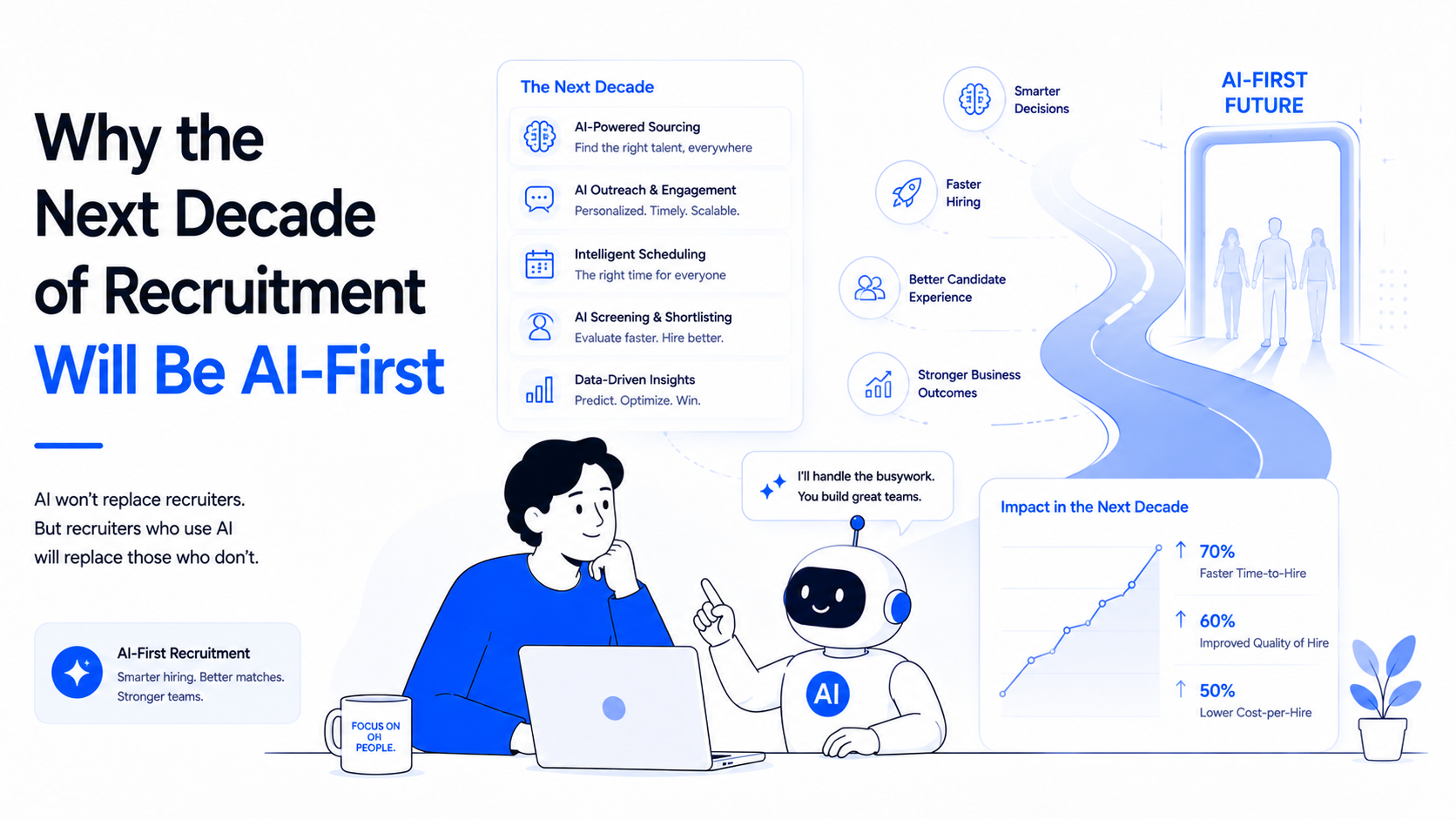
The distinction between AI-assisted and AI-first recruiting is critical and often misunderstood. AI-assisted recruiting uses artificial intelligence to optimize individual tasks within an existing process: an AI tool screens resumes faster, an AI chatbot handles initial candidate questions, an AI scheduling tool reduces coordination time. The process itself remains fundamentally the same. Recruiters still manage the workflow, make the key decisions, and coordinate between systems. AI-first recruiting inverts this model. The AI system owns the workflow, making operational decisions autonomously, coordinating across systems without human direction, and escalating to human recruiters only when judgment, creativity, or relationship
management is required. The recruiter role shifts from process manager to strategic advisor, focusing on candidate relationship quality, hiring manager partnership, and workforce planning. An agentic AI recruiting platform represents this AI-first model in its purest form: a system that operates autonomously across the full recruiting workflow, from sourcing through scheduling through offer management, making intelligent decisions at each stage and involving human recruiters only when their specific capabilities are required. The transition from AI-assisted to AI-first is not a technology upgrade. It is a fundamental re-architecture of how the recruiting function operates.
What AI-First Recruiting Actually Looks Like in Practice
An AI-first recruiting function operates differently at every stage of the hiring process. In sourcing, the AI system continuously scans talent pools, identifies candidates whose profiles match open and anticipated roles, and initiates personalized outreach based on candidate-specific context such as career trajectory, recent publications, and professional network activity. The system does not wait for a recruiter to run a search and select candidates. It proactively builds and maintains a dynamic talent pipeline that is always current and always matched to organizational needs. According to LinkedIn 2025 Global Talent Trends report, organizations with AI-driven continuous sourcing pipelines fill positions twenty-eight to thirty-five percent faster than those that rely on recruiter-initiated search, because the pipeline is already populated with qualified, engaged candidates when a role opens rather than requiring a sourcing sprint after the fact. The sourcing system operates around the clock across multiple channels and geographies, maintaining candidate engagement through contextual, non-intrusive touchpoints that keep the organization top of mind without creating the fatigue that drives candidates to disengage.
In screening and assessment, the AI-first model replaces manual resume review and structured interview scoring with intelligent evaluation that considers the full scope of candidate capability. Rather than filtering candidates based on keyword matches or rigid qualification thresholds, the system evaluates candidates holistically, considering career progression patterns, skill adjacency, project complexity, and demonstrated impact alongside traditional qualifications. This approach is particularly valuable for identifying high-potential candidates from non-traditional backgrounds who would be filtered out by conventional screening criteria. According to Gartner research on AI in hiring, organizations using AI-driven holistic assessment report thirty to forty percent more diverse candidate shortlists and fifteen to twenty percent higher new-hire performance ratings at the twelve-month mark, because the assessment identifies capability that keyword-based screening misses. The system also conducts initial candidate engagement through conversational AI that evaluates communication skills, cultural alignment, and role motivation in real time, providing assessment data that is far richer than what a static resume can convey.
In scheduling and coordination, the AI-first model eliminates the manual logistics that consume recruiting capacity. Interview scheduling, panel coordination, candidate
communication, and hiring manager alignment happen autonomously, with the AI system managing time zones, participant availability, organizational policies, and candidate preferences as integrated constraints within a unified optimization model. The recruiter sees exceptions and strategic decisions, not calendar conflicts and email threads. In offer management, the AI system generates competitive offer recommendations based on real-time market data, candidate engagement signals, and organizational compensation benchmarks, presenting the hiring manager with data-driven options rather than requiring manual research. The end-to-end integration of these capabilities is what distinguishes AI-first from AI-assisted. In an AI-assisted model, each capability is a separate tool that the recruiter orchestrates. In an AI-first model, the capabilities are unified in a single intelligent workflow that orchestrates itself. The distinction between these two models is explored in depth in analyses of the difference between AI sourcing and AI recruiting, where the most effective implementations are those that unify capabilities into a coherent system rather than deploying them as independent point solutions that require human coordination.
How AI-First Recruiting Changes the Recruiter Role
The most consequential impact of the AI-first transition is not on technology or process. It is on people. The recruiter role will change more in the next decade than it has in the previous three, and the organizations that manage this transition effectively will gain a decisive competitive advantage in the war for talent. The core change is a shift from operational execution to strategic advisory. Today, the average recruiter spends roughly sixty percent of their time on operational tasks: sourcing, screening, scheduling, correspondence, and administrative coordination. In an AI-first model, these tasks are handled autonomously, and the recruiter time is reallocated to activities that require human judgment, creativity, and relationship skills: candidate relationship management, hiring manager consulting, workforce planning, employer brand development, and strategic talent intelligence. This is not a reduction of the recruiter role. It is an elevation. Research on whether recruiters should worry about AI replacing their jobs consistently demonstrates that AI-first organizations report higher recruiter job satisfaction, lower recruiter turnover, and stronger recruiter hiring manager relationships, because recruiters are doing work that is more intellectually stimulating and more strategically valuable than the operational tasks that previously dominated their days.
The practical implications for recruiting leaders are significant. The recruiters who will thrive in the AI-first era are those who develop skills in data interpretation, strategic advisory, stakeholder management, and candidate relationship depth. Technical skills in Boolean search, resume formatting, and calendar management, which have historically been core recruiter competencies, will diminish in importance as AI handles these tasks more effectively than any human can. The recruiters who resist this transition, who cling to operational tasks as their primary value contribution, will find their roles increasingly automated and their career trajectories limited. Deloitte 2025 Human Capital Trends report identified the transition from operational recruiting to strategic talent advisory as the single most important workforce transformation facing recruiting functions, noting that organizations investing in recruiter upskilling
for the AI-first era are two and a half times more likely to report improved hiring outcomes than those focused primarily on technology deployment without corresponding talent development. The technology is necessary but insufficient. The recruiter transformation is what determines whether the AI-first transition produces competitive advantage or merely cost reduction.
The hiring manager relationship will also transform. Today, many hiring managers view the recruiting function as a service provider that delivers candidates for evaluation. In the AI-first model, the recruiter evolves into a strategic talent advisor who partners with the hiring manager on workforce planning, role design, candidate assessment strategy, and offer positioning. The AI handles the operational delivery of candidates and interview scheduling. The recruiter handles the strategic conversation about what the team needs, how to attract it, and how to evaluate it. This partnership model produces better hiring outcomes because it combines the hiring manager domain expertise with the recruiter talent market intelligence in a way that the service provider model does not support. EY research on the future of the HR business partner model has found that hiring managers who work with strategic talent advisors, rather than operational recruiters, make significantly better hiring decisions, as measured by new-hire performance, retention, and team impact, because the strategic conversation improves the quality of the hiring specification, the assessment criteria, and the offer strategy before any candidate is ever evaluated.
Building an AI-First Recruiting Strategy: Where to Start
The transition to AI-first recruiting should be approached as a multi-year strategic initiative, not a point technology deployment. The first phase should focus on data infrastructure. AI-first recruiting requires high-quality, integrated data from every relevant system: applicant tracking systems, human resource information systems, performance management platforms, compensation databases, and market intelligence feeds. Organizations that attempt to deploy AI recruiting tools on top of fragmented, siloed data achieve disappointing results because the AI is making decisions based on incomplete or inconsistent information. SHRM guidance on AI readiness in talent acquisition recommends conducting a comprehensive data audit before evaluating any AI recruiting technology, because data quality is the single strongest predictor of AI deployment success. The audit should assess data completeness, consistency, timeliness, and accessibility across all systems that feed the recruiting workflow.
The second phase focuses on process redesign. AI-first recruiting requires different processes than AI-assisted recruiting. Workflow steps that were designed for human execution must be reconfigured for AI orchestration. Decision points that required recruiter judgment must be evaluated to determine which can be delegated to AI and which must remain human. Communication cadences that were designed for manual management must be reimagined for automated delivery with human oversight. This process redesign is not about making existing processes faster. It is about rethinking what the process should accomplish and how AI can accomplish it differently and better. The third phase is technology selection and deployment.
Organizations evaluating AI recruiting platforms should prioritize platforms that support end-to-end workflow orchestration rather than point solutions for individual tasks. For guidance on how to approach this evaluation, resources on how to evaluate an AI sourcing tool before buying provide a framework for assessing orchestration depth, data integration capability, and learning adaptability. According to McKinsey analysis of digital transformation in HR, organizations that select integrated platforms over best-of-breed point solutions achieve forty to sixty percent faster time-to-value and thirty percent lower total cost of ownership over five years, because integrated platforms eliminate the data silos and integration maintenance that fragment the point-solution approach.
The fourth phase is organizational change management. Recruiting teams, hiring managers, and candidates must all adapt to new ways of working. Recruiters must develop new skills and embrace new roles. Hiring managers must learn to partner with AI-augmented recruiting teams. Candidates must adapt to AI-driven assessment and communication. Each of these transitions requires deliberate investment in communication, training, and feedback. The organizations that manage this change most effectively are those that frame the AI-first transition as an investment in recruiter capability and candidate experience rather than a cost reduction exercise, because the narrative shapes how stakeholders perceive and engage with the change. When recruiters see AI as a tool that elevates their role, they embrace it. When they see it as a threat that diminishes their value, they resist it. The evidence from early adopters is clear: AI-first recruiting produces better outcomes for organizations, recruiters, and candidates. The transition requires investment, patience, and deliberate change management. But the organizations that make the transition will have a decisive competitive advantage in the talent market of the next decade, an advantage that compounds over time as the AI systems learn and improve with every hiring decision they inform.
The Competitive Landscape of AI-First Recruiting
The adoption of AI-first recruiting is accelerating across industries and geographies, and the organizations that move first will accumulate advantages that late adopters will find difficult to overcome. Early adopters are building AI systems that learn from every hiring decision, every candidate interaction, and every market signal, creating a compounding data advantage that makes their recruiting more effective with each hire. Late adopters, by contrast, will face a dual disadvantage: they will compete for talent against organizations with faster, more effective hiring processes, and they will lack the training data that makes AI systems more intelligent over time. According to LinkedIn 2025 Hiring Trends report, organizations that deployed AI recruiting capabilities before 2025 are filling positions forty to fifty percent faster than those that have not yet deployed, and the gap is widening as early adopters accumulate learning data that improves their AI performance. This dynamic, where early adoption creates a self-reinforcing advantage, means that the window for organizations to begin the AI-first transition is narrowing. Organizations that wait until AI-first recruiting is the industry standard will find themselves competing against rivals with years of learning data and process optimization that cannot be replicated quickly.
The competitive dynamics are particularly intense in industries and geographies where talent scarcity is most acute. Technology companies, healthcare systems, financial services firms, and manufacturing enterprises with advanced automation needs are all competing for a limited and shrinking pool of skilled professionals. In these markets, the difference between an AI-first recruiting function and a traditional one is not marginal. It is decisive. AI-first organizations identify and engage candidates faster, deliver a superior candidate experience, make better hiring decisions, and retain new hires more effectively. These advantages compound across the entire talent lifecycle, from initial sourcing through onboarding and beyond, creating a talent ecosystem that becomes progressively stronger while traditional organizations struggle with the same challenges that AI-first systems have already solved. Gartner projects that by 2030, seventy-five percent of large enterprises will have adopted AI-first recruiting capabilities in at least one business unit, and that organizations without AI-first capabilities will face significant competitive disadvantage in talent acquisition, particularly for high-demand roles where candidate expectations have been shaped by the AI-first experience.
For Tomoko, the chief talent officer who watched her recruiting metrics deteriorate year after year despite increasing investment in traditional methods, the AI-first transition is not a theoretical aspiration. It is an operational imperative. Her organization has begun the transition by consolidating its fragmented recruiting technology stack onto an integrated AI platform, redesigning its sourcing and screening processes for AI orchestration, and investing in recruiter upskilling for strategic advisory roles. The early results are promising: time-to-fill for pilot roles has decreased by thirty-eight percent, candidate engagement scores have improved by twenty-five percent, and recruiter satisfaction has increased as operational burden has decreased. The full transition will take three to five years, but the direction is clear and the evidence is compelling. The next decade of recruitment will be AI-first not because it is a trend or a technology fad, but because the structural dynamics of the global talent market have made the traditional recruiting model progressively less effective. Organizations that recognize this reality and act on it will thrive. Those that do not will find themselves competing for talent with one hand tied behind their back, using approaches that were designed for a labor market that no longer exists. The question is not whether AI will transform recruiting. It already has. The question is whether your organization will lead the transformation or be disrupted by it.