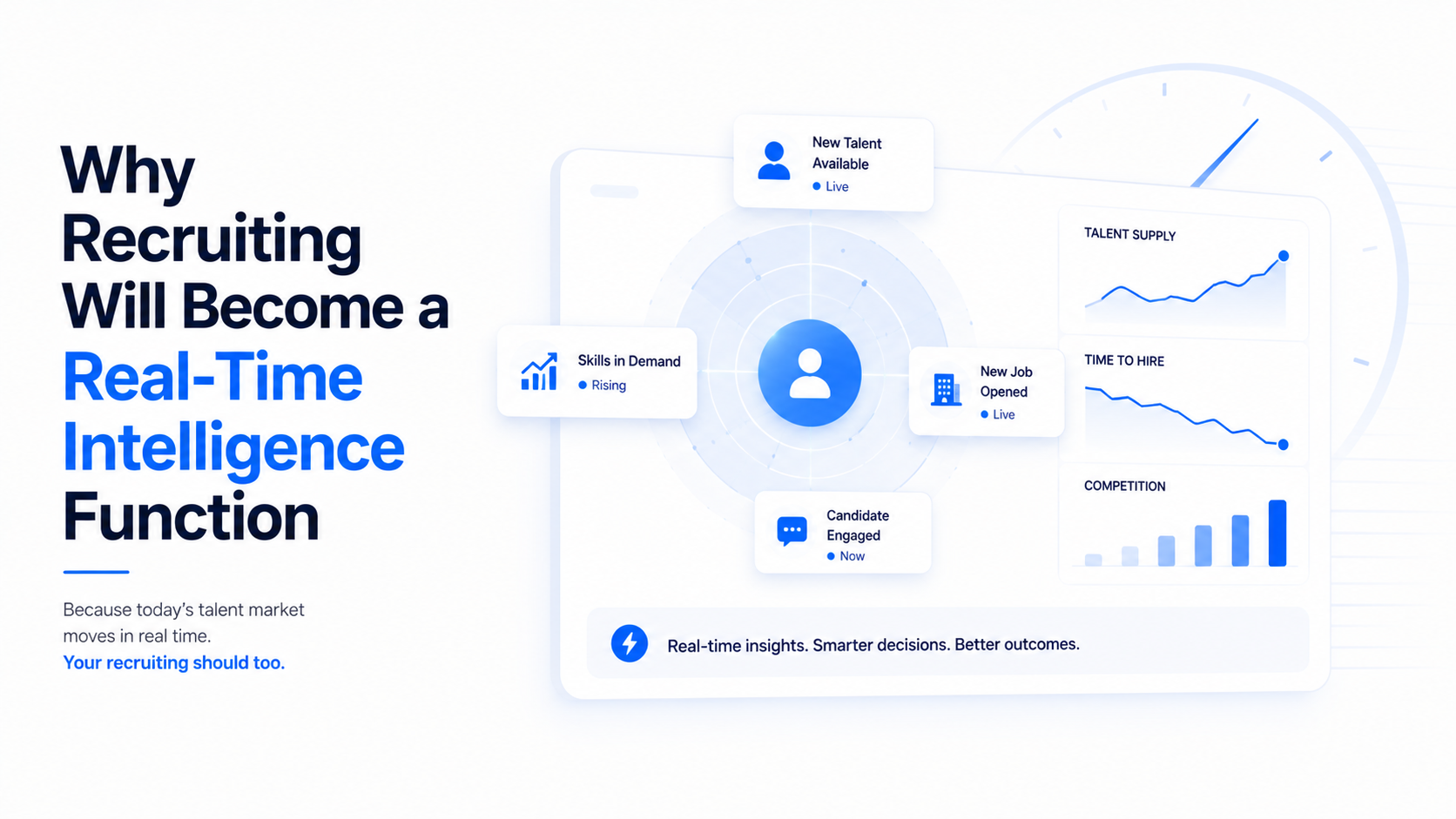
Hiroshi Tanaka, vice president of talent intelligence at a Tokyo-based electronics manufacturer with thirty-five thousand employees, was reviewing a standard monthly recruiting report when his real-time alert system notified him that a competitor had just posted twelve new roles in quantum computing, a capability area his organization had identified as strategically critical six months earlier. Within ninety minutes, his AI system had mapped the competitor's hiring targets against his own workforce, identified seventeen employees in quantum-related roles who matched the competitor's likely sourcing profile, generated recommended retention actions for the three most at-risk individuals, and updated the talent pipeline for quantum computing capabilities to reflect the reduced availability of candidates in the market. Hiroshi compared this real-time response to what his team would have produced under the old model. Under the batch approach, the competitor's hiring activity would have appeared in a quarterly competitive intelligence report three months from now, long after the most vulnerable employees had been approached and the talent pipeline had been depleted. The old model produced information about the past. The new model produced intelligence for the present. Hiroshi realized that he was not just managing a recruiting function anymore. He was managing a real-time intelligence operation that monitored the talent market the way a trading floor monitors financial markets, continuously, analytically, and with the speed to act on signals before they became irreversible trends.
The Death of Batch Recruiting: Why Periodic Processes Can No Longer Compete
Hiroshi Tanaka, vice president of talent intelligence at a Tokyo-based electronics manufacturer with thirty-five thousand employees, received an alert at three in the afternoon on a Tuesday that a competitor had posted fourteen new engineering roles in semiconductor design. Within the hour, his talent intelligence system had identified the specific skill profiles the competitor was targeting, mapped those profiles against his own organization's workforce to identify which teams were most vulnerable to poaching, and generated a set of recommended actions, including proactive engagement with engineers in the vulnerable teams, accelerated pipeline development for critical semiconductor design capabilities, and a compensation review for roles that overlapped with the competitor's hiring focus. This sequence, from competitor signal to actionable intelligence to recommended response, took less than ninety minutes. In the traditional recruiting model, this kind of competitive intelligence would have been available weeks or months later, through a quarterly market analysis report that documented trends after they had already shaped the competitive landscape. Hiroshi's organization had made a deliberate transition from batch recruiting, where activities are organized into periodic campaigns and reporting cycles, to real-time talent intelligence, where the recruiting function operates continuously and responds to signals as they emerge. According to research from McKinsey, the shift from batch to real-time operations is one of the most significant transformations in professional services, and recruiting is the HR function where this transition is most advanced because the external signals, candidate behavior, competitor activity, and market dynamics, are most abundant and most actionable.
The batch recruiting model, which has been the default operating approach for decades, was designed for a talent market that no longer exists. In this model, recruiting operates in discrete campaigns: a requisition opens, a sourcing sprint follows, a pipeline is built, interviews are conducted over a defined period, and an offer is extended. Each campaign is a self-contained episode with a beginning, middle, and end. Between campaigns, the recruiting function is relatively inactive, waiting for the next requisition or the next hiring surge. This model worked when talent markets were relatively stable, candidate availability was predictable, and competitor hiring activity was slow and opaque. None of these conditions hold today. Talent markets shift continuously as new technologies emerge and skill demand evolves. Candidate availability changes daily as professionals make career decisions. Competitor hiring activity is visible in real time through job postings, social media signals, and professional network activity. The batch model cannot respond to this continuous stream of signals because it was designed for a world where signals arrived periodically, not continuously. The result is a recruiting function that is perpetually behind the market, reacting to conditions that have already changed rather than anticipating and shaping the conditions that are emerging. Gartner has identified the transition from batch to real-time recruiting as one of the defining operational shifts in talent acquisition, noting that organizations operating in real-time achieve thirty to forty percent better hiring outcomes than those operating in batch mode,
because real-time operations enable the recruiting function to respond to market signals while they are still actionable rather than after they have already influenced outcomes.
The technology that enables this transition is fundamentally different from the technology that supported the batch model. Batch recruiting is supported by tools that process data in periodic cycles: resume databases that are updated weekly or monthly, compensation benchmarking reports that are published quarterly, and market intelligence analyses that are conducted annually. These tools provide snapshots of the talent market at a specific point in time, but the snapshots become progressively less accurate as the market moves between cycles. Real-time talent intelligence is supported by an AI system that monitors talent signals continuously, processes them as they emerge, and updates its understanding of the talent market in real time. The system does not wait for a data refresh cycle. It maintains persistent connections to data sources, professional networks, publication databases, job posting aggregators, and social media platforms, and updates its models continuously as new signals arrive. This continuous processing capability is what enables the system to provide the kind of real-time competitive intelligence that Hiroshi received about his competitor's hiring activity. The most advanced form of this capability is an agentic AI recruiting platform that operates as a continuous intelligence system rather than a periodic processing tool, making real-time decisions and providing real-time insights that keep the recruiting function synchronized with the talent market rather than lagging behind it.
The Intelligence Stack: Data, Signals, and Real-Time Decision-Making
A real-time intelligence function in recruiting requires a fundamentally different technology architecture than a batch recruiting operation. The architecture has three layers, each of which must operate in real time for the system to deliver its full value. The first layer is the data layer, which maintains continuous connections to every relevant data source. Internal sources include the applicant tracking system, human resource information system, performance management platform, compensation database, and learning and development records. External sources include professional networks, publication databases, patent filings, job posting aggregators, conference participation data, and compensation market feeds. The data layer must not only access these sources but integrate them into a coherent, unified data model that resolves inconsistencies across sources and maintains a single, accurate profile for each candidate, role, and hiring manager. This integration is the foundation of real-time intelligence, because decisions are only as good as the data they are based on, and data that is fragmented, inconsistent, or stale produces decisions that are similarly compromised. The issue of whether AI recruiting tools rely on outdated candidate data is a direct consequence of architectures that process data in periodic batches rather than continuously, leaving the system to make decisions based on candidate profiles that may have changed significantly since the last data refresh. According to LinkedIn analysis of recruiting data quality, organizations with real-time integrated data architectures make fifteen to twenty-five percent more accurate sourcing and
assessment decisions than those relying on periodically refreshed data, because the real-time architecture reflects the current state of the talent market rather than a historical snapshot.
The second layer is the signal layer, which processes raw data into actionable intelligence by identifying patterns, trends, and anomalies that are relevant to the organization's talent strategy. Raw data tells the organization that a candidate updated their profile. The signal layer interprets this update in context, determining that the profile update, combined with recent activity in industry forums and a reduction in their public engagement with their current employer, suggests an increased likelihood of openness to new opportunities. Raw data tells the organization that a competitor posted new roles. The signal layer interprets this posting in context, mapping the required skills against the organization's own workforce to identify vulnerability areas and recommending proactive engagement with the most at-risk employees. Raw data tells the organization that a candidate declined an offer. The signal layer interprets this rejection in context, analyzing the timing, compensation gap, and competing offers to provide intelligence about what the organization needs to change to win similar candidates in the future. This transformation from raw data to actionable signals is what distinguishes an intelligence function from a data processing function, and it requires AI capabilities that can interpret context, weigh multiple factors, and generate insights that are relevant to specific organizational situations. According to Deloitte research on talent analytics maturity, organizations with AI-driven signal processing capabilities identify talent risks and opportunities thirty to forty percent earlier than those relying on descriptive reporting, because the AI system detects patterns in real-time data that would not become visible in periodic reports until the trends had already produced consequences.
The third layer is the decision layer, which translates intelligence into action by making and executing operational decisions in real time. In a batch recruiting operation, decisions are made by recruiters based on periodic data and established processes. In a real-time intelligence function, many operational decisions are made by the AI system based on real-time signals and continuously refined decision models. The system decides which candidates to prioritize for engagement, what messaging strategy to use, when to follow up, how to adapt the approach based on candidate behavior, and when to escalate to a human recruiter for personal intervention. These decisions are not made according to rigid rules but through contextual reasoning that considers the full scope of available information, the specific circumstances of each candidate and role, and the lessons learned from previous hiring outcomes. The decision layer operates continuously, adjusting its behavior as new signals arrive and new outcomes provide additional learning data. This continuous decision-making capability is what makes the recruiting function truly real-time, because decisions are not delayed until a human reviewer is available or a reporting cycle completes. The system operates at the speed of the talent market rather than the speed of organizational processes, and this alignment between operating speed and market speed is what produces the superior hiring outcomes that real-time intelligence delivers.
Real-Time Candidate Engagement: The End of Scheduled
Interactions
The most visible manifestation of real-time intelligence in recruiting is the transformation of candidate engagement from a scheduled, template-driven process to a continuous, signal-responsive interaction. In the batch model, candidate engagement follows a predefined schedule: an initial outreach after sourcing, a follow-up after three to five business days, a status update after an interview, and a reminder after an offer. Each communication is triggered by a calendar rule, not by candidate behavior. The process treats all candidates as if they move through the hiring journey at the same pace and respond to the same stimuli, regardless of their individual circumstances, motivations, and engagement patterns. This one-size-fits-all approach was acceptable when candidates had few alternatives and were willing to wait for organizations to follow their internal schedules. It is unacceptable in a market where top candidates have multiple options and expect the same responsiveness from potential employers that they receive from every other digital service in their lives. Research on how many follow-ups one hire needs has demonstrated that the timing and content of follow-up communications are among the strongest predictors of candidate engagement and offer acceptance, but the optimal timing and content vary significantly across candidates based on their individual behavior signals, a level of personalization that scheduled engagement cannot provide but real-time intelligence delivers naturally.
Real-time candidate engagement operates on a fundamentally different principle: the system monitors each candidate's behavior continuously and responds when the response is most likely to be effective, rather than when a calendar rule dictates. A candidate who opens the initial outreach within two hours and visits the company careers page receives a substantive follow-up that same day, because their behavior signals active interest and the system capitalizes on that interest while it is warm. A candidate who does not open the initial outreach for five days receives a different, lighter-touch follow-up that acknowledges their busy schedule and offers an alternative way to engage, because their behavior signals lower immediate interest and a more delicate approach is appropriate. A candidate who responds to the initial outreach with detailed questions about the role receives immediate, thorough answers, because their engagement signals high interest and the system prioritizes maintaining their momentum. A candidate who views the engineering team's project page after receiving an interview invitation receives follow-up communication that connects their specific interests to the team's work, because the system detects their research behavior and personalizes the next interaction accordingly. This signal-responsive engagement model produces dramatically higher conversion rates because every interaction is timed and tailored to the individual candidate's demonstrated level of interest and specific areas of curiosity. According to EY research on candidate engagement effectiveness, signal-responsive engagement produces forty to fifty percent higher candidate-to-interview conversion rates and twenty-five to thirty-five percent higher offer acceptance rates compared to scheduled engagement sequences, because candidates perceive the interaction as personally attentive and organizationally responsive rather than mechanically automated.
The real-time engagement model also transforms how organizations manage the most critical moments in the hiring process, the points where candidate decisions are made and competitive offers are evaluated. In the traditional model, these critical moments are often handled poorly because they occur unpredictably and require immediate, informed response. A candidate receives a competing offer and wants a decision from your organization within hours. A candidate's interview feedback reveals a concern that, if addressed immediately, could prevent a withdrawal. A high-priority candidate becomes unresponsive and requires a carefully calibrated re-engagement strategy. In the batch model, these situations often languish while the recruiter becomes available, information is gathered, and approvals are obtained. In the real-time intelligence model, the AI system detects these critical moments as they emerge and either responds immediately within its decision authority or escalates to a human recruiter with a recommended action and the supporting intelligence needed to act quickly. This capability to detect and respond to critical moments in real time is one of the most practically valuable outcomes of the transition to intelligence-driven recruiting, because these moments often determine whether a candidate is hired or lost, and the difference between a fast, informed response and a slow, uncertain one can be the difference between winning and losing the talent competition. SHRM research on candidate experience at critical decision points has found that organizations with real-time response capabilities are fifty to sixty percent more likely to win competing offer situations, because the speed and quality of the response at the critical moment signals organizational commitment and operational excellence to the candidate.
Real-Time Competitive Intelligence: Knowing the Talent Market as It Changes
One of the most strategically valuable dimensions of real-time intelligence in recruiting is the ability to monitor and respond to competitive talent dynamics as they emerge rather than after they have already shaped outcomes. In the batch model, competitive intelligence is typically gathered through periodic analyses, quarterly talent market reports, annual compensation benchmarking studies, and ad hoc competitive hiring assessments conducted when a specific concern arises. These analyses provide useful but inherently backward-looking information, documenting what the talent market was like when the data was collected rather than what it is like now. In fast-moving talent markets, this lag is strategically consequential. A competitor's major hiring initiative, a significant shift in compensation for a critical skill set, or a new employer launching aggressive talent acquisition in a shared market can alter the competitive landscape within days. Organizations relying on periodic intelligence discover these shifts weeks or months after they occur, by which time the competitive damage, lost candidates, increased compensation costs, and weakened pipeline position, has already been incurred. Real-time competitive intelligence monitors competitor job postings, hiring velocity, employer brand activity, and talent movement patterns continuously, providing alerts and analysis as changes emerge rather than after they have produced consequences. According to McKinsey research on competitive intelligence in talent acquisition, organizations with real-time
competitive monitoring capabilities respond to competitor hiring initiatives forty to fifty percent faster than those relying on periodic analysis, and this speed advantage translates directly into better talent outcomes because the organization can adjust its strategy before candidates have been diverted to competitors.
The competitive intelligence capability of a real-time recruiting function extends beyond monitoring competitors to encompass the full dynamics of the talent market. The system tracks supply and demand signals for specific skill sets, identifying emerging shortages before they become critical. It monitors geographic and industry talent flows, detecting shifts in where talent is moving and why. It analyzes compensation trends in real time, providing offer recommendations that reflect current market conditions rather than historical benchmarks. It identifies emerging skill combinations that predict high-potential candidates, enabling the organization to source for capabilities that competitors have not yet recognized. And it synthesizes all of these signals into a coherent talent market picture that informs not only recruiting decisions but broader workforce planning and business strategy. This comprehensive, real-time market intelligence is what elevates the recruiting function from an operational service to a strategic intelligence function, providing the organization with insights about the talent landscape that inform business decisions well beyond hiring. The integration of sourcing intelligence and recruiting workflow management is central to this elevation. Discussions of the difference between AI sourcing and AI recruiting highlight that real-time intelligence requires unifying these traditionally separate functions into a single continuous process, because the intelligence generated by sourcing activities, market signals, candidate behavior patterns, and competitive dynamics, must flow directly into recruiting workflow decisions without the delays and information loss that occur when sourcing and recruiting operate as separate functions with separate data systems.
The strategic value of real-time competitive intelligence is most visible in the ability to make proactive rather than reactive talent decisions. In the batch model, most talent decisions are reactive: a role opens, the organization sources candidates, a candidate receives a competing offer, the organization responds. Each action is a response to an event that has already occurred. Real-time intelligence enables a fundamentally different approach: the system identifies emerging risks and opportunities before they become events that require reactive response. When the system detects that a competitor is scaling up hiring in a skill set that overlaps with the organization's critical capabilities, it recommends proactive engagement with at-risk employees before the competitor's outreach begins. When the system detects that compensation for a specific role is trending upward in the market, it recommends proactive adjustments before the organization loses candidates to competitors offering higher pay. When the system detects that the candidate pipeline for an upcoming role is thinner than expected, it recommends accelerated pipeline development before the role opens and the organization faces an urgent, time-constrained search. This shift from reactive to proactive talent management is the ultimate expression of real-time intelligence in recruiting, and it transforms the recruiting function from a cost center that responds to hiring requests into a strategic function that anticipates and shapes talent outcomes. According to LinkedIn data on talent acquisition
maturity, organizations with proactive, intelligence-driven recruiting functions report twenty-five to thirty-five percent lower voluntary turnover in critical roles, because the function identifies and addresses retention risks before they result in resignations, and thirty to forty percent faster time-to-fill for critical roles, because proactive pipeline development means the talent is already partially engaged when the need becomes urgent.
Building the Real-Time Intelligence Function: Architecture and Organization
The transition from batch recruiting to a real-time intelligence function requires simultaneous investment in three dimensions: technology architecture, data infrastructure, and organizational capability. The technology architecture must support continuous operation rather than periodic processing. This means selecting platforms that maintain persistent connections to data sources, process signals in real time, and make decisions continuously rather than in batch cycles. The platform must also support the three-layer intelligence stack, data integration, signal processing, and decision execution, as an integrated system rather than as a collection of separate tools. Organizations attempting to build real-time intelligence by connecting existing batch tools with integration middleware consistently achieve disappointing results, because the underlying tools were not designed for continuous operation and cannot process signals in real time. Gartner recommends that organizations evaluate recruiting platforms specifically on their real-time operation capabilities, including data freshness, signal processing latency, and decision execution speed, because these capabilities determine whether the platform can support a genuine intelligence function or will be constrained to the batch processing model regardless of its AI features.
The data infrastructure must support continuous, bidirectional integration with every relevant data source. This is the most technically challenging dimension of the transition, because most organizations' existing HR data infrastructure was designed for batch processing and periodic reporting, not for real-time access and continuous updates. The data infrastructure must enable the AI system to read data from every source in real time and write data back to systems of record to maintain consistency. It must also handle data quality issues, resolving inconsistencies between sources, flagging data that may be stale or unreliable, and maintaining the integrity of the unified candidate and role profiles that the intelligence system depends on. Organizations that underinvest in data infrastructure consistently achieve disappointing results from real-time intelligence deployments, because the AI system is making decisions based on incomplete, inconsistent, or outdated information. The organizational capability dimension requires redefining the recruiting team's role, skills, and operating model around real-time intelligence rather than batch processing. Recruiters must develop the ability to interpret real-time intelligence, act on AI-generated recommendations quickly, and provide strategic counsel to hiring managers based on current market conditions rather than historical reports. According to Deloitte research on HR technology transformation, organizations that invest equally in technology, data, and organizational capability achieve three to four times
the improvement in talent outcomes compared to those that focus primarily on technology, because the intelligence function delivers its value only when the people and processes around it are aligned with the real-time operating model.
The performance management system for the recruiting function must also be redesigned to reflect the real-time intelligence model. Traditional recruiting metrics, cost-per-hire, time-to-fill, and requisition fulfillment rate, measure batch process efficiency. Real-time intelligence functions require metrics that measure intelligence quality and competitive effectiveness: the accuracy of talent risk predictions, the speed of competitive response, the quality of proactive engagement recommendations, and the impact of intelligence-driven decisions on hiring outcomes and retention. These intelligence metrics focus the function on the quality of its insights and the speed of its responses rather than on the volume of its activities, aligning incentives with the new operating model. The organizations that have most successfully made this transition report that the shift in performance metrics was as important as the shift in technology, because the metrics drove behavioral change by rewarding the activities, rapid response, proactive engagement, and intelligence-driven decision-making, that the new model required. According to SHRM research on recruiting performance measurement, organizations that adopt intelligence-focused metrics achieve twenty to thirty percent faster improvement in hiring outcomes after transitioning to real-time capabilities, because the metrics reinforce the new behaviors while the old metrics would have reinforced the old batch-processing behaviors that the new model is designed to replace. The recruiting function is evolving from a batch process that reacts to hiring requests into a real-time intelligence function that anticipates and shapes talent outcomes. The organizations that build this capability now will operate with a level of talent market awareness and responsiveness that their competitors cannot match, creating a compounding advantage that grows stronger with every signal processed and every decision refined.