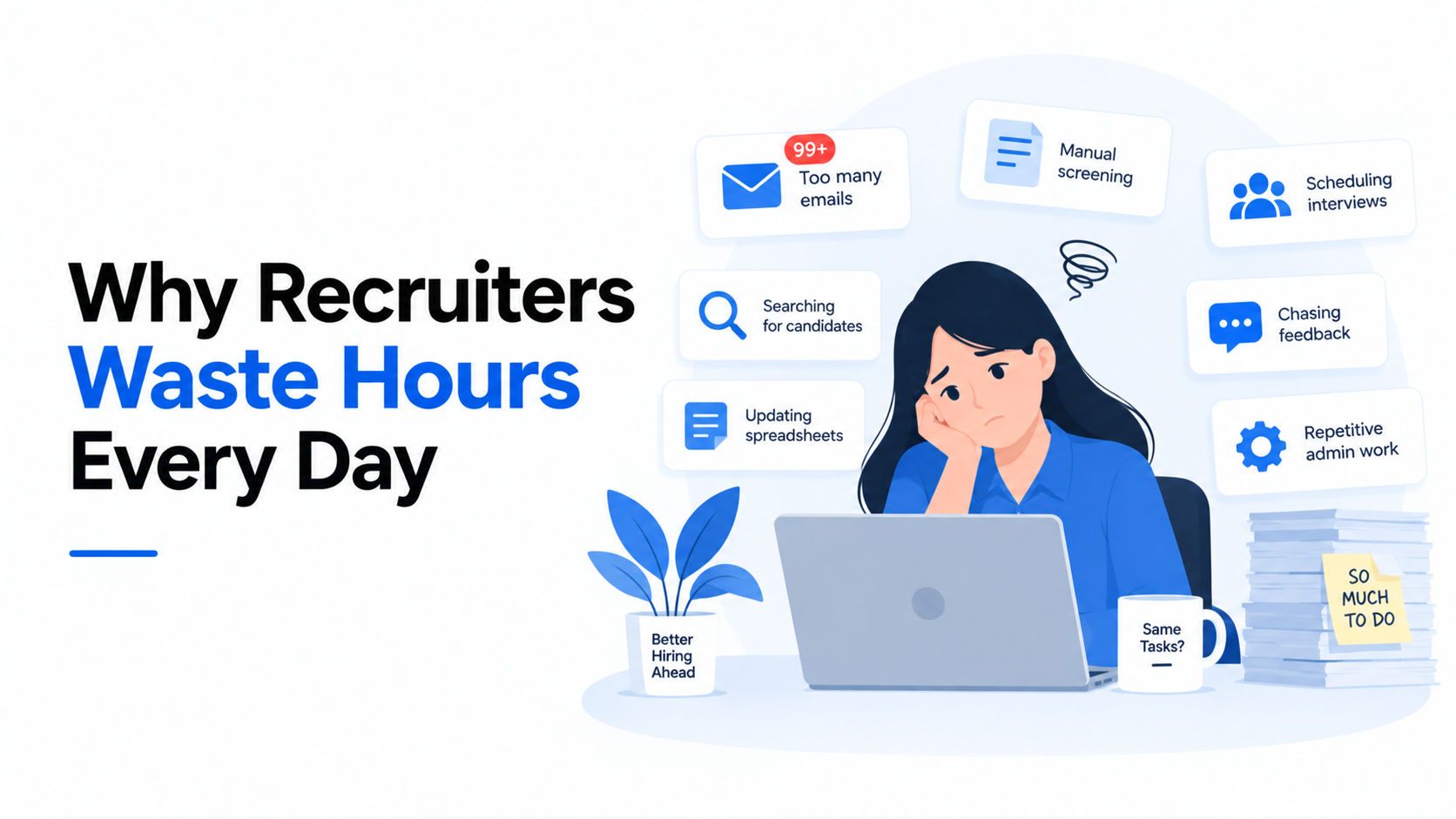
The average recruiter does not have a time management problem. They have a system design problem. They spend their days switching between tools, chasing hiring managers for feedback, manually scheduling interviews that require five calendars to align, and copying candidate data from one system to another because the integrations do not work. By the time they sit down to do the actual work of recruiting — finding great people and convincing them to join — they are exhausted, distracted, and out of time.
According to Bullhorn's GRID 2025 research cited by StaffingHub, AI and automation can give recruiters up to 17 hours back per week. That is more than two full workdays. Yet most recruiters are not getting those hours back. They are spending them on activities that do not require human judgment but consume human attention anyway.
The waste is not evenly distributed. It clusters in specific activities that recur every day, every week, and every hiring cycle. Understanding where the time goes is the first step toward reclaiming it.
The Scheduling Black Hole
Interview scheduling is the single largest time sink in recruiting. A typical hiring process involves three to five interview rounds. Each round requires coordinating schedules between the candidate and one or more interviewers, each of whom has their own calendar full of meetings, projects, and deadlines. The average interview takes 45 to 60 minutes of interviewer time plus 15 to 20 minutes of preparation and follow-up. For a team hiring 200 people per year, that is 600 to 1,000 interviews — or roughly 800 to 1,300 hours of interviewer time pulled away from actual work.
But the recruiter's time is even more heavily consumed. According to SHRM's 2025 Talent Acquisition Benchmark Report cited by Huntlo, interviewing is the single largest time investment in the recruiting process, accounting for 40 to 55 percent of total recruiter and hiring manager time. And a surprising amount of that time is spent on activities that do not actually require human judgment: scheduling logistics, asking the same basic screening questions to every candidate, collecting and synthesizing feedback from multiple interviewers, and trying to remember what was discussed in back-to-back interviews.
The back-and-forth of scheduling is particularly brutal. A recruiter sends three time slots to a candidate. The candidate is not available for any of them. The recruiter sends three more. The candidate picks one, but one of the interviewers is now double-booked. The recruiter starts over. This cycle can consume hours for a single interview, and it happens dozens of times per week.
The solution is not better time management. It is scheduling automation. Tools like GoodTime and Clockwork connect to calendars and automate the entire coordination process. Huntlo handles scheduling as an integrated part of its end-to-end workflow, coordinating directly with the candidate through the same channel they are already using. When the AI's conversational screening identifies a qualified, interested candidate, it can schedule the interview within the conversation, eliminating the need for a separate scheduling tool and the back-and-forth that consumes recruiter hours.
The Data Entry Tax
Recruiters spend an enormous amount of time moving data between systems. A candidate is sourced on LinkedIn, so the recruiter copies their profile into a spreadsheet. Then into the ATS. Then into an outreach tool. Then back into the ATS when they respond. Then into a scheduling tool. Then into an assessment platform. Then back into the ATS for the final decision. Every handoff is manual. Every manual step is an opportunity for error, delay, and frustration.
According to Metaview's analysis of talent ops in 2026, the average hiring team is running 11-plus tools by 2026. Without an architecture, every recruiter ends up running a personal stack on top of the shared one. The data lives in fragments across these tools, and the recruiter becomes the integration layer, manually connecting what should be automatically connected.
The cost is not just time. It is data quality. When data is entered manually, it is entered inconsistently. A candidate sourced in January is tagged differently than a candidate sourced in June. A hire from a referral is categorized differently than a hire from a job board. Without consistent taxonomy, the data cannot be trusted, and the analytics that should drive decisions become unreliable.
The solution is integration-first technology architecture. Every tool should connect to the central ATS. Data should flow automatically. Candidate information entered in the sourcing tool should appear in the ATS without manual re-entry. Interview feedback from the assessment platform should populate the candidate record. When a tool does not integrate, it creates friction that compounds over time, and the recruiter pays the price in hours lost to data entry.
The Follow-Up Trap
Recruiting is a relationship business, and relationships require follow-up. But the volume of follow-up required in modern recruiting is overwhelming. A recruiter managing 30 to 40 open requisitions might have 500 candidates in various stages of the pipeline. Each candidate needs touchpoints at specific intervals: initial outreach, first follow-up, second follow-up, scheduling confirmation, interview preparation, post-interview update, offer discussion, and post-offer nurture.
Without automation, these touchpoints are managed through memory, spreadsheets, and sticky notes. A candidate falls through the cracks because the recruiter was focused on a different role that week. A promising candidate goes cold because the follow-up was delayed. A competitor moves faster because their follow-up was automated and yours was manual.
According to Pin's 2026 recruitment funnel benchmarks, only 6% of job views become applications. Only 3% of applicants get interviews. And 27% of interviewees get hired. The biggest leak in the funnel is at the screening stage, where 97% of applicants are eliminated before speaking with a human. Much of this elimination is not deliberate rejection. It is candidates who were never properly engaged, never followed up with, and never given a reason to continue.
The solution is automated follow-up sequences that trigger based on candidate behavior. If a candidate does not respond to the first email, the system sends a follow-up through a different channel. If they open the message but do not reply, the system adjusts the messaging angle. If they express interest but are not ready to move, the system schedules a future check-in. These sequences do not replace human judgment. They replace human memory, which is the resource that runs out first.
The Context-Switching Penalty
Recruiters do not work on one thing at a time. They work on 30 to 40 things at a time, switching between them constantly. A recruiter might start the morning reviewing resumes for one role, pivot to scheduling interviews for another, take a screening call for a third, respond to a hiring manager email about a fourth, and update the ATS for a fifth. Each switch carries a cognitive cost.
Research on context switching shows that it takes an average of 23 minutes to return to full focus after an interruption. For a recruiter who switches tasks every 15 minutes, full focus is never achieved. The work gets done, but it gets done shallowly. Resumes are scanned, not evaluated. Emails are sent, not crafted. Calls are made, but the recruiter is already thinking about the next task before the current one is finished.
The volume of open requisitions makes this worse. According to Greenhouse's 2026 benchmarks, applications per recruiter have surged 411% since 2022 while recruiter headcount has dropped 56%. The same recruiter who managed 10 requisitions in 2022 now manages 30. The context-switching penalty has tripled, and the time available for deep work has disappeared.
The solution is not telling recruiters to focus better. It is redesigning the work so that deep work is possible. This means batching similar tasks: sourcing blocks, screening blocks, scheduling blocks. It means protecting recruiter time from the constant interruptions of Slack, email, and hiring manager requests. And it means using automation to handle the routine tasks that currently fragment the day into unproductive slivers.
The Hiring Manager Coordination Burden
Recruiters do not work alone. They work with hiring managers who have their own priorities, their own timelines, and their own ideas about what recruiting should look like. The coordination required to keep hiring managers aligned, informed, and engaged consumes a significant portion of recruiter time.
Hiring managers need to be briefed on the role, consulted on the candidate profile, reminded to submit interview feedback, nudged to make decisions, and updated on pipeline status. Each of these interactions is necessary, but the way they happen is often inefficient. A recruiter sends three emails to get one piece of feedback. A hiring manager misses a debrief because they were double-booked. A decision is delayed because the key stakeholder was on vacation and nobody knew.
According to Metaview's 2026 recruiting benchmarks, hiring manager satisfaction is a leading indicator of recruiting performance. The healthy target is NPS 30-plus or 4.0-plus on a 5-point scale. Low scores predict downstream pain: hiring managers stop using the TA team, start sourcing their own candidates, and push for expensive agency spend. But high satisfaction requires time that recruiters do not have because they are spending it on scheduling and data entry.
The solution is to give hiring managers self-service visibility into the pipeline. A dashboard that shows where each candidate stands, what feedback is pending, and what decisions are required. Automated reminders that prompt action without recruiter intervention. And structured processes that reduce the need for constant coordination by making expectations clear from the start.
The Administrative Load
Beyond the major time sinks, recruiters spend hours every week on administrative tasks that do not require their expertise. Updating the ATS. Formatting offer letters. Chasing down references. Coordinating background checks. Preparing reports for leadership. Filing compliance documentation.
None of these tasks are unimportant. But none of them require a recruiter's judgment, relationship skills, or market knowledge. They require accuracy, consistency, and timeliness — all things that automation handles better than humans.
According to TrueCalling's 2026 recruiting metrics analysis, AI sourcing typically lifts recruiter productivity 2 to 3x by removing manual search and first-draft outreach. Sourcing-to-shortlist time drops from days to minutes. Response rates on multichannel AI-personalized outreach clear 40%, compared to 15% on standard InMail. These are not marginal improvements. They are transformations of how recruiters spend their time.
But the transformation only happens when the administrative load is systematically eliminated. Not by telling recruiters to work faster. Not by hiring more recruiters to handle the same inefficient processes. But by redesigning the system so that the work that does not require human judgment is handled by technology, and the work that does require human judgment gets the time and attention it deserves.
What Recruiters Should Be Doing Instead
If recruiters are not spending their days on scheduling, data entry, follow-ups, and administrative coordination, what should they be doing?
They should be sourcing. Not just posting jobs and waiting for applications, but proactively mapping talent markets, identifying passive candidates, and building relationships with people who are not actively looking but might be open to the right opportunity. According to LinkedIn Talent Solutions data cited by Huntlo, 70% of the global workforce is passive talent. These people will not find your job posting on their own. They need to be found, engaged, and convinced.
They should be screening with depth. Not scanning resumes in seven seconds, but having structured conversations that probe capability, motivation, and fit. Conversational AI can handle the initial engagement, but the nuanced evaluation of whether a candidate can solve your specific problems requires human judgment.
They should be partnering with hiring managers. Not just coordinating their schedules, but advising them on market conditions, candidate expectations, and competitive positioning. The recruiter who understands the talent market deeply can guide hiring managers to better decisions about role definition, compensation, and interview design.
They should be building talent communities. Not just filling open requisitions, but maintaining relationships with candidates who were not right for today's role but might be perfect for tomorrow's. A nurtured talent community reduces time-to-fill, improves quality of hire, and creates a competitive moat that job boards cannot replicate.
How High-Performing Teams Reclaim the Time
The teams that have solved this problem do not work harder. They work within a system designed to eliminate waste.
They start with process design. Every step is defined, documented, and instrumented. There is no ambiguity about who does what, when, and how. The process is not a suggestion. It is the infrastructure that makes scale possible.
They invest in integration-first technology. Every tool connects to the central system. Data flows automatically. Recruiters do not copy and paste. They do not switch between six tabs to complete one task. They work in a unified environment where the information they need is available when they need it.
They automate routine communication. Follow-up sequences, scheduling coordination, and status updates happen without human intervention. The recruiter steps in when judgment is required, not when a reminder needs to be sent.
They protect deep work time. Sourcing blocks, screening blocks, and strategic planning blocks are calendar-protected. Interruptions are minimized. Context switching is reduced. The recruiter's most valuable resource — focused attention — is treated as sacred.
They measure and improve. They track where time goes. They identify the biggest leaks. They test changes. They measure outcomes. And they continuously refine the system based on what the data reveals.
The Bottom Line
Recruiters do not waste hours because they are lazy or disorganized. They waste hours because the systems they work within were designed for a different era of hiring. An era with fewer applications, fewer tools, and less complexity. Those systems have not evolved, and the recruiters are paying the price.
The cost is not just recruiter frustration. It is missed candidates, delayed hires, and competitive disadvantage. The best candidates are hired within 10 days. If your recruiter is spending two of those days on scheduling, you have already lost.
The solution is not to hire more recruiters to handle the same broken processes. It is to redesign the processes so that recruiters can do what they were hired to do: find great people, evaluate them well, and convince them to join. Everything else is waste. And waste is what separates the teams that win from the teams that wonder why they are always behind.