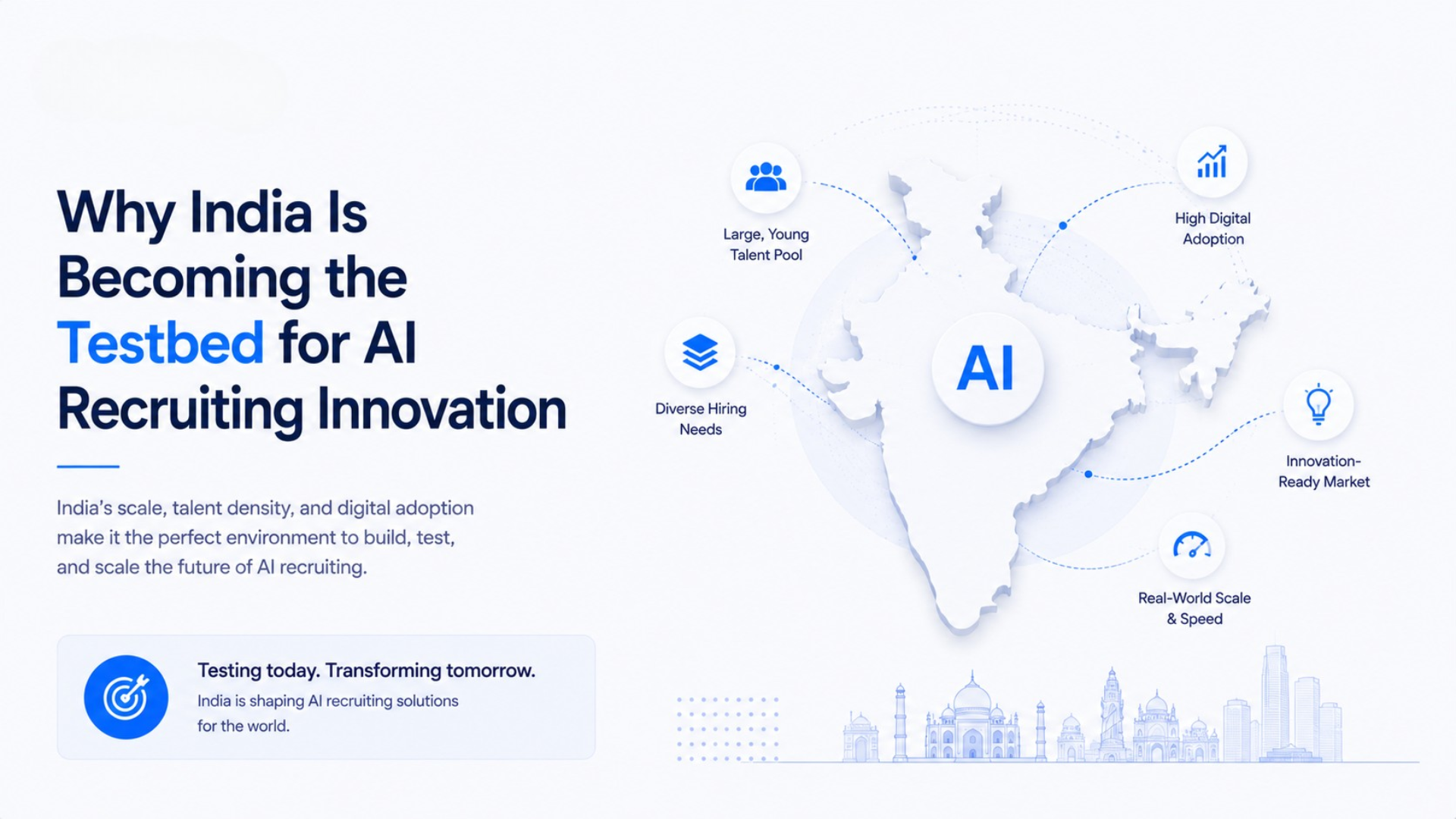
Silicon Valley has historically been assumed to be the epicenter of recruiting technology innovation. The biggest vendors are headquartered there, the largest venture capital investments flow there, and the most influential product decisions are made there. But a quiet revolution is shifting the center of gravity. India — with its 3-million-strong staffing industry, its 1.4 billion population generating unprecedented candidate volumes, its WhatsApp-native communication culture, and its ruthless cost-consciousness — is becoming the place where AI recruiting tools are tested, refined, and proven at scale before those innovations reach the rest of the world.
This isn't theoretical. The product teams behind AI recruiting platforms are increasingly using Indian user feedback to drive feature development. According to NASSCOM's 2025 technology adoption report, Indian staffing agencies and corporate TA teams are among the earliest and most intensive adopters of AI recruiting tools globally, with adoption rates 15-20% higher than the global average for agencies of comparable size. The reasons are structural, economic, and cultural — and they create a feedback loop that benefits the entire global recruiting technology ecosystem.
The Scale Argument: Volume Drives Innovation
Innovation in enterprise software is driven by usage volume. Features that work for 100 users may break at 10,000 users, and features that seem elegant in a small-scale pilot may prove impractical at production scale. India provides AI recruiting tools with scale that no other single market can match.
Consider the numbers. India's IT services and BPO industry — comprising companies like TCS, Infosys, Wipro, and HCL — hires an estimated 500,000-700,000 professionals annually, according to the IT industry body NASSCOM. The staffing industry, as documented by the Indian Staffing Federation (ISF), employs over 3 million temporary and contract workers at any given time, with annual turnover rates that require constant replenishment. Global Capability Centers (GCCs) of multinational companies operating in India — numbering over 1,600 according to Zinnov's GCC landscape report — collectively employ approximately 1.7 million professionals and are growing at 10-15% annually.
These hiring volumes create a testing environment that is simply impossible to replicate in any other single country. When an AI sourcing tool processes 50,000 candidate profiles per day for a single Indian staffing client, it encounters edge cases, data quality issues, and workflow bottlenecks that a tool serving a US agency processing 500 profiles per day might never see. The bugs found at Indian scale make the tool more robust for every user, regardless of geography.
Huntlo's AI sourcing engine, for example, handles candidate data from over 50 platforms including Indian job boards like Naukri, Indeed India, and regional language job portals. The data from these Indian sources — which often have different profile formats, different data quality standards, and different information architectures than Western platforms — stress-tests the AI's parsing, matching, and deduplication capabilities in ways that exclusively Western data sources wouldn't. The result is a more resilient and capable platform for all users.
The Cost Imperative: Necessity Is the Mother of Product Innovation
Indian organizations are among the most cost-conscious technology buyers in the world, and this cost consciousness forces AI recruiting tool vendors to build more efficient, more feature-dense, and more economically designed products. When your target customer is an Indian staffing agency paying recruiters ₹30,000-₹40,000 per month and operating on 10-15% margins, the AI tool you sell them must deliver extraordinary value per rupee or it won't get purchased.
According to SaaS pricing research from Zoho's SaaS research division, Indian SaaS customers pay 40-60% less than their US counterparts for comparable software, and they expect 20-30% more features per dollar spent. This price-performance expectation is brutal for vendors but enormously beneficial for the global product. When a vendor is forced to deliver maximum functionality at a fraction of the price point, the engineering response is to build more efficient technology — leaner code, smarter algorithms, more automation with fewer manual steps.
Huntlo's $99/seat/month flat-rate pricing is, in many ways, a product of the Indian market's influence on the company's pricing philosophy. While the price point is expressed in USD and is competitive for US and European buyers, it is specifically calibrated to be accessible to Indian staffing agencies where the equivalent of ₹8,300/seat/month represents a fraction of the cost of alternatives like hireEZ or SeekOut that price at $150-$500/seat/month (₹12,600-₹42,000/month). The Indian market demanded this pricing tier, and the product engineering required to deliver full-spectrum AI recruiting capabilities at that price point benefits every customer globally.
The cost imperative also drives innovation in how AI tools deliver value. Indian recruiters can't afford tools that require expensive add-ons for each additional capability. They need all-inclusive platforms that bundle sourcing, outreach, screening, and candidate management into a single subscription. This demand for bundled value forces vendors to think holistically about product design rather than nickel-and-diming customers for individual features — an approach that, once built into the product architecture, benefits all users regardless of their market.
The WhatsApp Factor: India Is Forcing Multi-Channel Innovation
India has over 500 million WhatsApp users, making it the platform's largest national market. For recruiting — particularly for mid-level roles, blue-collar positions, and the massive volume of jobs for freshers and internship jobs that Indian agencies fill — WhatsApp is not an optional channel. It is the primary communication medium. According to Meta's India user statistics, WhatsApp is used by 93% of Indian smartphone users, and for many candidate segments, it is the only digital channel they check regularly.
This WhatsApp dominance is forcing AI recruiting tool vendors to build serious WhatsApp integration — not the superficial "send a message via WhatsApp Web API" capability that some Western tools offer, but deep, native integration that supports automated outreach sequences, conversational AI screening via WhatsApp chat, document collection through the platform, and candidate nurturing campaigns. Building this capability for the Indian market creates WhatsApp integration that is more robust and more feature-complete than anything built primarily for markets where email and LinkedIn dominate.
Huntlo's WhatsApp outreach capability, which allows automated personalized messaging, conversational screening, and follow-up sequences through WhatsApp, was developed in direct response to the Indian market's requirements. The engineering investment in building a production-grade WhatsApp integration for Indian recruiters produces a capability that is equally valuable in the Gulf market (where WhatsApp is also the dominant channel), in Southeast Asia, in Latin America, and increasingly in Southern Europe. India's WhatsApp demand is creating a capability that extends globally.
India's AI Engineering Talent Is Building the Tools
India produces more AI and machine learning engineers than any other country. According to the All India Council for Technical Education (AICTE), India's engineering colleges produce approximately 1.5 million engineering graduates annually, with a growing concentration in AI/ML specializations. The TalentSprint and Stanford AI Index 2025 ranks India as the second-largest producer of AI research papers globally, behind only China.
This talent pool has two effects on AI recruiting innovation. First, many AI recruiting tool companies — including those headquartered in the US and Europe — have significant engineering teams in India. The engineers building these tools are often Indian professionals who understand the Indian recruiting market firsthand, and their cultural and market knowledge influences product design decisions in ways that wouldn't happen if the tools were built exclusively by engineers in San Francisco or London.
Second, India's growing AI startup ecosystem is producing homegrown recruiting technology companies that compete directly with Western incumbents on the basis of better understanding of Indian market needs. These startups — backed by India's maturing venture capital ecosystem, which according to Inc42's Indian tech startup funding report deployed over $12 billion in 2024 — are developing innovative approaches to candidate sourcing, screening, and engagement that are specifically optimized for India's unique market conditions.
The competitive pressure from Indian AI recruiting startups forces global vendors to improve their products for the Indian market, which in turn improves the products for everyone. When a Bangalore-based startup offers AI sourcing optimized for Indian job boards and WhatsApp communication at INR-denominated prices, vendors like hireEZ and SeekOut must respond — either by improving their Indian market offerings or by losing market share. This competitive dynamic accelerates innovation across the entire sector.
The High-Volume Screening Challenge
India's hiring volumes create a screening challenge that is qualitatively different from anything experienced in Western markets. A large Indian staffing agency might process 10,000-50,000 job applications per week across hundreds of active positions. An IT services company hiring for a major project might receive 100,000+ applications for a few hundred positions. An online jobs platform advertising work from home jobs might attract 200,000 responses in a single day.
These volumes make manual screening physically impossible and create the most demanding possible test environment for AI screening tools. The AI must handle diverse resume formats (India has dozens of regional resume templates), multiple languages (English, Hindi, and regional languages like Tamil, Telugu, and Bengali), inconsistent data quality (many Indian candidates lack LinkedIn profiles or have minimal online presence), and cultural nuances in how experience and qualifications are presented.
Huntlo's conversational AI screening was significantly shaped by the demands of the Indian market. The adaptive dialogue engine that asks follow-up questions based on each candidate's responses — rather than using static questionnaires — was developed partly because static questionnaires don't work well for Indian candidate pools, where qualification verification requires more nuanced, contextual questioning. The AI's ability to screen candidates in natural conversation, handling follow-up questions and evaluating communication skills simultaneously, is a direct product of the high-volume, high-variety screening challenge that the Indian market presents.
Multi-Language and Regional Diversity as an Innovation Driver
India's linguistic diversity — with 22 officially recognized languages and hundreds of dialects — creates a recruiting environment that is far more complex than the predominantly English-language markets of the US and UK. According to the 2011 Census of India and subsequent linguistic surveys, Hindi and English are widely used in professional contexts, but significant candidate pools communicate primarily in Tamil, Telugu, Kannada, Malayalam, Bengali, Marathi, and other regional languages.
This linguistic diversity forces AI recruiting tools to develop multi-language capabilities that go beyond simple translation. Names, job titles, educational institutions, and technical terms vary significantly across Indian languages and transliteration conventions. An AI tool that can't parse a Tamil transliteration of a candidate's name, or match a Bengali job title to its English equivalent, will miss significant portions of the Indian candidate pool.
The engineering required to handle Indian linguistic diversity — handling transliteration, matching across scripts, understanding regional naming conventions — creates AI capabilities that are directly transferable to other multilingual markets. A tool that can match candidates across Hindi, Tamil, and English can be extended to handle Spanish, Arabic, Mandarin, and other languages. India's linguistic complexity is creating multilingual AI recruiting capabilities that benefit the entire global market.
The GCC Connection: India as a Global Recruiting Hub
India's role as the primary talent supplier for the Gulf Cooperation Council (GCC) region adds another dimension to its importance as a recruiting innovation testbed. As covered in our analysis of Gulf hiring trends, India supplies millions of professionals to the Gulf across every skill level and industry. The recruiting workflows that connect Indian candidates with Gulf employers — cross-border sourcing, multi-channel outreach, credential verification, visa process management — are among the most complex in global recruiting.
Indian staffing agencies that specialize in Gulf placement have developed sophisticated workflows that combine AI sourcing with human relationship management. The AI handles candidate identification, initial outreach via WhatsApp, and first-round qualification, while human recruiters manage the relationship-intensive stages of credential verification, visa processing, and pre-departure counseling. This hybrid AI-human workflow, refined in the Indian-Gulf corridor, represents a model that is increasingly relevant for any cross-border recruiting scenario.
Huntlo's multi-channel outreach — combining email, LinkedIn, WhatsApp, and AI voice — was heavily influenced by the requirements of Indian agencies placing candidates in the Gulf. The ability to run coordinated outreach campaigns across all four channels, with the AI automatically routing to the channel where each candidate is most responsive, is a capability that was developed for the Indian-Gulf recruiting corridor and is now available to all Huntlo users globally.
What the Rest of the World Learns From India
The innovations being tested and refined in India don't stay in India. They flow into products used by recruiters in every market, often without the end users realizing that the features they rely on were developed in response to Indian market conditions.
Affordable Enterprise-Grade AI
The most significant export from India's recruiting innovation ecosystem is the proof that enterprise-grade AI recruiting capabilities can be delivered at accessible prices. When Indian agencies demand full-spectrum AI sourcing at ₹8,300/seat/month, the resulting product — Huntlo at $99/seat/month — challenges the pricing assumptions of the entire industry. US and European recruiters benefit from this price pressure, gaining access to capabilities that previously required enterprise budgets.
WhatsApp as a Professional Recruiting Channel
India's WhatsApp dominance is teaching the global recruiting industry that professional recruiting doesn't have to happen exclusively on email and LinkedIn. As WhatsApp penetration grows globally — particularly in Africa, Southeast Asia, and Latin America — the WhatsApp-first recruiting workflows developed in India are becoming relevant in new markets. Recruiters in Brazil, Nigeria, and Indonesia face similar communication dynamics as their Indian counterparts, and the WhatsApp integration built for India works in these markets too.
High-Volume AI Screening
The AI screening tools refined by India's massive hiring volumes are more robust, faster, and more accurate than tools developed primarily for lower-volume Western markets. A conversational AI screening system that has been tested on 100,000+ candidate interactions per week in India will perform more reliably for a US recruiter screening 500 candidates per week. The volume-driven improvement cycle benefits all users.
Multi-Language Capabilities
As Western countries become more linguistically diverse — driven by immigration, globalization, and remote work — the multilingual AI capabilities developed for India's 22-language landscape become increasingly valuable. A US recruiter sourcing Spanish-speaking candidates or a UK recruiter engaging Polish-speaking candidates benefits from the multi-language AI infrastructure that India's linguistic complexity forced vendors to build.
The Indian Companies and Agencies Leading the Way
The transformation isn't being driven solely by technology vendors — Indian staffing agencies and corporate TA teams are actively demanding and co-creating the AI capabilities that shape the market.
Large Indian IT staffing firms — companies like TeamLease, Quess Corp, and Adecco India — have been among the earliest adopters of AI sourcing tools, using them to manage the enormous candidate volumes required by their IT services and contract staffing operations. These companies process hundreds of thousands of candidate interactions monthly and provide the scale that drives product innovation.
Mid-size Indian staffing agencies — the thousands of firms with 10-50 recruiters that specialize in specific industries or geographies — are the most demanding customers from a value-for-money perspective. These agencies operate on tight margins and can't afford enterprise pricing, forcing vendors to deliver more capability at lower price points. According to the ISF's staffing industry survey, mid-size agencies are the fastest-growing segment of the Indian staffing market and the most aggressive adopters of AI recruiting technology.
Corporate TA teams at Indian GCCs — the in-house recruiting operations of multinational companies operating in India — represent another influential user segment. These teams are typically well-funded, technically sophisticated, and focused on employer branding, making them early adopters of AI capabilities that enhance candidate experience. Their feedback on AI screening quality, candidate engagement, and data security influences product development in ways that benefit all users.
The Challenges India Must Overcome
Despite its strengths as an AI recruiting innovation testbed, India faces challenges that could slow its progress if not addressed.
Data quality remains a persistent issue. Indian candidate profiles on job boards and professional networks are often incomplete, inconsistent, or outdated. According to Aspiring Minds' national employability report, a significant percentage of Indian job seeker profiles contain exaggerated or unverifiable claims. AI tools must be engineered to handle this data quality challenge without either over-screening (rejecting qualified candidates because of data inconsistencies) or under-screening (advancing unqualified candidates because of falsified information).
Infrastructure connectivity varies across India's urban-rural divide. While Tier 1 cities have reliable high-speed internet, candidates in Tier 2 and Tier 3 cities — where a growing share of India's tech talent is being developed — may have less reliable connectivity. AI tools that rely heavily on real-time cloud processing must account for variable connectivity conditions. Conversational AI screening via WhatsApp, which is more bandwidth-efficient than video-based screening, is well-suited to this reality.
The regulatory environment, particularly the DPDPA 2023 and its data protection requirements, is still being implemented, and uncertainty about enforcement creates risk for both vendors and users. As India's data protection framework matures, AI recruiting tools must demonstrate compliance, which may require product modifications and additional investment.
The Road Ahead: India as the Global Recruiting AI Laboratory
The trajectory is clear. India's combination of scale, cost pressure, communication culture, AI talent, and linguistic diversity makes it the most demanding and most instructive environment for AI recruiting innovation. The features, capabilities, and pricing models being developed for the Indian market will increasingly define the standard for AI recruiting tools globally.
For recruiters everywhere — whether you're in New York, London, Dubai, or Bangalore — this is good news. The innovations driven by India's demanding market conditions will make AI recruiting tools better, more affordable, and more capable for all users. The multi-channel outreach, high-volume screening, multilingual support, and cost-efficient pricing that India demands are capabilities that benefit every recruiter, in every market.
Huntlo's commitment to the Indian market — reflected in its INR-accessible pricing, its WhatsApp-first outreach capabilities, its Indian job board integrations, and its India-based customer support — is a bet that the innovations driven by Indian users will make the product better for everyone. It's a bet that the evidence so far strongly supports. India isn't just a market for AI recruiting tools. It's the place where those tools are becoming what they'll be for the rest of the world.
Related Topics
How Can Staffing Firms Reduce Recruiter Workload Using AI?
AI Sourcing for EdTech and SaaS Hiring: What High-Growth Teams Need to Know
Best AI Recruiting Software Platforms in 2026: Complete Guide