Nadia Kowalski, head of talent intelligence at a Toronto-based enterprise software company, opened her laptop on a Monday morning and reviewed the weekend activity report from her AI recruiting platform. In forty-eight hours, the system had updated the profiles of fourteen hundred candidates in the active pipeline, identified twenty-three candidates whose recent career changes made them newly relevant to three open positions, flagged a competitive hiring surge from a rival company in the machine learning talent segment, and adjusted compensation recommendations for two roles based on new market data. Nadia had not asked the system to do any of this. It had done it because it was designed to operate as a continuous intelligence system, not as a passive tool waiting for human input. She remembered what her job had been like three years ago, before the intelligence platform was deployed. She had spent her days manually searching for candidates across four different platforms, copying data between systems that did not synchronize, writing individual outreach messages that she hoped would resonate, and compiling weekly pipeline reports that were outdated by the time she finished them. Her hiring decisions then were based on whatever incomplete information she had managed to assemble in the limited time available. Her hiring decisions now were based on intelligence that was comprehensive, current, and synthesized in ways that she could never have achieved manually. The difference was not that she had become a better recruiter. The difference was that her intelligence capability had fundamentally changed.
The Volume of Information Is Exceeding Human Processing
Capacity
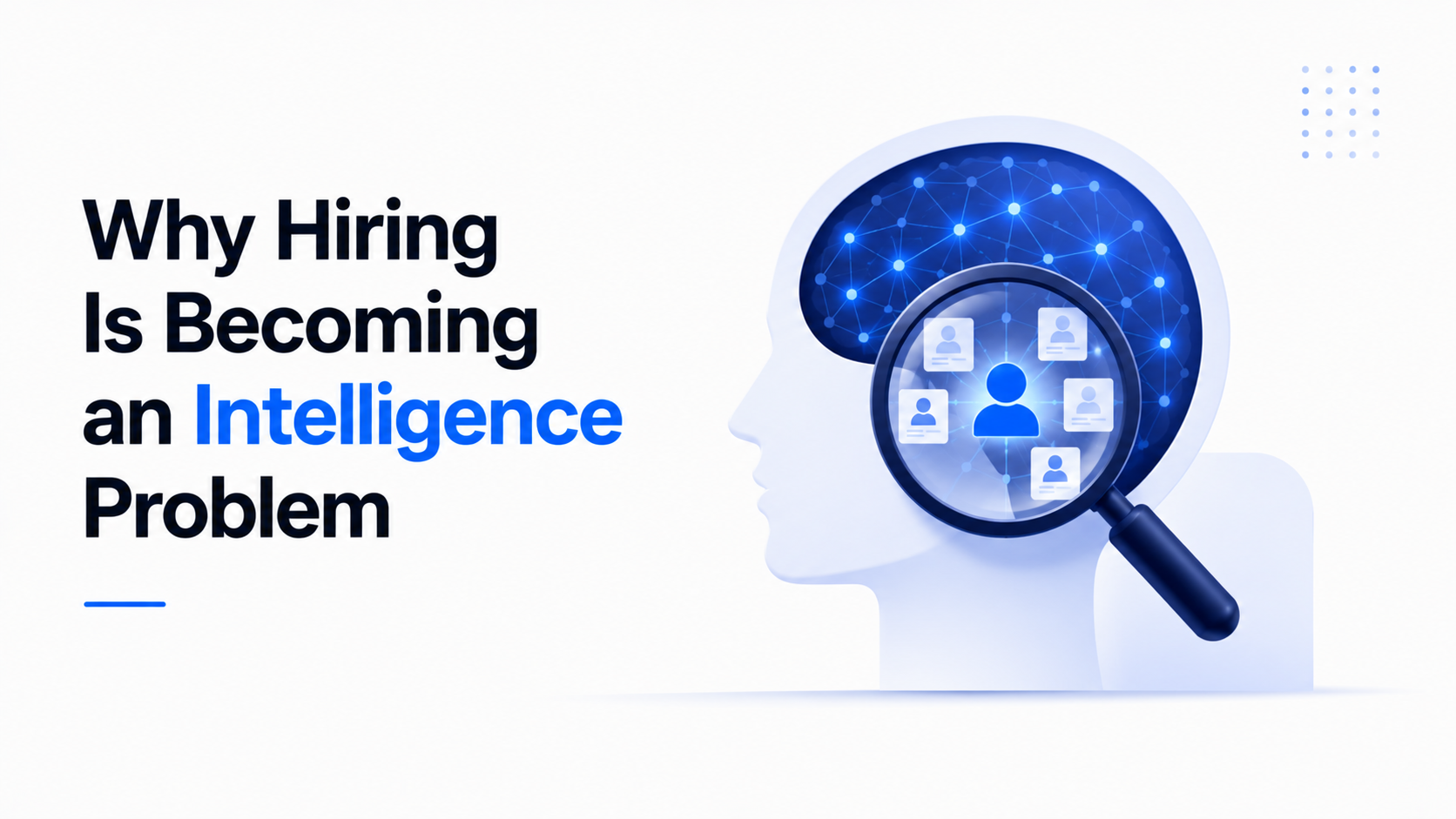
The fundamental challenge facing hiring teams today is not a shortage of candidates, a lack of recruiting tools, or insufficient budget. It is an intelligence problem. The amount of information that must be processed to make a good hiring decision has grown exponentially over the past decade, while the cognitive capacity of the humans making those decisions has remained constant. Consider what a recruiter must evaluate to assess a single candidate for a senior technical role: the candidate's resume and career trajectory, their GitHub contributions and code quality, their publication record and conference presentations, their professional network and reputation, their skill profile relative to the specific requirements of the role and the team, their compensation expectations relative to market rates, their likely cultural fit based on communication style and career values, their availability and timeline relative to the organization's hiring urgency, and the competitive dynamics of other organizations that may be pursuing the same candidate. Each of these dimensions generates its own data stream, and the data across dimensions must be synthesized into a coherent assessment that informs a recommendation. The distinction between AI sourcing and AI recruiting is relevant here because the intelligence problem spans the entire hiring lifecycle, from the initial identification of potential candidates through the final hiring decision, and each stage requires processing and synthesizing information that exceeds what any individual human can manage effectively at scale.
The scale of the intelligence problem becomes clear when you consider the number of decisions a recruiting team must make in a typical quarter. A mid-size company hiring for twenty open positions across multiple functions and locations may need to evaluate five hundred to a thousand candidates to produce the twenty to forty finalists who will receive offers. Each candidate evaluation requires synthesizing multiple data points across the dimensions described above. Each hiring decision requires weighing the relative merits of multiple finalists against the specific needs of the team, the organization's strategic priorities, and the competitive dynamics of the talent market. Each offer negotiation requires balancing the candidate's expectations against the organization's compensation framework and the value the candidate will create. The total number of information-processing decisions embedded in a single quarter of hiring runs into the tens of thousands, and each decision influences the quality of the final hiring outcome. When humans attempt to process this volume of information without adequate intelligence support, the predictable result is cognitive overload, inconsistent evaluation, missed signals, and suboptimal decisions. According to McKinsey research on decision-making under complexity in professional services, the quality of human decisions degrades significantly when the number of variables exceeds seven to nine, yet a typical hiring decision involves twenty to thirty or more relevant variables, meaning that unaided human judgment is operating well beyond its effective cognitive capacity in most hiring situations.
The intelligence problem is compounded by the speed at which the relevant information changes. Candidate skills evolve. Market compensation rates shift. Competitor hiring activity fluctuates. Business priorities change. A candidate who was not a strong fit for any open role three months ago may become the ideal candidate for a newly created position this week, but
only if the recruiting team has maintained awareness of their evolving profile and can connect it to the new opportunity in real time. In a static information environment, a recruiter could invest time in deeply researching a manageable number of candidates and make well-informed decisions. In the dynamic environment that characterizes modern talent markets, the information relevant to hiring decisions is continuously changing, which means the intelligence problem is not just about processing volume but about processing velocity. The recruiting team needs to continuously monitor, update, and synthesize a vast and shifting information landscape, and this requirement exceeds what any team of humans can accomplish through manual effort alone. According to Gartner analysis of talent market dynamics, the half-life of hiring-relevant information has shrunk from approximately six months in 2019 to less than three months in 2026, meaning that intelligence that was current at the beginning of a hiring process may be stale by the time a decision is made, unless the organization has systems in place for continuous information updating and synthesis.
Why More Data and More Tools Make the Problem Worse
The intuitive response to an intelligence problem is to gather more information and deploy more tools to process it. In hiring, this response has produced exactly the opposite of the intended effect. Organizations have responded to the growing complexity of hiring by adding more data sources, more recruiting tools, more assessment platforms, and more analytics dashboards, each promising to provide the intelligence needed to make better decisions. The result is not better intelligence but worse, because each additional tool adds its own data stream without integrating with the others, and the recruiting team is now drowning in disconnected information that they must manually correlate and synthesize. The recruiter who once had to check two or three systems to prepare for a candidate call now checks six or seven, each with its own interface, its own data model, and its own incomplete picture of the candidate. The pattern where organizations add more tools but experience the same hiring problems is the most direct manifestation of the intelligence paradox in hiring: more information, processed through more tools, managed by the same number of humans, produces worse decisions rather than better ones, because the fragmentation of information across multiple systems prevents the synthesis that good decisions require.
The intelligence problem in hiring is not a data deficit problem. It is a data integration and synthesis problem. The information needed to make good hiring decisions exists in abundance. It is scattered across applicant tracking systems, sourcing platforms, professional networks, public databases, interview feedback forms, compensation benchmarking tools, and the individual knowledge of recruiters and hiring managers. The challenge is not acquiring this information but integrating it into a coherent, current, and actionable picture that supports decision-making. When information is fragmented, the human brain must serve as the integration layer, manually transferring and correlating data across systems. This manual integration is slow, error-prone, and fundamentally limited by the bandwidth of human attention. A recruiter managing thirty active candidates across six open positions simply cannot maintain an integrated, up-to-date mental model of every candidate's status, every hiring manager's
preferences, and every competitive dynamic simultaneously. Something will be missed. Some signal will go unnoticed. Some connection will not be made. The consequences of these missed signals are not random. They systematically degrade the quality of hiring decisions, because the signals that get dropped are typically the subtle, cross-cutting insights that distinguish a good hire from a great one. According to LinkedIn research on recruiter effectiveness, recruiters who report high levels of information fragmentation, defined as needing to check more than four systems to get a complete picture of a candidate, make twenty to thirty percent more evaluation errors than those who operate in integrated information environments, because the cognitive cost of manual data integration reduces the mental resources available for judgment and analysis.
The technology industry's response to this problem has been to add analytics layers on top of existing fragmented tools, providing dashboards that aggregate metrics from multiple sources into a single view. While these analytics tools are an improvement over raw fragmentation, they address the symptom rather than the disease. A dashboard that shows candidate pipeline metrics from the ATS, sourcing metrics from the sourcing platform, and engagement metrics from the outreach tool is better than three separate dashboards, but it still presents information in aggregated, decontextualized form that does not support the kind of integrated, candidate-level intelligence that hiring decisions require. The recruiter knows that Candidate A has a seventy percent match score from the sourcing tool and a four-out-of-five rating from the phone screen, but the dashboard does not tell them how these assessments relate to each other, what the candidate's trajectory looks like over time, or how their profile compares to the specific nuances of the hiring manager's needs. This is intelligence at the metric level, not at the decision level, and hiring decisions require decision-level intelligence. According to EY research on data-driven decision-making in enterprise operations, organizations that invest in integrated decision intelligence platforms, systems that synthesize information at the level of individual decisions rather than aggregating it at the level of operational metrics, report thirty to forty percent better decision quality than those that rely on metric-level dashboards, because decision-level intelligence provides the contextual synthesis that metric-level reporting cannot.
Stale Intelligence Produces Bad Hiring Decisions
The intelligence problem in hiring is not only about the volume and fragmentation of information. It is also about the freshness of that information. Hiring decisions are only as good as the intelligence they are based on, and intelligence degrades rapidly in a dynamic talent market. A candidate's profile that was accurate three months ago may be significantly outdated today. They may have been promoted, acquired new skills, started a new project, or received a competing offer. An organization that makes a sourcing or engagement decision based on three-month-old candidate data is operating with intelligence that may be materially misleading, leading to irrelevant outreach, missed opportunities, and a degraded candidate experience. The question of why some AI recruiting tools have outdated candidate data is directly relevant to the broader intelligence problem, because data freshness is a prerequisite for
decision quality, and any intelligence system that cannot maintain current data will produce recommendations that are systematically misaligned with the actual state of the talent market. This is not a minor technical issue. It is a fundamental constraint on the quality of hiring decisions, and it is a constraint that most organizations underestimate.
The consequences of stale intelligence extend beyond individual hiring decisions to the strategic positioning of the entire talent acquisition function. When an organization's view of the talent market is based on outdated information, it makes systematic errors that compound over time. It may pursue talent segments that have become less competitive because other organizations have shifted their focus elsewhere. It may underestimate the compensation required to attract specific profiles because it is working with market data that does not reflect recent shifts. It may invest sourcing effort in channels that have become less productive because candidate behavior has changed. It may maintain hiring criteria that have become obsolete because the skill requirements of the roles it is hiring for have evolved. Each of these errors is individually manageable, but in combination they produce a talent acquisition strategy that is systematically misaligned with the actual state of the talent market, leading to persistent difficulty in attracting and hiring the right people. The organization does not understand why hiring is getting harder, because the intelligence it is using to diagnose the problem is itself part of the problem. According to Deloitte research on talent market intelligence, organizations that rely on data more than sixty days old for their talent acquisition planning make hiring strategy errors that result in fifteen to twenty percent higher cost-per-hire and twenty to twenty-five percent longer time-to-fill, because stale intelligence causes them to pursue suboptimal strategies that misallocate recruiting resources and effort.
Solving the freshness problem requires a fundamentally different approach to data management in talent acquisition. Instead of periodic data refreshes, where candidate and market data is updated on a weekly or monthly cycle, the organization needs continuous data streams that update in real time or near-real time. Instead of relying on a single data source, the organization needs to synthesize information from multiple complementary sources, including professional networks, public databases, direct candidate interactions, and proprietary sourcing data, each of which provides a different perspective on the candidate's current status and trajectory. Instead of treating data quality as a one-time migration exercise, the organization needs to establish ongoing data quality governance that monitors for decay, identifies anomalies, and triggers corrections before stale data leads to bad decisions. This continuous, multi-source, governed approach to data management is the foundation of the intelligence capability that modern hiring requires, and it is a capability that cannot be built on top of a fragmented tool stack. It requires an integrated platform that was designed from the ground up for continuous data integration and synthesis. According to McKinsey research on data-driven organizations, companies that invest in continuous data integration capabilities achieve forty to fifty percent faster improvement in decision quality compared to those that rely on periodic data updates, because the continuous approach eliminates the intelligence gaps that accumulate between refresh cycles and ensures that every decision is based on the most current information available.
The Intelligence Stack Hiring Teams Actually Need
The solution to the intelligence problem in hiring is not more tools. It is an intelligence stack, an integrated system that continuously collects, synthesizes, and delivers the information that hiring decisions require at the point and time when those decisions are made. The intelligence stack has four layers. The first layer is data collection, which gathers candidate information, market data, and organizational context from multiple sources on a continuous basis. The second layer is data integration, which reconciles, deduplicates, and enriches the collected data into a unified candidate graph that provides a complete, current, and consistent view of every potential candidate. The third layer is analysis and synthesis, which identifies patterns, generates insights, and produces recommendations that are relevant to specific hiring decisions. The fourth layer is delivery, which presents the right intelligence to the right person at the right time in a format that supports action. Each layer depends on the layers below it, and the value of the stack is determined by the quality of its weakest layer. A brilliant analysis layer cannot compensate for poor data collection, and excellent data delivery cannot compensate for superficial analysis. Understanding the best way to evaluate an AI sourcing tool before buying is essential when building this stack, because the evaluation must assess the platform's ability to deliver across all four layers rather than excelling at any single layer in isolation.
The practical operation of the intelligence stack transforms the hiring decision process in specific and measurable ways. When a hiring manager submits a new requisition, the intelligence stack does not wait for a recruiter to begin searching. It immediately cross-references the role requirements against the existing candidate graph, identifies potential matches, and presents a pre-ranked shortlist of candidates who have already been engaging with the organization or whose profiles indicate strong alignment. When a candidate responds to outreach, the intelligence stack provides the recruiter with a comprehensive brief that includes the candidate's full interaction history, their current career context, their likely motivations for considering a move, and the competitive dynamics of other organizations that may be pursuing them. When a hiring manager provides interview feedback, the intelligence stack incorporates that feedback into its candidate evaluation model in real time, adjusting its recommendations for subsequent candidates based on the patterns it identifies in the feedback. When compensation benchmarking data changes, the intelligence stack updates its offer recommendations to reflect current market conditions. Each of these capabilities represents intelligence that was previously generated manually, inconsistently, and often incompletely by recruiters working with fragmented tools. The intelligence stack automates the generation of this intelligence while improving its quality, consistency, and timeliness. According to Gartner research on AI-powered decision intelligence, organizations with mature intelligence stacks in their hiring functions report forty to fifty percent faster time-to-shortlist, twenty to thirty percent higher offer acceptance rates, and fifteen to twenty percent better first-year retention among new hires, because the intelligence stack ensures that every decision in the hiring process is informed by comprehensive, current, and synthesized information.
The intelligence stack also provides a strategic capability that extends beyond individual
hiring decisions. By continuously monitoring the talent market and synthesizing the information it collects, the stack generates organizational intelligence that informs workforce planning, employer branding, and competitive positioning. It can identify emerging skill shortages before they become acute, track competitor hiring patterns that signal strategic shifts, monitor candidate sentiment toward the organization and its competitors, and provide early warning of talent market disruptions that may affect future hiring. This strategic intelligence was previously available only through expensive consulting engagements or the informal observations of experienced recruiting leaders, and even then it was incomplete and intermittent. The intelligence stack makes it continuous, comprehensive, and systematically actionable. The recruiting leader who has access to this intelligence can participate in strategic business conversations with a level of talent market insight that was previously impossible, elevating the talent acquisition function from a service delivery operation to a strategic intelligence function that informs organizational decision-making. According to LinkedIn talent acquisition leadership research, recruiting leaders who have access to real-time talent market intelligence report forty to fifty percent higher confidence in their strategic recommendations and thirty percent greater influence on business planning decisions, because the intelligence gives them the evidence base and the analytical depth to participate credibly in conversations that were previously dominated by finance and operations leaders.
From Gut Feeling to Decision Intelligence
The ultimate implication of treating hiring as an intelligence problem is that it changes the standard of evidence for hiring decisions. In the old model, hiring decisions were ultimately based on gut feeling, the recruiter's professional intuition informed by their individual experience. This gut feeling was not irrational. It was the product of pattern recognition that experienced recruiters developed over years of making hiring decisions, and it often produced good results. But it was inherently limited by the scope of any individual recruiter's experience, inconsistent across recruiters with different levels of expertise, and opaque, meaning that the reasoning behind a decision could not be easily examined, challenged, or improved. The intelligence stack does not eliminate the role of human judgment in hiring. It provides human judgment with a dramatically better information foundation, enabling recruiters and hiring managers to make decisions that are informed by comprehensive data rather than limited to their individual experience. The shift is from gut feeling to decision intelligence, where human judgment is augmented by systematic analysis and presented with evidence that supports, challenges, or refines the intuitive assessment. According to SHRM research on evidence-based hiring practices, organizations that systematically incorporate data-driven intelligence into hiring decisions report twenty-five to thirty-five percent better quality-of-hire outcomes compared to those that rely primarily on recruiter intuition, because the data-driven approach reduces the influence of cognitive biases, fills gaps in individual experience, and provides a consistent foundation for decision-making across the recruiting team.
The transition from gut feeling to decision intelligence does not happen overnight. It requires building the data infrastructure, deploying the analytical capabilities, and developing the
organizational discipline to use intelligence systematically rather than falling back on intuition when the pressure to hire is intense. The most common failure mode is partial adoption, where the organization invests in intelligence capabilities but continues to make the most consequential decisions based on gut feeling because the intelligence is not yet trusted or because the organizational culture does not yet value data-driven judgment over experienced intuition. This partial adoption produces disappointing results, because the intelligence investment is not being leveraged to its full potential, and the disappointment then becomes a rationale for reducing the investment, creating a self-fulfilling cycle of underperformance. Breaking this cycle requires leadership commitment to the principle that hiring decisions should be informed by the best available intelligence, even when that intelligence conflicts with intuition. It requires creating feedback loops that track whether intelligence-informed decisions produce better outcomes than intuition-based decisions, building the evidence base that sustains organizational commitment to the new approach. According to Deloitte research on data-driven transformation in professional services, organizations that establish formal decision-tracking and outcome-feedback mechanisms achieve sixty to seventy percent faster adoption of intelligence-based decision-making, because the feedback loops provide tangible evidence that the new approach produces better results, which builds confidence and reduces reliance on intuition.
The organizations that recognize hiring as an intelligence problem and invest accordingly will build a sustainable competitive advantage in the talent market that compounds over time. Every hiring decision informed by better intelligence produces a better outcome, and every better outcome generates data that improves the intelligence for the next decision. This virtuous cycle of intelligence and outcomes is the defining characteristic of the most effective hiring organizations, and it is a cycle that cannot be replicated by organizations that continue to treat hiring as a process problem solvable with better tools or a volume problem solvable with more recruiters. The talent market has become too complex, too dynamic, and too competitive for anything less than systematic, integrated, and continuous intelligence. The organizations that build this intelligence capability will not just hire better. They will understand their talent market more deeply, adapt to changes more quickly, and make more confident strategic decisions about their workforce than their competitors. According to EY competitive intelligence research, organizations with mature decision intelligence capabilities in their hiring functions outperform their industry peers on revenue-per-employee by fifteen to twenty percent, because the quality of hiring decisions directly influences the quality of the workforce, which in turn drives business performance. According to McKinsey long-term analysis of talent as a competitive advantage, the correlation between hiring quality and business performance has strengthened significantly over the past decade, making the intelligence that drives hiring quality not just an HR concern but a strategic business imperative that warrants the same level of investment and executive attention as financial intelligence, market intelligence, and customer intelligence.