High-volume hiring is defined by one simple characteristic: the number of candidates who need to be evaluated exceeds the capacity of the recruiting team to evaluate them manually, within the timeline the business requires. That threshold is lower than most talent acquisition leaders assume. A team hiring for 50 customer service roles, 200 warehouse associates, or 300 delivery partners will need to screen thousands of applicants to produce qualified shortlists. Traditional phone screening — the default first-round evaluation method for most organizations — collapses under this weight. AI voice interviews are not an upgrade for high-volume hiring. They are a structural necessity, because the alternative is not slow hiring — it is no screening at all.
The Math That Breaks Phone Screening
Consider a realistic high-volume scenario. A logistics company needs to hire 150 warehouse associates across three locations in 45 days. Historical conversion data suggests the company needs to screen approximately 8 candidates per hire to produce a qualified shortlist — that is 1,200 phone screens in six weeks. A recruiting team of four people, each conducting 20 phone screens per week at 40 minutes per screen including documentation, can manage roughly 320 screens per week total, or about 1,920 over the full hiring window. On paper, that is enough. In practice, it is not, because the 1,200 screens are not evenly distributed. They arrive in waves driven by job posting responses, referral submissions, and agency sends — and during peak weeks, the team may need to process 400 or 500 screens while simultaneously coordinating interviews, managing offer processes, and handling the operational overhead of a multi-site hiring event.
According to SHRM’s talent acquisition benchmarks, recruiting teams operating at above 80% of their screening capacity start showing measurable quality degradation — shorter screens, less thorough documentation, and higher override rates on evaluation scores. LinkedIn’s hiring trends research confirms that time-to-fill for high-volume roles increases by 35–50% when recruiting teams exceed sustainable screening workloads, because the team spends more time managing the queue than actually evaluating candidates.
The math is unforgiving: once candidate volume exceeds recruiter capacity by more than 20%, the screening process stops being an evaluation and becomes a throughput exercise. Candidates get rushed through, weak candidates slip through, and strong candidates get missed entirely.
What High-Volume Screening Actually Requires
High-volume hiring does not mean low-quality hiring. The candidates filling customer service, logistics, retail, and operations roles interact directly with customers, handle inventory worth millions of dollars, and represent the brand in every transaction. A bad hire in a high-volume role is not a low-impact event — it is a customer experience failure, a safety risk, or a turnover cost that can reach 30–50% of annual salary when replacement costs are fully accounted for. Mercer’s workforce strategy research estimates that first-year turnover in high-volume roles costs organizations between $8,000 and $15,000 per departure when recruitment, training, and productivity loss are combined. At scale — 500 hires with 40% first-year turnover — that is $1.6 million to $3 million in preventable cost.
This means high-volume screening needs to accomplish three things simultaneously: it needs to be fast enough to keep up with candidate volume, thorough enough to reliably identify the candidates who will succeed in the role, and consistent enough to apply the same standard to every candidate regardless of when they are screened, which recruiter processes them, or how many candidates are in the queue that day. Traditional phone screening delivers on none of these at scale. It is slow by design, inconsistent because it depends on individual recruiter judgment, and its thoroughness degrades proportionally as volume increases. This is precisely the failure mode that leads organizations to keep investing in ATS upgrades that do not solve the underlying problem — the bottleneck is not the technology that manages the pipeline, it is the human-dependent screening step at the top of the funnel.
How AI Voice Interviews Solve the Volume-Quality Tradeoff
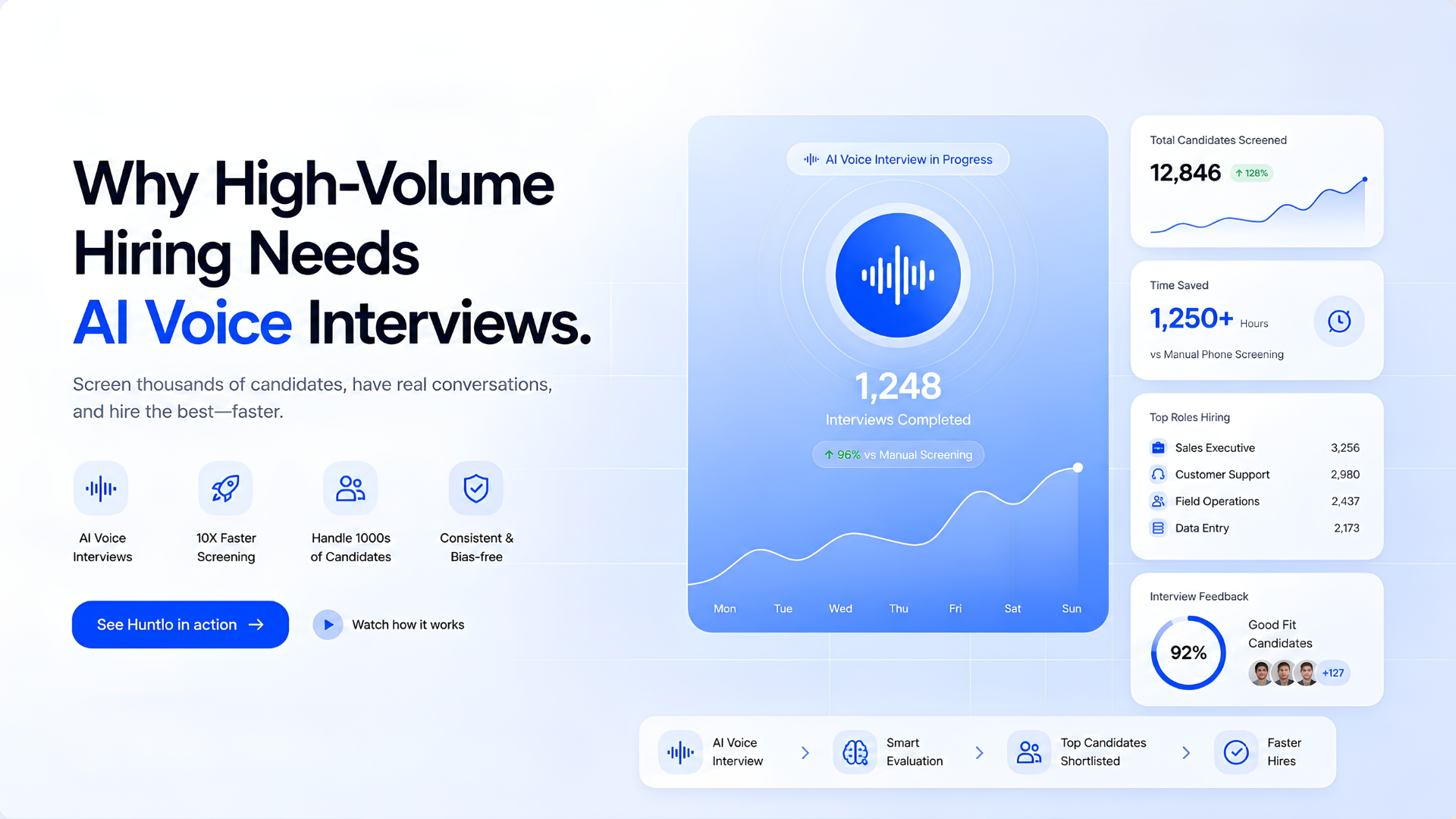
AI voice interviews eliminate the volume-quality tradeoff by decoupling screening capacity from recruiter availability. An AI voice interview is a structured, real-time voice conversation between a candidate and an AI agent that asks role-specific questions, evaluates responses against a predefined competency framework, and produces a detailed scorecard for recruiter review. The candidate completes the interview on their own schedule — no scheduling required, no recruiter time consumed during the conversation. The recruiter’s role shifts from conducting the screen to reviewing the AI’s evaluation, which takes 5 to 8 minutes per candidate compared to 40 to 60 minutes for a manual phone screen.
The capacity impact is immediate and dramatic. A recruiter who can manually process 20 screens per week can review 150 to 200 AI-generated scorecards in the same period. For a team of four recruiters managing the 1,200-candidate warehouse hiring scenario described earlier, AI voice interviews compress what would be a six-week screening effort
into roughly one week of scorecard review — while producing more thorough, more consistent, and better-documented evaluations than the manual alternative. PwC’s hiring technology analysis has found that organizations using AI screening for high-volume roles report 45–60% reductions in time-to-shortlist and 20–30% improvements in first-year retention, because better screening data leads to better hiring decisions even when speed is the primary driver.
The consistency advantage is equally important. In a manual high-volume process, the quality of screening varies significantly based on which recruiter handles the call, how many calls they have already done that day, and how much time they have before the next candidate. AI voice interviews apply the exact same questions, scoring criteria, and evaluation methodology to every single candidate. This consistency has a direct impact on fairness and compliance — particularly significant for organizations operating under evolving AI-in-employment regulations that increasingly require documented, auditable evaluation processes. Every AI voice interview produces a complete, structured record of what was asked, how the candidate responded, and how the evaluation was scored — an audit trail that manual phone screens simply cannot match at volume.
Sourcing, Screening, and the Follow-Up Problem
High-volume hiring does not happen in a vacuum. Before candidates can be screened, they need to be sourced and engaged. And after they are screened, the ones who pass need to be moved through the pipeline quickly before they lose interest or accept other offers. This is where the biggest operational challenge in high-volume hiring emerges: the handoff problem. Most organizations use separate tools for sourcing, screening, and pipeline management. Candidates are sourced through job boards and aggregators, screened through phone calls, and managed through an ATS. Each handoff between tools creates friction — data gets lost, candidates fall through cracks, and recruiters spend more time on administrative coordination than on actual evaluation.
The follow-up challenge compounds this further. Research on follow-up persistence in recruiting has shown that the best hires in high-volume pipelines often come after the third, fourth, or even seventh outreach attempt. Yet most recruiting teams give up after one or two follow-ups, especially in high-volume contexts where the sheer number of candidates makes personalized follow-up feel impractical. The result is that high-volume recruiting teams systematically lose the most employable candidates — the ones who are already employed, already receiving multiple recruiter messages, and need persistent, well-timed outreach to engage.
This is also why referrals consistently outperform cold outreach in high-volume hiring — not because referred candidates are inherently better, but because the referral relationship provides the persistent, trust-based engagement that cold outreach at scale fails to deliver. The implication for AI voice interviews is clear: screening technology only delivers its full value when it is connected to the sourcing and engagement systems that feed candidates into it. Standalone AI voice screening tools that require manual candidate
import and export create as much work as they save.
Candidate Experience at Scale: The Hidden Competitive Advantage
In high-volume hiring, candidate experience is often treated as a luxury that organizations cannot afford. Candidates for warehouse, customer service, and logistics roles are assumed to be less selective about their application experience than candidates for professional roles. The data contradicts this assumption. The Talent Board’s CandE benchmarking research shows that candidate experience scores for high-volume roles have converged with professional roles in recent years, and that candidates who report positive experiences in high-volume processes are 38% more likely to refer others and 27% more likely to reapply for future openings. In industries where referral pipelines and repeat applicants represent a significant source of qualified candidates, this translates directly into lower cost-per-hire over time.
AI voice interviews improve candidate experience in high-volume hiring through two mechanisms. First, they eliminate the scheduling bottleneck that causes the most common candidate complaint in high-volume processes: long waits between application and first contact. When a candidate can complete an AI voice interview within hours of applying — rather than waiting days or weeks for a phone screen slot — the perceived responsiveness of the hiring process improves dramatically. Second, the structured, consistent nature of AI voice interviews ensures that every candidate receives the same quality of screening experience, regardless of when they apply or how many other candidates are in the queue. Deloitte’s workforce research has found that perceived fairness in the hiring process — which consistent, structured evaluation directly supports — is the single strongest predictor of candidate experience satisfaction across all role levels and industries.
The Platform That Handles Volume Without Breaking
AI voice interviews are a powerful screening tool for high-volume hiring. But a screening tool that is not connected to your sourcing pipeline, your outreach system, and your interview scheduling process creates as much operational overhead as it removes. The organizations getting the most from AI voice screening are the ones using it within an integrated platform where candidates are sourced by AI, engaged through automated multi-channel outreach, screened through AI voice interviews, and scheduled for next-round interviews — all within the same system, using the same candidate data, without manual handoffs.
Huntlo is built as exactly this kind of end-to-end hiring operating system. Its AI sourcing engine searches across 50+ platforms simultaneously. Its multi-channel outreach (email, LinkedIn, WhatsApp) engages candidates with persistent, automated follow-up sequences. Its AI voice screening evaluates candidates on role-specific competencies and produces structured scorecards. And its scheduling system coordinates next-round interviews without recruiter intervention. For high-volume hiring teams — whether you are a staffing agency filling hundreds of contract roles, a logistics company onboarding seasonal
workers, or a customer service operation scaling across locations — this integration is what turns AI voice screening from a useful tool into a transformative capability.
The recruiters who succeed in high-volume hiring are not the ones who work longer hours or process candidates faster at the expense of quality. They are the ones who use AI to handle the repetitive, high-volume work of sourcing, screening, and scheduling — and invest the time they get back into the human decisions that determine whether a hire succeeds or fails. AI voice interviews are the screening component of that equation. The platform connecting that screening to everything else is what makes the whole system work.
Related Topics:
The ATS Mistake Companies Keep Repeating