Priya Sharma, talent acquisition leader at a Mumbai-based SaaS company with eight hundred employees, arrived at the office on a Monday morning and opened her laptop to find that her AI recruiting system had already completed a full weekend of work. Twenty-three candidates had been identified across four open engineering roles, personalized outreach messages had been sent to fourteen of them, three responses had been received and engaged with contextually appropriate replies, interview feedback from two Friday interviews had been collected and summarized, and a talent market alert had been generated notifying her team that a competitor had posted twelve new engineering positions overnight, signaling a likely increase in competition for the same candidate pool. Priya had not asked the system to do any of these things. It had done them because it understood the team's objectives, maintained awareness of the current state of every active hiring process, and operated continuously while the human team was offline. She turned to her deputy and said something that captured the shift more precisely than any vendor presentation she had ever seen: it does not feel like using a tool anymore. It feels like working with a colleague who never sleeps.
From Tools You Use to Teammates You Work With
The distinction between a tool and a teammate is not semantic. It is structural. A tool waits for you to pick it up. A teammate anticipates what you need and delivers it before you ask. A tool executes the specific action you initiate. A teammate understands the broader goal and takes independent action to advance it. A tool produces output when you provide input. A
teammate generates insights from its own observation of the environment and shares them proactively. This distinction is the lens through which to understand the transformation now underway in talent acquisition technology. The first generation of recruiting software consisted of tools, systems that required human initiation and human judgment at every step. An applicant tracking system stores candidate data, but it does not suggest which candidates to prioritize. A job board displays postings, but it does not recommend which roles to advertise where. A scheduling tool shows calendar availability, but it does not propose the optimal interview sequence based on candidate availability, interviewer expertise, and hiring urgency. The emerging generation of AI recruiting technology operates differently. It functions as a teammate that maintains awareness of the full hiring context and takes autonomous action to advance shared objectives. Understanding what makes an AI recruiting platform agentic versus just automated is essential to grasping this shift, because the agentic quality, the ability to take independent, goal-directed action rather than simply executing predefined instructions, is precisely what transforms a system from a tool into a teammate.
The practical experience of organizations that have deployed agentic AI recruiting platforms illustrates this teammate dynamic clearly. When a new requisition is approved, the AI teammate does not wait for a recruiter to build a search. It begins sourcing immediately, drawing on its knowledge of the organization's talent needs, the specific requirements of the role, and the current state of the candidate market. It identifies potential candidates, initiates personalized outreach, and begins building engagement before the human recruiter has even reviewed the requisition. When a candidate responds to outreach, the AI teammate handles the initial conversation, answers common questions about the role and the organization, and schedules a recruiter call only when the conversation has reached a point where human expertise adds value. When a hiring manager provides feedback after an interview, the AI teammate incorporates that feedback into its evaluation framework for subsequent candidates, adjusting its recommendations without being explicitly instructed to do so. Each of these actions reflects the characteristic that distinguishes a teammate from a tool: the AI is not waiting to be told what to do. It is observing the environment, understanding the goal, and taking action to advance that goal independently. According to McKinsey research on AI-augmented work, teams that deploy agentic AI systems report thirty to forty percent higher productivity than teams using traditional tool-based systems, because the AI teammate handles the operational coordination that previously consumed a large portion of the human team's time and attention.
The teammate metaphor also captures the iterative, learning relationship that develops between human recruiters and AI systems over time. When you work with a tool, the relationship is static. You learn the tool's features, and the tool does not change in response to your usage patterns. When you work with a teammate, the relationship is dynamic and reciprocal. You learn the teammate's strengths and limitations, and the teammate learns your preferences, priorities, and decision patterns. An AI recruiting teammate that has worked with a specific recruiting team for six months has accumulated organizational knowledge that makes it more effective than a newly deployed system. It knows which hiring managers prefer detailed candidate profiles and which prefer concise summaries. It knows which outreach messages
produce the highest response rates for specific talent segments. It knows the typical timeline from first contact to offer acceptance for different role types. This accumulated organizational learning is a form of institutional memory that was previously stored only in the minds of experienced recruiters and lost when those recruiters left the organization. The AI teammate externalizes and preserves this memory, making it a persistent organizational asset rather than a fragile individual capability. Gartner projects that by 2028, more than half of mid-size and large enterprises will describe their AI recruiting systems as team members rather than tools, reflecting the practical reality that these systems operate with a level of autonomy, contextual awareness, and learning capability that the tool metaphor no longer adequately describes.
What AI Teammates Do That Tools Cannot
The specific capabilities that distinguish AI teammates from traditional recruiting tools fall into three categories: autonomous orchestration, contextual judgment, and proactive intelligence. Autonomous orchestration is the ability to manage multi-step workflows without requiring human initiation or coordination at each step. In a traditional tool environment, the recruiter initiates each action: searching for candidates, sending messages, scheduling interviews, collecting feedback, and updating the applicant tracking system. In an AI teammate environment, the AI manages this workflow end to end, initiating the next step based on the outcome of the previous step without requiring the recruiter to serve as the coordination layer. When a candidate responds positively to outreach, the AI teammate automatically moves to the next stage of engagement. When a candidate goes silent, the AI teammate adjusts its follow-up strategy based on the specific context of the silence rather than applying a one-size-fits-all reminder cadence. This orchestration capability eliminates the single biggest time sink in traditional recruiting: the manual coordination of activities across multiple tools, stakeholders, and candidate touchpoints. The reason referrals outperform cold outreach has always been instructive in this context, because referral-based hiring implicitly benefits from the kind of contextual orchestration that AI teammates can now provide at scale, where each interaction is informed by the full history of the relationship and the specific dynamics of the candidate's situation.
Contextual judgment is the ability to make decisions that consider the full circumstances of a specific situation rather than applying a fixed rule. Traditional recruiting tools operate with rigid logic: if a candidate has not responded in three days, send a reminder. If a candidate's skills match eighty percent of the job requirements, advance them to the next stage. These rules are necessary simplifications, but they produce suboptimal outcomes because they cannot account for the nuance of real-world situations. An AI teammate with contextual judgment can distinguish between a candidate who has not responded because they are not interested and a candidate who has not responded because they are in the middle of a critical project at their current job and will become responsive again in a week. It can recognize that a candidate whose skills match seventy percent of the requirements may be a stronger fit than an eighty percent match if the missing skills are easily learned while the seventy percent candidate's unique experience addresses a critical unspoken need of the hiring team. This
contextual capability produces better hiring decisions because it evaluates candidates in the full context of the role, the team, and the market rather than against a simplified checklist. According to LinkedIn talent acquisition research, organizations using AI systems with contextual judgment capabilities report twenty to thirty percent higher candidate satisfaction scores, because candidates experience a more personalized and thoughtful interaction that respects their individual circumstances rather than treating them as interchangeable units in a standardized process.
Proactive intelligence is the ability to identify and communicate insights that the human team has not explicitly requested but that are relevant to their objectives. A traditional recruiting tool reports the data you ask for. An AI teammate tells you what you need to know, even when you have not thought to ask. For example, an AI teammate might alert the recruiting team that a specific competitor has recently increased its hiring activity in a talent segment where the organization also needs to hire, suggesting that the competitive dynamics in that segment are about to intensify. It might identify that three candidates who were previously unresponsive have recently updated their LinkedIn profiles with new skills or certifications, signaling a potential shift in their openness to new opportunities. It might notice that the average time from first contact to candidate response has been increasing across the team's outreach campaigns, suggesting a market-level shift in candidate behavior that requires an adjustment in engagement strategy. These are insights that a human recruiter could theoretically discover by spending hours analyzing data across multiple systems, but in practice, no recruiter has the time or the cognitive bandwidth to conduct this level of continuous environmental scanning. The AI teammate provides this intelligence as a natural byproduct of its continuous operation, turning information that would otherwise be invisible into actionable strategic input. According to SHRM research on talent acquisition strategy, organizations that receive proactive talent market intelligence from their AI systems make twenty-five to thirty-five percent better hiring decisions in competitive talent segments, because the intelligence allows them to adjust their strategy before market shifts become acute rather than reacting after the fact.
How AI Teammates Transform Daily Recruiting Work
The impact of AI teammates on the daily experience of recruiting work is best understood by comparing a typical day in the traditional model with a typical day in the AI-teammate model. In the traditional model, a recruiter arrives at work, opens the applicant tracking system, reviews the overnight notifications for new applications and candidate responses, prioritizes which candidates to contact first, drafts individual outreach messages, sends them, checks for interview feedback from hiring managers, follows up on overdue feedback, updates candidate status records, reconciles data between the ATS and the sourcing tool, attends a standup meeting to report pipeline status, and spends the remaining hours on phone screens and candidate calls. This day is characterized by constant context-switching between systems, repetitive data entry, and reactive prioritization based on whatever feels most urgent at the moment. The question of how many follow-ups one hire needs is a constant source of anxiety in this model,
because the recruiter knows that follow-ups are critical but can never find the time to execute them with the consistency and personalization that they require. The result is a recruiter who ends the day feeling busy but uncertain about whether they have made meaningful progress on any of their open positions.
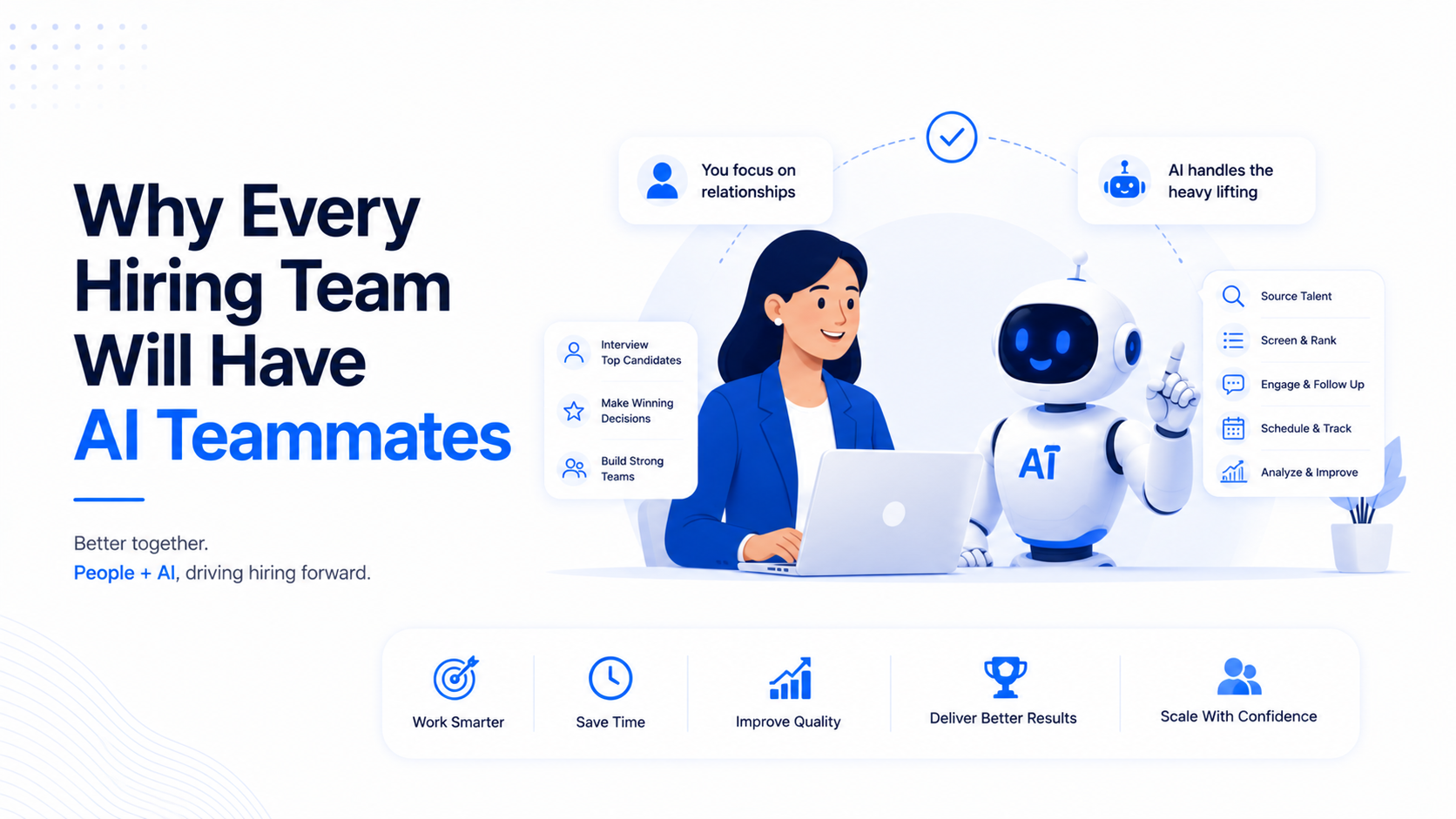
In the AI-teammate model, the recruiter arrives at work and opens a dashboard that shows the current state of every active hiring process, updated in real time by the AI teammate that has been working while the recruiter was offline. The AI teammate has already responded to overnight candidate inquiries, sent follow-up messages to candidates in active pipelines, collected and summarized interview feedback from hiring managers, updated candidate status records, and flagged three items that require human attention: a candidate who has received a competing offer and needs a recruiter conversation to address concerns, a hiring manager who has not provided feedback on two interviews from last week, and a candidate whose profile shows a career change that affects their fit for an upcoming final-round interview. The recruiter's morning is spent on these three high-value activities rather than on the administrative coordination that consumed their morning in the traditional model. The afternoon is available for deep candidate conversations, strategic discussions with hiring managers about upcoming role requirements, and talent market analysis that informs workforce planning. The character of the work has shifted from operational execution to strategic engagement, and the recruiter's energy is directed toward activities that require human skills rather than activities that merely require human attention. According to Deloitte research on the future of work in HR, recruiters working alongside AI teammates report forty to fifty percent higher job satisfaction and thirty percent lower burnout rates compared to recruiters in traditional tool-based environments, because the elimination of administrative overhead allows them to focus on the relational and strategic aspects of recruiting that attracted them to the profession.
The transformation extends beyond individual productivity to team-level collaboration and effectiveness. In a traditional recruiting team, each recruiter manages their own pipeline independently, and the team's collective knowledge is distributed across individual brains and personal spreadsheets. When a recruiter goes on vacation or leaves the organization, their pipeline knowledge goes with them, creating information gaps that slow down hiring and frustrate candidates. An AI teammate creates a shared operational context that the entire team can access. When one recruiter identifies a strong candidate who is not quite right for their current role but might be perfect for a colleague's upcoming position, the AI teammate can suggest the cross-referral automatically, because it maintains awareness of all open positions across the team, not just the ones assigned to a single recruiter. When a candidate interacts with the AI teammate while their primary recruiter is unavailable, the AI maintains the conversation context so the recruiter can pick up seamlessly when they return. This shared context eliminates the information silos that traditionally fragment recruiting teams and creates a collective capability that is greater than the sum of individual recruiter efforts. EY has documented that recruiting teams using shared AI teammates fill positions twenty to thirty percent faster than teams where each recruiter operates independently, because the shared AI enables real-time collaboration, cross-pipeline intelligence, and seamless coverage that prevents candidates
from falling through the gaps between individual recruiter workloads.
The Skills Recruiters Need in an AI-Teammate World
The arrival of AI teammates does not reduce the importance of human recruiters. It changes the skills that make recruiters valuable. The skills that define an effective recruiter in a tool-based environment, proficiency in operating multiple software platforms, speed in executing repetitive administrative tasks, and the ability to manage large volumes of concurrent requisitions, are precisely the skills that AI teammates render less critical. The skills that define an effective recruiter in an AI-teammate environment are fundamentally different: strategic thinking, consultative communication, deep talent market expertise, and the ability to synthesize complex information into actionable recommendations for hiring managers and organizational leaders. The recruiter in an AI-teammate world spends less time doing and more time advising. They are less like a skilled craftsman operating a set of tools and more like a senior consultant who brings specialized knowledge and judgment to complex decisions. This shift in required capabilities has significant implications for how organizations recruit, develop, and retain their talent acquisition professionals. According to McKinsey analysis of skill evolution in AI-augmented professions, the half-life of operational recruiting skills is shrinking as AI capabilities expand, while the premium on strategic and relational skills is increasing, creating a growing mismatch between the skills that current recruiters have and the skills that future recruiting roles will require.
The most important new skill for recruiters in an AI-teammate world is what might be called AI collaboration literacy: the ability to work effectively alongside an AI system, understanding its capabilities and limitations, providing it with the context and guidance it needs to perform well, and evaluating its outputs with appropriate skepticism and critical judgment. This skill is not about technical expertise in AI or machine learning. It is about practical competence in a new mode of professional collaboration. A recruiter who can clearly articulate hiring criteria, provide nuanced feedback on AI recommendations, and identify situations where the AI's contextual understanding is insufficient will extract far more value from an AI teammate than a recruiter who treats the AI as a black box to be either blindly trusted or completely ignored. The organizations that invest in developing this collaboration literacy, through training programs, mentorship, and structured feedback processes, will see significantly better returns from their AI investments than those that deploy the technology without preparing their people. Gartner research on AI adoption in enterprise functions has found that the single strongest predictor of AI ROI is the quality of the human-AI collaboration, accounting for more variance in outcomes than the specific AI technology deployed, the amount of data available, or the scale of the deployment. The AI teammate is only as effective as the human team's ability to work with it productively.
A second critical skill is business acumen, the ability to understand the organization's strategic objectives, competitive dynamics, and operational challenges well enough to align talent acquisition strategy with business needs. In a tool-based environment, recruiters can be
effective with deep knowledge of the recruiting function itself, because the tools handle the operational execution and the recruiter's primary interaction is with candidates and hiring managers who speak the language of recruiting. In an AI-teammate environment, the AI handles the operational execution, which frees the recruiter to engage at a higher strategic level, but only if the recruiter has the business knowledge to participate meaningfully in those strategic conversations. A recruiter who can discuss a hiring need in terms of business impact, team capability gaps, and competitive talent positioning will be far more valuable to the organization than one who frames the same need in terms of requisition details and process timelines. This shift elevates the recruiting function from a service delivery operation to a strategic advisory function, but it requires recruiters who can operate at the strategic level. LinkedIn data on recruiting professional development shows that recruiters who invest in business acumen training alongside their AI collaboration skills are promoted thirty to forty percent faster and produce measurably better hiring outcomes, because they can translate talent market intelligence into business-relevant strategic recommendations that resonate with hiring managers and organizational leaders.
Building Your First AI Hiring Teammate
For organizations ready to introduce an AI teammate to their hiring team, the implementation approach matters as much as the technology selection. The most successful deployments follow a phased model that builds organizational confidence and capability incrementally. The first phase is deployment for a single, well-defined use case, typically high-volume sourcing for roles where the candidate pool is large and the evaluation criteria are relatively standardized. This use case provides a controlled environment where the AI teammate can demonstrate its value without requiring the organization to change its broader recruiting processes. The second phase expands the AI teammate's scope to include candidate engagement and follow-up management, building on the trust and familiarity established in the first phase. The third phase extends the AI teammate's role to include interview coordination, feedback collection, and hiring recommendation support, which requires deeper integration with the organization's existing systems and processes. The distinction between AI sourcing and AI recruiting is relevant at this stage because the phased deployment mirrors the natural progression from sourcing-focused activities to full-recruiting-cycle support, and organizations that understand this distinction can plan their deployment phases more effectively by aligning each phase with the appropriate set of capabilities.
Technology selection for an AI teammate should prioritize three characteristics that differentiate teammate-grade platforms from tool-grade alternatives. The first is orchestration depth, the ability to manage multi-step workflows across the full hiring cycle without requiring human initiation at each step. A platform that can source candidates but requires a human to send outreach messages is a tool, not a teammate. A platform that can manage the full sequence from sourcing through offer acceptance with human oversight only at key decision points is a teammate. The second is learning velocity, the speed at which the platform improves its performance based on outcomes and feedback. A teammate that learns quickly
from hiring outcomes, recruiter feedback, and candidate behavior will compound in value much faster than one that requires extensive manual tuning. The third is integration breadth, the ability to connect with the organization's existing systems, including the applicant tracking system, the HR information system, communication platforms, and calendar systems, because a teammate that operates in isolation from the organization's technology ecosystem will always be constrained by data gaps that prevent it from exercising full contextual judgment. According to SHRM talent acquisition technology guidance, organizations should evaluate AI recruiting platforms on these three dimensions, orchestration depth, learning velocity, and integration breadth, rather than on individual feature checklists, because these dimensions determine whether the platform can function as a true teammate or will remain limited to the tool paradigm.
The change management component of deploying an AI teammate is as important as the technology itself, and it is the component most frequently underestimated. Recruiters who have built their careers and professional identities around their operational skills may perceive the AI teammate as a threat rather than an enhancement, particularly if the deployment narrative focuses on efficiency and cost reduction rather than on capability expansion and role evolution. The most effective change management programs reframe the AI teammate as an opportunity for recruiters to elevate their professional practice, positioning the technology as a lever that enables recruiters to spend more time on the strategic, relational, and advisory activities that produce the highest value for the organization and the most professional satisfaction for the recruiter. This narrative must be backed by tangible investment in skill development, including training on AI collaboration, business acumen, and strategic talent advisory. It must also include visible role model behavior from recruiting leaders who demonstrate the new way of working and the new value that recruiters can create in the AI-teammate model. According to Deloitte research on HR technology adoption, organizations that invest in comprehensive change management alongside AI deployment achieve three to four times the improvement in recruiting outcomes compared to those that focus primarily on technology, because the human transition determines whether the technology is adopted effectively or resisted and underutilized. EY has similarly found that organizations where recruiting leaders personally use and advocate for the AI teammate see fifty to sixty percent faster adoption rates across their teams, because leadership modeling reduces the uncertainty and anxiety that naturally accompany a significant change in how work is performed.
The Inevitability of AI Teammates in Hiring
The adoption of AI teammates in hiring teams is not a question of if but of when and how quickly. The structural forces driving this transition are too strong for any organization to resist indefinitely. The first force is the escalating complexity of the talent market. As skill requirements diversify, as remote work expands the geographic scope of competition, and as candidate expectations for speed and personalization increase, the cognitive demands on recruiting teams grow beyond what unaided human teams can sustain. The second force is the competitive dynamics of talent acquisition. Organizations that deploy AI teammates will hire
faster, hire better, and build stronger talent pipelines than those that do not, creating a competitive gap that will be visible to candidates, hiring managers, and business leaders. The third force is the improving capability and decreasing cost of AI technology. Each generation of AI recruiting platforms is more capable, easier to deploy, and more affordable than the last, which means the barrier to entry is steadily declining and the return on investment is steadily increasing. These three forces are converging to make AI teammates a standard feature of hiring teams across industries and organization sizes. Gartner projects that by 2029, AI teammates will be involved in more than eighty percent of professional-level hiring decisions at large enterprises, and the adoption curve for mid-size and small organizations will follow closely behind as platform costs decrease and implementation complexity declines.
The organizations that will benefit most from this transition are those that engage with it proactively rather than reactively. Proactive organizations are those that begin building their AI-teammate capability now, while the technology is still maturing and while the competitive advantage of early adoption is still available. They invest in understanding the technology, developing their people, and redesigning their processes to accommodate the new model. By the time AI teammates become an industry standard, these organizations will have accumulated years of operational data, refined processes, and developed recruiter capabilities that create a compounding advantage very difficult for late adopters to replicate. Reactive organizations, by contrast, will be forced into adoption by competitive pressure, deploying AI teammates in a rushed, underprepared manner that limits their effectiveness and increases the risk of failed implementations. The difference between these two approaches is not merely a matter of timing. It is a matter of strategic positioning. The organizations that build AI-teammate capability as a deliberate strategic initiative will be positioned to define the standard for talent acquisition effectiveness in their industries, while those that adopt reactively will be perpetually catching up to a moving target. According to McKinsey long-term analysis of technology adoption competitive dynamics, early strategic adopters of transformative technologies capture sixty to seventy percent of the available value, while fast followers capture most of the remainder, and late adopters are left competing primarily on cost rather than capability.
The fundamental reason every hiring team will have AI teammates is that the alternative, continuing to rely exclusively on human recruiters operating traditional tools, will become competitively untenable. This is not because human recruiters are inadequate. It is because the talent market has become too complex, too fast-moving, and too competitive for any human team, no matter how skilled, to manage without AI augmentation. The volume of candidate data, the speed of market changes, the breadth of talent pools, and the intensity of competition for top talent all exceed the cognitive and operational capacity of unaided human teams. AI teammates do not replace this human capacity. They extend it, providing the information processing, pattern recognition, and continuous operational capability that allows human recruiters to focus their limited time and attention on the activities where human judgment creates the most value. The hiring team of the near future will be a hybrid unit composed of human recruiters who provide strategic judgment, relational depth, and creative problem-solving, and AI teammates that provide data processing, workflow orchestration, and proactive
intelligence. This hybrid model will outperform both all-human and all-AI approaches, because it combines the distinctive strengths of each while compensating for their respective limitations. According to LinkedIn annual talent acquisition trends report, eighty-two percent of talent acquisition leaders surveyed in early 2026 said they expect their hiring teams to include AI capabilities within the next three years, and sixty-one percent said they believe AI teammates will become as standard in hiring as applicant tracking systems are today. The transition is not coming. It is here. And the organizations that recognize this reality, invest accordingly, and build the human-AI collaboration skills that the new model requires will be the ones that attract and hire the best talent in the market that is emerging.