Rajesh Venkatesh, the chief people officer at a Mumbai-based financial services firm with thirty-two thousand employees across eleven countries, opened the Q1 2026 hiring review and saw a dashboard that told a story of systemic breakdown. The technology hiring team had filled only sixty percent of its Q4 target, despite adding four new recruiters and subscribing to two additional sourcing platforms. Average time-to-fill for senior roles had crossed ninety days, up from fifty-one days just two years earlier. The candidate experience survey showed a net promoter score of negative twelve, the lowest in the firm history. But the number that troubled Rajesh most was the integration cost line item: his team was spending thirty-eight percent of its recruiting technology budget simply keeping seven different tools talking to each other, with four full-time analysts dedicated to data reconciliation across systems that refused to synchronize cleanly. He had inherited this tool stack piece by piece over six years, each addition promising to solve a specific problem, and each addition instead adding another layer of complexity. Rajesh had begun researching unified AI recruiting platforms and the concept of an AI hiring operating system, and what he found made him realize that his organization did not have a recruiting performance problem. It had a recruiting architecture problem. And no amount of additional point solutions was going to fix it.
The Talent Market Has Outgrown Traditional Recruiting Infrastructure
Rajesh Venkatesh, the chief people officer at a Mumbai-based financial services firm
managing thirty-two thousand employees across eleven countries, sat through the quarterly hiring review in March 2026 and heard a pattern that had become painfully familiar. The technology division had missed its Q4 hiring target by forty percent. The compliance team had taken ninety-three days on average to fill senior analyst roles, compared to fifty-one days two years earlier. Candidate withdrawal rates had reached twenty-two percent, meaning nearly one in four accepted offers never converted to actual hires. The recruiting technology stack, which now included an applicant tracking system, three separate sourcing tools, a standalone interview scheduling platform, a background check vendor portal, and a compensation benchmarking database, required a team of four analysts just to maintain data consistency across systems. Rajesh was not experiencing a recruiting slump. He was experiencing the structural failure of a recruiting technology architecture that was built for a simpler, slower, and less competitive talent market. According to the SHRM 2025 Talent Acquisition Benchmarking Report, sixty-one percent of enterprise recruiting leaders reported that their technology stacks had become more fragmented over the preceding three years, not less, despite significant investment in new tools. The average enterprise now uses seven to twelve distinct recruiting technology products, each with its own data model, integration requirements, and vendor relationship. The result is not better recruiting. It is more complex recruiting with marginally better individual task performance and significantly worse system-level outcomes.
The root cause of this fragmentation is historical. Enterprise recruiting technology was not designed as a unified system. It evolved as a collection of point solutions, each addressing a specific task: job posting, resume parsing, interview scheduling, candidate communication, offer management, and onboarding. Each tool was acquired or built independently, often by different teams at different times, with no overarching architectural vision. The consequence is a recruiting technology landscape that resembles a city built without a master plan: individual buildings may be functional, but the roads between them are congested, the utilities are inconsistent, and the overall experience is inefficient and frustrating for everyone who has to navigate it. McKinsey research on HR technology architecture has found that enterprises with highly fragmented recruiting technology stacks spend thirty to forty percent of their total recruiting technology budget on integration, data reconciliation, and vendor management rather than on capabilities that directly improve hiring outcomes. The fragmentation tax is not merely financial. It degrades candidate experience, slows decision-making, and prevents the kind of data-driven optimization that modern recruiting requires. When candidate data lives in six different systems that do not communicate seamlessly, no single system has a complete picture of the candidate journey, and no recruiter can make fully informed decisions.
The talent market itself has undergone structural changes that make fragmented infrastructure increasingly untenable. The shift to remote and hybrid work has expanded the geographic scope of virtually every open role, transforming local talent markets into global competitions. Candidates now expect the same seamless digital experience in their job search that they receive as consumers in every other domain. They expect rapid response times, personalized communication, transparent processes, and intuitive interfaces. When an enterprise recruiting
process requires candidates to re-enter the same information into multiple systems, experience scheduling delays because the interview platform does not sync with the hiring manager calendar, or receive generic communications that demonstrate no understanding of their specific profile and interests, they disengage. They do not complain. They simply accept offers from competitors who deliver a better experience. The concept of an agentic AI recruiting platform represents the architectural response to this challenge: a unified system that operates autonomously across the entire recruiting workflow, maintaining coherent candidate context, making intelligent decisions at each stage, and presenting both recruiters and candidates with an experience that is integrated, responsive, and personalized. The shift from fragmented tools to a unified operating system for hiring is not an incremental improvement. It is a necessary response to a talent market that has fundamentally changed.
What an AI Hiring OS Actually Means
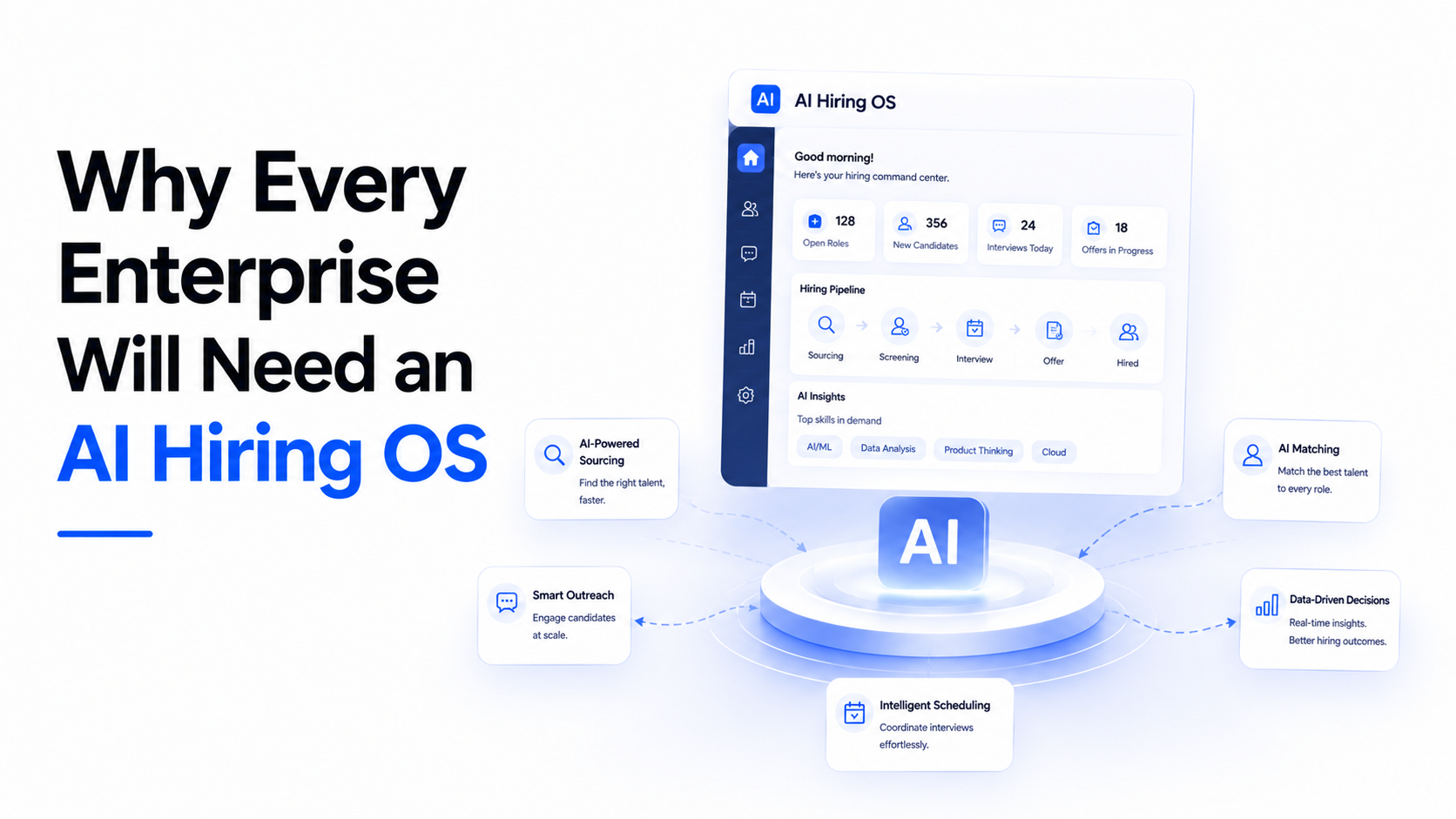
The term operating system, when applied to enterprise hiring, is not a marketing metaphor. It describes a specific architectural pattern that mirrors how operating systems work in computing. A computer operating system provides a unified layer of services, memory management, process scheduling, file handling, and device coordination, that allows applications to run without each application needing to manage these underlying functions independently. An AI hiring OS provides the equivalent layer for the recruiting function: unified candidate data management, intelligent workflow orchestration, automated cross-system coordination, and adaptive decision-making that allows recruiters, hiring managers, and candidates to interact with a coherent system rather than a collection of disconnected tools. The operating system does not replace the applications. It provides the infrastructure that makes them work together effectively. In the hiring context, this means that sourcing, screening, scheduling, communication, assessment, and offer management all operate on a shared data layer with a unified intelligence layer that coordinates activities across the entire recruiting lifecycle. According to LinkedIn 2025 Global Talent Trends report, enterprises that have adopted unified recruiting platforms, as opposed to fragmented tool stacks, report forty-two percent faster hiring cycles and thirty-one percent higher candidate satisfaction scores, because the unified architecture eliminates the handoff delays, data gaps, and inconsistent experiences that characterize fragmented systems.
The AI component of an AI hiring OS is what distinguishes it from previous attempts at recruiting platform consolidation. Earlier generations of integrated recruiting platforms consolidated tools visually, putting multiple capabilities behind a single dashboard, but each capability still operated independently with its own logic, its own data model, and its own decision-making process. An AI hiring OS consolidates intelligence. A single AI engine manages the entire recruiting workflow, making decisions that are informed by data from every stage of the process and every interaction with every stakeholder. When the AI sources a candidate, it does so with awareness of the current screening criteria, the hiring manager availability for interviews, the compensation benchmarks for the role, and the candidate engagement patterns that predict acceptance likelihood. When it schedules an interview, it considers candidate
time zone preferences, panel composition requirements, and the optimal sequencing of assessment stages. When it generates an offer recommendation, it incorporates market data, candidate engagement signals, internal equity constraints, and historical acceptance patterns. This unified intelligence is fundamentally more powerful than the sum of individual AI point solutions, because each decision benefits from information that no single point solution has access to. Unfortunately, many enterprises have fallen into the trap described in analyses of why adding more tools often produces the same hiring problems, where investment in additional AI-powered point solutions fails to improve system-level outcomes because the underlying fragmentation remains unaddressed. The AI hiring OS is the structural answer to that trap: rather than adding more intelligent tools, it unifies the intelligence layer so that every capability benefits from complete information and coherent decision-making.
The practical implications of this architectural shift are significant for every stakeholder in the recruiting process. For recruiters, it means working within a single coherent environment rather than switching between seven to twelve different tools throughout the day. It means having a single source of truth for candidate information, hiring progress, and decision history. It means being able to focus on strategic activities, candidate relationship management, hiring manager consulting, and workforce planning rather than on data entry, system navigation, and cross-platform troubleshooting. For hiring managers, it means receiving candidates who have been evaluated through a consistent, comprehensive assessment process rather than through the variable and often incomplete screening that occurs when different tools handle different stages. It means having visibility into the full candidate journey rather than seeing only the portion that passes through the tools they interact with directly. For candidates, it means a seamless experience from first contact through onboarding, with consistent communication, transparent status updates, and interactions that demonstrate the organization understands their specific profile and interests. Gartner projects that by 2028, sixty percent of large enterprises will have adopted or be actively transitioning to an AI-operating-system model for recruiting, up from less than fifteen percent in 2025, driven by the compounding inefficiencies of fragmented tool stacks and the competitive pressure of talent markets that reward speed, coherence, and personalization.
The Infrastructure Gaps That Force the Shift
The pressure to adopt an AI hiring OS is not coming from technology vendors or industry hype. It is coming from measurable failures in the existing infrastructure that directly impact business performance. The most visible failure is speed. In a talent market where top candidates receive multiple offers within days of entering the job market, every week of delay in the hiring process reduces the probability of a successful hire. Research by Deloitte on enterprise hiring performance found that organizations with hiring processes exceeding forty-five days from initial contact to offer acceptance lose thirty-five to forty percent of their top-choice candidates to faster competitors. These are not marginal candidates. They are the candidates that hiring managers most want to hire, and they are precisely the candidates who have the most alternatives and the least patience for slow, fragmented processes. The
fragmented tool stacks that dominate enterprise recruiting are a primary driver of this slowness, because every handoff between systems, from sourcing tool to ATS to scheduling platform to assessment vendor, introduces delays, data loss, and coordination overhead that accumulate across the hiring workflow.
The second infrastructure failure is data quality and decision intelligence. Fragmented systems produce fragmented data. When a candidate interacts with five different recruiting tools during their hiring journey, each tool captures a partial picture of that candidate, and no single system has the complete view needed for optimal decision-making. The sourcing tool knows the candidate response rate but not the interview performance. The scheduling tool knows the availability patterns but not the assessment scores. The ATS knows the application status but not the candidate engagement signals from email and messaging interactions. This fragmentation means that the decisions recruiters and hiring managers make, which candidates to advance, what offer to make, how to prioritize roles, are based on incomplete information. The result is systematically suboptimal hiring decisions: strong candidates are overlooked because their strengths are distributed across multiple systems, weak candidates advance because their weaknesses are hidden in systems that other decision-makers do not see, and offer strategies are based on partial data rather than comprehensive candidate intelligence. Organizations that recognize this problem often look for guidance on how to evaluate an AI sourcing tool before buying, but the evaluation framework must extend beyond individual tool capabilities to assess how well the solution integrates into a unified intelligence architecture. A brilliant AI screening tool that does not share its data with the sourcing and offer management systems is still contributing to the fragmentation problem, not solving it.
The third infrastructure failure is scalability. As enterprises grow, acquire companies, expand into new markets, and adapt to new work models, their recruiting processes must scale accordingly. Fragmented tool stacks scale poorly because each additional tool, integration, and data flow increases complexity exponentially rather than linearly. Adding a new business unit might require integrating three new tools, each with its own data model and vendor relationship, into an already fragile technology ecosystem. Supporting a new hiring model, such as global remote hiring or contingent workforce management, might require capabilities that do not exist in any current tool and cannot be bolted onto the existing stack without creating further fragmentation. An AI hiring OS addresses this scalability challenge through its architectural design: new capabilities are integrated into the unified intelligence layer, new data sources feed the shared data model, and new workflows are orchestrated by the same AI engine that manages existing processes. EY research on enterprise technology scalability found that organizations with unified platform architectures scale their recruiting operations sixty to seventy percent faster than those with fragmented tool stacks, because new requirements are addressed through configuration and extension rather than through the procurement, integration, and maintenance of additional point solutions. For enterprises operating in dynamic talent markets where the ability to scale recruiting capacity quickly is a competitive advantage, this architectural scalability is not a convenience. It is a strategic necessity.
How an AI Hiring OS Transforms Recruiting Outcomes
The transformation from fragmented tools to a unified AI hiring OS produces measurable improvements across every dimension of recruiting performance. The most immediate impact is on speed. When a single AI engine manages the entire workflow from sourcing through onboarding, the handoff delays that accumulate across fragmented systems are eliminated entirely. The AI does not wait for a recruiter to export data from the sourcing tool, import it into the ATS, and then trigger the scheduling platform. It manages all of these transitions autonomously and instantaneously, because all of the data and all of the workflow logic reside in a single system. SHRM case studies on unified recruiting platforms report average time-to-fill reductions of thirty to forty-five percent within the first year of deployment, with the largest improvements coming not from any single capability but from the elimination of inter-system delays and data re-entry. For roles in competitive talent markets, where the difference between hiring the best candidate and the second-best candidate often comes down to a matter of days, this speed improvement translates directly into better hiring outcomes.
The second transformation is in decision quality. When an AI hiring OS has access to complete candidate data from every stage of the process and every interaction channel, its recommendations are based on a comprehensive picture that no fragmented system can provide. The system can identify patterns that are invisible when data is siloed: for example, that candidates who ask specific types of questions during initial conversations tend to perform better in technical assessments, or that candidates referred by employees in a particular department have higher long-term retention rates. These patterns, which emerge only when data is unified and analyzed holistically, enable more accurate candidate evaluation, more effective offer strategies, and more precise role-candidate matching. The distinction between AI capabilities in different parts of the recruiting process is explored in depth in analyses of the difference between AI sourcing and AI recruiting, where the most effective implementations are those that break down the artificial boundaries between sourcing, screening, and recruiting and treat the entire talent acquisition process as a unified intelligence problem rather than a collection of separate tasks. The AI hiring OS embodies this unified approach at the architectural level, ensuring that intelligence flows freely across every stage of the process.
The third transformation is in recruiter effectiveness and satisfaction. When recruiters work within a unified AI hiring OS, their daily experience changes fundamentally. Instead of spending sixty to seventy percent of their time on operational coordination, navigating between systems, reconciling data, and managing administrative tasks, they focus on the activities that require human judgment and relationship skills: building candidate relationships, consulting with hiring managers on role design and assessment strategy, developing talent pipeline strategies, and contributing to workforce planning. This shift does not just improve recruiter productivity. It improves recruiter retention, because professionals who spend their time on intellectually stimulating strategic work report significantly higher job satisfaction than those mired in administrative coordination. According to McKinsey research on the future of work in HR, enterprises that have transitioned their recruiting teams from fragmented
tool environments to unified AI-operating-system models report twenty-five to thirty-five percent lower recruiter turnover and forty to fifty percent higher recruiter hiring manager satisfaction scores. The recruiter becomes a strategic talent advisor rather than a process coordinator, and both the recruiter and the organization benefit from this elevation. The AI hiring OS does not replace the recruiter. It liberates the recruiter to do the work that only a human can do.
The Enterprise Decision: Build, Buy, or Fall Behind
For enterprise leaders evaluating the transition to an AI hiring OS, the strategic question is not whether to make the transition but how to execute it effectively. Three broad paths exist. The first is to build a custom AI hiring OS internally, leveraging the organization own engineering talent to create a unified platform tailored to its specific processes, data structures, and strategic requirements. This approach offers maximum customization and control but requires significant engineering investment, typically eighteen to thirty-six months of development time, and ongoing commitment to platform maintenance and enhancement. The second path is to adopt a commercially available AI hiring OS platform that provides the unified architecture and intelligence layer as a managed service. This approach offers faster time-to-value, typically three to nine months for initial deployment, but requires the organization to adapt its processes to the platform capabilities and accept the vendor roadmap for future development. The third path, continuing with the fragmented tool stack, is not a viable long-term strategy. It is the path of competitive decline. LinkedIn data on enterprise hiring performance shows a widening performance gap between organizations that have adopted unified recruiting platforms and those that remain on fragmented stacks, with the unified-platform cohort outperforming on every measurable metric: speed, quality, cost, candidate experience, and recruiter satisfaction.
The decision between build and buy should be guided by three factors: internal engineering capacity, timeline urgency, and the degree of customization required. Organizations with large engineering teams, unique recruiting processes that cannot be adapted to commercial platforms, and the patience for a multi-year build-out may find the custom approach compelling. Organizations that need to move quickly, have limited engineering capacity to dedicate to recruiting technology, and can adapt their processes to a well-designed platform will find the commercial approach more practical. Most enterprises, in practice, choose a hybrid approach: adopting a commercial AI hiring OS platform as the foundation and building custom integrations, analytics, and workflow extensions on top of it. This hybrid approach leverages the speed and reliability of a commercial platform while preserving the ability to customize for unique organizational requirements. Gartner analysis of HR technology adoption patterns found that sixty-eight percent of enterprises pursuing unified recruiting platforms in 2025 and 2026 are choosing the hybrid model, combining commercial platform foundations with custom extensions, because it offers the best balance of speed, flexibility, and total cost of ownership. The key evaluation criteria for any platform, whether built or bought, should include the depth of its AI orchestration capability, the quality of its data integration
architecture, the breadth of its workflow coverage, and the sophistication of its learning and adaptation mechanisms.
The cost dynamics of the transition are more favorable than many enterprise leaders assume. While the initial investment in an AI hiring OS, whether built or bought, is significant, the total cost of ownership over three to five years is typically lower than the ongoing cost of maintaining a fragmented tool stack. Fragmented stacks incur hidden costs that unified platforms eliminate: integration maintenance, data reconciliation, vendor management overhead, recruiter training for multiple systems, and the opportunity cost of slower hiring and suboptimal decisions. Deloitte modeling of recruiting technology total cost of ownership found that enterprises transitioning from fragmented stacks to unified AI platforms reduce their three-year recruiting technology costs by twenty to thirty percent while simultaneously improving hiring outcomes by thirty to forty percent. The transition is not a cost increase. It is a cost reallocation from maintenance and integration to capability and intelligence. For Rajesh, the chief people officer watching his organization struggle with a seven-tool recruiting stack that was failing to deliver results, the decision was not difficult once he understood the true cost of fragmentation. The question was not whether his enterprise could afford to build an AI hiring OS. The question was whether it could afford not to.
The Talent Market Will Not Wait
The global talent market is entering a period of structural scarcity that will make the next decade the most competitive environment for enterprise hiring in modern history. Demographic shifts, including aging workforces in developed economies and rapid skills obsolescence driven by technological change, are shrinking the available pool of qualified candidates for critical roles while simultaneously increasing demand for those roles. The EY Workforce of the Future report estimates that by 2030, global enterprises will face a talent shortage affecting more than eighty-five million workers across technology, healthcare, financial services, and advanced manufacturing, creating a persistent imbalance between talent supply and demand that will intensify competition for every qualified candidate. In this environment, the quality of an enterprise recruiting function is not a human resources concern. It is a strategic capability that directly determines which organizations can execute their business strategies and which cannot. Organizations with fragmented, slow, and impersonal recruiting processes will lose the competition for talent consistently and predictably, regardless of how strong their employer brand or how generous their compensation packages may be.
The AI hiring OS is the infrastructure that enables enterprises to compete effectively in this environment. It provides the speed to engage candidates before competitors do, the intelligence to make better hiring decisions, the coherence to deliver a candidate experience that attracts top talent, and the scalability to adapt to changing talent market conditions without requiring constant technology procurement and integration. The enterprises that are building or adopting AI hiring operating systems today are not making a speculative technology bet. They are making a disciplined response to a structural market shift that is already underway
and accelerating. The evidence from early adopters is consistent and compelling: faster hiring, better hiring decisions, lower recruiter turnover, higher candidate satisfaction, and lower total cost of ownership. These are not theoretical benefits projected from vendor marketing materials. They are measured outcomes from enterprises that have made the transition. According to McKinsey analysis of enterprise talent acquisition transformation, organizations that adopt unified AI recruiting platforms achieve return on investment within twelve to eighteen months, with the payback coming primarily from reduced time-to-fill, improved new-hire retention, and the elimination of fragmentation-related costs that previously consumed thirty to forty percent of the recruiting technology budget.
The transition to an AI hiring OS is not a question of technology adoption. It is a question of organizational readiness and strategic commitment. The technology exists today. The platforms are mature enough for enterprise deployment. The evidence base is sufficient to support confident investment decisions. What separates the enterprises that will thrive from those that will struggle is the willingness to make a decisive break with the fragmented, tool-by-tool approach that has defined recruiting technology for two decades and commit to the unified, intelligence-driven architecture that the talent market now demands. For every enterprise leader responsible for talent acquisition, the analysis is straightforward: the talent market has structurally changed, the existing recruiting technology architecture is inadequate for the new reality, and the AI hiring OS is the architectural response that addresses the root cause of recruiting underperformance. The enterprises that act on this analysis will build a compounding advantage in the talent market that late adopters will find increasingly difficult to overcome. The enterprises that do not act will continue to invest more money in more tools and continue to produce the same disappointing results, falling further behind with each passing quarter until the gap between their recruiting capability and the market demand becomes too large to close.