Amara Osei, senior vice president of people at a Toronto-based enterprise software company with nine thousand employees, sat in the monthly executive talent review and listened to the head of product development describe the hiring situation in language that had become painfully familiar. The team needed four senior engineers, two data architects, and a machine learning specialist. The requisitions had been open for an average of seventy-two days. The recruiting team had sourced over three hundred candidates, conducted forty-eight initial screens, advanced sixteen to interview, and extended three offers. Two offers had been declined for competing opportunities, and one candidate had accepted but had not yet started. The product development timeline was slipping by two weeks per month because the team could not hire fast enough. Amara had approved additional recruiting headcount, expanded the sourcing tool budget, and implemented an employee referral bonus program. None of it had closed the gap between talent need and talent supply. She had recently begun reading about AI-driven talent acquisition platforms that operated autonomously across the full hiring lifecycle, and she wondered whether the fundamental problem was not insufficient effort but an outdated model, one where humans attempted to manage a complexity of data, signals, and interactions that had grown beyond human cognitive capacity. The question was not whether her team was working hard enough. It was whether they were working in a model designed for a talent market that no longer existed.
The Structural Forces Driving AI to the Center of Talent
Acquisition
Amara Osei, senior vice president of people at a Toronto-based enterprise software company with nine thousand employees, attended an industry conference in October 2025 and heard a statistic that reframed her entire approach to talent strategy. A keynote speaker presented data showing that the average time from a critical skill need emerging in a business unit to a qualified candidate starting in the role had increased from sixty-three days to ninety-one days over the previous three years, while the cost of each vacant critical role had risen by forty-four percent. The gap between the organization's need for talent and its ability to acquire that talent was widening, and the traditional approaches, more recruiters, more job postings, more sourcing tools, were not closing it. Amara realized that her organization was not facing a recruiting performance problem that could be solved by working harder or spending more. It was facing a structural transformation in the talent market that required a fundamentally different approach. The forces driving this transformation are documented extensively by organizations including McKinsey, whose research on global talent markets identifies four converging structural trends: persistent skill shortages that give candidates increasing leverage, the globalization of every role competition through remote work, the explosion of data that makes it impossible for humans to process all relevant candidate signals manually, and the rising expectations of candidates who compare the hiring experience to consumer-grade digital interactions. These forces are not temporary disruptions. They are permanent structural changes that make the human-orchestrated recruiting model progressively less effective, creating the conditions for AI to move from a supporting tool to the central architecture of talent acquisition.
The significance of these structural forces is best understood by examining what they collectively demand from the talent acquisition function. Skill shortages mean that the organization must identify and engage candidates who are not actively looking for work, because the pool of active job seekers is too small to meet demand. This requires continuous, proactive talent intelligence rather than reactive, requisition-driven sourcing. Globalized competition means that the organization is competing for candidates against employers worldwide, requiring real-time awareness of compensation benchmarks, competitive hiring dynamics, and candidate expectations across multiple geographies simultaneously. The explosion of data means that the strongest hiring signals, a candidate's recent project contributions, their professional network evolution, their learning trajectory, and their engagement with industry developments, are scattered across dozens of platforms and cannot be synthesized by a human reviewing individual profiles. And rising candidate expectations mean that every interaction must be fast, personalized, and respectful of the candidate's time, because top candidates have multiple options and will disengage from processes that feel slow, generic, or impersonal. These demands, continuous intelligence, global awareness, multi-source data synthesis, and personalized responsiveness at scale, exceed human cognitive capacity. They do not exceed AI's capacity. Gartner has identified this gap between what the talent market demands and what human-orchestrated processes can deliver as the primary driver of AI adoption in talent
acquisition, projecting that by 2028, AI will be involved in more than eighty percent of hiring decisions at large enterprises, not as a screening tool but as the primary decision intelligence system.
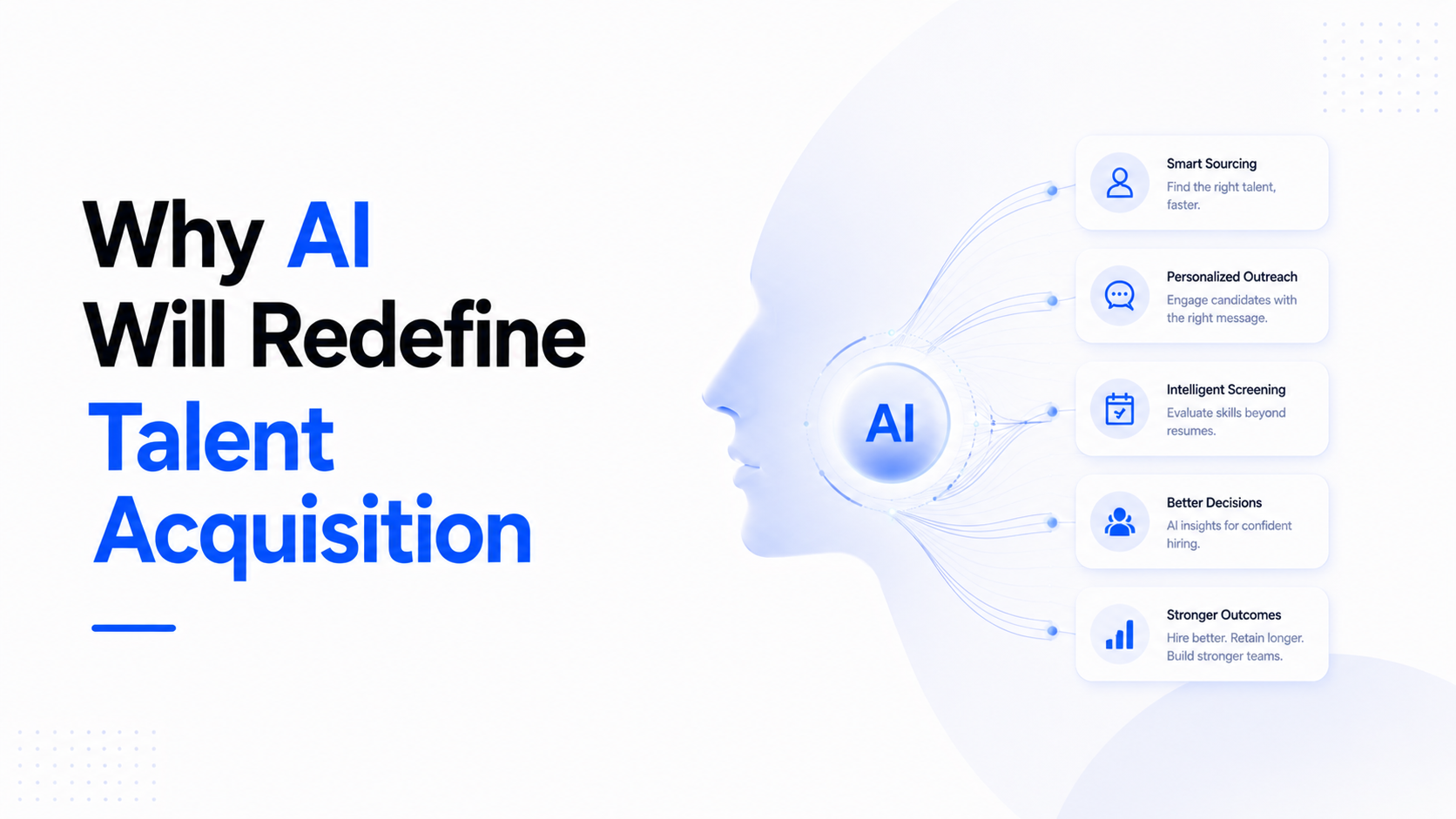
The redefinition of talent acquisition by AI is not about replacing human recruiters with machines. It is about building a talent acquisition capability that operates at the speed, scale, and sophistication that the modern talent market requires. In this model, the AI system serves as the operational core of the recruiting function, managing the continuous flow of talent intelligence, candidate engagement, assessment, and workflow coordination that constitutes the hiring process. The human recruiters serve as the strategic layer, providing judgment on complex decisions, building the deep candidate relationships that require genuine human connection, advising hiring managers on talent strategy, and managing the organizational dynamics that affect hiring outcomes. This division of labor is not a diminishment of the recruiter's role. It is a recognition that the operational demands of modern recruiting have grown beyond what any human team can manage effectively, and that the highest-value contribution of a recruiter is strategic judgment and relationship depth, not operational throughput. The most advanced expression of this model is an agentic AI recruiting platform that operates as an intelligent agent across the full talent acquisition workflow, making contextual decisions at each stage, learning from every outcome, and involving human recruiters at precisely the points where their capabilities add the most value.
How AI Redefines Each Stage of the Talent Acquisition Lifecycle
The impact of AI on talent acquisition is not uniform across the hiring lifecycle. It is most transformative at the stages where the gap between market demand and human capacity is widest. In talent intelligence and pipeline development, AI redefines what is possible by maintaining continuous awareness of the talent landscape rather than conducting periodic sourcing sprints. The system monitors professional activity, career transitions, skill development, and hiring market dynamics across the talent pool in real time, building and maintaining a dynamic pipeline that is always current and always matched to organizational needs. When a role opens, the pipeline is already populated with qualified, partially engaged candidates rather than requiring a reactive search from scratch. According to LinkedIn talent acquisition research, organizations with AI-driven continuous talent intelligence report fifty-five to sixty-five percent shorter sourcing-to-engagement timelines and thirty to forty percent higher candidate response rates, because the AI identifies and begins cultivating relationships with candidates before the role becomes formally open, meaning the candidate is already warm when the first outreach occurs. This shift from reactive sourcing to continuous intelligence is the most fundamental redefinition of the talent acquisition lifecycle that AI enables.
In candidate engagement, AI redefines the relationship between the organization and the candidate by making every interaction contextually personalized and responsively timed. Traditional engagement operates on sequences and templates: a three-email outreach sequence, a follow-up after five business days, a status update after an interview. These
interactions are triggered by calendar intervals, not by candidate behavior. AI-driven engagement operates on signals and context: the system monitors each candidate's behavior, email opens, link clicks, page visits, response timing, and adapts its approach accordingly. A candidate who visits the company careers page within hours of receiving outreach is signaling active interest and receives a different, more substantive follow-up than a candidate who has not engaged after a week. A candidate who views a specific team's page receives follow-up content that connects their background to that team's work. This signal-responsive engagement model produces dramatically higher conversion rates because candidates perceive the interaction as personally relevant rather than automated. The distinction between AI that optimizes a single activity like sourcing and AI that transforms the entire lifecycle is central to understanding the difference between AI sourcing and AI recruiting, where the full-lifecycle approach produces compounding advantages that point solutions cannot match, because insights from each stage inform and improve every other stage in a continuous feedback loop.
In assessment and selection, AI redefines how organizations evaluate candidate capability by moving beyond keyword matching and static qualification criteria to holistic, context-aware evaluation. Traditional screening asks whether a candidate's profile matches a list of requirements. AI-driven assessment asks whether a candidate's capabilities, as demonstrated through their career trajectory, project history, skill development patterns, and professional accomplishments, predict success in the specific context of the role and the team. This contextual evaluation is particularly valuable for identifying candidates from non-traditional backgrounds, career changers, and professionals whose strongest capabilities are not well captured by standard resume formats. The assessment also extends beyond resume analysis to include conversational AI interactions that evaluate communication skills, problem-solving approach, and role motivation in real time, producing a multi-dimensional candidate profile that is far richer than what a static document can convey. SHRM research on AI-driven assessment has found that organizations using context-aware AI evaluation produce twenty-five to forty percent more diverse candidate shortlists and fifteen to twenty percent higher new-hire performance ratings at the twelve-month mark, because the assessment identifies capability and potential that static criteria-based screening systematically overlooks.
The Organizational Impact: From Cost Center to Strategic Advantage
The redefinition of talent acquisition by AI extends beyond process improvement to a fundamental shift in the function's strategic position within the organization. For decades, talent acquisition has been treated primarily as a cost center, a function that consumes budget in proportion to the number of hires it produces. This framing has shaped how the function is measured, cost-per-hire, time-to-fill, and recruiter productivity, and how it is managed, with continuous pressure to do more with less. AI redefines this equation by transforming talent acquisition from a cost of doing business into a source of competitive advantage. When an AI system can source, engage, assess, and manage candidates at a fraction of the cost and time of a
human-orchestrated process, the marginal cost of each additional hire decreases significantly. More importantly, when the AI system learns and improves with every hiring cycle, the quality of hiring outcomes improves over time, producing a compounding return that the traditional cost-center model cannot capture. This shift from cost center to strategic advantage is the most consequential organizational impact of AI in talent acquisition, because it changes how the function is funded, measured, and positioned in the organizational hierarchy. The persistent challenge of organizations adding more tools, same hiring problems illustrates the limitations of the cost-center framing: when talent acquisition is treated as a cost to be minimized, organizations invest in tools that reduce the cost of individual tasks without addressing the systemic factors that determine hiring quality, producing incremental efficiency gains without strategic improvement.
The strategic advantage created by AI-driven talent acquisition manifests in several measurable ways. First, faster hiring translates directly into faster execution of business strategy. When a critical role is filled in thirty days instead of ninety, the product launch, market expansion, or organizational initiative that depends on that role accelerates by sixty days. In competitive markets, this speed advantage compounds across multiple hires and multiple initiatives, creating a strategic tempo that competitors using slower hiring processes cannot match. Second, better hiring quality translates into stronger operational performance. When AI-driven assessment identifies candidates who are more likely to succeed in the specific role and team context, new-hire performance improves, ramp-up time decreases, and retention increases, reducing the costly cycle of failed hires and replacements. Third, superior candidate experience translates into stronger employer brand, which attracts more and better candidates in future hiring cycles, creating a self-reinforcing advantage. According to Deloitte research on the strategic value of talent acquisition, organizations that have achieved AI-driven improvements in hiring speed, quality, and experience report fifteen to twenty-five percent stronger business performance metrics, including revenue growth and market share, compared to peers with traditional hiring processes, because the talent advantage translates directly into execution advantage.
The transformation of talent acquisition from cost center to strategic advantage also changes the function's relationship with the rest of the business. When talent acquisition is a cost center, hiring managers are customers who submit requisitions and evaluate the candidates the recruiting team delivers. When talent acquisition is a strategic advantage, the recruiting function becomes a strategic partner that proactively advises the business on talent market dynamics, role design, workforce planning, and competitive positioning. The AI system provides the data and intelligence that enables this strategic partnership. It can identify emerging skill gaps before they become critical, recommend role design modifications based on talent availability, forecast hiring timelines based on market conditions, and advise on compensation strategy based on real-time competitive intelligence. This proactive, intelligence-driven partnership model is fundamentally different from the reactive service delivery model that most talent acquisition functions operate under today. EY analysis of the evolving role of HR in business strategy has found that organizations where talent acquisition functions have transitioned
from service delivery to strategic advisory, enabled by AI-driven intelligence, are two to three times more likely to report that their talent strategy is a significant contributor to overall business performance, because the intelligence the function provides shapes business decisions rather than merely serving them.
The Recruiter's New Identity in an AI-Redefined Talent Acquisition Function
The question that recruiting professionals ask most frequently as AI redefines talent acquisition is what happens to their role and their career. The answer, based on the experience of organizations that have already made the transition, is that the recruiter's role does not disappear. It transforms in ways that make it more strategic, more impactful, and ultimately more satisfying, but the transition requires deliberate adaptation. The operational tasks that currently dominate most recruiters' days, sourcing candidates, screening resumes, scheduling interviews, sending status updates, and managing pipeline data, are precisely the tasks that AI handles most effectively. In AI-redesigned talent acquisition functions, these tasks are managed autonomously by the AI system, and recruiter time is reallocated to activities that require human judgment, creativity, and relational depth. These activities include building relationships with passive senior candidates who require a genuine human connection to consider a move, consulting with hiring managers on role design, team composition, and assessment strategy, developing talent market intelligence that informs business planning, and managing the candidate experience at the critical moments where human interaction creates disproportionate value. The concern about whether recruiters should worry about AI replacing their jobs is best answered by the evidence from early adopters: organizations that have transitioned to AI-augmented recruiting report higher recruiter satisfaction, lower recruiter turnover, and stronger recruiter hiring-manager relationships, because recruiters are doing work that is more intellectually engaging and more strategically valuable than the operational tasks that previously defined their roles.
The skills that define recruiting success in the AI-redesigned function are different from the skills that define success in the traditional model. Boolean search expertise, applicant tracking system proficiency, and email template management, which have been core recruiter competencies for a decade, are diminishing in importance as AI handles these tasks more effectively than any human can. The emerging recruiter competencies, which are far more difficult to automate, include data interpretation, the ability to read AI-generated insights and translate them into actionable strategies, strategic advisory, the ability to counsel hiring managers on talent market dynamics and role design, stakeholder management, the ability to navigate organizational politics and align competing priorities, and relationship depth, the ability to build genuine trust with candidates and hiring managers through sustained, high-quality human interaction. These skills represent a higher-order professional capability that positions the recruiter as a talent strategist rather than a process executor. According to McKinsey research on the evolution of professional roles in response to AI, recruiters who develop these
higher-order skills and transition to strategic advisory roles consistently outperform their peers on career advancement, compensation growth, and job satisfaction, because the skills are scarce, valuable, and difficult to replicate.
The transition to the new recruiter identity requires organizational investment in capability development. Most recruiting professionals did not enter the field to become data interpreters or strategic advisors. They entered because they enjoyed working with people, building relationships, and helping organizations find the talent they need. The AI-augmented model does not ask recruiters to abandon these motivations. It asks them to express them at a higher level of impact. Instead of building transactional relationships with dozens of candidates who may or may not be a good fit, recruiters build deep, strategic relationships with the candidates and hiring managers who need them most. Instead of managing process logistics, they shape hiring strategy. Instead of reporting on what happened, they provide intelligence about what should happen next. This is a more demanding and more rewarding professional role, but it requires training, mentorship, and a supportive organizational culture that values strategic contribution over operational throughput. According to LinkedIn data on the evolving skills profile of recruiting professionals, the organizations most successful in managing this transition are those that combine AI deployment with structured recruiter development programs, achieving thirty to forty percent faster capability adoption and significantly better retention of high-performing recruiters, because the development program provides a clear path from the old role to the new one.
Building an AI-Redefined Talent Acquisition Function: The Roadmap
The transition to an AI-redefined talent acquisition function should be approached as a multi-year strategic initiative with four distinct phases. The first phase is foundation building: establishing the data infrastructure, governance frameworks, and organizational readiness that the AI system requires. This includes integrating data from existing HR systems, defining the decision boundaries within which the AI will operate autonomously, and developing the performance metrics that will measure the function's success in its new model. This phase is the most commonly underinvested, and its quality determines the success of everything that follows. Gartner research on AI adoption in HR consistently finds that organizations investing more than fifty percent of their AI implementation budget on data integration, governance, and readiness, and less than fifty percent on technology procurement, achieve significantly better outcomes than those that skew investment toward technology, because the AI system's performance is bounded by the quality of the data and governance it operates within. The foundation phase typically takes three to six months, and it should be completed before any AI system is deployed in production.
The second phase is pilot deployment, selecting a bounded domain where the AI system can demonstrate its value with manageable risk. The ideal pilot domain is a high-volume, high-impact hiring category where the current process has clear pain points and measurable
outcomes. Engineering hiring, sales hiring, and healthcare professional hiring are common pilot domains because they combine volume with strategic importance and well-defined success metrics. The pilot should be designed to produce rigorous outcome data, comparing the AI-driven process to the traditional process on metrics that matter, not just efficiency metrics like time-to-fill but outcome metrics like quality of hire, retention, and hiring manager satisfaction. This outcome data serves two purposes: it builds the evidence base for broader deployment, and it provides the initial training data that the AI system needs to improve its performance. The third phase is progressive expansion, extending the AI system from the pilot domain to additional hiring categories, geographies, and stages of the talent acquisition lifecycle. Each expansion should be accompanied by the same rigorous outcome measurement that characterized the pilot, creating a continuous evidence base that demonstrates value and identifies areas for refinement. Deloitte guidance on AI transformation in HR recommends a phased expansion approach, where each phase builds on the evidence and organizational learning from the previous phase, rather than a big-bang deployment that introduces the AI system across the entire function simultaneously.
The fourth phase is organizational transformation, the point at which the AI system is fully integrated into the talent acquisition function and the recruiter role has transitioned from operational execution to strategic advisory. This phase is the most challenging and the most important, because it requires changing deeply entrenched behaviors, expectations, and organizational relationships. Hiring managers must learn to partner with AI-augmented recruiting teams rather than simply submitting requisitions. Recruiters must fully embrace their new identity as talent strategists. Candidates must experience the AI-driven process as a genuine improvement. And the organization must measure the function's success on outcome metrics rather than activity metrics. This transformation does not happen automatically when the technology is deployed. It requires sustained investment in communication, training, feedback, and leadership. SHRM research on organizational change in talent acquisition has found that the organizations achieving the strongest outcomes from AI transformation are those that invest at least as heavily in change management and capability development as they do in technology, because the technology delivers its potential only when the people and processes around it are aligned with the new model. AI will redefine talent acquisition. The question is not whether this redefinition will happen but whether your organization will lead it or be disrupted by it. The structural forces driving the transformation, skill shortages, data complexity, global competition, and rising candidate expectations, are not diminishing. They are accelerating. The organizations that recognize this reality and begin building the AI-redefined talent acquisition function now will accumulate the data assets, process architectures, team capabilities, and learning advantages that produce compounding returns over the coming decade.