The Phone Screen Is Broken — and Recruiters Know It
Every recruiter has lived through the same cycle. A requisition opens, two hundred applications arrive within the first week, and the screening calls begin. Forty to sixty candidates need a phone screen to fill an interview slot. Each call takes fifteen to thirty minutes including prep, the conversation itself, and post-call notes. That is ten to thirty hours of recruiter time per role, consumed entirely by the least strategic step in the hiring funnel. Analysis by Zivaro found that recruiters spend an average of 23 hours per hire on screening activities alone — nearly half of the total 45 hours that an average hire consumes from application to offer (https://www.zivaro.ai/blog/recruiter-time-per-hire). For a team making 100 hires per year, that translates to 2,300 hours spent solely on screening calls.
SHRM's 2026 Talent Trends report found that nearly 70% of HR professionals still face significant challenges recruiting for full-time positions, and that the volume of applications per open role has continued to climb, making the screening bottleneck more severe with each passing quarter (https://www.shrm.org/topics-tools/research/2026-talent-trends). The scheduling friction inherent in phone screens compounds the time problem. Data cited by Outhire, drawing on SHRM's 2024 research, found that traditional phone screening introduces 3 to 5 days of scheduling delay into every hiring process (https://outhire.ai/blog/ai-phone-screening-complete-guide). Research by Pin found that AI recruiting tools cut time-to-hire by up to 70% by automating the three stages where recruiters lose the most time: sourcing, screening, and scheduling (https://www.pin.com/blog/time-to-hire-metrics-ai).
There is also the consistency problem. Two recruiters screening the same candidate for the same role will often reach different conclusions about communication skills and fit, not because either is wrong, but because human evaluation is inherently subjective. Research published by NIH found that structured interviews significantly reduce bias and improve hiring outcomes compared to unstructured formats (https://pmc.ncbi.nlm.nih.gov/articles/PMC9553626). AI voice interviews eliminate this inconsistency by applying the same evaluation framework to every candidate, every time.
Then there is burnout. Research compiled by Pin found that recruiter burnout hit 55% of U.S. recruiting professionals in 2025, with recruiters managing 30 or more open requisitions sitting well above that average (https://www.pin.com/blog/recruiter-burnout-prevention). A survey cited by Hired AI found that 27% of talent acquisition leaders report their teams are carrying unmanageable workloads — up from 20% just one year earlier — and that burnout is now the primary driver of TA team turnover. The repetitive, high-volume nature of phone screening is one of the most frequently cited contributors. The question was never whether the phone screen would be automated. It was when the technology would be good enough to preserve what makes voice valuable while eliminating the repetitive manual labor.
How AI Voice Interviews Actually Work
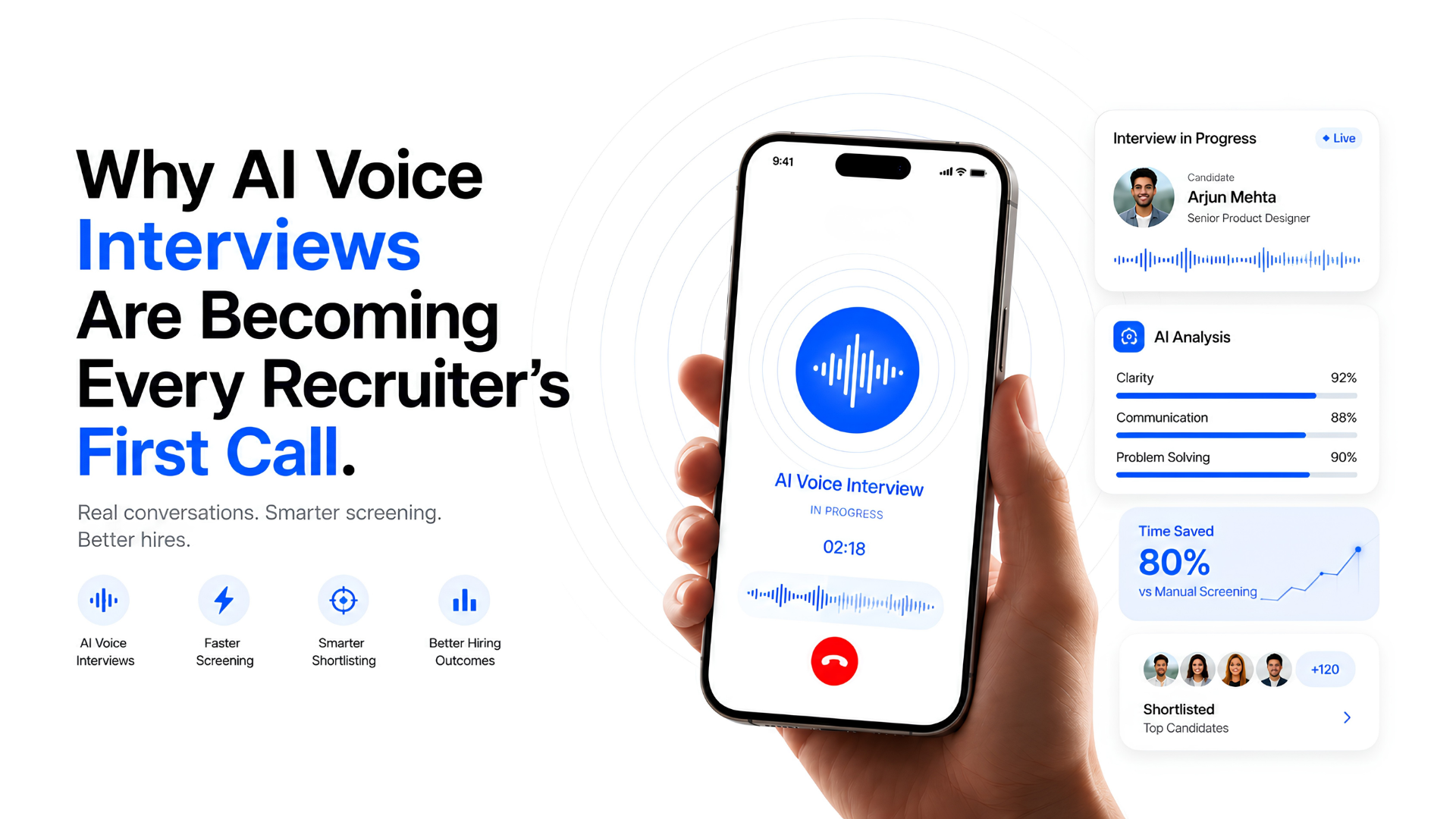
An AI voice interview is a real-time, two-way phone or browser-based conversation between a candidate and an AI agent that uses speech recognition to understand the candidate's spoken responses, natural language processing to analyze the content and structure of those responses, and text-to-speech synthesis to ask follow-up questions and maintain a natural conversational flow. The candidate speaks. The AI listens, interprets, and responds. The conversation proceeds in real time, much as it would with a human recruiter, except the AI can conduct hundreds of these conversations simultaneously, around the clock, without fatigue or variation in quality.
This is fundamentally different from an automated phone tree, a text-based chatbot, or a one-way video interview. Automated phone trees follow fixed branching logic — press one for yes, press two for no — and cannot deviate from their script. Chatbots communicate through text, which eliminates the vocal cues (tone, pacing, confidence) that make voice conversations information-rich. One-way video interviews ask candidates to record responses to preset questions without any interactive dialogue. An AI voice interview, by contrast, is a dynamic, adaptive conversation where the AI can ask clarifying questions, probe deeper into specific answers, and adjust its line of questioning based on what the candidate says — just as a skilled human screener would.
The technology stack behind a modern AI voice interview platform combines four core capabilities. First, automatic speech recognition (ASR) that transcribes the candidate's spoken words into text in real time, with accuracy now exceeding 95% for most English accents (https://www.imocha.io/blog/ai-interviewing-phone-screening). Second, natural language understanding (NLU) that interprets the transcribed text to extract meaning — not just keywords, but the candidate's reasoning, the specificity of their examples, their communication clarity, and their alignment with the role requirements. Third, a dialogue management system that decides what to ask next based on the candidate's previous responses, the screening criteria configured for the role, and the overall assessment objectives. Fourth, text-to-speech (TTS) synthesis that converts the AI's next question into natural-sounding speech, complete with appropriate intonation, pacing, and conversational fillers that make the interaction feel human.
Phenom's 2026 guide to AI voice agents describes these systems as "autonomous, voice-first AI systems that hold natural spoken conversations with a user, reason about the conversation context, and take actions" (https://www.phenom.com/blog/-10-talent-acquisition-resolutions). The key phrase is "at scale" — a single AI voice agent can conduct hundreds of screening calls simultaneously, 24 hours a day, seven days a week, without fatigue, distraction, or variation in quality. The output is not a single opaque score but a multi-dimensional profile. The system evaluates content relevance, structure, specificity, communication clarity, and verbal reasoning, mapping each to pre-defined competency rubrics that produce a structured assessment a recruiter can drill into.
Voice vs. Video vs. Text: Why Voice Wins the First Touch
The recruitment technology market has experimented with three primary formats for AI-assisted first-touch screening: text-based chatbots, one-way video interviews, and AI voice interviews. Each has strengths, but for the first-touch screening use case, voice is emerging as the clear winner.
Text-based chatbot screening gained rapid adoption during the pandemic because it was easy to deploy and required no special hardware. However, its limitations are now well-documented. Text-based screening cannot assess verbal communication skills — which is often the primary thing a phone screen is designed to evaluate. It also creates a different candidate experience depending on the candidate's typing speed and written communication style, which may not reflect their verbal abilities at all. Research from PMaps on conversational AI in hiring notes that while chatbots are useful for qualification verification and scheduling, they have a ceiling as assessment tools because they cannot capture the paralinguistic signals that voice conveys (https://www.pmapstest.com/blog/conversational-ai-in-hiring).
One-way video interviews capture voice but introduce camera anxiety. Research published in NIH/PMC found that video interviewing introduces bias risks including first-impression effects, visual distraction from the actual verbal assessment, and candidate self-consciousness that alters natural speech patterns (https://pmc.ncbi.nlm.nih.gov/articles/PMC12151341). The camera introduces a friction that voice alone does not. For first-touch screening, where the goal is to get an honest baseline assessment of communication skills, camera anxiety is a confounding variable that works against assessment validity.
AI voice interviews occupy the sweet spot. They capture the paralinguistic signals — tone, pacing, enthusiasm, confidence — that text cannot. They eliminate the camera anxiety that distorts video assessments. They work in low-bandwidth environments where video fails entirely. They are familiar — every candidate knows how to do a phone interview — which reduces the learning curve and candidate drop-off. And they are fast. A typical AI voice interview takes ten to fifteen minutes, compared to fifteen to thirty for a human phone screen and twenty to thirty minutes of setup and recording time for one-way video. At scale, the productivity multiplier is five to ten times on the most time-consuming step in the funnel. Organizations that integrated AI phone screening reported a 50% reduction in time-to-hire, averaging just 12 days compared to 24 days with traditional methods (https://learn.ntrvsta.com/ai-phone-screening/ai-phone-screening-vs-traditional-interviews-surprising-results-in-2026).
What the Evidence Actually Shows
The case for AI voice interviews is not built on vendor marketing material. It is built on a growing body of research that spans recruitment technology, natural language processing assessment validity, and candidate experience.
The most significant piece of evidence is a peer-reviewed field experiment conducted by researchers at the University of Chicago Booth School of Business, published on SSRN in 2025 (https://papers.ssrn.com/sol3/papers.cfm?abstract_id=5395709). The study, titled "Voice AI in Firms: A Natural Field Experiment on Automated Job Interviews," involved approximately 70,000 job applicants who were randomly assigned to be interviewed either by a human recruiter or by an AI voice agent. The roles spanned healthcare, IT, and industrial sectors, providing cross-industry validity. The researchers tracked applicants through the full hiring funnel — from initial screen through job offer, acceptance, start date, and subsequent retention and performance.
The results were striking. Candidates interviewed by the AI voice agent were 12% more likely to receive a job offer and, once hired, showed 17% higher 30-day retention (https://brianjabarian.org/voiceai). There was no statistically significant difference in employee productivity between candidates hired through the AI pathway and those hired through the human pathway. The researchers attributed the offer-rate difference to the AI's ability to screen more candidates more consistently, producing a larger and more qualified pool at every subsequent stage. The retention difference, they suggested, reflected better role-candidate fit resulting from more thorough and consistent initial screening.
Complementary research reinforces these findings. On assessment quality, NIH's research on structured interviews confirmed that structured approaches significantly outperform unstructured formats in predictive validity and bias reduction (https://pmc.ncbi.nlm.nih.gov/articles/PMC9553626). AI voice interviews are inherently structured, giving them a significant validity advantage over the typical human phone screen. On organizational readiness, McKinsey's 2025 research found that 76% of employees reported using AI in some capacity, up from just 30% in 2023 — a rate of adoption that suggests organizational readiness for AI voice interviews is higher than many assume (https://www.mckinsey.com/capabilities/people-and-organizational-performance/our-insights/the-organization-blog/how-ai-is-and-isnt-changing-the-future-of-work). Deloitte's 2026 Talent Acquisition Technology Trends report named the shift from automation to "orchestrated recruiting" as its top trend, noting that AI agents can manage entire segments of the recruiting process — a description that fits voice interview workflows integrated into end-to-end hiring pipelines (https://action.deloitte.com/insight/5005/2026-talent-acquisition-technology-trends-the-new-imperative). SHRM's 2026 Recruiting Executives Priorities and Perspectives report found that 87% of recruiting leaders expect increased AI and automation use, and critically, 62% of organizations expect AI adoption to increase headcount rather than reduce it (https://www.shrm.org/topics-tools/research/recruiting-benchmarking/full-data-brief).
Making the Transition Without Losing the Human Touch
The strongest implementation pattern emerging across early adopters is not a wholesale replacement of human phone screens. It is a targeted delegation of the high-volume, low-complexity screens that consume the most time while delivering the least strategic value. Most teams start by routing volume roles — customer service, sales, operations, and similar positions with large applicant pools — through AI voice interviews first. Senior, executive, and specialized roles continue to receive human-conducted screens. Over time, as the team builds confidence in the AI's assessment quality and candidates provide positive feedback, the scope expands.
The design of the question set is critical to assessment quality. Every question should map to a specific competency dimension that the role requires. A generic "Tell me about yourself" does not map to anything specific and produces scores that are difficult to interpret. Questions should progress from broad screening to focused probing within a single session, and they should be phrased the way a recruiter would actually say them on a phone call — with conversational openers and a tone that signals the candidate can take their time. Each question should have a recommended response time so the candidate can pace themselves. The final question should be candidate-initiated, giving them a chance to ask questions, which itself is an assessment signal: what they ask about reveals priorities and engagement level.
Integration with the existing technology stack is equally important. Voice interview results should flow directly into the applicant tracking system as structured assessment data, not as a separate report that requires manual entry. The AI voice interview should be triggered at the right moment in the outreach sequence, not deployed as a standalone tool disconnected from the rest of the hiring workflow. Platforms that integrate AI sourcing, multi-channel outreach, voice-based screening, and structured ATS push represent the fully connected workflow that recruiting teams are increasingly demanding. When the voice interview results live in the same candidate profile as the sourcing data and the outreach history, recruiters get a complete picture without context-switching between tools.
Transparency with candidates is non-negotiable. Candidates should know they are speaking with an AI, not a human, before the conversation begins. Research consistently shows that candidates who are informed upfront rate the experience more positively than those who feel deceived. The AI should be presented as a tool that accelerates their candidacy, not as a gatekeeping obstacle. And every candidate should have a clear pathway to reach a human recruiter if they have questions the AI cannot answer or if they feel the process did not accurately represent their qualifications.
The Bigger Picture: AI as Recruiter Multiplier, Not Replacement
The data points in a consistent direction. AI voice interviews deliver higher assessment consistency than human phone screens, better candidate experience than video alternatives, and significant recruiter productivity gains — all supported by maturing technology and growing organizational readiness. The University of Chicago study demonstrated that these benefits do not come at the cost of quality of hire. SHRM's research confirms that recruiting leaders expect AI to expand their capacity, not eliminate their roles. Deloitte's research points to a future where AI agents orchestrate entire segments of the recruiting process. McKinsey's data shows that employees are more ready for AI than their leaders imagine.
The technology is not replacing the phone screen because recruiters are being displaced. It is replacing the manual phone screen because the repetitive first-touch conversation is finally a problem that AI can solve well, and recruiters are eager to reclaim the hours it consumes. The recruiting teams that will thrive over the next five years are not the ones that resist this transition or the ones that adopt it carelessly. They are the ones that approach AI voice interviews as a precision tool: deployed for the right roles, configured with well-designed question sets, integrated into a connected workflow, and always paired with human judgment at the decision points that matter. The end of manual phone screening is not the end of human recruiting. It is the beginning of a version of recruiting where human recruiters have the time and data to do their best work.
Related Articles
Best AI Interview Tools for Recruiting Teams: https://www.huntlo.ai/blog/best-ai-interview-tools-for-recruiting-teams
How to Reduce Recruiter Burnout With Workflow Automation: https://www.huntlo.ai/blog/how-to-reduce-recruiter-burnout-with-workflow-automation
Best AI Recruiting Tools for Staffing Agencies in 2026: https://www.huntlo.ai/blog/best-ai-recruiting-tools-for-staffing-agencies-in-2026