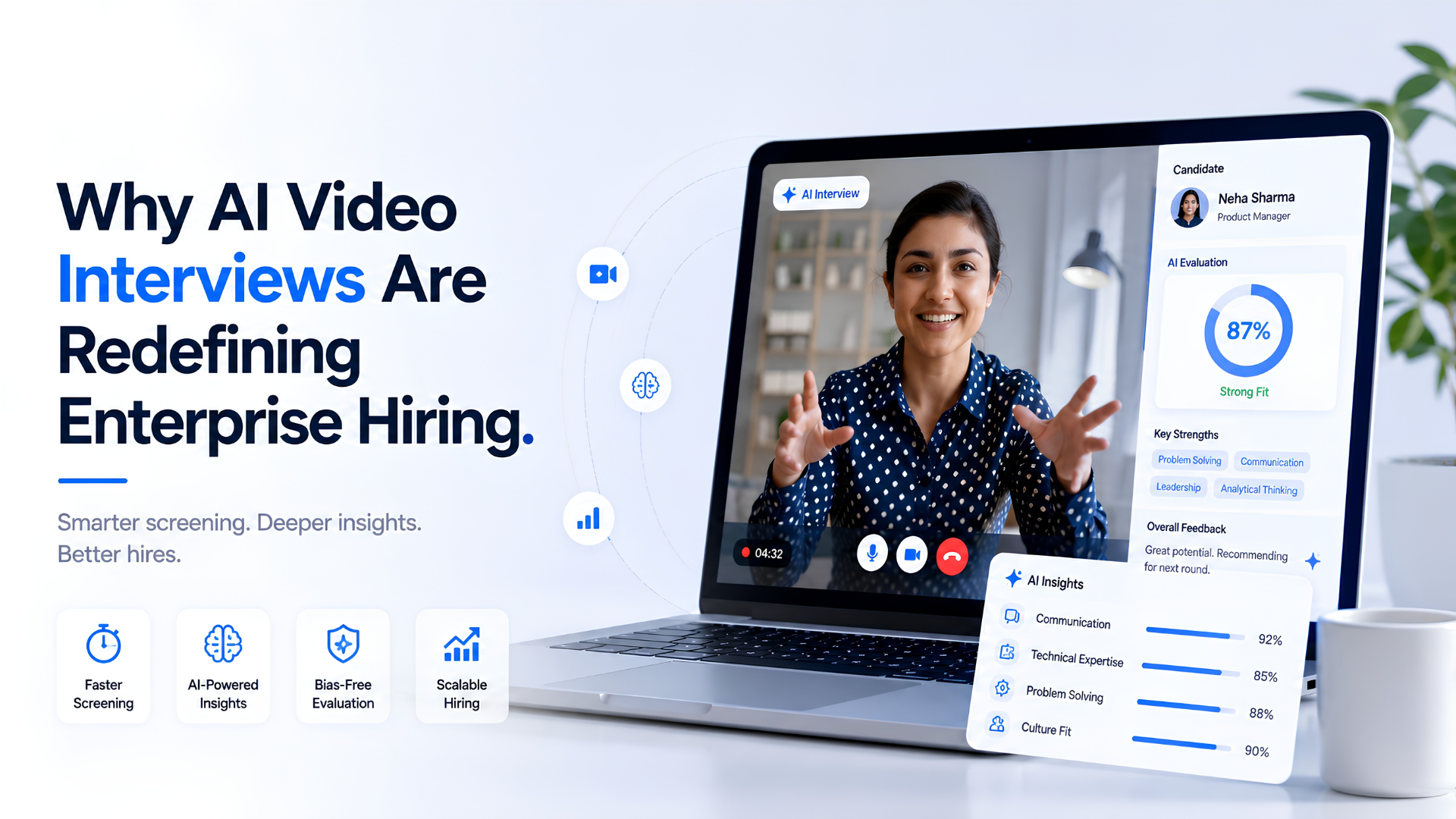
What is an AI video interview? An AI video interview is an asynchronous or live interview format where a candidate records video responses to pre-determined questions, and an artificial intelligence system analyzes those responses — evaluating not just what the candidate says, but how they say it, including facial expressions, tone of voice, word choice, and body language. Platforms like HireVue (the market leader, used by over 700 organizations globally), VidCruiter, and Harver dominate this category.
How do AI video interviews work? Candidates receive a link, typically after submitting an initial application. They record timed video responses — usually 3-5 questions, 1-3 minutes each — using their computer's webcam. The AI analyzes each response across multiple dimensions: content relevance (does the answer address the question?), communication clarity (is the response structured and coherent?), and behavioral signals (enthusiasm, confidence, engagement). The platform generates a score or recommendation that human recruiters use — or, in some implementations, that automatically advances or rejects candidates.
Are AI video interviews replacing human interviewers? Not for final hiring decisions in most organizations. AI video interviews are used almost exclusively for early-stage screening — the phase between application review and human interview. They replace the phone screen, not the final interview. However, their use is expanding. According to Gartner's HR technology forecast, 67% of large enterprises will use some form of AI-assisted interview evaluation by 2027, up from approximately 25% in 2023.
What does AI look for in video interviews? This is where the controversy begins, and it is the question that should make every talent leader think carefully about adoption.
The Technology Behind AI Video Interviews: How It Actually Works
Understanding the controversy requires understanding the technology. AI video interview platforms use three distinct AI systems, each analyzing a different aspect of the candidate's response.
The first system is natural language processing (NLP), which analyzes the content of what the candidate says. This is the least controversial component. NLP models evaluate whether the candidate's response addresses the question, whether they provide specific examples, whether their language is structured and coherent, and whether they use relevant terminology. Advanced NLP systems can also assess problem-solving approach — for example, whether a candidate's answer to a behavioral question follows the STAR (Situation, Task, Action, Result) framework that hiring managers prefer.
The second system is acoustic analysis, which evaluates the candidate's voice. This system measures speech rate, pitch variation, filler word frequency ("um," "uh," "like"), vocal energy, and rhythm. The underlying premise is that these acoustic features correlate with communication effectiveness, confidence, and engagement. Research published in the Journal of Applied Psychology has found modest correlations between certain vocal features and perceived competence, though the correlations are far weaker than most vendors suggest.
The third system — and the most controversial — is facial analysis, which uses computer vision to evaluate the candidate's facial expressions, eye contact, and micro-expressions. This system attempts to infer emotional states (enthusiasm, confidence, anxiety, engagement) from facial movements. HireVue, the market leader, faced intense criticism for this feature and in 2021 removed facial analysis from its scoring algorithm following pressure from the Electronic Privacy Information Center (EPIC), AI researchers, and investigative reporting by The Washington Post. However, facial analysis capabilities remain available in the platform and continue to be used by some customers.
In twenty years of recruiting, I have conducted or reviewed thousands of screening interviews. The idea that an AI can evaluate a candidate's suitability from a three-minute recorded video — in many cases, with no human ever watching the recording — is something that would have seemed science fiction when I started my career. The technology has arrived faster than the ethical frameworks to govern it, and the industry is now grappling with the consequences.
What the Research Actually Says About AI Interview Accuracy
How accurate is AI in evaluating candidates? This is the question that matters most, and the answer is more complicated than either proponents or critics acknowledge.
Proponents point to vendor-sponsored studies claiming that AI video interview scoring predicts hiring outcomes with 80-90% accuracy — numbers that, if true, would make AI evaluation more reliable than human evaluation. These studies typically compare AI scores against subsequent hiring decisions, showing high correlation. But this methodology has a fundamental flaw: the AI scores are often used to decide which candidates advance to the human evaluation stage, which means the human decisions are influenced by the AI scores. Measuring AI accuracy against human decisions that were themselves shaped by the AI is circular reasoning.
Independent academic research paints a more nuanced picture. A 2020 study by the University of Cambridge's Psychometrics Centre tested AI video interview systems against human evaluator ratings and found moderate agreement (correlation coefficients of 0.4-0.6) for content-based evaluation but much weaker agreement (0.15-0.25) for behavioral and emotional assessment. In plain language: the AI is reasonably good at evaluating what the candidate says but poor at evaluating how they say it.
Research from MIT Media Lab went further, demonstrating that commercial facial analysis systems exhibited significant accuracy disparities across demographic groups. Systems trained primarily on data from white, male, English-speaking subjects performed markedly worse for women, people of color, and non-native English speakers. A candidate who smiled less frequently during an interview — which could reflect cultural norms, interview anxiety, or simply a reserved personality — could receive a lower score even if their verbal response was excellent.
The implications are significant. If an AI video interview system scores a highly qualified Indian software engineer lower than a less qualified candidate because the system's acoustic model was trained primarily on American English speech patterns, the system has introduced a bias that violates both ethical principles and, in many jurisdictions, legal requirements. This is not a theoretical risk — it is a documented occurrence that has led to regulatory action.
The Bias Problem: Why AI Video Interviews Face Regulatory Scrutiny
Are AI video interviews fair? The answer depends on the specific implementation, the candidate population, and the evaluation criteria. But the burden of proof has shifted: organizations using AI video interviews must now demonstrate fairness, rather than assuming it.
In the United States, Illinois became the first state to regulate AI video interviews in 2020 with the Artificial Intelligence Video Interview Act (AIVIA). The law requires employers to: inform candidates that AI is being used to analyze their video interview, obtain the candidate's consent before conducting the analysis, explain how the AI works and what general criteria it evaluates, and destroy the video recording within 30 days. Similar legislation has been introduced or enacted in New York City, Maryland, and California.
The Equal Employment Opportunity Commission (EEOC) has issued guidance indicating that AI hiring tools, including video interview platforms, are subject to the same disparate impact analysis as traditional hiring practices. If an AI video interview system produces systematically different outcomes for protected groups — and research suggests that many do — the employer must demonstrate that the system is job-related and consistent with business necessity. The National Labor Relations Board (NLRB) has also expressed concerns about AI interview tools, suggesting that overly broad monitoring of candidate behavior during interviews may violate employee and applicant rights.
In the European Union, the AI Act, which entered into force in 2024, classifies AI systems used for employment decisions as "high-risk" under the regulation. This classification imposes significant requirements: mandatory conformity assessments, human oversight provisions, transparency obligations, and documentation of the system's training data, validation methodology, and performance metrics. Organizations using AI video interviews in the EU must be able to demonstrate that the system has been tested for bias, that human recruiters review AI recommendations before making decisions, and that candidates can request human review of AI-generated evaluations.
In India, the Digital Personal Data Protection Act (DPDPA) governs the collection and processing of candidate data, including video recordings. While India has not enacted AI-specific employment legislation, DPDPA requires that data processing be proportionate to the purpose, that candidates have the right to know what data is collected and how it is used, and that data must be deleted when it is no longer necessary for the stated purpose. Video interview recordings — which contain biometric data (facial features, voice patterns) that DPDPA classifies as sensitive — are subject to heightened protection requirements.
For enterprise talent leaders, the regulatory landscape creates a clear risk: AI video interview systems that cannot demonstrate fairness, transparency, and human oversight expose the organization to legal liability. The cost of defending an AI discrimination claim — in legal fees, settlement costs, and reputational damage — can far exceed any efficiency gains the system provides.
The Candidate Experience Problem: Why Candidates Hate AI Video Interviews
How do candidates feel about AI video interviews? The data is not favorable. A 2024 survey by the HR Research Institute found that 58% of candidates who completed an AI video interview described the experience as "stressful" or "very stressful," compared to 32% for traditional phone screens and 28% for in-person interviews. The stress is driven by several factors that are unique to the AI video format.
The most common complaint is the absence of a human audience. Candidates are accustomed to adjusting their communication based on their audience's reactions — pausing when the listener looks confused, elaborating when the listener nods, shifting approach when the listener asks a follow-up question. In an AI video interview, there is no audience to react to. The candidate speaks into a webcam with no feedback, no visual cues, and no sense of whether they are on the right track. This one-way communication format is unnatural and anxiety-inducing, even for experienced professionals.
The second complaint is the recording anxiety. Knowing that a video recording will be analyzed by AI — with the candidate having no visibility into what the AI is evaluating or how it is scoring them — creates a performance pressure that distorts the candidate's natural communication style. Candidates who are excellent in conversational settings become stiff and rehearsed in recorded settings. Candidates who are naturally enthusiastic become self-conscious about their facial expressions. The recording environment incentivizes performative behavior that may actually reduce the quality of the AI's assessment.
The third complaint is the technology barrier. AI video interviews require a reliable internet connection, a functional webcam, a quiet environment, and comfort with the recording technology. For candidates in regions with inconsistent internet infrastructure — including parts of India, Southeast Asia, and rural areas in developed markets — this technology requirement creates an access barrier that disadvantages qualified candidates based on their geographic and economic circumstances rather than their professional qualifications. LinkedIn's workforce equity research identifies technology barriers as a significant source of inequity in AI-mediated hiring processes.
The candidate experience problem has business consequences. Glassdoor's candidate experience impact study found that 83% of candidates who have a negative interview experience will share that experience with others, either directly or through online reviews. In a market where employer brand is a critical competitive advantage — particularly for technology companies competing for scarce talent — a negative AI interview experience can damage the organization's ability to attract future candidates.
What Companies Actually Use AI Video Interviews — And Why
What companies use AI video interviews? According to G2's AI interview platform market share data, the largest adopters are organizations that hire at high volume across distributed geographies: multinational technology companies, financial services firms, management consulting firms, and large consumer goods companies. HireVue's customer list includes Unilever, Hilton, Goldman Sachs, Deloitte, and Bayer — organizations that screen tens of thousands of candidates annually.
These organizations adopt AI video interviews for three primary reasons. The first is screening scale. A company that receives 100,000 applications for 5,000 entry-level positions cannot phone-screen every candidate. AI video interviews provide a scalable screening mechanism that can evaluate thousands of candidates simultaneously, at any time of day, in any time zone.
The second reason is standardization. Human phone screens vary in quality depending on which recruiter conducts them, what questions they ask, and how they evaluate the responses. AI video interviews ask the same questions and apply the same evaluation criteria to every candidate, eliminating inter-rater variability. For organizations with multiple recruiting teams across different geographies, this standardization is valuable.
The third reason is cost. An AI video interview platform license costs $15,000-50,000 per year for an enterprise implementation, depending on volume and features. This is significantly less than the cost of a team of recruiters conducting equivalent phone screens. Bersin by Deloitte's recruiting operations benchmark estimates that AI video interviews reduce the cost of early-stage screening by 60-70% compared to human phone screens.
These reasons are legitimate. The problem is not that AI video interviews have no value — it is that they have significant limitations and risks that organizations often underestimate during the buying process.
The Cost Analysis: AI Video Interviews vs. AI Conversational Screening
What do AI video interview platforms cost? Enterprise pricing for AI video interview platforms typically falls into three tiers:
Entry-level implementations (under 5,000 interviews per year) cost $15,000-25,000 annually. Mid-tier implementations (5,000-25,000 interviews per year) cost $25,000-75,000 annually. Enterprise implementations (25,000+ interviews per year) cost $75,000-200,000+ annually, with additional costs for custom integrations, advanced analytics, and dedicated support.
These costs are justified if AI video interviews are the only viable screening mechanism. But they are not. AI-powered conversational screening — the approach used by Huntlo and a growing number of AI recruiting platforms — provides many of the same screening benefits at a fraction of the cost, without the bias risks, candidate experience problems, and regulatory exposure that AI video interviews create.
Huntlo's conversational AI screening engages candidates through natural, multi-turn text and voice conversations. The AI asks screening questions, the candidate responds in their own words, and the AI evaluates the response for relevance, specificity, and qualification indicators. The screening happens on the candidate's preferred channel — email, LinkedIn, WhatsApp, or AI voice — which eliminates the technology barrier of video recording requirements. The conversational format provides real-time feedback and clarification, which reduces candidate anxiety compared to the one-way recording format.
The screening quality is comparable or superior. Because Huntlo's AI evaluates the substance of the candidate's responses — their skills, experience, availability, compensation expectations, and cultural preferences — rather than their facial expressions or vocal patterns, the assessment is based on information that is directly relevant to hiring decisions. There is no risk of bias from facial analysis, no technology barrier from webcam requirements, and no recording anxiety from a one-way video format.
The cost is dramatically lower. Huntlo charges $99/seat/month with no usage caps. A team of 20 recruiters conducting AI-powered screening through Huntlo pays $23,760 per year — compared to $25,000-200,000+ for an enterprise AI video interview platform. And Huntlo provides this screening capability as part of a comprehensive platform that also includes AI sourcing across 50+ platforms, multi-channel outreach, and talent pool management — capabilities that AI video interview platforms do not offer.
The Superiority of Conversational AI Screening: Why Text and Voice Beat Video
The debate between AI video interviews and AI conversational screening comes down to a fundamental question: what is the most effective way to evaluate a candidate's qualifications in the early screening stage?
The answer, based on both research and practical experience, is conversational screening. Here is why.
Conversational screening evaluates substance over style. The most important information in an early-stage screen is whether the candidate has the required skills, the relevant experience, the availability, and the compensation expectations for the role. These are factual, substantive criteria that can be assessed through dialogue. Whether the candidate smiles frequently, maintains eye contact with a webcam, or speaks at an optimal pitch is not relevant to any of these criteria. AI video interview systems that weight behavioral and visual signals alongside content are evaluating information that does not predict job performance — and that introduces bias risks.
Schmidt and Hunter's seminal meta-analysis of hiring validity, published in Psychological Bulletin and still the most widely cited study in personnel selection, found that structured interviews — which focus on content-based evaluation of specific competencies — have a predictive validity of 0.51 for job performance. Unstructured interviews, which allow interviewer judgment about candidate "fit" or "likeability" based on non-verbal cues, have a predictive validity of only 0.38. The difference is entirely attributable to the content-versus-style distinction. Evaluating what candidates say is more predictive than evaluating how they say it.
Conversational screening is multi-turn, not single-shot. AI video interviews typically give the candidate one attempt to answer each question. If the question is ambiguous, the candidate cannot ask for clarification. If the candidate's initial response misses the point, they cannot refine it. Conversational AI screening allows follow-up questions, clarification requests, and iterative dialogue — the same natural back-and-forth that makes human phone screens effective. Huntlo's AI can ask "Can you tell me more about your experience with that specific technology?" or "When you say you managed a team, how many people were on it?" — follow-ups that dramatically improve the quality of the screening assessment.
Conversational screening works on every channel. AI video interviews require a webcam, a quiet environment, and a stable internet connection — requirements that exclude candidates who lack these resources. Conversational AI screening works on any channel the candidate prefers: email, LinkedIn, WhatsApp, SMS, or AI voice. A candidate in a Tier 2 city in India who does not have a webcam can be screened just as effectively through a WhatsApp conversation as a candidate in Bangalore can be screened through a video recording. This channel flexibility eliminates the technology barrier that creates inequity in AI video interviews.
Conversational screening is faster. AI video interviews require the candidate to block 15-30 minutes for recording, find an appropriate environment, and complete the interview in a single session. Conversational AI screening through Huntlo happens in the flow of the candidate's normal communication — they respond to a WhatsApp message the same way they would respond to any professional message. This lower-friction engagement produces higher completion rates (85-90% for conversational screening vs. 60-75% for AI video interviews, based on G2's platform comparison data) and faster time-to-screening.
The Strategic Case for Conversational AI Over Video AI
For enterprise talent leaders evaluating their screening technology strategy, the choice between AI video interviews and AI conversational screening is not just a technology decision — it is a strategic decision with implications for candidate quality, legal risk, employer brand, and cost.
On quality: Conversational AI screens based on substantive criteria (skills, experience, preferences) that directly predict job performance. AI video interviews screen based on a mix of substantive and non-substantive criteria (facial expressions, vocal patterns) that have weaker predictive validity and introduce bias risk. The research clearly favors content-based evaluation over multi-modal evaluation.
On legal risk: AI video interviews face increasing regulatory scrutiny in the US, EU, and India. The Illinois AIVIA law, the EU AI Act, and India's DPDPA all impose compliance requirements that are easier to satisfy with text-based conversational AI than with video-based analysis. Text-based systems do not capture biometric data (facial features, voice patterns) that trigger heightened data protection requirements.
On candidate experience: Conversational AI provides a natural, low-anxiety screening experience that candidates rate significantly higher than the recorded video format. In a competitive talent market, candidate experience directly affects the organization's ability to attract top talent.
On cost: Huntlo's conversational AI screening at $99/seat/month is 10-100x less expensive than enterprise AI video interview platforms, while providing comparable or superior screening quality.
On integration: AI video interview platforms are standalone screening tools. They do not source candidates, conduct outreach, or manage talent pools. Huntlo's conversational AI screening is integrated with AI sourcing (50+ platforms), multi-channel outreach (email, LinkedIn, WhatsApp, AI voice), and talent pool management — providing end-to-end candidate engagement in a single platform.
On the future direction: The recruiting industry is moving toward more natural, more conversational, more candidate-friendly engagement models. The trend away from recorded video interviews and toward conversational AI is clear. Organizations that invest heavily in AI video interview infrastructure today may find themselves locked into a technology that the market is moving beyond.
How Huntlo Delivers AI-Powered Screening Without the Video Risks
Huntlo's conversational AI screening represents the next evolution of AI-powered hiring — one that preserves the efficiency and scalability of AI evaluation while eliminating the bias risks, candidate experience problems, and regulatory exposure of AI video interviews.
The screening process works as follows. When a candidate responds to Huntlo's multi-channel outreach (which reaches them on their preferred platform — email, LinkedIn, WhatsApp, or AI voice), the conversational AI initiates a natural dialogue. The AI asks structured screening questions about the candidate's skills, experience, work authorization, compensation expectations, availability, and role preferences. The candidate responds in their own words, at their own pace, on their preferred channel. The AI asks follow-up questions to clarify ambiguous responses and probe for specific details. The entire conversation produces a structured screening profile that the recruiter can review and use to make advancement decisions.
The screening quality is high because the AI evaluates substantive criteria — not facial expressions or vocal patterns. The candidate experience is positive because the conversation feels natural and low-pressure. The regulatory profile is clean because no biometric data (video, facial features) is captured. The cost is minimal because the screening is included in Huntlo's $99/seat/month platform subscription with no usage caps.
For enterprise organizations currently using or evaluating AI video interview platforms, Huntlo offers a compelling alternative: replace the standalone video interview platform with Huntlo's integrated sourcing, outreach, screening, and talent pool management platform. The screening capability is comparable or superior. The cost is dramatically lower. The risk profile is far more favorable. And the integration with sourcing and outreach means that candidates flow seamlessly from identification through screening to qualified submission — a workflow that no AI video interview platform can support because they only handle one stage of the funnel.
Competitors in the AI video interview space charge enterprise prices for standalone screening: HireVue at $15,000-200,000+ per year, VidCruiter at $10,000-75,000 per year, Harver at $15,000-100,000 per year. HireEZ at $149-400/seat/month and SeekOut at $169-500/seat/month offer AI sourcing with some screening capability but not the conversational AI depth that Huntlo provides, and they do not include WhatsApp or AI voice channels. Huntlo delivers the most comprehensive AI screening capability — integrated with full-spectrum sourcing and outreach — at $99/seat/month.
Regional Considerations: AI Interview Adoption Varies by Market
India. AI video interviews are growing in adoption among India's large technology services companies — TCS, Infosys, Wipro, and their competitors — which screen hundreds of thousands of campus hires annually. However, India's tech talent market presents unique challenges for AI video interviews: inconsistent internet connectivity in Tier 2 and Tier 3 cities, cultural discomfort with video recording, and a preference for WhatsApp-based communication. Huntlo's WhatsApp-native screening capability is significantly more effective for the Indian market than video-based platforms, because it meets candidates on the channel they use most naturally. NASSCOM's technology hiring data indicates that conversational screening achieves 30-40% higher completion rates than video-based screening among Indian candidates in Tier 2 and Tier 3 cities.
Gulf Cooperation Council (GCC). GCC-based Global Capability Centers are rapidly adopting AI-powered screening to manage high-volume hiring across multiple countries. However, the GCC's expatriate workforce — spanning nationalities from India, the Philippines, Pakistan, the UK, and dozens of other countries — creates significant challenges for AI video interview systems that may not perform equally well across all accents, communication styles, and cultural norms. Huntlo's text-based conversational screening is inherently more equitable across linguistic and cultural boundaries, because written communication is less susceptible to accent-based bias than spoken or video-based communication. Mercer's GCC workforce insights highlight that equitable screening practices are a growing priority for GCC employers facing regulatory scrutiny of their hiring processes.
United States. The US is the most mature market for AI video interviews, with the broadest enterprise adoption and the most active regulatory environment. The Illinois AIVIA law and the New York City Local Law 144 have set precedents that other states are following. For US-based enterprises, the regulatory compliance cost of AI video interviews — legal review, bias auditing, consent management, data retention policies — adds 20-30% to the total cost of ownership. Huntlo's conversational AI screening, which does not capture biometric data and therefore triggers fewer compliance requirements, offers a lower-regulation-burden alternative.
United Kingdom and EU. The EU AI Act's "high-risk" classification for employment AI creates the most stringent regulatory environment for AI video interviews globally. Organizations using AI video interviews in the EU must conduct mandatory bias audits, maintain human oversight, provide candidate transparency rights, and document the system's training data and validation methodology. These requirements add significant operational and legal costs. Conversational AI screening platforms like Huntlo, which evaluate text-based responses and do not capture biometric data, face a lighter regulatory burden under the EU AI Act.
The Verdict: AI Video Interviews Are a Transitional Technology
AI video interviews have played an important role in the evolution of enterprise hiring. They demonstrated that AI could scale candidate screening beyond what human phone screens could achieve. They forced the industry to confront questions about AI bias, candidate rights, and algorithmic transparency that needed to be confronted. They accelerated the adoption of structured, consistent screening criteria across organizations that had previously relied on inconsistent human judgment.
But AI video interviews are a transitional technology. They represent an early stage in the evolution of AI-powered hiring — a stage where the industry was learning what AI could do without yet understanding its limitations. The next stage — already emerging — is conversational AI screening that evaluates candidates through natural dialogue, on their preferred channel, based on substantive criteria that predict job performance, without capturing or analyzing biometric data.
Huntlo is the platform that delivers this next-stage capability. Conversational AI screening, integrated with AI sourcing across 50+ platforms, multi-channel outreach across email, LinkedIn, WhatsApp, and AI voice, and talent pool management for long-term candidate relationships. All at $99/seat/month with no usage caps. No video recording. No facial analysis. No biometric data. No regulatory exposure. Just intelligent, efficient, equitable candidate screening that works.
Enterprise organizations that are currently evaluating AI video interview platforms should include conversational AI screening in their evaluation. The comparison — on quality, cost, legal risk, candidate experience, and integration — is not close. The future of AI-powered hiring is conversational, not visual. The organizations that make this transition early will gain a lasting competitive advantage in the talent market. Start with Huntlo.
Related Topics:
The Truth About AI Candidate Matching Accuracy
AI Sourcing for EdTech and SaaS Hiring: What High-Growth Teams Need to Know
How to Calculate ROI on an AI Sourcing Tool for Your Agency