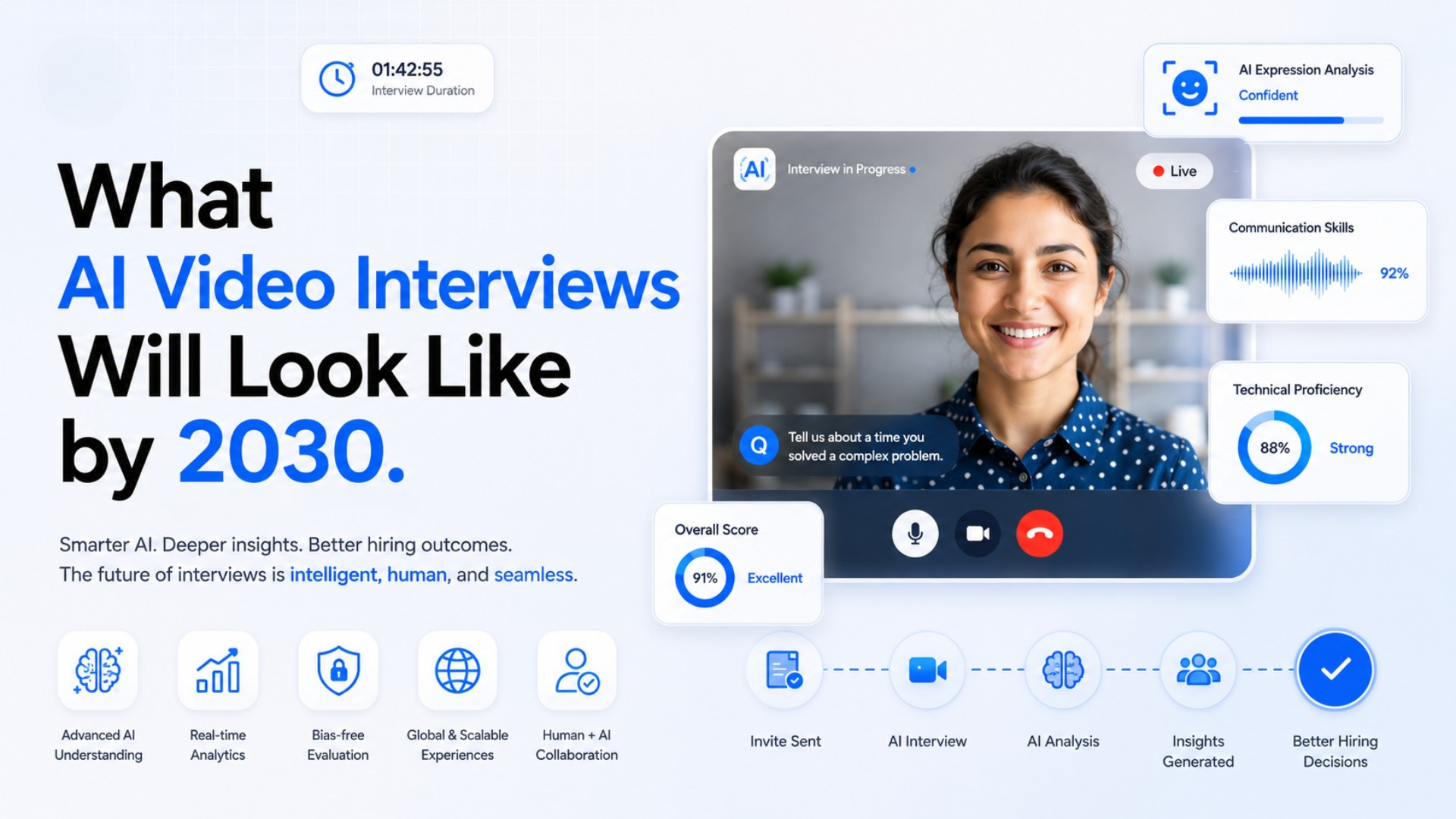
The AI video interview as most people know it today — a candidate staring into a webcam, answering pre-set questions against a ticking timer, then waiting days for a score — is a transitional technology. It solved a genuine problem during the pandemic era, enabling remote-first hiring at scale when offices were empty and travel was impossible. But it also introduced friction: candidates felt judged by an invisible algorithm, recruiters struggled to interpret black-box scores, and the one-way format eliminated the back-and-forth dialogue that makes a good interview genuinely useful. The question is not whether this format will survive. The question is what replaces it.
By 2030, the AI video interview will have evolved through five interconnected technological shifts that fundamentally alter what an interview feels like, what it measures, and how it fits into the broader hiring workflow. These shifts are not speculative. They are already underway, driven by advances in large language models, real-time multimodal AI, regulatory pressure for transparency, and a labor market that is restructuring itself around skills rather than credentials. According to Gartner's 2025 survey of CIOs, AI will touch 100% of information technology work by 2030, with 75% of tasks performed by humans augmented with AI and 25% handled by autonomous AI systems. Hiring is no exception to this trajectory, and the video interview — the highest-bandwidth touchpoint between employer and candidate — will be one of the most visibly transformed stages in the funnel.
This article maps the specific technological, regulatory, and market forces that will reshape AI video interviews over the next five years. It is written for talent acquisition leaders, recruiting operations managers, and HR technology decision-makers who need to separate hype from actionable intelligence and build a roadmap that keeps their organizations competitive as the interview technology landscape shifts beneath them.
Where AI Video Interviews Stand Today (2025–2026)
To understand where AI video interviews are heading, it is important to anchor the starting point. As of mid-2026, the market for AI recruitment technology sits at approximately $640 million globally, according to Mordor Intelligence, and is projected to reach $920 million by 2031 at a compound annual growth rate of 7.5%. The broader AI in HR market — which includes interview technology alongside sourcing, onboarding, and workforce planning tools — is significantly larger, valued at $6.3 billion in 2026 and projected to reach $15.2 billion by 2030, according to Grand View Research.
Adoption has accelerated sharply. SHRM's 2025 Talent Trends report found that 51% of organizations now use AI in recruitment, making it the leading HR function for AI adoption. The 2026 update from SHRM's State of AI in HR report shows AI use across all HR tasks climbing to 43%, up from 26% just two years earlier, with recruiting leading every other use case. Deloitte's 2026 Talent Acquisition Technology Trends report identifies the shift from simple automation to "orchestrated recruiting" — where AI agents manage entire segments of the hiring workflow rather than executing isolated tasks — as the defining trend of the current cycle.
The current AI video interview landscape is split between two dominant formats. The first is the asynchronous one-way interview, where candidates record responses to predetermined questions on their own time. Platforms in this space have refined the experience with better UI, mobile optimization, and practice questions, but the fundamental interaction model has not changed since the format's pandemic-era breakout. The second is the AI-assisted live interview, where a human interviewer is supported by real-time AI that transcribes the conversation, suggests follow-up questions, and generates post-interview summaries. Neither format fully delivers on the original promise of AI interviews: an experience that is simultaneously scalable, insightful, and fair.
The gaps are visible. A 2025 study published in Frontiers in Artificial Intelligence found that job applicants who were rejected by AI interview systems perceived the process as significantly less fair than those rejected by human recruiters, even when the underlying evaluation criteria were identical. HireVue's own 2025 AI report offered a counterpoint, noting that the majority of HR leaders now trust AI-driven hiring decisions and that candidates increasingly see AI as a tool that can enhance fairness if implemented responsibly. The reality sits somewhere between these findings: the technology has capability, but trust remains uneven, and the candidate experience is still the primary constraint on adoption.
SHRM's Recruiting Executives Priorities and Perspectives 2026 report found that approximately 87% of recruiting leaders expect increased use of AI and automation across general recruiting processes, and 62% of organizations expect AI adoption to increase headcount rather than reduce it — reinforcing the signal that AI is replacing tasks, not people, in the recruitment function. This is the foundation on which the next five years of evolution will be built.
Shift One: From Asynchronous One-Way to Real-Time Conversational AI
The most visible change in AI video interviews by 2030 will be the death of the static, one-way recording as the default format. In its place will be real-time conversational AI interviews — live, two-way interactions where an AI agent asks questions, listens to responses, and adapts its follow-up probing in real time, much as a skilled human interviewer would. This is not a minor UX upgrade. It represents a fundamental shift in what an AI interview can assess.
Today's one-way interviews evaluate whether a candidate can deliver a coherent, structured answer to a known question. They are, in effect, oral exams. Real-time conversational AI interviews evaluate something different: how a candidate thinks on their feet, how they handle ambiguity, and how they respond when the conversation takes an unexpected turn. A World Economic Forum experiment on conversational AI in hiring concluded that "the key to the future of hiring lies in human-AI collaboration" and that "conversational AI serves as a highly effective initial filter" — particularly when the AI can adapt its questions based on candidate responses rather than following a fixed script.
The technology enabling this shift is the maturation of large language models with sub-second latency and long-context memory. Research published in Frontiers in Artificial Intelligence in early 2026 mapped the growing use of LLMs across the hiring pipeline and found that their application in candidate evaluation is expanding from resume parsing — where they have been used for years — into live conversational assessment, where they must process speech in real time, maintain conversational coherence, and generate contextually appropriate follow-up questions within milliseconds. The technical barrier to real-time conversational AI interviews is not the language model itself; it is the orchestration layer that connects speech recognition, natural language understanding, response generation, and video rendering into a seamless experience.
By 2030, expect the following capabilities in real-time conversational AI interviews. First, adaptive questioning: the AI will dynamically adjust the difficulty, topic, and style of questions based on the candidate's demonstrated competence, moving from broad screening to deep domain probing within a single session. Second, contextual follow-ups: when a candidate mentions a specific project or skill, the AI will ask clarifying questions about that specific experience rather than moving to the next pre-set item on a list. Third, real-time calibration: the AI will continuously update its assessment model as the conversation progresses, weighting later responses more heavily if they demonstrate growth or if early responses were affected by nervousness — a pattern well-documented in human interviewer behavior but absent from current one-way systems.
The candidate experience implications are substantial. Real-time conversational AI eliminates the awkwardness of talking to a blank screen with no feedback. It also addresses one of the most common complaints about one-way interviews: the inability to ask clarifying questions or request a moment to think. A responsive AI interviewer can say "take your time" or "let me rephrase that" — small gestures that research on procedural justice suggests significantly affect candidates' perceptions of fairness.
Shift Two: Multimodal Analysis — Beyond Text to Voice, Emotion, and Behavior
Current AI video interviews primarily analyze the content of what candidates say — the words, the structure, the relevance to the question asked. By 2030, multimodal AI systems will simultaneously analyze speech patterns, vocal characteristics, facial expressions, body language, and even the physical environment in which the candidate is sitting. This is a controversial frontier, and for good reason, but it is advancing rapidly and organizations need to understand both its potential and its risks.
The technical foundation for multimodal analysis is the convergence of several AI capabilities that have matured independently over the past few years. Natural language processing now handles not just what is said but how it is said — pacing, hesitation, filler words, sentence complexity, and the ratio of concrete examples to abstract claims. Computer vision models can track eye contact, facial micro-expressions, and posture with increasing accuracy. Voice analysis systems can detect stress indicators, confidence markers, and engagement levels from vocal tone alone. When these signals are combined and analyzed in aggregate, they produce a far richer assessment signal than text analysis alone.
However, multimodal analysis in hiring sits at the center of an intense debate about fairness, scientific validity, and regulatory compliance. A comprehensive survey published by ACM in 2024 examined fairness and bias in algorithmic hiring systems through a multidisciplinary lens and found that multimodal systems — particularly those analyzing facial expressions and vocal characteristics — risk encoding cultural biases that are difficult to detect and even harder to mitigate. Candidates from different cultural backgrounds express enthusiasm, respect, and confidence in fundamentally different ways, and a system trained primarily on data from one cultural context may systematically disadvantage candidates from another.
The EU AI Act, which classifies AI systems used in employment decisions as high-risk, will be fully applicable by August 2026. Under the Act's requirements, organizations deploying AI interview systems that analyze biometric data — which includes facial expression analysis and voice profiling — must conduct mandatory conformity assessments, maintain detailed technical documentation, ensure human oversight, and provide candidates with the right to explanation and the right to contest automated decisions. The European Commission's digital strategy portal outlines these obligations clearly: high-risk AI systems in employment must demonstrate that their training data is representative, that their outputs are auditable, and that human decision-makers retain meaningful control over final hiring decisions.
By 2030, the multimodal analysis that survives in commercial AI interview platforms will likely be limited to signals that have strong, peer-reviewed evidence of predictive validity and low cross-cultural bias. This means focusing on communication structure — clarity of argument, use of evidence, responsiveness to questions — rather than on emotional state or personality inference. Some platforms may offer multimodal analysis as an opt-in layer that candidates can activate or decline, giving candidates agency over the depth of assessment they are comfortable with. The platforms that win will be those that can demonstrate the scientific rigor of their multimodal models through independent audits and published validation studies, not those that claim the broadest set of analytical capabilities.
Shift Three: Skills-Based Adaptive Assessment Replacing Credential Screening
The World Economic Forum's Future of Jobs Report 2025 projects that 39% of existing skill sets will be transformed or rendered obsolete by 2030, while 170 million new jobs will be created and 92 million displaced. This staggering rate of skill turnover means that the traditional interview — which often revolves around credential verification and experience narration — will become progressively less useful as a predictor of on-the-job performance. In its place, AI video interviews by 2030 will increasingly function as skills-based adaptive assessments: structured evaluations that test what candidates can actually do, not just what they claim to have done.
LinkedIn's 2026 Talent Report found that 89% of organizations are concerned about skills agility — the ability to identify, develop, and deploy new skills as business needs change — and that companies with the most skills-based hiring searches are 12% more likely to make a quality hire. This data point is significant because it connects skills-based hiring directly to business outcomes, not just philosophical preference. The report also found that 30% of organizations globally are now using some form of skills-based hiring, up from 20% just two years earlier, with the fastest growth in technology, professional services, and financial services sectors.
In the context of AI video interviews, skills-based adaptive assessment means that the interview itself becomes a performance task rather than a conversation about past performance. A software engineering candidate might be asked to walk through a debugging scenario in real time while the AI evaluates their problem-solving approach, not just their answer. A sales candidate might be presented with a simulated objection from a difficult client and evaluated on how they reframe, pivot, and close. A customer success candidate might be asked to de-escalate a hypothetical complaint while the AI measures empathy, resolution orientation, and communication clarity.
McKinsey's ongoing research on the future of work supports this direction. Their analysis of how AI is changing work emphasizes that as AI automates routine tasks, the value of human workers shifts toward skills that are difficult to automate: complex problem-solving, creative thinking, interpersonal communication, and adaptive learning. AI video interviews that can assess these capabilities directly — through scenario-based, adaptive questioning — will be far more valuable to hiring managers than interviews that simply confirm what a resume already states.
The technology to power this kind of adaptive assessment already exists in primitive form. CodeSignal's AI interviewer, for example, combines video analysis with real-time coding evaluation. iMocha's platform integrates video interviews with skills assessments across hundreds of job competencies. By 2030, these capabilities will be unified into single interview sessions where the AI seamlessly shifts between conversational dialogue and performance-based evaluation, creating an experience that feels like a realistic work simulation rather than a traditional interview.
Shift Four: Agentic AI — Self-Orchestrating Interview Workflows
Perhaps the most profound shift for recruiting operations is not in the interview experience itself but in how interviews are initiated, configured, scheduled, and integrated into the broader hiring workflow. By 2030, AI video interviews will be orchestrated by agentic AI systems — platforms that do not simply execute predefined rules but autonomously decide how to achieve a recruiting objective across multiple steps, reasoning about what should happen next, using available tools, and adapting when conditions change.
Deloitte's 2026 Talent Acquisition Technology Trends report explicitly names the move from "automation to orchestrated recruiting" as its top trend, noting that "AI agents can both own and automate tasks" and that "as AI matures, it is enabling agents to manage entire segments of the recruiting process." This distinction between automation and agency is critical. An automated system sends a video interview link when a candidate reaches a certain stage in a pipeline. An agentic system decides whether a video interview is the right next step for this particular candidate, configures the interview parameters based on the role requirements and the candidate's profile, schedules it at a time optimized for the candidate's availability and engagement likelihood, and adjusts the assessment criteria based on real-time calibration data from previous candidates for the same role.
For recruiting teams, this means the video interview is no longer a standalone tool that requires manual configuration for each role and each candidate. Instead, it becomes a node in an intelligent workflow that the AI orchestrates end-to-end. A candidate sourced from LinkedIn might receive a different interview configuration than one sourced from a referral, because the AI has access to different signal sets for each. A candidate who performed exceptionally well on a skills assessment might skip the initial screening interview entirely and move directly to a deeper conversational assessment. A candidate who struggled with initial questions might be routed to a different interview track that focuses on potential and learning agility rather than demonstrated expertise.
McKinsey's 2025 research on AI in the workplace found that 76% of employees reported using AI in some capacity, up from just 30% in 2023 — a rate of adoption that suggests the organizational infrastructure for supporting AI agents is maturing rapidly. When AI agents can integrate with sourcing platforms, ATS systems, calendar tools, communication channels, and assessment libraries, the video interview becomes a dynamically configured component of a much larger intelligent system rather than a static checkpoint in a linear process.
For a platform like Huntlo, which connects sourcing across 50+ platforms with AI-driven screening, multi-channel outreach, and Webhook ATS integration, this agentic evolution is a natural extension. The AI hiring OS that sources candidates, initiates conversations, conducts conversational screening, and pushes structured results into the ATS is already the architectural precursor to the fully agentic interview workflows that will be standard by 2030. The competitive advantage will shift from "does your platform have AI interviews?" to "how intelligently does your platform decide when, how, and what kind of interview to deploy for each individual candidate?"
Shift Five: Multilingual and Cross-Cultural Intelligence
The global labor market is becoming simultaneously more connected and more distributed. LinkedIn's 2026 data shows that 62% of companies are expanding their candidate search geographically, driven by remote work infrastructure and skills shortages in local markets. The World Economic Forum projects that AI and Big Data skills will see an 87% net increase in demand globally by 2030, and that these skills are not concentrated in any single geography. For organizations hiring across borders, the language barrier in video interviews is a significant practical constraint that AI is uniquely positioned to eliminate.
Current AI interview platforms operate primarily in English, with some offering limited support for a handful of other languages. By 2030, real-time multilingual AI interviews will be standard. The AI will conduct the interview in the candidate's preferred language — not through a crude translation layer, but through natively trained models that understand cultural context, idiomatic expression, and professional communication norms in each language. A candidate interviewing in Mandarin for a role at a European headquarters will be evaluated on the substance of their responses, not penalized for English proficiency that is irrelevant to the role.
This capability has profound implications for global hiring equity. Candidates who are highly qualified but not fluent in the hiring organization's primary language will no longer be filtered out at the interview stage. This is particularly significant for roles where language proficiency in the organization's operating language can be developed after hire, but domain expertise and technical skills are the immediate requirement. A 2026 benchmark of LLMs for recruitment found that the latest generation of models shows dramatically improved performance across non-English languages, reducing the accuracy gap between English and other major languages from over 30% in 2023 to under 8% in 2026.
Cross-cultural intelligence goes beyond translation. It means the AI understands that different cultures structure arguments differently, that directness in communication is valued differently across regions, and that the same behavioral signal can mean different things in different cultural contexts. An AI interview system with cross-cultural intelligence will calibrate its evaluation framework to the candidate's cultural context rather than applying a single cultural norm universally. This is both a technical challenge — requiring diverse training data and culturally aware model design — and a competitive advantage for platforms that solve it. Organizations that can hire the best talent globally, without language or cultural assessment bias, will have a structural advantage over those constrained by monolingual, monocultural interview systems.
The Candidate Experience Revolution
All of these technological shifts converge on one point: the candidate experience in 2030 will be fundamentally different from what it is today. The current AI video interview experience is often described as impersonal, anxiety-inducing, and opaque. Candidates record answers into a void, receive no feedback during the process, and are left wondering what invisible criteria determined their score. This experience gap is not just a fairness issue; it is a business issue. Research indicates that negative candidate experiences directly affect offer acceptance rates and employer brand perception.
A 2025 analysis found that job offer acceptance rates have fallen from 74% to 51% over two years, and that distrust of AI-driven hiring processes is a significant contributing factor. The study, drawing on three independent research efforts, concluded that candidates who feel they were evaluated by a fair, transparent process are substantially more likely to accept offers and to speak positively about the employer — regardless of whether they received an offer at all.
By 2030, the best AI video interview platforms will address this trust gap through several mechanisms. Transparency will be non-negotiable: candidates will know exactly what is being evaluated, how scores are generated, and what data points influence the assessment. The EU AI Act's right-to-explanation requirement will set a regulatory floor, but competitive pressure will push platforms beyond compliance. Leading platforms will offer real-time feedback during the interview — not on the evaluation itself, which would compromise the assessment, but on the process: "your answer was well-structured" or "you might want to provide a specific example to support that point." This kind of formative feedback turns the interview from a high-stakes judgment into a constructive professional interaction.
Personalization will also define the 2030 candidate experience. Rather than every candidate for a given role receiving the identical interview, the AI will tailor the experience to the individual — adjusting question difficulty, topic focus, and even the conversational style based on the candidate's profile and responses. A senior candidate with 15 years of experience should not be asked the same entry-level behavioral questions as a recent graduate. An AI system that recognizes this and adapts accordingly communicates respect for the candidate's time and expertise, which is a powerful signal of organizational culture.
Accessibility will be embedded by design, not bolted on as an afterthought. Current AI interview platforms often struggle to accommodate candidates with speech differences, visual impairments, or conditions that affect typical communication patterns such as autism or social anxiety. By 2030, the best platforms will offer configurable interview modes: text-based chat for candidates who prefer written communication, extended time options that do not flag the candidate as scoring lower, simplified question phrasing for non-native speakers, and the ability to pause and resume interviews without penalty. Deloitte's 2026 Global Human Capital Trends report emphasizes that the gap between AI's potential and its actual impact in HR is widest in areas related to equity, inclusion, and accessibility — and that closing this gap is both a moral imperative and a competitive advantage in a tight talent market.
Speed of feedback will become a key differentiator. Today, candidates who complete an AI video interview often wait days or weeks to hear back, undermining one of the primary advantages of automation. By 2030, leading platforms will provide candidates with a structured summary of their interview performance within hours — not a hiring decision, but a constructive profile that highlights demonstrated strengths and areas where responses could have been stronger. This kind of feedback serves a dual purpose: it improves the candidate experience by providing closure, and it strengthens the employer brand by treating every candidate — including those who are not selected — as a professional worth investing in.
The Regulatory Landscape: EU AI Act and the Emerging Compliance Framework
No discussion of AI video interviews in 2030 is complete without examining the regulatory environment that will shape — and in some cases constrain — how the technology evolves. The EU AI Act, which entered into force in August 2024 with full applicability for high-risk systems by August 2026, is the most comprehensive regulatory framework for AI in hiring currently in effect. It classifies AI systems used in employment decisions — including recruitment, screening, and interview evaluation — as high-risk, subjecting them to a demanding set of requirements.
The Act mandates that organizations deploying AI interview systems conduct conformity assessments to verify that the system meets specific requirements before it is placed on the market or put into service. These requirements include risk management systems, data governance standards that ensure training data is relevant, representative, and free from errors, technical documentation that enables regulatory authorities to assess compliance, record-keeping that logs the system's operation throughout its lifecycle, transparency provisions that inform candidates they are interacting with an AI system, human oversight mechanisms that allow humans to review and override AI-generated assessments, and accuracy, robustness, and cybersecurity standards that ensure the system performs reliably across a range of operating conditions.
For staffing businesses and recruitment agencies, the compliance deadline of August 2026 is particularly pressing. As the official AI Act implementation site notes, the Act provides for significant fining powers — up to 35 million euros or 7% of global annual turnover for the most severe violations. Beyond the EU, regulatory momentum is building. New York City's Local Law 144 already requires bias audits for automated employment decision tools. Similar legislation is under consideration in California, Illinois, and at the federal level in the United States. The SHRM Evolving Role of AI in Recruitment and Retention report notes that the AI recruitment sector is projected to expand at a 6.17% compound annual growth rate from 2023 to 2030, but that regulatory uncertainty remains the single largest barrier to faster adoption.
By 2030, the regulatory environment will have produced a clear two-tier market. Platforms that have invested in compliance infrastructure — audit trails, explainability features, bias testing protocols, and human-in-the-loop workflows — will serve enterprise clients and regulated industries. Platforms that have not will be confined to less regulated markets and smaller organizations. The cost of compliance will be a barrier to entry, but it will also be a competitive moat for platforms that meet it early and build trust with enterprise buyers.
For organizations deploying AI video interviews, the practical implication is clear: any platform evaluation in 2026 or 2027 should include a rigorous compliance assessment. Can the platform provide audit logs? Does it support human override? Can it generate candidate-facing explanations of its evaluations? Does it conduct regular bias audits with published results? These questions will transition from nice-to-have differentiators to table-stakes requirements within the next few years.
How Recruiting Teams Will Work Differently by 2030
The evolution of AI video interview technology does not eliminate the need for human recruiters. Instead, it fundamentally changes what recruiters do, how they add value, and where they spend their time. SHRM's 2026 research found that 62% of organizations expect AI adoption to increase headcount in recruiting functions, not reduce it — a finding that aligns with the broader pattern identified by Gartner, which projects that AI will create more jobs than it eliminates in IT by 2028 and that the same dynamic will extend to knowledge work more broadly.
The recruiter of 2030 will spend far less time on administrative coordination and initial screening — tasks that agentic AI systems will handle end-to-end. Instead, recruiters will focus on three higher-value activities. First, strategic talent advisory: working with hiring managers to define role requirements, design assessment strategies, and interpret AI-generated candidate profiles in the context of team dynamics, culture fit, and organizational priorities. Second, relationship management: building and maintaining candidate relationships, managing offer negotiations, and serving as the human face of the employer brand for candidates who have progressed past the AI screening stages. Third, system oversight: monitoring AI interview systems for bias, calibration drift, and candidate experience quality, and continuously refining assessment criteria based on downstream performance data.
This transition is not without its challenges. Recruiters who have built their careers on screening efficiency and pipeline volume will need to develop new competencies in data interpretation, AI governance, and strategic workforce planning. Organizations that invest in upskilling their recruiting teams now — rather than waiting for the technology to force the transition — will have a significant advantage. Deloitte's Future of Work and AI research emphasizes that as AI-driven agents reshape work, "what future organizations will look like, how roles for managers and workers may change, and how skills may evolve" are the critical questions for leaders to address proactively.
The interview itself will become a collaboration point between AI and human judgment rather than a handoff from one to the other. A typical 2030 workflow might look like this: the AI conducts an initial conversational interview, generating a structured assessment that covers technical competence, communication skills, problem-solving approach, and cultural alignment indicators. The recruiter reviews this assessment — not a single score, but a detailed, multi-dimensional profile — and decides whether to advance the candidate. For candidates who are advanced, the recruiter conducts a follow-up conversation that focuses on areas the AI flagged as ambiguous or where the human recruiter's contextual knowledge can add value: team fit, career motivation, and the softer signals that require human intuition. This hybrid model leverages the scalability and consistency of AI with the contextual intelligence and empathic judgment that humans provide.
The Market Trajectory: From Niche to Mainstream Infrastructure
The market for AI video interview technology is on a clear trajectory from a niche category within HR tech to a mainstream hiring infrastructure component. Multiple market research firms project significant growth through the end of the decade. Grand View Research values the broader AI in HR market at $15.2 billion by 2030. MarketResearch.com projects the AI recruitment market specifically at $796.1 million by 2030. Straits Research estimates growth from $646.8 million in 2026 to $1.156 billion by 2034. While exact figures vary by research methodology and market definition, the direction is unanimous: the market is growing, and growth is accelerating as the technology matures and regulatory frameworks provide clarity.
Several factors will drive this expansion. The shift to skills-based hiring — now practiced by 30% of organizations and growing — creates demand for assessment tools that can evaluate skills directly, which video interviews with adaptive questioning are uniquely positioned to do. The globalization of talent markets — with 62% of companies expanding geographic search — creates demand for multilingual interview capabilities. The regulatory codification of AI hiring standards — through the EU AI Act and similar frameworks — creates demand for compliant, auditable platforms that smaller or less sophisticated tools cannot meet. And the persistent shortage of recruiting talent — SHRM reports a 23% year-over-year increase in demand for HR professionals — creates demand for automation that amplifies recruiter capacity rather than simply adding headcount.
The competitive landscape will consolidate. Today's market features dozens of point solutions for specific interview tasks — one-way recording platforms, live transcription tools, AI scoring engines, scheduling automation. By 2030, these capabilities will be absorbed into integrated hiring platforms that offer end-to-end workflows from sourcing through offer management. The standalone AI video interview tool will become an anachronism, much as standalone resume parsing tools have been absorbed into ATS platforms. Platforms like Huntlo, which already integrate AI sourcing across 50+ platforms, conversational screening, and Webhook ATS integration, represent the architectural direction the market is heading: a unified AI hiring operating system where video interviews are one intelligent component in a connected workflow, not a separate product that requires its own configuration, login, and data pipeline.
The Risks and the Guardrails
The vision of AI video interviews in 2030 is compelling, but it carries risks that must be acknowledged and managed. The most significant risks fall into four categories.
First, bias amplification. AI systems learn from historical data, and historical hiring data reflects the biases of the humans who created it. If an organization's past hiring decisions systematically favored candidates from certain universities, certain backgrounds, or certain communication styles, an AI trained on that data will replicate and potentially amplify those patterns unless explicit debiasing measures are implemented. The ACM's multidisciplinary survey on fairness in algorithmic hiring warns that bias in AI hiring systems is "difficult to detect and even harder to mitigate" precisely because it can be encoded in subtle, non-obvious features of the training data and model architecture.
Second, over-reliance on AI judgment. The risk is not that AI will make decisions independently — most organizations will maintain human oversight through 2030 — but that human decision-makers will defer to AI recommendations out of convenience, cognitive laziness, or institutional pressure. When a recruiter is processing 200 candidates for a role and the AI has already scored and ranked them, the temptation to accept the AI's top 10 without meaningful independent review is substantial. This is sometimes called "automation bias" in the behavioral science literature, and it is a well-documented phenomenon in high-volume decision environments. Research from Missouri University of Science and Technology, published on procedural justice in AI hiring, found that trust and perceived fairness mediate the effects of AI hiring on organizational attraction — suggesting that the design of the human review process is just as important as the AI's underlying algorithm. Structuring the review so recruiters must articulate their reasoning for agreeing with or overriding the AI's recommendation is a practice that both improves decision quality and builds the recruiter's skill in evaluating AI outputs critically.
Third, candidate alienation. Even the most sophisticated AI interview system will fail if candidates perceive it as dehumanizing or unfair. The research on candidate fairness perceptions is clear: candidates who feel the process was opaque, impersonal, or beyond their control are less likely to accept offers, less likely to refer others, and more likely to share negative experiences publicly. The platforms and organizations that succeed will be those that treat candidate experience as a design priority, not an afterthought.
Fourth, security and data privacy. AI video interviews collect sensitive personal data: biometric data (facial expressions, voice patterns), behavioral data (response times, eye tracking), and professional data (assessment results, career history). The regulatory frameworks governing this data are tightening globally, and the reputational consequences of a data breach in the hiring context — where candidates have not yet entered into an employment relationship and may have limited recourse — are severe.
The guardrails for these risks are known, even if they are not yet universally implemented. Regular bias audits conducted by independent third parties, with results published and shared with candidates upon request. Mandatory human review of AI-generated hiring recommendations, structured in a way that requires the human reviewer to engage actively with the assessment rather than rubber-stamping it. Transparent communication with candidates about what data is collected, how it is used, and how long it is retained — ideally before the interview begins, not after a complaint is filed. Robust data encryption, access controls, and retention policies that comply with GDPR, CCPA, and the specific data protection requirements of the EU AI Act. And, most fundamentally, a clear organizational policy that positions AI as a tool that informs and augments human decision-making, never as a substitute for it.
Organizations should also establish formal appeal and redress mechanisms for candidates who believe they were unfairly assessed. The EU AI Act's requirement for the right to contest automated decisions creates a legal floor, but organizations that go further — offering candidates a pathway to have their assessment reviewed by a human, or to retake an interview under different conditions — will differentiate themselves in a market where candidate trust is a scarce and valuable commodity.
Preparing Your Organization for 2030: A Practical Roadmap
For talent acquisition leaders reading this article, the question is not whether these changes will happen — the technological, regulatory, and market forces are already in motion — but what to do about them now. Here is a phased approach to preparation.
In the near term (2026–2027), the priority is audit and awareness. Conduct a thorough inventory of the AI interview tools currently in use across your organization. Assess each tool's compliance posture against the EU AI Act requirements, even if your organization is not headquartered in the EU — the Act's extraterritorial reach means it applies to any organization that recruits within the European market. Evaluate your current candidate experience through post-interview surveys and offer acceptance rate analysis. Identify the gaps between your current interview capabilities and the capabilities described in this article, and prioritize them by business impact.
In the medium term (2027–2028), the priority is integration and experimentation. Begin evaluating integrated AI hiring platforms that combine sourcing, screening, interview, and ATS integration into unified workflows — the architectural pattern that will be standard by 2030. Pilot conversational AI interviews alongside your existing one-way format and compare candidate experience scores, assessment quality, and downstream hiring outcomes. Invest in recruiter upskilling, particularly in data interpretation, AI governance, and strategic talent advisory. Establish a cross-functional AI hiring governance committee that includes talent acquisition, legal, compliance, IT security, and employee relations.
In the longer term (2028–2030), the priority is optimization and differentiation. By this point, AI video interviews will be table stakes. The competitive advantage will come from how intelligently your organization configures and integrates them. Develop role-specific assessment frameworks that go beyond generic competency models to test the specific capabilities that predict success in your organization's unique context. Build feedback loops that connect AI interview assessments to post-hire performance data, enabling continuous calibration of your evaluation models. And invest in the candidate experience as a brand differentiator — not just meeting the regulatory floor for transparency and fairness, but exceeding it in ways that make your organization a destination employer for the talent you most want to attract.
The organizations that treat AI video interviews as a static tool to be implemented and forgotten will find themselves at a significant disadvantage by 2030. The organizations that treat them as a dynamic, evolving capability — continuously refined through data, governed through policy, and integrated into a broader intelligent hiring workflow — will be the ones that attract, identify, and hire the best talent in an increasingly competitive and complex global labor market. The future of AI video interviews is not just about better technology. It is about building a hiring system that is simultaneously more scalable, more insightful, more fair, and more human than anything that exists today.
Related Topics:
https://www.huntlo.ai/blog/best-ai-interview-tools-for-recruiting-teams
https://www.huntlo.ai/blog/what-makes-an-ai-recruiting-platform-agentic-vs-just-automated
https://www.huntlo.ai/blog/how-can-gccs-automate-hiring-workflows-in-2026